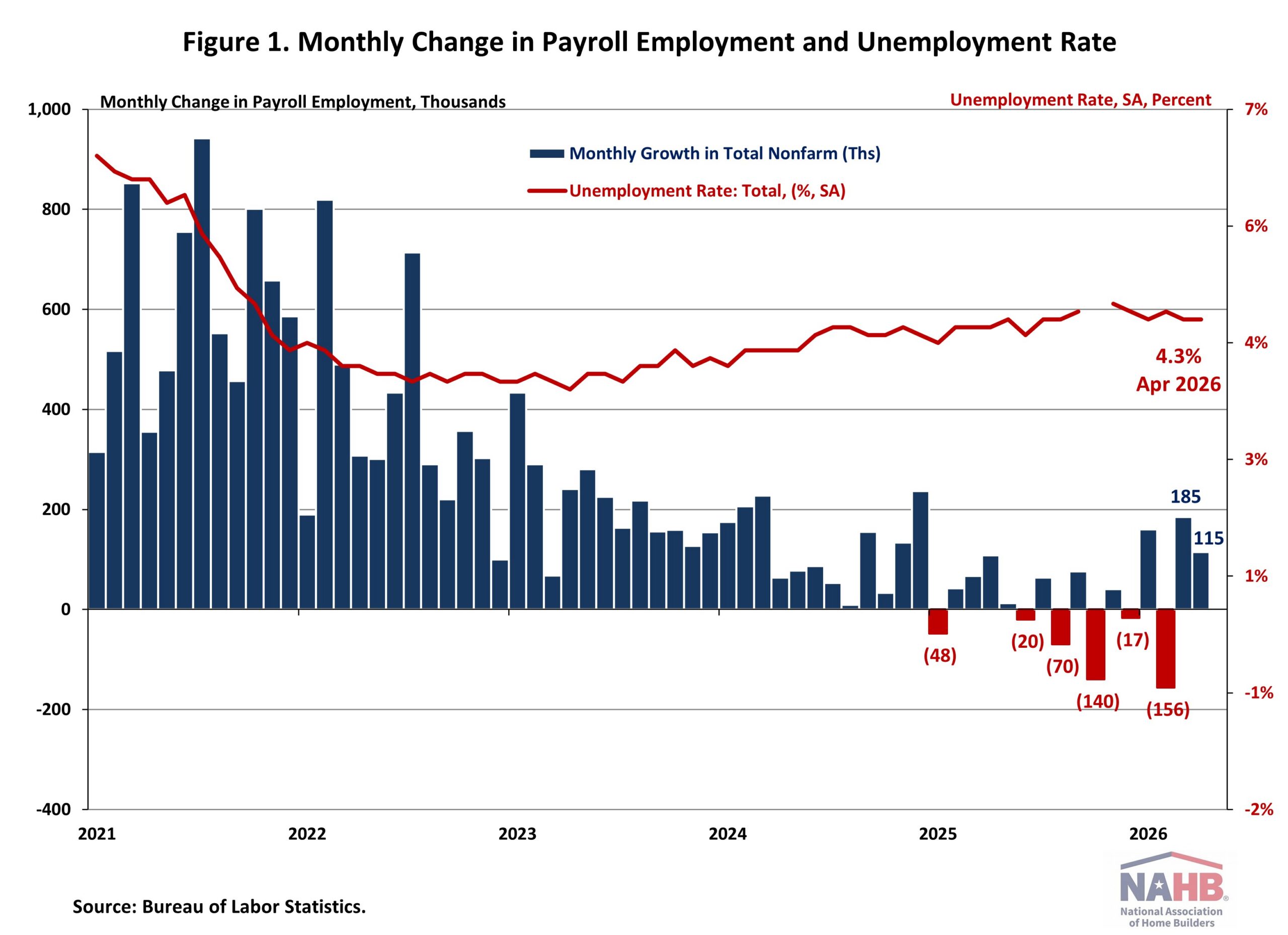
The U.S. labor market continued to show resilience in April, with job growth persisting despite elevated interest rates and rising geopolitical uncertainty related to the Iran conflict. The unemployment rate held steady at 4.3%. Hiring gains were concentrated in health care, transportation and warehousing, and retail trade, underscoring continued strength in service-oriented sectors.
Wage growth accelerated modestly in April, with average hourly earnings rising 3.6% year-over-year. This pace is 0.3 percentage points lower than a year ago. Importantly, wage growth has been outpacing inflation for nearly two years, which typically occurs as productivity increases.
National Employment
According to the Employment Situation Summary reported by the Bureau of Labor Statistics (BLS), total nonfarm payroll employment increased by 115,000 in April, following an upwardly revised gain of 185,000 jobs in March. Revisions to prior months were modest overall. The monthly change in total nonfarm payroll employment for February was revised down by 23,000 from -133,000 to -156,000, while the change for March was revised up by 7,000 from +178,000 to +185,000. Combined, these revisions reduced previously reported employment by 16,000 jobs.
Job growth in early 2026 remains well below 2024 levels but stronger than the weak pace recorded in 2025. Through April, monthly payroll gains have averaged 76,000, compared with 10,000 per month in 2025 and 122,000 in 2024.
The unemployment rate remained unchanged at 4.3% in April. Over the month, the number of persons unemployed rose by 134,000, while the number of persons employed declined by 226,000.
Meanwhile, the labor force participation rate—the proportion of the population either looking for a job or already holding a job—declined 0.1 percentage points to 61.8%. This marks the lowest level since November 2021 and remains below its pre-pandemic level of 63.3% recorded at the beginning of 2020. Among prime working-age individuals (aged 25 to 54), the participation rate held steady at 83.8%.
In April, job gains occurred in health care (+37,000), transportation and warehousing (+30,000), and retail trade (+22,000), while federal government employment continued to decline. Since reaching a peak in October 2024, federal government employment has fallen by 348,000 jobs, or 11.5%.
Construction Employment
Employment in the overall construction sector rose by 9,000 jobs in April, following a downwardly revised gain of 16,000 in March. Within the industry, residential construction shed 10,400 jobs, while non-residential construction added 19,000 jobs.
Residential construction employment now stands at 3.3 million in April, including 927,000 workers employed by builders and remodelers and nearly 2.4 million residential specialty trade contractors.
The six-month moving average of job gains for residential construction remains negative, reflecting an average monthly loss of 2,333 jobs and declines in three of the past six months. However, over the last 12 months, residential construction has shed a net of 49,200 jobs, marking the fourteenth consecutive annual decline and the longest stretch of annual losses since the Great Recession. Despite these declines, residential construction has gained 1,297,100 positions from its post-Great Recession low.
Meanwhile, the unemployment rate for construction workers declined to 3.7% in April on a seasonally adjusted basis, remaining relatively low compared with historical norms.
This article was originally published by a eyeonhousing.org . Read the Original article here. .