Tag

housing

Browsing


Following the release of the 2024 single-family MAI last week, the National Association of Home Builders developed the Multifamily Market Association Index (MAI) to measure how closely multifamily building permits in metro areas follow national patterns. By comparing local and national trends, the MAI helps industry leaders and forecasters better understand and predict housing market activity.

Nationally, multifamily permits displayed little variation over the second half of the 2010s. Permit levels began growing significantly during the pandemic and peaked at nearly 700,000 in 2022. However, both 2023 and 2024 reported declines, with 2024 having 496,000 units permitted, closer to pre-2020 levels.

The MAI uses 2015-2024 multifamily permit data to create five- and ten-year correlations for each metropolitan statistical area (MSA), showing their similarity to national patterns. The five- and ten-year correlations are then averaged, with more weight given to the five-year correlation. The resulting correlation coefficient ranges from negative one to positive one, indicating the strength and direction of the relationship between local and national trends.

The MSA that had the highest associations with the national trend was Clarksville, TN-KY with a correlation of 0.97, while the MSA that recorded the lowest association with the national trend was College Station-Bryan, TX. The scatter plot below illustrates the linear relationship between these MSAs and the national trend. For example, when national permit levels rose near 700,000, Clarksville (positive correlation) also had relatively high permit levels of around 2,500. At the same time, College Station-Bryan (negative correlation) had relatively low permits of about 230.

Of the 387 metro areas included in the multifamily MAI, the average correlation is 0.17. In total, 241 MSAs had a correlation greater than zero, and 145 MSAs had less than zero. One MSA had an average correlation of zero (Morgantown, WV), with no multifamily permits in the last five years. A positive correlation is expected as MSAs in total accounted for almost 95% of all multifamily permits in the U.S. on average between 2015 and 2024. A complete list of the MSA correlations is found here and shown on the map below.

Additionally, below are the top ten and bottom ten in terms of the Multifamily MAI.

Discover more from Eye On Housing

Subscribe to get the latest posts sent to your email.


This article was originally published by a eyeonhousing.org . Read the Original article here. .


Three-bedroom single-family homes reached their largest share of starts since 2011 and remained the most prevalent number of bedrooms among new homes. The share of starts for four-bedroom homes declined for the third consecutive year but remained well above the shares for two-bedroom or less and five-bedroom or more homes.

The share of single-family homes started with three bedrooms rose for the second straight year to its highest level since 2011 to 47.0%. All other bedroom number categories fell from 2023, with 4-bedroom homes falling the most from 33.1% to 32.4%, a 0.7 percentage point decline from the year prior. The share of single-family homes with 2 bedrooms or less remained greater than that of 5 bedrooms or more for the third straight year.

U.S. Divisions

Across U.S. Census Divisions, the share of new single-family homes with four or more bedrooms displays geographic variation. The share ranged from a low of 22.2% in the New England division to the highest share of 46.7% in the West South Central division. Coinciding with the fall in the share of new single-family homes with 4 bedrooms or more nationally, there are no divisions that have a share above 50%.

Purpose of Construction

The number of bedrooms in new homes varies depending on the purpose of construction (built-for-sale, contractor-built, owner-built, built-for-rent). Most of this variation comes from the two-bedroom or less homes and four-bedrooms homes. For example, the share of new single-family homes with two bedrooms or less ranges from 5.6% of homes built-for-sale to 37.8% of homes built-for-rent. Meanwhile, three-bedroom homes and five or more-bedroom homes display relatively little change across purpose of construction. Five or more-bedrooms homes held the smallest share of starts across purpose of construction for all types except for built-for-sale homes.

Discover more from Eye On Housing

Subscribe to get the latest posts sent to your email.


This article was originally published by a eyeonhousing.org . Read the Original article here. .


Every year, NAHB and other industry experts and economists bring their latest insights to the NAHB International Builders’ Show® (IBS). For 2026, IBS offers an unparalleled lineup of IBS Education sessions that cover every sector of the housing industry: single-family, multifamily, remodeling, design trends, and building materials.  

The Builders’ Show in 2026 is in Orlando, February 17 – 19. This is the only event where you’ll find all these speakers and sessions at one conference: 

The Outlook: 2026 Housing & Economic Forecast (Super Session)  

Tuesday, February 17 | 2:15 – 3:45 PM  

This IBS Super Session is hosted by our very own Chief Economist, Robert Dietz, as well as Chief Economist of Realtor.com, Danielle Hale, and Chief Economist of Zonda, Ali Wolf. Not only does this session give you the chance to hear from these three nationally recognized economists, but it also gives you a complete overview of the housing economy.  

2026 Multifamily Market Outlook 

Tuesday, February 17 | 10:00 – 11:00 AM  

Danushka Nanayakkara-Skillington, NAHB AVP of Forecasting & Analysis, and Selma Hempp, Chief Economist of Cotality, host a deep dive into multifamily housing. Explore the construction pipeline, financing challenges, rent growth, and more. Join the discussion for an exclusive forecast of where the multifamily sector is headed.  

Remodeling by the Numbers: Market Outlook & Business Benchmarks for 2026 

Wednesday, February 18 | 8:15 – 9:15 AM 

Featuring NAHB Economist Eric Lynch, as well as remodeling expert Alan Hanbury, learn what key indicators and trends are shaping the home improvement industry and where it is headed. Compare how your business is doing with exclusive benchmarks on profit margins, operating costs, and more with exclusive findings from the NAHB ‘Remodelers’ Cost of Doing Business’ study.  

Home Trends, Buyer Preferences & Most Likely Features for 2026 

Wednesday, February 18 | 10:00 – 11:00 AM 

Explore the latest research on the home and community features buyers want most in this session led by NAHB AVP of Survey Research, Rose Quint and architect and industry thought-leader Donald Ruthroff. Discover what trends are shaping new home designs, including how preferences shift by price– point. See these trends in action, illustrated through award-winning designs from recent Best in American Living Awards™ (BALA) winners. 

Building Materials in Flux: Pricing Trends, Trade Dynamics & Supply Chain 

Wednesday, February 18 | 2:15 – 3:15 PM 

Gain timely insights into the ever-evolving trending issue of building materials, hosted by NAHB Director of Tax and Trade, Jesse Wade, custom builder and industry leader Don Dabbert, and industry expert and analyst Nishu Sood from John Burns Research and Consulting. Learn how key building materials like lumber are affected by tariffs and other international trade dynamics. Explore what’s driving material costs and availability, and how global and domestic supply chains are adapting.   

Register Now  

To attend IBS Education sessions, you must register for an Expo+Education Pass.  Seating for sessions is on a first-come, first-served basis. So, register for an IBS Expo+Education Pass and then mark these sessions on your calendar. For more information on all that IBS has to offer, please visit BuildersShow.com. We hope to see you there!  

Discover more from Eye On Housing

Subscribe to get the latest posts sent to your email.


This article was originally published by a eyeonhousing.org . Read the Original article here. .


In 2024, most new single-family homes included laundry connections on the first floor (70%), according to the Census Bureau’s Survey of Construction. The first floor is also where most customers prefer to have the laundry, as shown in Chapter 2 of What Home Buyers Really Want.     

The second floor was the next most common location, accounting for 28% of new single-family homes, while laundry areas in the basement accounted for just 2%. The share of new homes with laundry in any other location was negligible. 

Across all Census Divisions, the first floor remains the most common location for laundry, even in regions where two-story homes are more prevalent. Nevertheless, some regional differences exist. In the West South Central division, 91% of homes had a laundry area on the first floor, compared to just 51% in the Pacific division. Meanwhile, a second-floor laundry was most popular in the Pacific division at 46%, and least common in the West South Central at 8%. 

Not surprisingly, laundry connections in basements are more common in areas of the country where basements themselves are more common: primarily in the northern regions. The West North Central division led with 14% of homes featuring a basement laundry, followed by New England at 9%. These two divisions are also among the few where most new homes include a full or partial basement.  

Among age-restricted homes, where accessibility and main-level living are key design priorities, 93% featured laundry on the first floor. 

Multifamily Laundry Trends

For multifamily units completed in 2024, 88% of apartments included an individual laundry, while 12% offered shared or no laundry facilities. This share has remained relatively stable since 2015, reflecting continued renter demand for in-unit laundry. 

Regionally, the Northeast has the highest shared or no laundry facilities percentage at 33%. In contrast, shared or no laundry facilities remained far less common elsewhere: 3% in the Midwest, 4% in the South, and 9% in the West. 

The pattern extends to the built-for-rent (BFR) segment, where 88% of units had an individual laundry, unchanged from the prior two years. In contrast, built-for-sale multifamily units saw a decrease—from 92% with individual laundry in 2023 to 81% in 2024—suggesting a possible shift toward more affordable condo projects, which are more likely to include shared facilities. 

Discover more from Eye On Housing

Subscribe to get the latest posts sent to your email.


This article was originally published by a eyeonhousing.org . Read the Original article here. .


Average mortgage rates in October trended downward to the lowest rates in over a year. According to Freddie Mac, the 30-year fixed-rate mortgage averaged 6.25% in October, 10 basis points (bps) lower than September. Meanwhile, the 15-year rate declined just 1 bp to 5.49%. Both the 30-year and 15-year rates remain lower than a year ago, dropping by 17 bps and 11 bps year-over-year, respectively.  

The 10-year Treasury yield, a key benchmark for long-term borrowing, averaged 4.09% in October – a 5-basis point decrease from the previous month. Markets priced in rate cuts from the Fed at the start of the month, resulting in relatively unchanged rates following the announcement of a 25 bps cut to the federal funds rate on October 29th. 

Falling mortgage rates have shown some small impacts on housing activity. According to the latest Mortgage Bankers Association (MBA) report, mortgage application activity strengthened, with refinancing applications rising and purchase applications also increasing. Additionally, existing home sales rose to a seven-month high in September. There is no data available for new home sales in September due to the government shutdown. 

Looking forward, the industry faces a bifurcated market characterized by a weakening job market and elevated inflation. Additionally, there are wildcard factors such as the upcoming Supreme Court case regarding the legality of recent tariffs and lack of economic data. As a result, the vote at the December Fed meeting will be difficult to predict.  

Discover more from Eye On Housing

Subscribe to get the latest posts sent to your email.


This article was originally published by a eyeonhousing.org . Read the Original article here. .


Single-family built-for-rent construction fell back in the second quarter, as a higher cost of financing crowded out development activity.

According to NAHB’s analysis of data from the Census Bureau’s Quarterly Starts and Completions by Purpose and Design, there were approximately 12,000 single-family built-for-rent (SFBFR) starts during the second quarter of 2025. This is down significantly relative to the second quarter of 2024 (25,000 starts). Over the last four quarters, 71,000 such homes began construction, which is a 16% decrease compared to the 85,000 estimated SFBFR starts in the four quarters prior to that period.

The SFBFR market is a source of inventory amid challenges over housing affordability and downpayment requirements in the for-sale market, particularly during a period when a growing number of people want more space and a single-family structure. Single-family built-for-rent construction differs in terms of structural characteristics compared to other newly-built single-family homes, particularly with respect to home size. However, investor demand for single-family homes, both existing and new, has cooled with higher interest rates.

Given the relatively small size of this market segment, the quarter-to-quarter movements typically are not statistically significant. The current four-quarter moving average of market share (7%) is nonetheless higher than the historical average of 2.7% (1992-2012).

Importantly, as measured for this analysis, the estimates noted above include only homes built and held by the builder for rental purposes. The estimates exclude homes that are sold to another party for rental purposes, which NAHB estimates may represent another three to five percent of single-family starts based on industry surveys.

The Census data notes an elevated share of single-family homes built as condos (non-fee simple), with this share averaging more than 4% over recent quarters. Some, but certainly not all, of these homes will be used for rental purposes. Additionally, it is theoretically possible some single-family built-for-rent units are being counted in multifamily starts, as a form of “horizontal multifamily,” given these units are often built on a single plat of land. However, spot checks by NAHB with permitting offices indicate no evidence of this data issue occurring.

With the onset of the Great Recession and declines for the homeownership rate, the share of built-for-rent homes increased in the years after the recession. While the market share of SFBFR homes is small, it has clearly expanded. Given affordability challenges in the for-sale market, the SFBFR market will likely retain an elevated market share. However, in the near-term, SFBFR construction is likely to slow until the return on new deals improves.

Discover more from Eye On Housing

Subscribe to get the latest posts sent to your email.


This article was originally published by a eyeonhousing.org . Read the Original article here. .


Both real and nominal wage growth for residential building workers slowed during the second quarter of 2025, reflecting a broader cooling in the construction labor market, according to the latest report from the U.S. Bureau of Labor Statistics (BLS).

In nominal terms, average hourly earnings (AHE) for residential building workers rose to $39.35 in June 2025, a 3.5% increase from $38.02 a year ago. This marks a continued deceleration in the year-over-year wage growth, which peaked at 9.3% in June 2024. The recent slowdown reflects a slowdown in residential construction activity and a decline in labor demand across the sector. Meanwhile, the number of open, and unfilled construction sector jobs has continued to trend downward, in line with the overall slowdown in housing activity.

Despite the slowdown in wage growth, residential building workers’ wages remain competitive:

11.4% higher than the manufacturing sector ($35.32/hour)

25.3% higher than the transportation and warehousing sector ($31.4/hour)

2.3% lower than the mining and logging sector ($40.29/hour)

Note:

Data used in this post relate to all employees in the residential building industry. This group includes both new single-family housing construction (excluding for-sale builders) and residential remodelers but does not include specialty trade contractors.

Discover more from Eye On Housing

Subscribe to get the latest posts sent to your email.


This article was originally published by a eyeonhousing.org . Read the Original article here. .


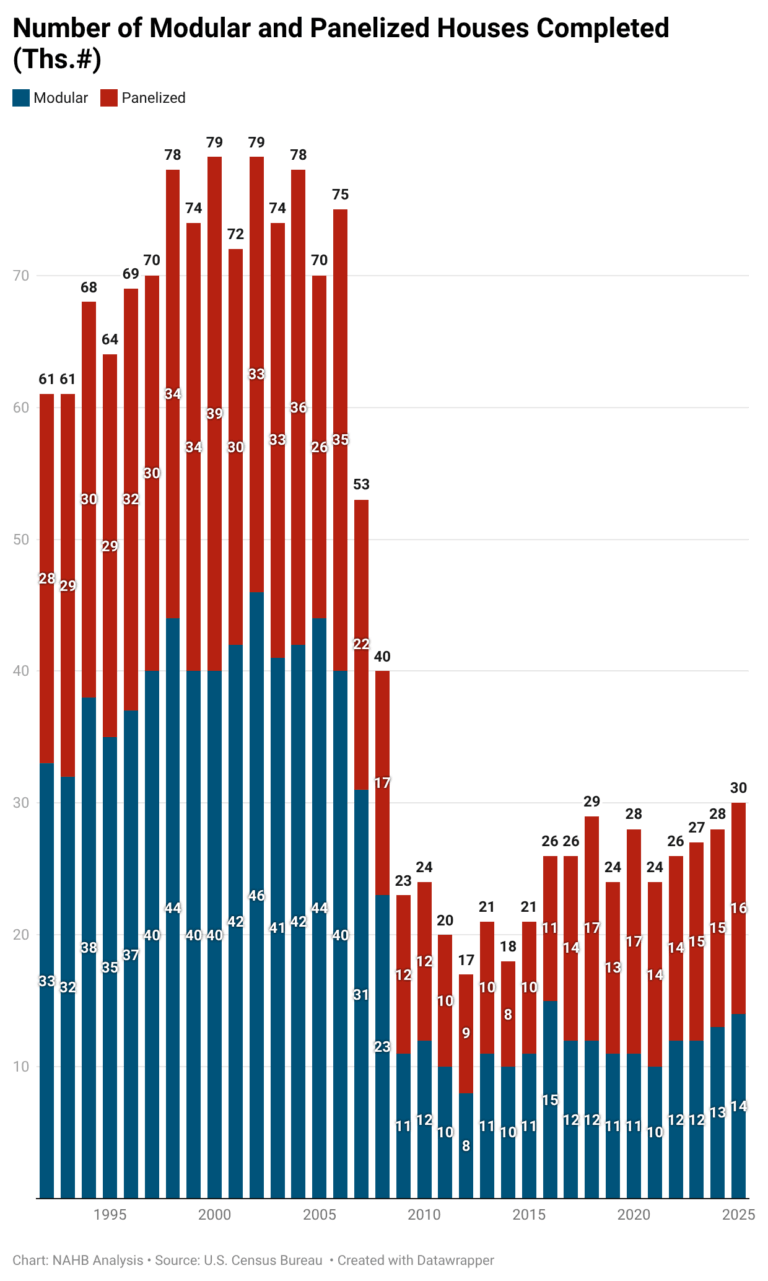
The total market share of non-site built single-family homes (modular and panelized) was just 3% of single-family homes in 2024, according to completion data from the Census Bureau Survey of Construction data and NAHB analysis. This is the same as the 3% share in 2023. This share has been steadily declining since the early-2000s despite the high-level of interest for non-site built construction. This low market share in fact runs counter to some media commentary on off-site construction suggesting recent gains. Nonetheless, there exists potential for market share gains in the years ahead due to the need to increase productivity in the residential construction sector.

In 2024, there were 28,000 total single-family units built using modular (13,000) and panelized/pre-cut (15,000) construction methods, out of a total of 1,019,000 single-family homes completed. It is worth noting that the Census definitions of off-site construction are relatively narrow. In a separate survey, the Home Innovation Research Labs Survey of U.S. Home Builders has a higher share for panelized construction (5-12%) due to a wider definition of “panelized” construction.

While the Census-measured market share is small, there exists potential for expansion. This 3% market share for 2024 represents a decline from years prior to the Great Recession. In 1998, 7% of single-family completions were modular (4%) or panelized (3%). This marked the largest share for the 1992-2024 period.

One notable regional concentration is found in the Midwest and the Northeast. These two regions have the highest market share of homes built using non-site build methods. In the Midwest, 7% (8,000 homes) of the region’s 136,000 housing units were completed using these methods. In the Northeast, 5% (3,000 homes) of the region’s 66,000 housing units were completed using non-site build methods. However, numerically, the South continues to be the biggest market for this type of construction where 13,000 homes were built using non-site build methods.

With respect to multifamily construction, approximately 3% of multifamily buildings (properties, not units) were built using modular and panelized methods. This is significantly lower than the 7% share in 2023 but on par with the average for the last 5 years. It is notable that modular construction method accounted for 2% of this share. In previous years it was only panelized construction methods that made up the higher share of non-site build methods in multifamily construction. Prior to last year, the highest levels of modular and panelized methods share in multifamily construction was in 2000 and 2011, where 5% of multifamily buildings were constructed with modular (1%) or panelized construction methods (4%).

Discover more from Eye On Housing

Subscribe to get the latest posts sent to your email.


This article was originally published by a eyeonhousing.org . Read the Original article here. .


American housing market is facing a persistent shortage. Home prices have reached historic highs and affordability has declined. Normally, in response to higher prices, housing supply would increase. However, new home construction has not kept pace with population growth and household formation, especially following the surge of demand in the wake of the pandemic. Recent research has claimed that the relationship between prices and supply has become diluted over time because of regulatory barriers and political dynamics. 

 A recent working paper “America’s Housing Supply Problem: the Closing of the Suburban Frontier?” by economist Edward Glaser and Joseph Gyourko, took a deep dive into why the supply of new housing has shifted lower, especially in the sunbelt regions like Dallas, Atlanta, and Phoenix. These areas, which once led the nation in new home construction, are now seeing a sharp slowdown.  

This research showed that the once-strong link between increasing home prices and new home constructions has weakened or even reversed in many metro areas. The authors analyzed Census tract data from the 1970s to the 2010 to track how construction has responded to price changes over time. Housing markets that used to expand rapidly in response to higher prices are now largely unresponsive. This breakdown in market dynamics reflects the growing influence of regulatory barriers and political constraints. 

Land use regulations, zoning restrictions, and permitting processes have become more restrictive since the 2000s. These constraints increase the cost and difficulty of building new homes, even as home prices increase. Therefore, housing supply is less responsive to demand. The latest NAHB study on this topic shows that regulations now account for nearly $94,000 of the average new home price. Furthermore, housing supply is becoming endogenous or determined by local socioeconomic dynamics. As neighborhoods become more affluent, wealthier or in some cases higher educated, residents are more likely to oppose new development through changing the permit environment or increasing zoning restrictions. In effect, demand is no longer driving the supply through NIMBYism. 

The authors use prices and density to explore where and why new housing is built. The traditional negative relationship between density and housing construction has weakened, or in some cases, reversed in recent decades. The results show that housing supply growth has slowed significantly in low-density areas, particularly in the areas with higher home prices, where much of the housing expansion would traditionally have been expected. This shift reflects the growing impact of regulatory barriers, as suburban and low-density areas now face stricter zoning, and longer permitting processes. These factors make building more homes more difficult and less responsive to demands or market signals. 

The striking finding of this new analysis is that the traditional engine of home building in the South is weakening. The South has had stronger population growth and lower regulatory barriers to land development and home construction than most of the rest of the country.  But as incomes have increased, the authors claim that regulatory barriers have increased, slowing this once fast-growing region. 

Despite the higher home prices, builders face challenges, including higher interest rates, rising inflations, lot and labor shortages, and regulations, that prevent them from building more new homes. According to NAHB’s estimates, based on 2021 data, the U.S. needs 1.5 million additional units to fill the housing shortage gap. In short, the combination of regulatory barriers and economic headwinds continues to hamper housing production nationwide and these challenges are expanding to regions of the country that were once less affected. 

Discover more from Eye On Housing

Subscribe to get the latest posts sent to your email.


This article was originally published by a eyeonhousing.org . Read the Original article here. .


Private fixed investment in student dormitories inched up 0.3% in the second quarter of 2025, reaching a seasonally adjusted annual rate (SAAR) of $3.9 billion. This gain followed a 1.1% decrease in the previous quarter, as elevated interest rates placed a damper on student housing construction. Moreover, private fixed investment in dorms was 2.1% higher than a year ago 

Private fixed investment in student housing experienced a surge after the Great Recession, as college enrollment increased from 17.2 million in 2006 to 20.4 million in 2011. However, during the pandemic, private fixed investment in student housing declined drastically from $4.4 billion (SAAR) in the last quarter of 2019 to a lower annual pace of $3 billion in the second quarter of 2021, as COVID-19 interrupted normal on-campus learning. According to the National Student Clearinghouse Research Center, college enrollment fell by 3.6% in the fall of 2020 and by 3.1% in the fall of 2021.  

Since then, private fixed investment in dorms has rebounded, as college enrollments show a gradual recovery from pandemic driven declines. Effective in-person learning requires college students to return to campuses, boosting the student housing sector.  Still, demographic trends are reshaping the outlook for student housing. The U.S. faces slower growth in the college-age population as birth rates declined following the Great Recession. As a result, total enrollment in postsecondary institutions is projected to only increase 8% from 2020 to 2030, according to the National Center for Education Statistics, well below the 37% increase between 2000 and 2010. 

Despite recent fluctuations, the student housing construction shows signs of recovery and future growth is expected in response to increasing student enrollment projections. 

Discover more from Eye On Housing

Subscribe to get the latest posts sent to your email.


This article was originally published by a eyeonhousing.org . Read the Original article here. .

Pin It