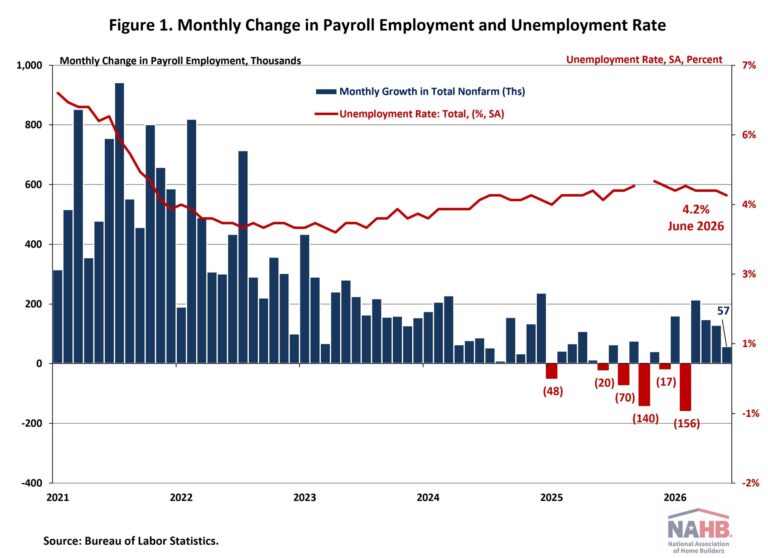
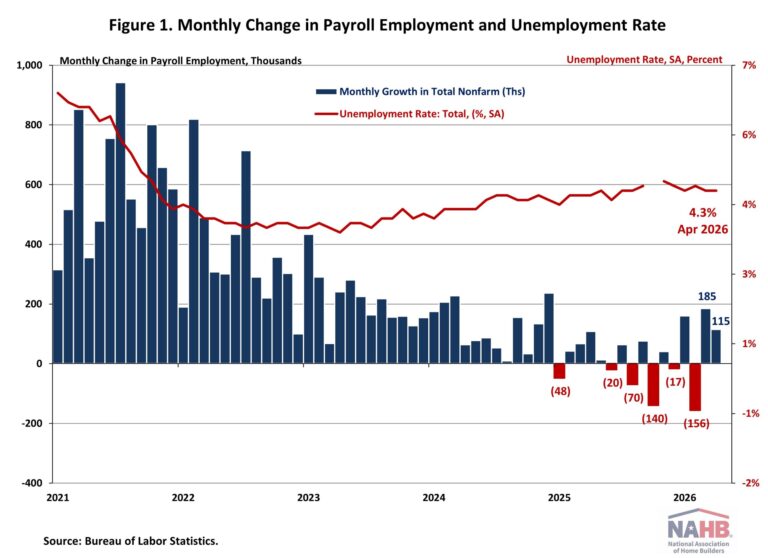
The U.S. labor market cooled in September, with nonfarm payroll employment increasing by just 29,000 as downward revisions erased most of August’s previously reported strength. The unemployment rate edged up to 4.2%, as both employment and the labor force continued to grow. The September report indicates that the labor market is losing momentum, with job growth slowing and unemployment edging higher.
The labor market has lost jobs in seven of the last 21 months.
Wage growth continued to cool, with average hourly earnings rising 3.0% year over year in September, down from 3.1% in August and marking the slowest pace of 2026. Average hourly earnings reached $37.81. The continued deceleration in wage growth points to easing wage pressures, even as the pace of hiring moderates.
National Employment
According to the Employment Situation Summary reported by the Bureau of Labor Statistics (BLS), total nonfarm payroll employment increased by 29,000 in September, following a downwardly revised gain of 133,000 in August. Revisions to prior months were broadly negative, reversing the upward revisions reported last month. The change for July was revised down by 31,000, from a gain of 21,000 reported last month to a decline of 10,000. The change for August was revised down by 29,000, from the preliminary estimate of 162,000 to 133,000. Combined, these revisions subtracted 60,000 jobs from previously reported totals, compared with the 55,000 upward revision reported in the prior month.
Job growth in 2026 has slowed again. Through September, monthly payroll gains have averaged 68,000 based on the current data vintage, down from the 80,000 pace reported through August, reflecting both September’s modest print and the downward revisions to July and August. This compares with an average of just 10,000 per month in 2025 and 122,000 per month in 2024. Over the past 12 months, total nonfarm employment has grown by 496,000, down from the 603,000 gain reported a month ago.
The unemployment rate rose to 4.2% in September from 4.1% in August, though it remains two-tenths of a point below its year-ago level of 4.4%. Over the month, the number of employed persons rose by 406,000, while the number of unemployed persons increased by 78,000. Combined, the civilian labor force expanded by 485,000 in September, continuing the labor force growth that began in August.
Meanwhile, the labor force participation rate—the proportion of the population either looking for a job or already holding a job—rose 0.2 percentage points to 61.8% in September, marking its third consecutive monthly increase. However, the rate remains well below its pre-pandemic level of 63.3% recorded at the start of 2020. Among prime working-age individuals (aged 25 to 54), the participation rate rose 0.3 percentage points to 83.7%, matching its year-ago level.
Outside of construction, employment gains in September were led by health care (+17,000) and leisure and hospitality (+10,000), with manufacturing (+9,000) and transportation and warehousing (+7,600) also expanding. These gains were partially offset by declines in government (-17,000) and information (-10,000).
Construction Employment
Employment in the overall construction sector rose by 11,000 jobs in September, following a gain of 16,000 in August, which was revised down from the 22,000 originally reported. Within the industry, residential construction employment declined by 4,900, reversing August’s gain (also revised down, from 10,700 to 7,900), while nonresidential construction added approximately 16,100 jobs.
Residential construction employment stood at 3.3 million in September, including 923,000 workers employed by builders and remodelers, up from 920,000 in August, and approximately 2.3 million residential specialty trade contractors.
The six-month moving average of residential construction employment changes worsened to a loss of approximately 4,400 jobs per month in September, from a loss of roughly 2,033 in August. Over the last 12 months, residential construction has shed a net of 32,800 jobs, marking the nineteenth consecutive month of year-over-year decline. Despite these losses, residential construction employment remains 1,280,600 positions above its post-Great Recession low. This cushion narrowed from 1,285,500 in August, reflecting September’s employment loss.
Meanwhile, the unemployment rate for construction workers rose to 4.3% in September on a seasonally adjusted basis, up from 4.1% in August but still roughly four-tenths of a point below its year-ago level of 4.7%.
This article was originally published by a eyeonhousing.org . Read the Original article here. .