Tag

U.S

Browsing


The U.S. labor market continued to show resilience in April, with job growth persisting despite elevated interest rates and rising geopolitical uncertainty related to the Iran conflict. The unemployment rate held steady at 4.3%. Hiring gains were concentrated in health care, transportation and warehousing, and retail trade, underscoring continued strength in service-oriented sectors.

Wage growth accelerated modestly in April, with average hourly earnings rising 3.6% year-over-year. This pace is 0.3 percentage points lower than a year ago. Importantly, wage growth has been outpacing inflation for nearly two years, which typically occurs as productivity increases.

National Employment

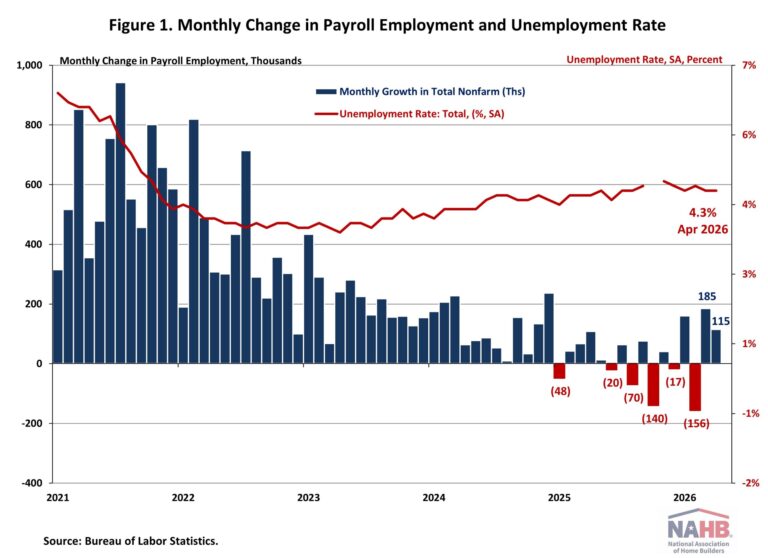
According to the Employment Situation Summary reported by the Bureau of Labor Statistics (BLS), total nonfarm payroll employment increased by 115,000 in April, following an upwardly revised gain of 185,000 jobs in March. Revisions to prior months were modest overall. The monthly change in total nonfarm payroll employment for February was revised down by 23,000 from -133,000 to -156,000, while the change for March was revised up by 7,000 from +178,000 to +185,000. Combined, these revisions reduced previously reported employment by 16,000 jobs.

Job growth in early 2026 remains well below 2024 levels but stronger than the weak pace recorded in 2025. Through April, monthly payroll gains have averaged 76,000, compared with 10,000 per month in 2025 and 122,000 in 2024.

The unemployment rate remained unchanged at 4.3% in April. Over the month, the number of persons unemployed rose by 134,000, while the number of persons employed declined by 226,000.

Meanwhile, the labor force participation rate—the proportion of the population either looking for a job or already holding a job—declined 0.1 percentage points to 61.8%. This marks the lowest level since November 2021 and remains below its pre-pandemic level of 63.3% recorded at the beginning of 2020. Among prime working-age individuals (aged 25 to 54), the participation rate held steady at 83.8%.

In April, job gains occurred in health care (+37,000), transportation and warehousing (+30,000), and retail trade (+22,000), while federal government employment continued to decline. Since reaching a peak in October 2024, federal government employment has fallen by 348,000 jobs, or 11.5%.

Construction Employment

Employment in the overall construction sector rose by 9,000 jobs in April, following a downwardly revised gain of 16,000 in March. Within the industry, residential construction shed 10,400 jobs, while non-residential construction added 19,000 jobs.

Residential construction employment now stands at 3.3 million in April, including 927,000 workers employed by builders and remodelers and nearly 2.4 million residential specialty trade contractors.

The six-month moving average of job gains for residential construction remains negative, reflecting an average monthly loss of 2,333 jobs and declines in three of the past six months. However, over the last 12 months, residential construction has shed a net of 49,200 jobs, marking the fourteenth consecutive annual decline and the longest stretch of annual losses since the Great Recession. Despite these declines, residential construction has gained 1,297,100 positions from its post-Great Recession low.

Meanwhile, the unemployment rate for construction workers declined to 3.7% in April on a seasonally adjusted basis, remaining relatively low compared with historical norms.


This article was originally published by a eyeonhousing.org . Read the Original article here. .


Real GDP growth accelerated in the first quarter of 2026, rebounding from a weak finish at the end of 2025, as government spending recovered following a disruptive shutdown. First-quarter growth was also supported by strong gains in business investment in equipment, driven by an artificial intelligence spending boom and rapid data center construction. Meanwhile, consumer spending showed signs of softening as elevated inflation continued to weigh on household purchasing power.

According to the “advance” estimate released by the Bureau of Economic Analysis (BEA), real gross domestic product (GDP) expanded at an annual rate of 2.0% in the first quarter, up from a 0.5% increase in the fourth quarter of 2025. This growth rate came in slightly above the NAHB forecast for the quarter (1.8%).

However, the latest data from the GDP report indicates that inflationary pressures remained elevated. The price index for gross domestic purchases rose 3.6% in the first quarter, compared with an increase of 3.7% in the fourth quarter of 2025. The Personal Consumption Expenditures (PCE) Price Index, which measures inflation (or deflation) across various consumer expenses and reflects changes in consumer behavior, accelerated to 4.5%. This is higher than a 2.9% rise in the previous quarter.

Breaking down the first-quarter data further, the acceleration in real GDP primarily reflected increases in government spending, exports, and business investment, which were partially offset by a slowdown in consumer spending. Imports, which are a subtraction in the calculation of GDP, increased during the quarter.

Consumer spending, the backbone of the U.S. economy, rose at an annual rate of 1.6% in the first quarter, the slowest pace since the first quarter of 2025. Within this category, spending on services grew at a 2.4% annual rate, while spending on goods edged down 0.1%.

Gross private domestic investment contributed 1.48 percentage points to headline GDP growth, led by robust gains in equipment and intellectual property products, alongside a buildup in private inventories. These increases were partially offset by declines in both residential and nonresidential structures.

Nonresidential fixed investment rose sharply, increasing 10.4% in the first quarter. Strong gains in equipment (+17.2%) and intellectual property products (+13.0%) offset a decrease in structures (-6.7%). Meanwhile, residential fixed investment (RFI) declined 8.0% in the first quarter, marking the fifth consecutive quarterly decline. Within the residential category, single-family permanent site structures fell 8.0% at an annual rate, multifamily permanent site structures posted a modest 1.9% increase, and spending on home improvements dropped 4.6%.

Government spending provided a notable boost to growth, largely due to an increase in federal nondefense expenditures following the prior quarter’s disruptions. 

Trade activity also strengthened, with both exports and imports increasing. The increase was primarily driven by the goods trade, particularly in computers, peripherals, and related components. 

For the common BEA terms and definitions, please access bea.gov/Help/Glossary.


This article was originally published by a eyeonhousing.org . Read the Original article here. .


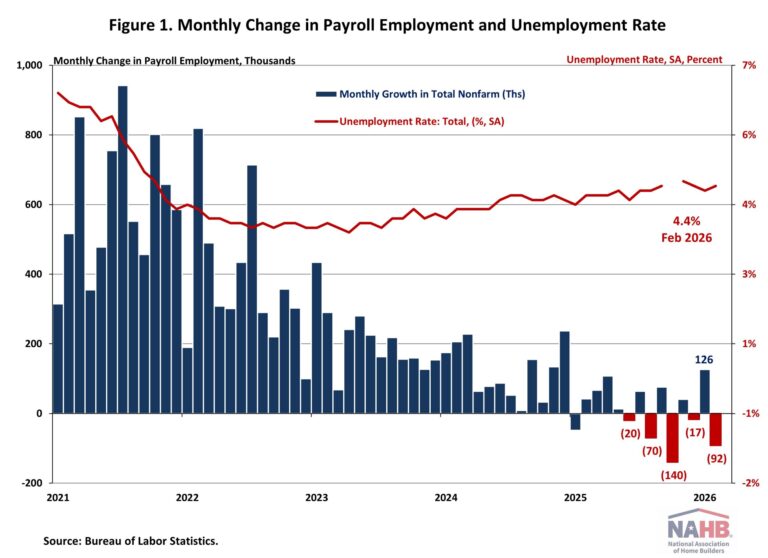
The U.S. labor market weakened in February, as payroll employment declined and the unemployment rate rose to 4.4%. The cooling labor market could place the Federal Reserve in a challenging position as policymakers weigh slower job growth against inflation pressures from rising oil prices.

Wage growth accelerated slightly in February, with average hourly earnings rising 3.8% year-over-year. This pace is 0.3 percentage points lower than a year ago. Importantly, wage growth has been outpacing inflation for nearly two years, which typically occurs as productivity increases.

National Employment

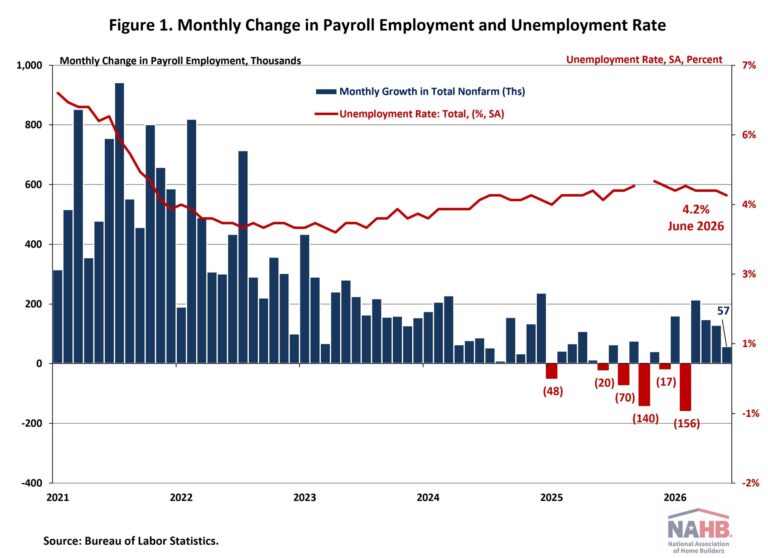
According to the Employment Situation Summary reported by the Bureau of Labor Statistics (BLS), total nonfarm payroll employment fell by 92,000 in February, following a downwardly revised gain of 126,000 jobs in January. This marks the sixth monthly decline since January 2025 and the second-largest monthly job loss during that period.

Estimates for the previous two months were revised lower. The monthly change in total nonfarm payroll employment for December was revised down by 65,000 from +48,000 to -17,000, while the change for January was revised down by 4,000 from +130,000 to +126,000. Combined, these revisions reduced previously reported employment by 69,000 jobs.

The unemployment rate ticked up to 4.4% in February from 4.3% in January. Over the month, the number of persons unemployed rose by 203,000, while the number of persons employed declined by 185,000.

Meanwhile, the labor force participation rate—the proportion of the population either looking for a job or already holding a job—declined 0.1 percentage points to 62.0%. This was the lowest rate since January 2022 and remains below its pre-pandemic level of 63.3% recorded at the beginning of 2020. Among prime working-age individuals (aged 25 to 54), the participation rate decreased to 83.9%.

Health care, which has been the primary growth driver of payroll growth in recent months, lost 28,000 jobs in February, largely due to a strike at Kaiser Permanente during the BLS survey period. Employment in the information sector also trended down, shredding 11,000 jobs, while federal government cut another 10,000 jobs.  Meanwhile, the social assistance sector added 9,000 jobs, driven by gains in individual and family services (+12,000).

Construction Employment

Employment in the overall construction sector declined by 11,000 jobs in February, following an upwardly revised gain of 48,000 in January. Within the industry, residential construction shed 7,100 jobs, while non-residential construction lost 3,800 positions.

Residential construction employment now stands at 3.3 million in February, including 929,000 workers employed by builders and remodelers and nearly 2.4 million residential specialty trade contractors.

The six-month moving average of job gains for residential construction remains negative, at a loss of 533 per month, reflecting losses in three of the past six months. Over the last 12 months, residential construction has seen a net loss of 46,100 jobs, marking the twelfth consecutive annual decline and the longest stretch of annual losses since the Great Recession. Since the low point following the Great Recession, residential construction has gained 1,306,900 positions.

In February, the unemployment rate for construction workers edged down slightly to 4.6% on a seasonally adjusted basis, remaining relatively low compared with historical norms.


This article was originally published by a eyeonhousing.org . Read the Original article here. .


NAHB recently released its 2026 Priced-Out Analysis, highlighting the housing affordability challenge. While previous posts discussed the impacts of rising home prices and interest rates on affordability, this post focuses on the related U.S. housing affordability pyramid. The pyramid reveals that 52% of households (70 million) cannot afford a $300,000 home, while the estimated median price of a new home is around $410,000 in 2026.

The housing affordability pyramid illustrates the number of households able to purchase a home at various price steps. Each step represents the number of households that can only afford homes within that specific price range. The largest share of households falls within the first step, where homes are priced under $200,000. As home prices increase, fewer and fewer households can afford the next price level, with the highest-priced homes, those over $2.5 million, having the smallest number of potential buyers. Housing affordability remains a critical challenge for households with income at the lower end of the spectrum.

The pyramid is based on income thresholds and underwriting standards. Under these assumptions, the minimum income required to purchase a $200,000 home at the mortgage rate of 6% is $55,500. In 2026, about 47.5 million households in the U.S. are estimated to have incomes no more than that threshold and, therefore, can only afford to buy homes priced up to $200,000. These 47.5 million households form the bottom step of the pyramid. Of the remaining households that can afford a home priced at $200,000, 22.4 million can only afford to pay a top price of somewhere between $200,000 and $300,000. These households make up the second step on the pyramid. Each subsequent step narrows further, reflecting the shrinking number of households that can afford increasingly expensive homes.

It is worthwhile to compare the number of households that can afford homes at various price levels and the number of owner-occupied homes available in those ranges, as shown in Figure 2. For example, while around 47.5 million households can afford a home priced at $200,000 or less, there are only 20.7 million owner-occupied homes valued in this price range. This trend continues in the $200,000 $300,000 price range, where the number of households that can afford homes is much higher than the number of housing units in that range. These imbalances reflect the ongoing challenges of housing affordability.


This article was originally published by a eyeonhousing.org . Read the Original article here. .


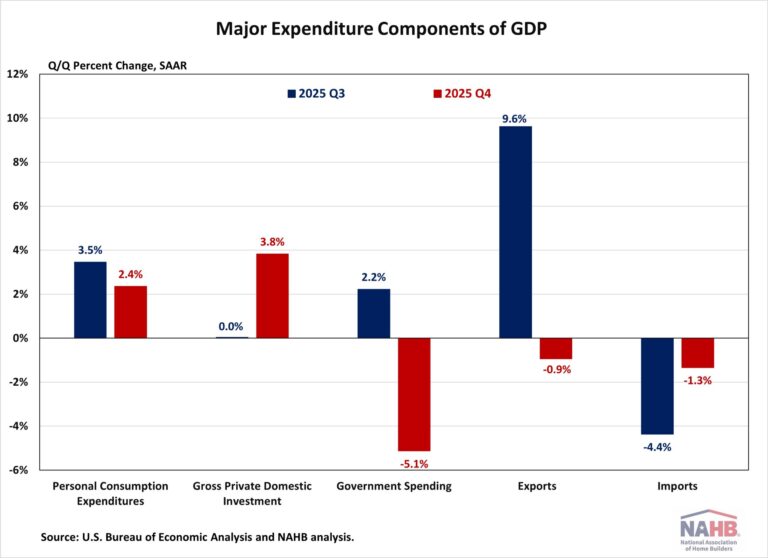
Real GDP growth slowed sharply in the fourth quarter of 2025 as the historic government shutdown weighed on economic activity. While consumer spending continued to drive growth, federal government spending subtracted over a full percentage point from overall growth.

According to the “advance” estimate released by the Bureau of Economic Analysis (BEA), real gross domestic product (GDP) expanded at an annual rate of 1.4% in the final quarter of 2025, a notable deceleration from a 4.4% increase in the third quarter. This growth rate was below the NAHB forecast for the quarter.

Furthermore, the latest data from the GDP report indicates that inflationary pressures intensified over the quarter. The price index for gross domestic purchases rose 3.7%, up from a 3.4% increase in the third quarter of 2025. The Personal Consumption Expenditures Price (PCE) Index, which measures inflation (or deflation) across various consumer expenses and reflects changes in consumer behavior, increased 2.9% in the fourth quarter. This is slightly higher than a 2.8% rise in the previous quarter.

For the full year, real GDP grew 2.2% in 2025. It marks a slowdown from the 2.8% increase in 2024 and stands as the weakest annual growth rate since the pandemic. The annual gain matched NAHB’s forecast and primarily reflected continued strength in consumer spending and gains in investment.

Breaking down the fourth-quarter data further, the increase in real GDP primarily reflected increases in consumer spending and investment, partially offset by decreases in government spending and exports. Imports, which are a subtraction in the calculation of GDP, decreased during the quarter as tariffs had measurable effects.

Consumer spending, the backbone of the U.S. economy, rose at an annual rate of 2.4% in the fourth quarter, the slowest pace since the first quarter of 2025. Spending on services remained solid, increasing at a 3.4% annual rate, while spending on goods edged down 0.1%.

Gross private domestic investment added 0.66 percentage points to headline GDP growth in the fourth quarter. The gain in investment was primarily driven by increases in intellectual property products, private inventory investment, and equipment spending.

Government spending fell, reflecting the effects of a prolonged federal government shutdown. 

Nonresidential fixed investment increased 3.7% in the fourth quarter. The increases in equipment (+3.2%) and intellectual property products (+7.4%) offset the decrease in structures (-2.4%). Meanwhile, residential fixed investment (RFI) declined 1.6% in the fourth quarter, marking the fourth consecutive quarterly decline. Within the residential category, single-family permanent site structures fell 5.2% at an annual rate, multifamily permanent site structures declined 3.6%, and spending on home improvements dropped 3.2%.

For the common BEA terms and definitions, please access bea.gov/Help/Glossary.


This article was originally published by a eyeonhousing.org . Read the Original article here. .


According to the U.S. Census Bureau’s latest estimates, the U.S. resident population grew by 1,781,060 to a total population of 341,784,857. The population grew at a rate of 0.5%, a sharp decline from the near 1.0% growth in 2024. The growth rate was the lowest since 2021 when it grew at 0.2%. The vintage population estimates are released annually and represent the change in the U.S. population between July 1st of 2024 and 2025.

The primary source of population growth continued to be net international migration. For 2025, the level of net international migration was less than half of its level in 2024, falling from 2.7 million to 1.3 million. Natural change, represented as births minus deaths, was up marginally from 514,277 to 518,858 in 2025. The decline in net international migration and stable natural change led to lower population growth nationally between 2024 and 2025.

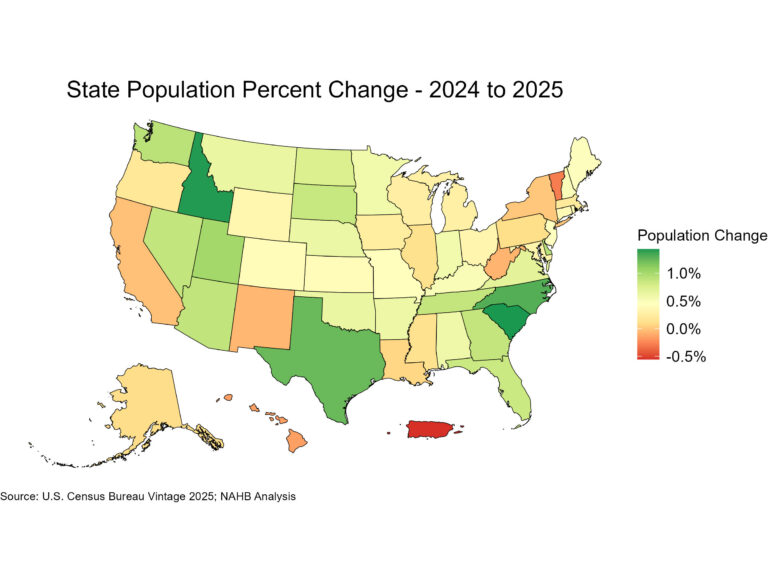
Each region in the U.S. experienced population growth over the period. The South led in population growth at 0.9%, followed by the Midwest at 0.4%. Meanwhile, the West grew 0.3%, while the Northeast grew the least at 0.2%.

At the state level, 45 States and the District of Columbia saw a population increase over the year. South Carolina had the highest population percentage growth, at 1.5%. This was followed by Idaho (1.4%) and North Carolina (1.3%). Numerically, Texas experienced the largest population increase, gaining 391,243. This was followed by Florida at 196,980 and North Carolina at 145,907.

Five states and Puerto Rico experienced population declines. The population of Puerto Rico fell by 0.6%, followed by Vermont at 0.3% and Hawaii at 0.1%. The other states that experienced population declines were West Virgina, New Mexico and California

California remained the most populous state with a population of 39,355,309. The next most populous state was Texas at 31,709,821. To round out the top five states by total population, the proceeding highest were Florida (23,462,518), New York (20,002,427), and Pennsylvania (13,059,432).


This article was originally published by a eyeonhousing.org . Read the Original article here. .


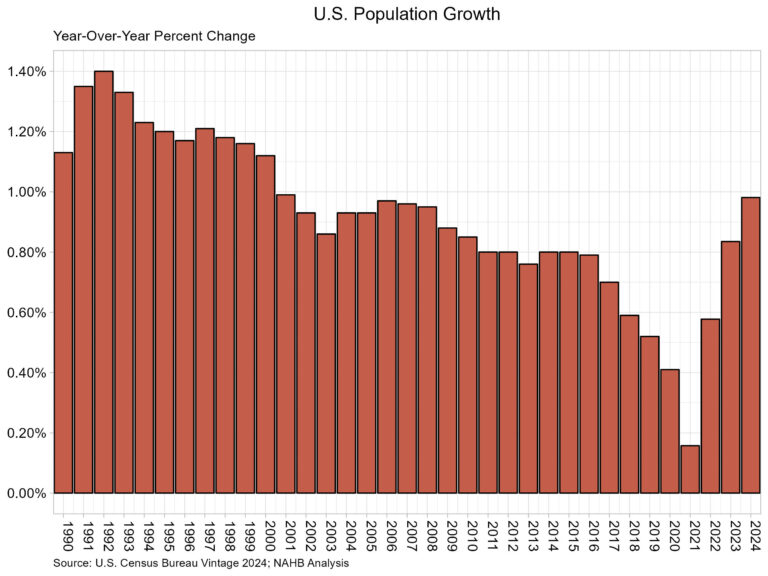
According to the U.S. Census Bureau’s latest estimates, the U.S. resident population grew by 3,304,757 to a total population of 340,110,988. The population grew at a rate of 0.98%, the highest rate since 0.99% in 2001. This also marked the third straight increase in the growth rate of the U.S. population. The vintage population estimates are released annually and represent the change in the U.S. population between July 1st of 2023 and 2024.

The Census Bureau reports that the primary source of population growth was net international migration (immigration), as international migration levels once again were higher than the previous year. The level of net international migration between 2023 and 2024 was 2,786,119. The second component of population growth is natural growth, which represents births minus deaths. Births totaled 3,605,563, down slightly from last year, while the number of deaths was reported at 3,086,925, also a decrease from last year. The natural growth, therefore, between 2023 and 2024 was 518,638.

Each region in the U.S. experienced population growth for the 2023-2024 period. The South led in population growth at 1.34% followed by the West at 0.85%. Meanwhile, the Midwest population grew 0.75%, while the Northeast grew the least at 0.59%.  

At the State level, 47 States and the District of Columbia had a population increase over the year. Of note, D.C. had the highest growth rate at 2.13%. Florida was second with population growth at 2.00% followed by Texas at 1.80%. Numerically, Texas experienced the largest population increase gaining 562,941. This was followed by Florida at 467,347 and California at 232,570.

Only three states lost population or remained level according to Census estimates. Vermont and West Virginia tied with a decline of 0.03%. Meanwhile Mississippi saw no population change.

California remained the most populous state by a healthy margin. California’s population was at 39,198,693, while the next most populous state was Texas at 31,290,831. To round out the top five States by total population the proceeding highest were Florida (23,372,215), New York (19,867,248), and Pennsylvania (13,078,751).


This article was originally published by a eyeonhousing.org . Read the Original article here. .


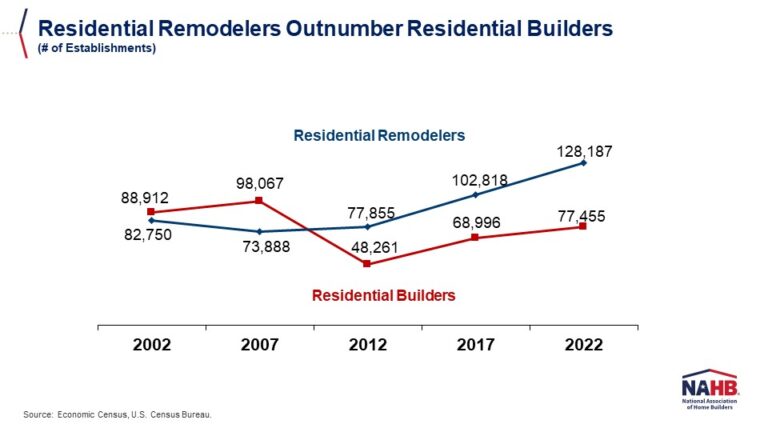
The number of residential remodelers in the U.S. has reached a record high of 128,187 establishments, 65% higher than the number of residential builders (single-family and multifamily), which stands at 77,455.  These official government counts were released by the U.S. Census Bureau as part of its 2022 Economic Census, which tallies American businesses every five years (in years ending in 2 and 7).

Growth in the number of remodelers significantly outpaced that of builders between 2017 and 2022. In that 5-year span, the remodeler count increased by 25% (102,818 to 128,187), while the number of builders grew at half that pace–by 12% (68,996 to 77,455).

A starker dichotomy emerges when comparing 2022 counts to those in 2007, prior to the financial crisis and the ensuing housing recession.  In that 15-year period, the official number of residential remodelers in the U.S. grew by 73% (73,888 to 128,187), while the official number of residential builders contracted by 21% (98,067 to 77,455).

Another way to analyze this data is by creating a combined universe of both builders and remodelers and then calculating each group’s share of the total. In 2022, for example, remodelers represented 62% of the total number of builders and remodelers in the U.S, while builders made up a minority share of 38%.  Remodelers have accounted for at least 60% of this total in the last three Economic Census (2012, 2017, and 2022). 

The last time builders comprised a majority share was in 2007, when they represented 57% of the combined total number of builders and remodelers in the country.


This article was originally published by a eyeonhousing.org . Read the Original article here. .


In 2023, nearly 6.45 million homes, around 5% of U.S housing stock, were classified as inadequate according to the American Housing Survey (AHS). Of these, 1.65 million homes were classified as severely inadequate, showing significant concerns over housing quality. While this reveals ongoing issues in nation’s housing conditions, it signals probable market growth for remodeling and home improvements in the year ahead.

The U.S. Department of Housing and Urban Development (HUD) defines physical adequacy based on whether a home meets the basic standard of “a decent home and a suitable living environment”. Homes are severely inadequate if they exhibit major deficiencies, such as exposed wiring, lack of electricity, missing hot or cold running water, or the absence of heating or cooling systems. Additionally, homes with at least five significant structural problems such as water leaks, large open cracks or holes in the floor also belong to this category.  Moderately inadequate homes have three or four significant structural issues, or have problems such as incomplete kitchen facilities, lack of vented heating equipment, or prolonged toilet breakdowns.

Housing inadequacy has remained a persistent issue over the past decade, shown in Figure 1.  In 2023, around 6.5 million households lived in moderately or severely inadequate housing. While the total number of inadequate homes declined slightly from 6.9 million in 2015 to 6.0 million in 2019, it rebounded to 6.7 million in 2021 and remained elevated in 2023.  The majority, around 4.8 million, of inadequate homes were moderately inadequate, while 1.65 million households lived in severely inadequate conditions in 2023.

The share of inadequate homes varies significantly by the age of the home (Figure 2). Older homes have higher rates of inadequacy. Homes built before 1940 have the highest inadequacy rate at 9%, followed by those built between 1940 and 1959 at 7%. While housing units from 1960 to 1979 show a moderate inadequacy rate of 5%, they account for the largest number of inadequate homes, with 1.2 million classified as moderately inadequate and 465,000 as severely inadequate in 2023. In contrast, newer homes (1980-Present) have lower inadequacy rates with the share steadily declining from 4% for homes built between 1980 and 1999 to 3% for those constructed from 2000 to the present.

Geographically, inadequate housing is most concentrated in smaller metro areas. Around 50.4% of moderately inadequate homes (2.4 million units) and 43.6% of severely inadequate homes (720,000 units) are in these areas in 2023. This trend is likely driven by aging housing stock and lower household income compared to major metro areas. However, major metro areas still have a substantial share of inadequate homes, with 29.7% of moderately inadequate (1.4 million) and 38.2% of severely inadequate units (631,000). Non-metro areas have the lowest total numbers, (953,000 moderately inadequate and 720,000 severely inadequate homes), though challenges persist.

In 2023, around 6.45 million households lived in inadequate housing, with more renters (3.5 million) than owners (2.8 million). Housing cost burdens varied greatly among these two groups: Among those households in inadequate homes, 1.9 million owners spent less than 30% of their income on housing, compared to 1.6 million renters. It suggests that many homeowners living in inadequate housing may indeed have the financial capacity to improve their housing conditions if they choose to do so. In contrast, renters in inadequate housing face greater financial constraints, with 1.1 million spending more than 50% of their income on housing, more than double the 480,000 cost-burdened owners. This disparity highlights the challenges renters are facing, including limited affordable housing options and a lack of control over property conditions.


This article was originally published by a eyeonhousing.org . Read the Original article here. .


In April 2020, total payroll employment in the United States fell by an unprecedented 20.5 million, following a loss of 1.4 million in March, as the COVID-19 pandemic brought the economy to a sudden halt. The unemployment rate surged by 10.4 percentage points to 14.8% in April. It was the highest rate effectively since the Great Depression. Tracking the labor market impact is critical for understanding the follow-on effect on home building activity during the last five years.

As people stayed at home and businesses shut down under government directives, millions of Americans lost their jobs. Initial unemployment insurance claims soared to 2.9 million during the week of March 21, 2020. For the following 19 consecutive weeks, more than one million Americans filed for unemployment each week, totaling roughly 50.9 million claims over just five months.

While the national labor market suffered an unprecedented collapse in both speed and depth, the effects varied significantly across U.S. metro areas. Local economies experience dramatically different outcomes depending on their industrial composition, the feasibility of remote work, and the strictness of local public health restrictions. A map of metro areas across the United States reveals striking variations in employment losses from February 2020 to the pandemic’s employment trough. Nonfarm employment payrolls declined by anywhere from 5% to 35% across 393 metro areas.

Kahului-Wailuku, Hawaii, experienced the steepest job losses, with employment plummeting by 35%. This metro area’s deep dependence on tourism and hospitality, particularly in accommodation and food services, left it vulnerable to travel restrictions and widespread shutdown. Similarly, Atlantic City-Hammonton, New Jersey, as a prime tourism destination, was devastated by pandemic-related closures. By May 2020, its total employment dropped 34% from the February 2020 level.

Some metro areas experienced major setbacks tied to their dominant industries. In Elkhart-Goshen, Indiana, as the heart of the U.S. RV manufacturing industry, employment plunged 34% as production ground to a halt.

At the other end of the spectrum, Logan, UT-ID, recorded the mildest downturn, with a relatively modest 5% employment drop, reflecting a more resilient local economy.

In sheer numbers, New York-Newark-Jersey City, New York-New Jersey saw the largest employment losses in the nation, shedding nearly 2 million jobs, or about 20% of its pre-pandemic workforce. Los Angeles–Long Beach–Anaheim, California, followed closely, losing 1.1 million jobs, about 17% of its February 2020 level.

Despite the historic scale of these losses, the U.S. labor market rebounded faster than many anticipated. Within just 26 months, overall employment had fully recovered, surpassing its February 2020 level to reach 152.4 million by June 2022. Yet, as with the initial losses, the recovery varied widely across metro areas. By August 2025, 93 of the 393 metro areas had still not regained their pre-pandemic employment levels.

Lake Charles, Louisiana, remains the slowest to recover, with employment at only 87% of its February 2020 level. The region’s setbacks have been compounded by multiple disasters—COVID-19, followed by Hurricanes Laura and Delta in 2020—that disrupted both infrastructure and labor markets. Kankakee, Illinois (92% recovered), and Weirton–Steubenville, West Virginia–Ohio (93%), also lagged, highlighting how recovery can be delayed by structural and regional challenges.

In contrast, many other metro areas have not only recovered but expanded beyond their pre-pandemic employment levels. As of August 2025, 300 metro areas have fully rebounded, with some even booming. Wildwood–The Villages, Florida, leads the nation with employment reaching 127% of its February 2020 level, followed by St. George, Utah, at 125%.

Notably, the areas that suffered the sharpest employment declines in 2020 did not necessarily experience the slowest recoveries. Las Vegas–Henderson–North Las Vegas, Nevada, for instance, lost 277,900 jobs, about 26% of its workforce, but has rebounded strongly, reaching 109% of its pre-pandemic employment. By contrast, Enid, Oklahoma, which lost just 1,600 jobs, remains slightly below its February 2020 level, still 2% short of full recovery.

The story of employment loss and recovery across U.S. metro areas underscores the uneven geography of the COVID-19 economy. The resilience of local economies has since reshaped the post-pandemic landscape, revealing not only where recovery has taken root but also where it remains incomplete. And of course, the health of local labor markets has important impacts on the status of local home building and remodeling conditions.


This article was originally published by a eyeonhousing.org . Read the Original article here. .
Pin It