Buying a home typically generates a wave of consumer spending beyond the purchase of the home itself. Following a home purchase, households often buy appliances and furnishings and undertake remodeling and repair projects to make the home fit their needs and preferences. This spending supports many businesses and industries, extending the economic impact of home buying.
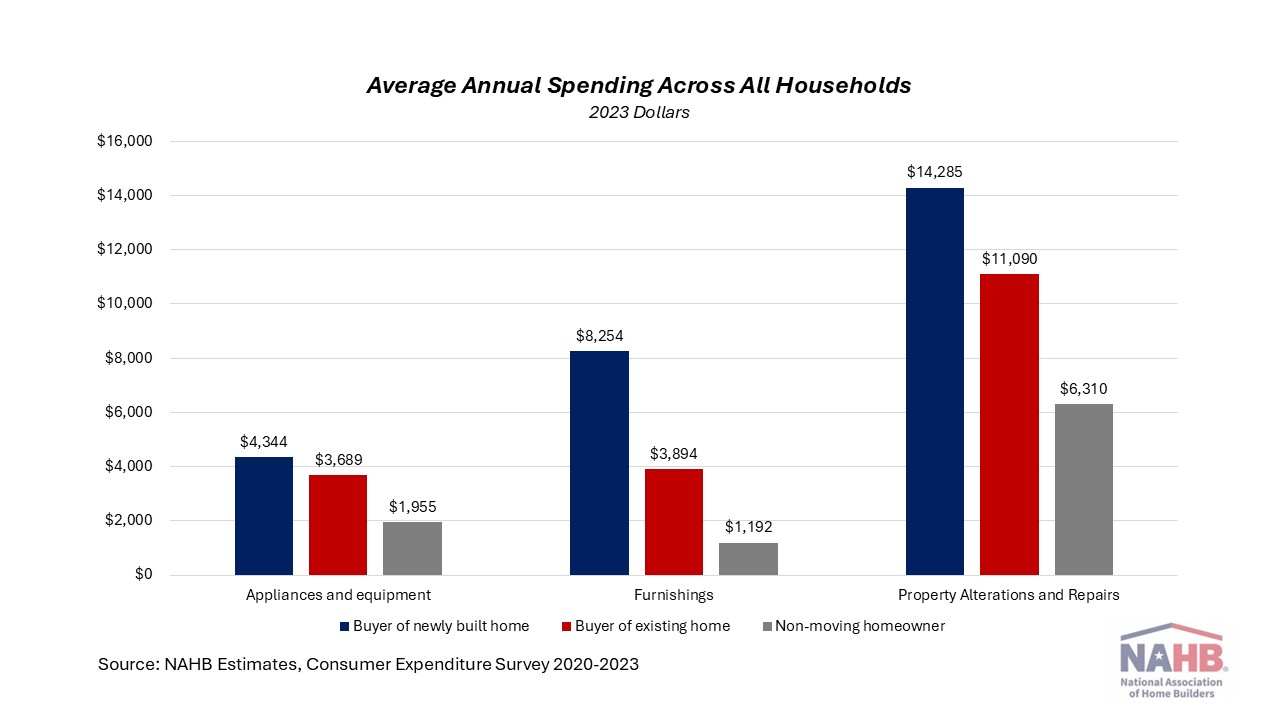
NAHB analysis of Consumer Expenditure Survey data from 2020 through 2023 shows that buyers of both newly built and existing single-family detached homes spend substantially more than homeowners who did not move. As shown in chart below, buyers of newly built homes spend an average of $26,882 on appliances, furnishings, and remodeling and repairs during the first year after purchasing a home, nearly three times the $9,457 spent by non-moving homeowners. Meanwhile, buyers of existing homes spend an average of $18,673 during the first year after purchasing a home, approximately twice the amount spent by non-moving homeowners.
Appliances
Among all households, buyers of newly built homes spend an average of $4,344 on appliances during the first year after purchasing a home, compared with $3,689 for buyers of existing homes and $1,955 for non-moving homeowners. The largest appliance expenditure among buyers of newly built homes includes refrigerators and home freezers, televisions, clothes washers and dryers, computers, and lawn equipment. This pattern may partly reflect differences in which appliances are already included with a newly built home and which items buyers must acquire separately. Most newly-constructed homes include essentials like stoves, ovens, and dishwashers. However, refrigerators and/or freezers and laundry appliances are often optional upgrades.
Televisions, while not among the most expensive appliances, rarely come with new homes. As a result, buying television sets for multiple rooms in the new house can add up to the high level of spending, reflecting the high frequency of these purchases by new home buyers rather than a particularly high cost of the item. Buyers of existing homes exhibit a similar spending pattern, although average expenditures are somewhat lower. However, spending on clothes washers and dryers is higher for buyers of existing homes ($481) than for buyers of newly built homes ($387).
Furnishings
Recent home buyers also spent considerably more on furnishings than non-moving homeowners Among all households, buyers of newly built homes spend an average of $8,254, more than twice the $3,894 spent by buyers of existing homes and approximately seven times the $1,192 spent by non-moving homeowners.
Compared with buyers of existing homes, buyers of newly built homes spend more on nearly every major furnishing category. The largest furnishing expenditure among buyers of newly built homes is for bedroom furniture (about $1,204) and sofas ($1,178), followed by blinds, shades, and other window coverings ($1,089). The corresponding expenditures for buyers of existing homes are $385, $1,010, and $183, respectively, while non-moving homeowners spend only $111, $208, and $31.
Spending on dining room and kitchen furniture also differs substantially across homeowner groups. Buyers of newly built homes spend $702, compared with $399 for buyers of existing homes and $47 for non-moving homeowners. These differences reflect the need to furnish an entire home after a purchase, particularly for buyers of newly constructed homes with few window treatments.
Property Alterations and Repairs
Property alterations and repair projects account for the largest share of home buyer spending. During the first year after purchasing a home, buyers of newly built homes spend an average of $14,285 on property alterations and repairs, compared with $11,090 for buyers of existing homes and $6,310 for non-moving homeowners. While both groups of home buyers spend substantially more than non-moving homeowners, the composition of their property alterations expenditures differs considerably.
The composition of property alterations and repair spending differed between the two home buyer groups. Buyers of newly built homes allocate relatively more spending to projects that customized or expanded the property, including landscaping, patios, walkways, fences, driveways, swimming pools, and finishing basements, attics, or porches.
Buyers of existing homes, by contrast, invest more spending into updating, replacing, or repairing existing components. Major categories included room property alterations, heating and air-conditioning systems, flooring, painting, and roofing. The results, therefore, suggest that buyers of newly built homes tend to focus more on customization and additions, while buyers of existing homes tend to focus more on renovation and replacement.
This article was originally published by a eyeonhousing.org . Read the Original article here. .