Tag

Eye

Browsing


Home builders are keenly aware of the complex long-term outlook ahead for the home building industry. A recent NAHB/Wells Fargo HMI survey asked builders to assess the impact of 14 major trends and forces on the health of the industry and housing demand over the next 10 years. Results show that home builders expect a mix of demographic, economic, and technological forces to exert significant, long-term influence on the industry. 

At one end, most builders consider five forces as strong or somewhat negative long-term risks to the industry and housing demand:

Government debt levels: 82%

Declining fertility rate: 78%

Long-term inflation outlook: 70%

Declining marriage rate: 67%

Energy costs: 61%

At the same time, builders identified several forces they expect to have a strong or somewhat positive impact on the health of the home building industry and housing demand over the next decade, led by structural and technological shifts:

Aging housing stock: 73%

Work-from-home trends: 65%

Artificial intelligence: 52%

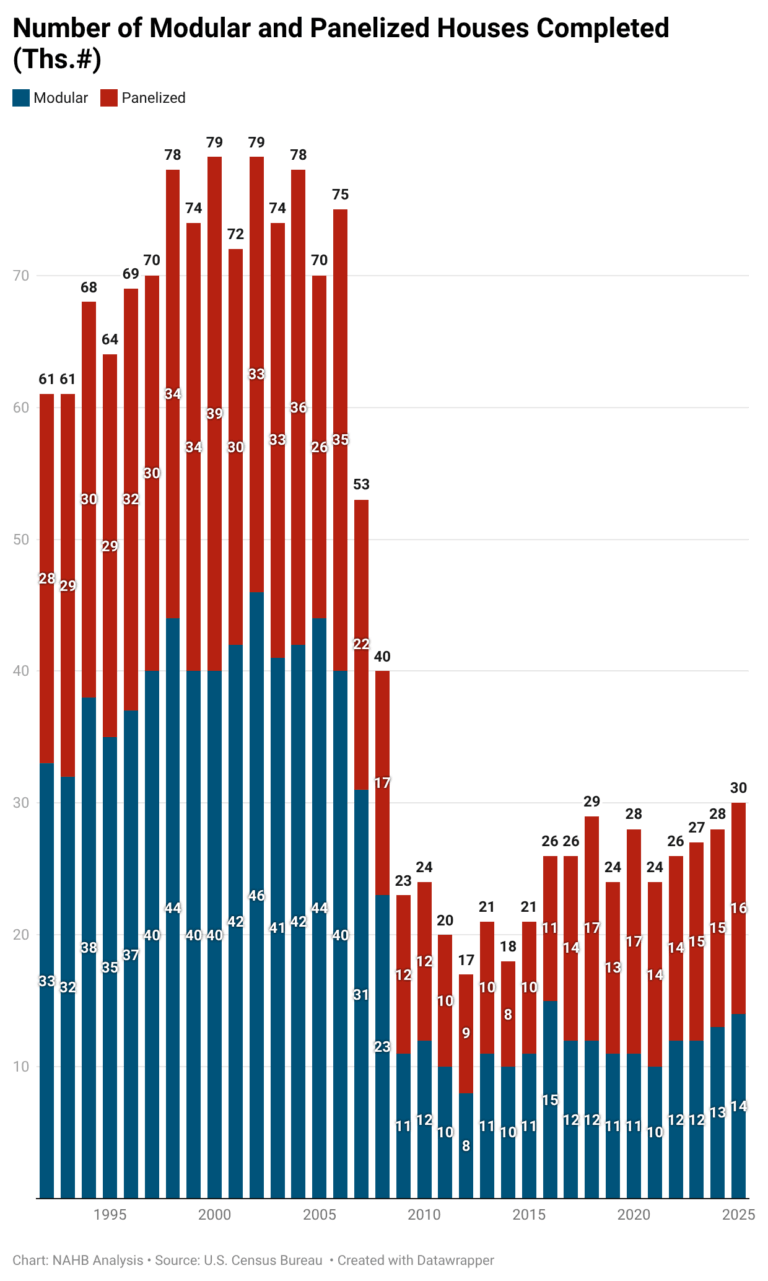
Modular and panelized construction: 45%

These findings reveal that while long-term demographic trends and fiscal pressures are considered serious headwinds, builders also see meaningful opportunities to adapt related to an aging housing stock, evolving work patterns, and artificial intelligence. For additional details and results, please consult the full survey report.


This article was originally published by a eyeonhousing.org . Read the Original article here. .


Though new and existing homes remain largely unaffordable, the needle moved slightly in the right direction in the second half of 2025, according to the latest data from the National Association of Home Builders (NAHB)/Wells Fargo Cost of Housing Index (CHI). The CHI results from the fourth quarter of 2025 show that a family earning the nation’s median income of $104,200 needed 34% of its income to cover the mortgage payment on a median-priced new home. Low-income families, defined as those earning only 50% of median income, would have to spend 67% of their earnings to pay for the same new home.

In the last three quarters of 2025, the income share needed to buy a new home declined from 36% in the second quarter, to 35% in the third quarter and 34% in the final quarter of 2025. These figures indicate a slight improvement in affordability.

The same trend holds true for existing homes. A typical family would have to pay 37% of their income for a median-priced existing home in the second quarter, 36% in the third quarter and 34% in the final three months of 2025. A low-income family would need to pay 69% of their earnings to make the same mortgage payment on an existing home in the fourth quarter.

The U.S. data for the percentage of earnings needed to purchase a new home in the fourth quarter is based on a national median new home price of $405,300 and median income of $104,200. The fourth quarter median new home price is down 1.2% from $410,100 in the third quarter. The corresponding price for an existing home in the fourth quarter fell to $414,900, 2.8% down from $426,800 in the previous quarter. The average 30-year mortgage rate moved lower from 6.65% in the third quarter to 6.32% in the fourth quarter.

CHI is also available for 175 metropolitan areas, calculating the percentage of a family’s income needed to make the mortgage payment on an existing home based on the local median home price and median income in those markets.

In eight out of 175 markets in the fourth quarter, the typical family is severely cost-burdened (must pay more than 50% of their income on a median-priced existing home). In 69 other markets, such families are cost-burdened (need to pay between 31% and 50%). There are 98 markets where the CHI is 30% of earnings or lower.

The Top 5 Severely Cost-Burdened Markets

San Jose-Sunnyvale-Santa Clara, Calif., was the most severely cost-burdened market in the CHI, where 80% of a typical family’s income is needed to make a mortgage payment on an existing home. This was followed by:

Urban Honolulu, Hawaii (69%)

San Francisco-Oakland-Fremont, Calif. (63%)

San Diego-Chula Vista-Carlsbad, Calif. (62%)

Barnstable Town, Mass. (56%)

Miami-Fort Lauderdale-West Palm Beach, Fla. (56%)

Naples-Marco Island, Fla. (56%)

Low-income families would have to pay between 111% and 159% of their income in all seven of the above markets to cover a mortgage.

The Top 5 Least Cost-Burdened Markets

By contrast, many of the least cost-burdened markets were located in Illinois. In the top five least cost-burdened markets, typical families needed to spend just 16-18% of their income to pay for a mortgage on an existing home. These markets are:

Decatur, Ill. (16%)

Elmira, N.Y. (16%)

Springfield, Ill. (17%)

Peoria, Ill. (17%)

Davenport-Moline-Rock Island, Iowa-Ill. (18%)

Low-income families in these markets would have to pay between 32% and 36% of their income to cover the mortgage payment for a median-priced existing home.

Visit nahb.org/chi for tables and details.


This article was originally published by a eyeonhousing.org . Read the Original article here. .


Mortgage rates continued to decline in February, dipping below 6% in the last week of February. According to Freddie Mac, the 30-year fixed-rate mortgage averaged 6.05% last month, 5 basis points (bps) lower than January. Meanwhile, the average 15-year rate declined only a basis point to 5.43%. Compared to a year ago, the 30-year and 15-year rates are lower by 79 bps and 60 bps, respectively.

The 10-year Treasury yield, a key benchmark for long-term borrowing, held relatively steady for most of February with an average 4.18% – a marginal decrease of 2 bps from the previous month. However, yields fell significantly in the final week of February as investors moved to secure U.S. Treasuries amid rising risk aversion in corporate credit markets, widening the spread between corporate bond yields and U.S. Treasuries. Investor concerns centered on the large capital expenditures by major technology firms to finance artificial intelligence infrastructure, much of which has been funded through corporate bond issuance, contributing to rising debt levels among these “hyperscalers”.

Following the recent escalation of conflict in the Middle East, the 10-year Treasury yield has shown signs of reversing course. Investors are closely monitoring how protracted the conflict may become and its potential implications for global energy markets. If oil prices rise significantly or remain elevated, inflation pressures could intensify, potentially pushing Treasury yields higher.


This article was originally published by a eyeonhousing.org . Read the Original article here. .


U.S. house prices continued to rise at the close of 2025, though the pace of growth has slowed compared with the rapid gains of previous years. Elevated mortgage rates, affordability challenges, and ongoing economic uncertainty have restrained buyer demand, resulting in wide variations in local housing markets. While some states and metropolitan areas continue to post solid price gains, others are experiencing flat or declining prices.

Nationally, according to the quarterly purchase-only House Price Index (HPI)1 released by the Federal Housing Finance Agency (FHFA), U.S. house prices rose 1.8% in the fourth quarter of 2025, compared to the same period in 2024. This represents the slowest year-over-year (YoY) appreciation since the second quarter of 2012, indicating a cooling in the housing market following more than a decade of robust price growth. On a quarterly basis, appreciation was modest, increasing 0.8% from the third quarter.

The FHFA’s purchase-only HPI tracks average price changes based on more than six million repeat sales transactions on the same single-family properties. It offers insights about house price changes not only at the national level but also across states and metropolitan areas.

At the state level, 43 states experienced positive YoY price growth between the fourth quarter of 2024 and the fourth quarter of 2025, with gains ranging from 0.1% to 6.4%. North Dakota led the nation with a 6.4% gain, followed by Delaware with a 6.3% gain and Illinois with a 6.1% gain. On the opposite end, nine states and the District of Columbia reported negative YoY house price appreciation. Florida posted the most significant price decline at 2.7%. Notably, 33 states exceeded or matched the national YoY growth rate of 1.8%. On a quarterly basis, home prices declined in five states compared to the third quarter of 2025, highlighting softening momentum in select regional markets.

At the metro level, the divergence is even more pronounced. Among the 100 largest U.S. metro areas tracked by FHFA, YoY house price appreciation ranged from a 9.1% decline to an 8.9% increase. Cape Coral-Fort Myers, FL recorded the steepest annual decline, while Allentown-Bethlehem-Easton, PA-NJ posted the strongest annual gains over the previous four quarters. In total, 34 out of the 100 largest metro areas experienced annual price declines in the fourth quarter, while 66 metro areas posted gains.  Many of the strongest performers were concentrated in the Midwest and Northeast, where inventory remains limited and price levels are comparatively affordable. In contrast, several Sun Belt and Mountain West metro areas that saw outsized appreciation earlier in 2021-2022 are now facing flatter or negative growth as affordability pressures weigh on demand.

Note:


This article was originally published by a eyeonhousing.org . Read the Original article here. .


The percentage of new apartment units that were absorbed within three months after completion was unchanged for new units completed in the second quarter, according to the Census Bureau’s latest release of the Survey of Market Absorption of New Multifamily Units (SOMA). The survey covers new units in multifamily residential buildings with five or more units. The number of new multifamily units completed rose marginally in the second quarter and remained above 90,000 units for the seventh consecutive quarter.

Apartments

The percentage of apartments absorbed within three months has remained below 50% for four straight quarters. The SOMA data has never featured more than two consecutive quarters with under 50% absorption rates. Currently, the rate stands at 47%, meaning that 47% of the 93,680 units completed in the second quarter were rented within three months of completion. The median asking rent in the second quarter was $1,860, up 5.3% from $1,766 last year. The SOMA data has also displayed two quarters of median rent declines, as the asking rent has fallen from $1,941 for completions in the fourth quarter of 2024.

Along with the three-month absorption rate and completions, SOMA also reports absorption rates at six, nine, and twelve months after completion. For apartments completed six months ago (93,400 units), 70% have been absorbed into the market. Of the 125,100 apartments completed nine months ago, 85% have been absorbed. For those completed twelve months ago (142,700 units), 91% were absorbed into the multifamily market.

Condominiums and Cooperative Units

The three-month absorption rate for new condominiums and cooperative units rose to 69%. Total completions of new condominiums and cooperative units, according to SOMA, doubled in the second quarter from 2,551 to 5,167.


This article was originally published by a eyeonhousing.org . Read the Original article here. .


Private residential construction spending was up 1.5% for the last month of 2025. This modest gain was driven primarily by increased spending on home improvements and single-family construction. Despite this increase, total spending remained 1.3% lower than a year ago, reflecting the continued impact of housing affordability challenges facing the sector.

According to the latest construction spending data from the U.S. Census, single-family construction spending was up by 1.6% in December, consistent with the soft builder confidence reflected in the NAHB/Wells Fargo Housing Market Index (HMI). Compared to a year ago, single-family construction spending decreased 3.6%. Meanwhile, multifamily construction spending edged up 0.1% in December, marking a seventh consecutive month of modest gains. Compared to a year earlier, multifamily spending was 2.9% higher. Improvement spending (remodeling) rose 1.8% for the month but stayed flat relative to a year ago.

The NAHB construction spending index is shown in the graph below. The index illustrates how   spending on single-family construction has slowed since early 2024 under the pressure of elevated interest rates and concerns over building material tariffs. Multifamily construction spending growth has also slowed down after the peak in July 2023, with the index largely plateauing since late 2024. In contrast, improvement spending has been on an upward trend since the beginning of 2025.

Spending on private nonresidential construction was down 1.8% over a year ago. The annual private nonresidential spending decrease was primarily driven by a $26 billion drop in manufacturing construction spending, followed by a $2 billion decrease in healthcare construction spending.


This article was originally published by a eyeonhousing.org . Read the Original article here. .


Residential improvement activity remained solid in 2024, though growth has moderated from the surge seen in 2022. The market continues to be supported by an aging housing stock, elevated homeowner equity, and a growing need for aging-in-place improvements. According to the 2024 Home Mortgage Disclosure Act (HMDA) data, the number of home improvement loan applications declined 3% from a year earlier, while the total dollar volume of these loans held steady at approximately $144 billion, essentially unchanged from 2023.

In this article, NAHB’s analysis of the 2024 HMDA data provides insight into remodeling trends across states and counties nationwide. The 2024 HMDA data, published by Consumer Financial Protection Bureau (CFPB), includes detailed information on residential mortgage lending, such as loan purpose and type, loan characteristics, and demographic information about loan applicants.

State-Level Analysis:

Remodeling activity varies not only by borrowers’ age but also across geographic areas, reflecting differences in cost of living, local economic conditions, and house prices.

With respect to the total number of home improvement loan applications, California recorded the highest number in 2024, with 120,167 applications. Florida ranked second with 94,901 home improvement loan applications. At the other end of the spectrum, Wyoming, Alaska, and Puerto Rico had the lowest total numbers of home improvement loan applications, with 212, 1,397, and 1,600 applications, respectively.

When adjusting for population size, smaller states stand out. Rhode Island and New Hampshire recorded the highest number of home improvement loan applications per 1,000 people, at 6.0 and 5.6, respectively. Maine and Idaho ranked third and fourth, followed by Utah with 5.3 applications per 1,000 people.

Nationally, there were 3.5 home improvement loan applications for every 1,000 people in 2024. California, the nation’s most populous state, reported 3.0 applications per 1,000 people, which is lower than the national average.

County-Level Analysis:

The analysis of county-level home improvement loan applications per 1,000 people reveals that overall population size is not strongly correlated with per capita remodeling loan activity. In 2024, the ten most populous counties in the United States had an average of 2.6 home improvement loan applications per 1,000 people. Los Angeles County in California, one of the nation’s largest counties, reported 2.7 applications per 1,000 people. 

In contrast, several counties with a lower population had higher levels of home improvement loan applications relative to their population. For example, Rich County in Utah, with roughly 3,000 people, had the highest level nationwide at 12.0 applications per 1,000 people. Camas County in Idaho, with approximately 1,000 people, ranked higher than 99.9% of U.S. counties on this measure.

Additionally, the analysis finds that home improvement loan applications are relatively more common in the Mountain and New England divisions. In total, there were 30 counties that reported 7 or higher home improvement loan applications per 1,000 people, and about 73% of these counties were located in the Mountain and New England divisions. None of these 30 counties were in the West South Central, or Pacific divisions.

The five counties with the highest number of home improvement loan applications relative to their population in 2024 were: Washington County (WI), Rich County (UT), Camas County (ID), Boise County (ID), and Nantucket County (MA).


This article was originally published by a eyeonhousing.org . Read the Original article here. .


Private fixed investment for student dormitories was up 1.5% in the last quarter of 2025, reaching a seasonally adjusted annual rate (SAAR) of $3.9 billion. This gain followed three consecutive quarterly declines before rebounding in the final two quarters of the year. The elevated interest rates continued to weigh on student housing construction. Despite the quarterly gain, private fixed investment in dorms was 1.3% lower than a year ago 

Private fixed investment in student housing experienced a surge after the Great Recession, as college enrollment increased from 17.2 million in 2006 to 20.4 million in 2011. However, during the pandemic, private fixed investment in student housing declined drastically from $4.4 billion (SAAR) in the last quarter of 2019 to $3 billion in the second quarter of 2021. According to the National Student Clearinghouse Research Center, college enrollment fell by 3.6% in the fall of 2020 and by 3.1% in the fall of 2021.  

Since then, private fixed investment in dorms has rebounded, as college enrollments show a gradual recovery from pandemic-driven declines. Effective in-person learning requires college students to return to campuses, boosting the student housing sector. Still, demographic trends are reshaping the outlook for student housing. The U.S. faces slower growth in the college-age population as birth rates declined following the Great Recession. As a result, total enrollment in postsecondary institutions is projected to only increase 9% from 2021 to 2031, according to the National Center for Education Statistics, well below the 37% increase between 2000 and 2010. 

Despite recent fluctuations, student housing construction shows signs of recovery, and future growth is expected in response to a structurally slower-growth student enrollment projection. 


This article was originally published by a eyeonhousing.org . Read the Original article here. .


Residential building material prices rose at a slower rate in January, according to the latest Producer Price Index release from the Bureau of Labor Statistics. This was the first decline in the rate of price growth since April of last year. Metal products continue to experience price increases, while specific wood products are showing declines in prices.

The Producer Price Index for final demand increased 0.5% in January, after rising 0.4% in December. The January increase in final demand is linked directly to final demand services, which saw prices rise 0.8% in January. The index for final demand goods decreased 0.3% in January.

The price index for inputs to new residential construction rose 0.7% in January and was up 3.3% from last year. The price of goods used in new residential construction was up 0.9% over the month and 2.4% from last year. Meanwhile, the price for services was up 0.3% over the month and up 4.7% from last year.

Input Goods

The goods component has a larger importance to the inputs to residential construction price index, representing around 60%. On a monthly basis, the price of input goods to new residential construction was up 0.9% in January.

The input goods to residential construction index can be further broken down into two separate components, one measuring energy inputs with the other measuring remaining goods. The latter of these two components simply represents building materials used in residential construction, which makes up around 93% of the goods index.

Energy input prices fell 0.9% in January and were 10.3% lower than one year ago. Building material prices were up 1.0% in January and up 3.3% compared to one year ago, marking the lowest year-over-year price change since July of last year.

The largest year-over-year price increases continue to show in metal products. Topping the list in January was metal molding and trim, with prices up 48.3% from last year. One product that has seen rapid price growth acceleration over the past few months has been nonferrous metal and cable with prices up 19.7%. Price declines for materials over the year are concentrated among wood products with prices for particleboard and fiberboard down 24.4%, treated wood products down 5.0%, and softwood lumber down 3.3%.

Input Services

Prices for service inputs to residential construction reported an increase of 0.3% in January. On a year-over-year basis, service input prices were up 4.7%. The price index for service inputs to residential construction can be broken out into three separate components: a trade services component, a transportation and warehousing services component, and a services excluding trade, transportation, and warehousing component (other services).

The most significant component is trade services (around 60%), followed by other services (around 29%), and finally transportation and warehousing services (around 11%). The largest component, trade services, was up 7.1% from a year ago. The transportation and warehousing services rose 2.0%, while prices for other services were up 1.1% over the year.

Expanded Inputs to New Construction

Within the PPI that BLS publishes, new experimental data was recently published regarding inputs to new construction. The data expands existing inputs to industry indexes by incorporating import prices with prices for domestically produced goods and services. With this additional data, users can track how industry input costs are changing among domestically produced products and imported products. This data focuses on new construction, but the complete dataset includes indices across numerous industries that can be found here on BLS website. 

New construction input prices are primarily influenced by domestically produced goods and services, with domestic products accounting for 90% of the weight of the industry index for new construction. Imported goods make up the remaining 10% of the index.  

The latest available data, for November 2025, showed that domestically produced goods continue to have faster price growth compared to imported goods used in new construction. On a year-over-year basis, the index for domestic goods increased 3.0%, while prices for imported goods have fallen 3.0%.


This article was originally published by a eyeonhousing.org . Read the Original article here. .


Home improvement activity has remained elevated in the post-pandemic period, but both the volume of loan applications and the age profile of borrowers have shifted in notable ways. Data from the Home Mortgage Disclosure Act (HMDA), analyzed by NAHB, show that total home improvement loan applications have eased from their recent post-pandemic peak, and the distribution of borrowers across age groups has gradually tilted older.

The number of home improvement loan applications increased sharply during the housing boom and the remodeling surge that followed the onset of the pandemic. After totaling 1.15 million loans in 2019, activity fell 20% to 0.92 million in 2020 as uncertainty and lockdowns disrupted markets. Applications then rebounded to 1.07 million in 2021 and climbed to a cycle high of 1.49 million in 2022, reflecting strong demand for renovations. Since then, activity has moderated but remains historically solid, edging down to 1.25 million loans in 2023 and 1.20 million in 2024. Despite cooling from the pandemic-era surge, the 2024 total stands above pre-pandemic levels, supported by an aging housing stock and limited inventory of existing homes for sale.

Alongside these changes in loan volume, the age composition of borrowers has gradually shifted, revealing notable changes across age groups.

In 2019, applicants ages 45-54 accounted for the largest share of home improvement loans at 26.0%. By 2024, their share slipped slightly to 25.2% but remained the largest cohort. The 55-64 age group experienced a more noticeable decline, falling from 23.2% in 2019 to 21.7% in 2024.

In contrast, both younger and older segments expanded their presence in the remodeling market. Borrowers ages 35-44 increased their share from 22.0% to 22.9%, while those ages 25-34 rose from 8.7% to 9.1%. Although, still representing a small portion of total applications, applicants under age 25 edged up from 0.4% to 0.5%. More notably, the share of older loan applicants increased. The 65-74 cohort ticked up from 13.1% to 13.2%, and applicants over age 74 rose from 4.7% to 5.4%.

Overall, the data indicate a gradual aging of home improvement activity. Borrowers aged 65 and older accounted for 17.8% of loan applications in 2019, increasing to 18.6% in 2024. This shift likely reflects both the aging of the homeowner population and a growing preference among older homeowners to undertake aging-in-place renovation and maintain homes they have owned for many years. Meanwhile, the modest gains among borrowers in their mid-30s to early 40s suggest continued renovation demand from trade-up buyers and households choosing to remodel rather than buy a new home amid high interest rates.


This article was originally published by a eyeonhousing.org . Read the Original article here. .

Pin It