State-level employment data for September continued to show a mixed labor market, with job gains and losses split across the county. Although national nonfarm payroll employment increased modestly, year-over-year job growth varied considerably across states. Construction employment continued to expand nationally, but state-level trends remained uneven. Meanwhile, unemployment rates highlighted persistent differences in labor market conditions across the country, with rates ranging from 2.0% in South Dakota to 5.6% in the District of Columbia.
In September, nonfarm payroll employment increased in 23 states and the District of Columbia (D.C.) compared to August, while 25 states recorded declines. Hawaii and West Virginia reported no change. According to the Bureau of Labor Statistics, total U.S. nonfarm payroll employment increased by 29,000 jobs in September, following a gain of 133,000 jobs in August. Through September, monthly payroll gains have averaged 68,000 jobs per month for this year based on the current data vintage.
On a month-over-month basis, employment gains were led by New York (+19,600), followed by New Jersey (+14,900) and South Carolina (+12,500). In contrast, the 25 states that recorded losses collectively shed 100,100 jobs, with Wisconsin posting the largest decline (-13,700). In percentage terms, South Carolina recorded the strongest increase (+0.5%), while Wisconsin experienced the largest decrease (-0.4%) between August and September.
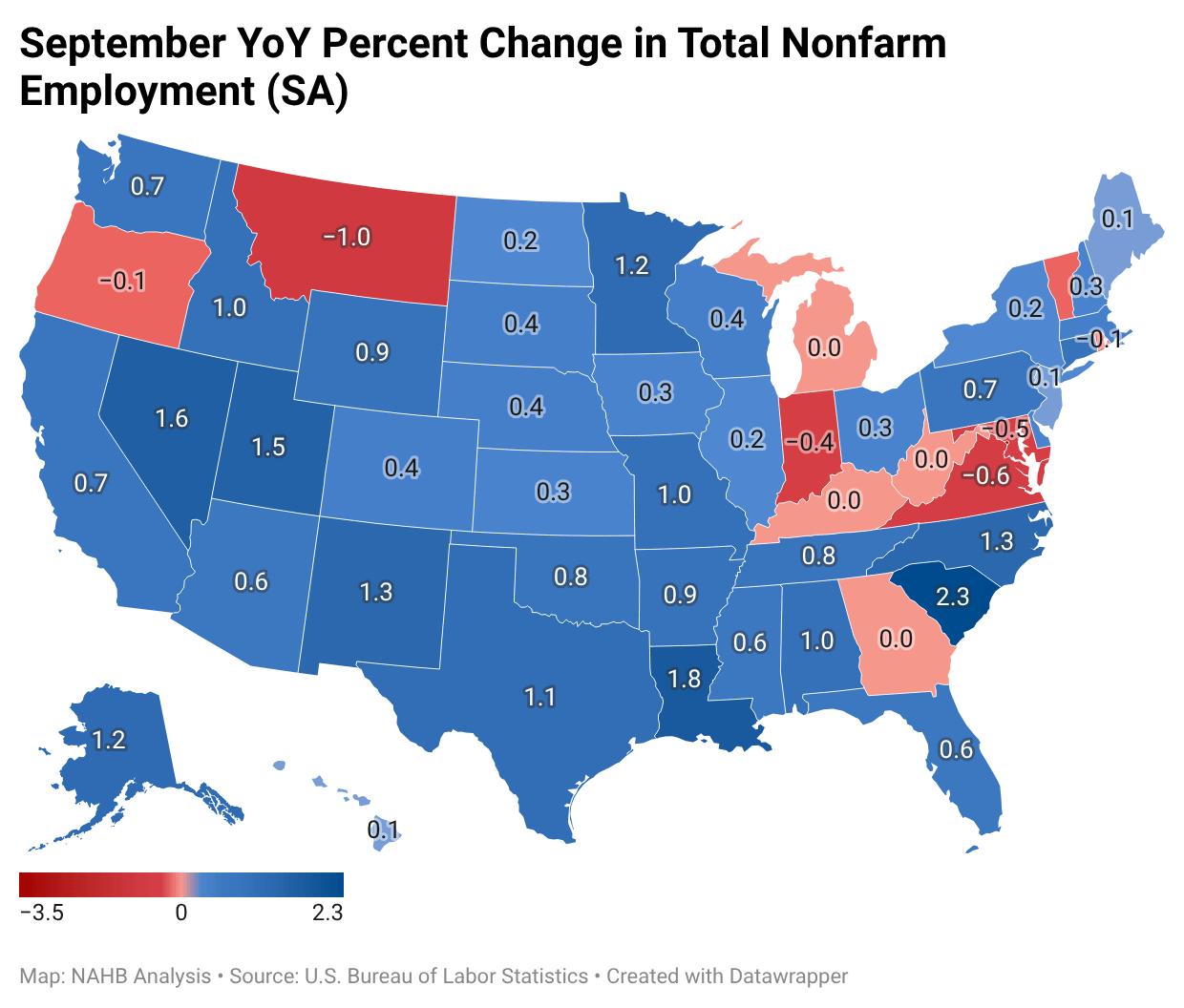
Over the 12 months ending in September, total nonfarm employment increased by 496,000 jobs nationwide, representing a 0.3% gain. Job gains ranged from 400 in Hawaii to 154,300 in Texas. Collectively, nine states and D.C. lost 86,300 jobs over the past 12 months, with D.C. recording the largest decline (-25,800).
In percentage terms, job growth ranged from 0.1% in New Jersey, Maine, and Hawaii to 2.3% in South Carolina. Michigan, West Virginia, Georgia, and Kentucky reported no change over the past 12 months. Among states experiencing employment declines, losses ranged from 0.1% in Vermont, Oregon, and Rhode Island to 1.0% in Montana. D.C., however, recorded a substantially larger decline of 3.5%.
Construction Employment
Construction employment —which includes both residential and non-residential construction, posted a net gain in September. Twenty-five states added construction jobs compared to August, while 21 states lost jobs; four states and D.C. reported no change. Oregon recorded the largest monthly gain (+2,000), while Wisconsin recorded the largest loss (-3,300). Overall, the construction sector added a net 11,000 jobs nationwide in September. In percentage terms, Rhode Island recorded the strongest monthly increase (+2.2%), while Alaska experienced the steepest decline (-3.3%).
Year-over-year, construction employment increased by 109,000 jobs nationwide, a 1.3% gain from September 2025. Louisiana led all states with an increase of 18,800 construction jobs, while Georgia recorded the largest loss (-4,900). In percentage terms, Louisiana posted the strongest annual growth in construction employment (+13.9%), while Alaska experienced the largest decline (-5.3%).
State Unemployment Rate
The state unemployment rate is a key indicator of labor market conditions, measuring the share of the labor force that is actively seeking work but unable to find employment. Higher unemployment rates generally signal weaker economic conditions, while lower rates indicate tighter labor markets that may contribute to upward wage pressures.
South Dakota recorded the nation’s lowest unemployment rate at 2.0%, while D.C. posted the highest rate at 5.6%. The elevated unemployment rate in D.C. reflects significant federal workforce reductions and layoffs that occurred during 2025. North Dakota, New Hampshire, Vermont, Hawaii, Nebraska, and Wyoming also reported unemployment rates of 3.0% or below. Meanwhile, Michigan, Oregon, Connecticut, and California recorded unemployment rates of 5.0% or higher.
This article was originally published by a eyeonhousing.org . Read the Original article here. .