Tag

Buyers

Browsing


Buying a home typically generates a wave of consumer spending beyond the purchase of the home itself. Following a home purchase, households often buy appliances and furnishings and undertake remodeling and repair projects to make the home fit their needs and preferences. This spending supports many businesses and industries, extending the economic impact of home buying.

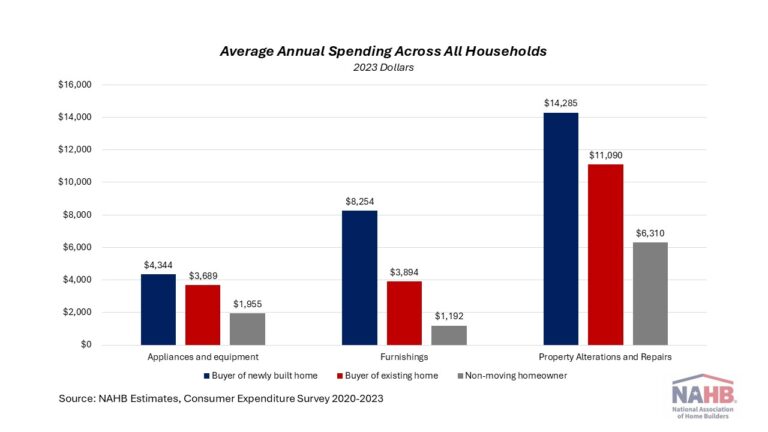
NAHB analysis of Consumer Expenditure Survey data from 2020 through 2023 shows that buyers of both newly built and existing single-family detached homes spend substantially more than homeowners who did not move. As shown in chart below, buyers of newly built homes spend an average of $26,882 on appliances, furnishings, and remodeling and repairs during the first year after purchasing a home, nearly three times the $9,457 spent by non-moving homeowners. Meanwhile, buyers of existing homes spend an average of $18,673 during the first year after purchasing a home, approximately twice the amount spent by non-moving homeowners.

Appliances

Among all households, buyers of newly built homes spend an average of $4,344 on appliances during the first year after purchasing a home, compared with $3,689 for buyers of existing homes and $1,955 for non-moving homeowners. The largest appliance expenditure among buyers of newly built homes includes refrigerators and home freezers, televisions, clothes washers and dryers, computers, and lawn equipment. This pattern may partly reflect differences in which appliances are already included with a newly built home and which items buyers must acquire separately. Most newly-constructed homes include essentials like stoves, ovens, and dishwashers. However, refrigerators and/or freezers and laundry appliances are often optional upgrades.

Televisions, while not among the most expensive appliances, rarely come with new homes. As a result, buying television sets for multiple rooms in the new house can add up to the high level of spending, reflecting the high frequency of these purchases by new home buyers rather than a particularly high cost of the item. Buyers of existing homes exhibit a similar spending pattern, although average expenditures are somewhat lower.  However, spending on clothes washers and dryers is higher for buyers of existing homes ($481) than for buyers of newly built homes ($387).

Furnishings

Recent home buyers also spent considerably more on furnishings than non-moving homeowners Among all households, buyers of newly built homes spend an average of $8,254, more than twice the $3,894 spent by buyers of existing homes and approximately seven times the $1,192 spent by non-moving homeowners.

Compared with buyers of existing homes, buyers of newly built homes spend more on nearly every major furnishing category. The largest furnishing expenditure among buyers of newly built homes is for bedroom furniture (about $1,204) and sofas ($1,178), followed by blinds, shades, and other window coverings ($1,089). The corresponding expenditures for buyers of existing homes are $385, $1,010, and $183, respectively, while non-moving homeowners spend only $111, $208, and $31.

Spending on dining room and kitchen furniture also differs substantially across homeowner groups. Buyers of newly built homes spend $702, compared with $399 for buyers of existing homes and $47 for non-moving homeowners. These differences reflect the need to furnish an entire home after a purchase, particularly for buyers of newly constructed homes with few window treatments.

Property Alterations and Repairs

Property alterations and repair projects account for the largest share of home buyer spending. During the first year after purchasing a home, buyers of newly built homes spend an average of $14,285 on property alterations and repairs, compared with $11,090 for buyers of existing homes and $6,310 for non-moving homeowners. While both groups of home buyers spend substantially more than non-moving homeowners, the composition of their property alterations expenditures differs considerably.

The composition of property alterations and repair spending differed between the two home buyer groups. Buyers of newly built homes allocate relatively more spending to projects that customized or expanded the property, including landscaping, patios, walkways, fences, driveways, swimming pools, and finishing basements, attics, or porches.

Buyers of existing homes, by contrast, invest more spending into updating, replacing, or repairing existing components. Major categories included room property alterations, heating and air-conditioning systems, flooring, painting, and roofing. The results, therefore, suggest that buyers of newly built homes tend to focus more on customization and additions, while buyers of existing homes tend to focus more on renovation and replacement.


This article was originally published by a eyeonhousing.org . Read the Original article here. .

With the end of 2024 approaching, NAHB’s Eye on Housing is reviewing the posts that attracted the most readers over the last year. In May, Rose Quint shared key takeaways of NAHB’s study of home buyers. 

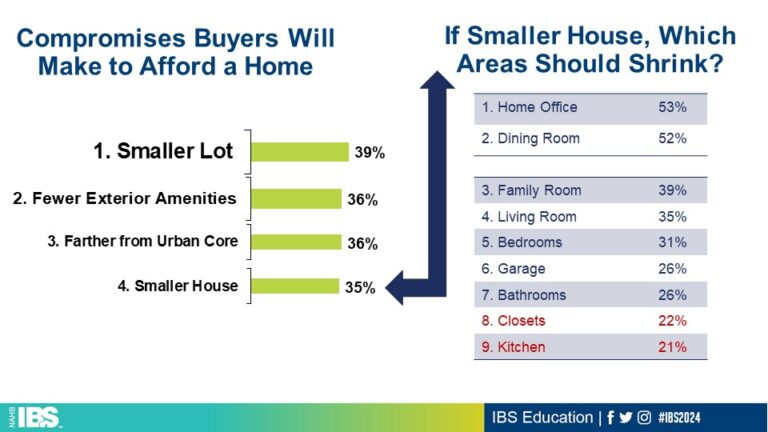
High mortgage rates and double-digit growth in home prices since COVID-19 have brought housing affordability to its lowest level in more than a decade.  Given this reality, a recent NAHB study on housing preferences* asked home buyers about which specific compromises they would be willing to make to achieve homeownership.

For 39% of buyers, accepting a smaller lot is the path to affording a home.  This finding highlights the paramount importance of reforming zoning laws that mandate lot sizes, as nearly 4 out of 10 buyers would be willing to give up land in exchange for owning a home.  For 36% of buyers, accepting fewer exterior amenities is the way to homeownership—they will simply add that deck or patio at some point in the future.  Another 36% were willing to move farther from the urban core and 35% will accept a smaller house if that’s what it takes to buy it.

But what areas of the home, specifically, should shrink to reduce the overall footprint of the home?  Most buyers who will take the smaller house compromise sent builders and architects a clear message: shrink the home office (53%) and the dining room (52%) to save on square footage.  Also, loud and clear in the message: leave the kitchen (only 21% would want that smaller) and closet space (22%) alone.

What Home Buyers Really Want, 2024 Edition sheds light on the housing preferences of the typical home buyer and is based on a national survey of more than 3,000 recent and prospective home buyers.  Because of the inherent diversity in buyer backgrounds, the study provides granular specificity based on demographic factors such as generation, geographic location, race/ethnicity, income, and price point.

Discover more from Eye On Housing

Subscribe to get the latest posts sent to your email.


This article was originally published by a eyeonhousing.org . Read the Original article here. .


NAHB published research earlier this year on home buyer preferences called What Home Buyers Really Want. Consumers were asked to rate how 19 technology features would influence their home purchase decision, if at all, using the following four-point scale:

Do not want – not likely to buy a home with this design or feature.

Indifferent – wouldn’t influence decision.

Desirable – would be seriously influenced to purchase a home because this design or feature was included.

Essential/Must have – unlikely to purchase a home without this design or feature

Seventy-eight percent of home buyers rated a programmable thermostat as either essential/must have or desirable, followed by security cameras (76%), video doorbell (74%), and wireless home security system (70%).  Sixteen of the 19 technology features had at least 50% of home buyers rating them as essential or desirable.

The top eight features reveal that home buyers are looking for technology that helps them achieve two main goals:

Improve Energy Efficiency (programmable thermostat, multi-zone HVAC system, lighting control system, energy management system/display) AND

Increase Safety (security cameras, video doorbell, wireless & wired home security system)

Additionally, like the other areas of the home covered in the study, every question on technology features is tabulated by the buyer’s income, age, geography, race, household type, and the price they expect to pay for the home. These details can be very useful in particular cases. For example, the study discusses the five technology features that have the largest preference margins between the youngest and oldest buyers along with analyzing the prevalence of virtual tours by income and price point. 

Discover more from Eye On Housing

Subscribe to get the latest posts sent to your email.


This article was originally published by a eyeonhousing.org . Read the Original article here. .

The latest NAHB study on home buyer preferences – What Home Buyers Really Want Study – asked consumers about the features and amenities they would want in a home, specifically regarding windows and exterior doors.  Respondents were asked to rate eight window and four exterior door features using the following four-point scale:

Do not want – not likely to buy a home with this design or feature.

Indifferent – wouldn’t influence decision.

Desirable – would be seriously influenced to purchase a home because this design or feature was included.

Essential/Must have – unlikely to purchase a home without this design or feature.

Windows

ENERGY STAR rated windows were rated essential or desirable by 83% of home buyers, followed by triple-pane insulating glass (77%) and low e-insulating glass (67%).  Since its introduction to the survey in 2007, ENERGY STAR rated windows have been wanted by at least 83% of home buyers (Figure 1).  Additionally, ENERGY STAR windows were ranked the third most wanted feature out of the 200+ options asked within the survey.

Doors

All four exterior door features were rated essential or desirable by a majority of home buyers (>50%) with very little separating the highest (sliding patio doors at 64%) to the lowest (double main entry door at 58%) rated options.  Furthermore, all four exterior door features have increased in popularity compared to 2020, with double main entry door rising the most (10 percentage points) (Figure 2). 

Additionally, like the other areas of the home covered in the study, every question on windows and doors is tabulated by the buyer’s income, age, geography, race, household type, and the price they expect to pay for the home.  These details can be very useful in particular cases.  For example, the study discusses the three window features that appeal to older buyers, as well as how preferences for hinged/French patio doors change by income level and home price. 

Discover more from Eye On Housing

Subscribe to get the latest posts sent to your email.


This article was originally published by a eyeonhousing.org . Read the Original article here. .


In the most recent NAHB research on home buyer preferences, What Home Buyers Really Want Study, consumers were asked to rate how 28 kitchen and 18 bathroom features would influence their home purchase decision, if at all,  using the following four-point scale:

Do not want – not likely to buy a home with this design or feature.

Indifferent – wouldn’t influence decision.

Desirable – would be seriously influenced to purchase a home because this design or feature was included.

Essential/Must-have – unlikely to purchase a home without this design or feature.

Kitchen

Eighty percent of respondents rated a walk-in pantry and table space for eating as either essential/must-have or desirable, followed by a double sink (78%), drinking water filtration (75%), pull-out shelves and a central island (both at 74%), and a granite or natural stone countertop (73%).  Overall, home buyers want to have kitchens with lots of amenities: of the 28 kitchen features, 21 were essential or desirable to at least 50% of buyers.  A walk-in pantry has been at least tied for the top-rated kitchen feature in every iteration of the survey (Figure 1).

Bathroom

Similar to kitchens, home buyers are looking for bathrooms with lots of amenities, with 14 of the 18 features rated as either essential/must-have or desirable by 50% or more respondents.  The results show an  emphasis on the primary bath, with the top three highest rated bathroom features being listed for this area: both a shower & tub (78%), a linen closet (76%), and a private toilet compartment (70%).  Both a shower stall & tub, as well as a linen closet, have been the top two rated bathroom features by home buyers in every iteration of the survey (Figure 2). 

Like the other areas of the home covered in this study, every question on kitchens and bathrooms is tabulated by the buyer’s income, age, geography, race, household type, and the price they expect to pay for the home.  These details can be very useful in particular cases.  For example, the report discusses the three kitchen features that appeal differentially to buyers in the Millennial generation, as well as three bathroom features that are especially important to include in more expensive homes. 

Discover more from Eye On Housing

Subscribe to get the latest posts sent to your email.


This article was originally published by a eyeonhousing.org . Read the Original article here. .


CNN
 — 

When Dana McMahan sold her home this spring, she decided to try to maximize her take-home profit by skipping out on the help of a full-service Realtor.

Traditionally, home sellers in the US have been responsible for paying real estate commissions. The standard 5% or 6% commission was usually split between the seller’s broker and the buyer’s broker, referred to as cooperative compensation.

“I think it’s safe to say that for quite some time I’ve really not felt like it was fair for a home seller to be paying a 6% commission,” McMahan said.

McMahan, a content creator in Louisville, Kentucky, was slightly ahead of the curve when she opted out of the standard commission-sharing model: Beginning August 17, a new set of rules went into effect for the 1.5 million real estate professionals who are part of the National Association of Realtors designed to shift the conversation about how Realtors get paid.

Amid record-high home prices and elevated mortgage rates, NAR’s changes may only seem like tweaks to the opaque process of buying and selling a home. But many experts predict the new rules may eventually spur increased price competition in the real estate industry, opening up the possibility for Americans to save thousands of dollars on Realtor commissions in the future.

Cutting out a traditional Realtor means taking on extra work, though.

“I hosted an open house myself; I provided my own photography and I wrote my own listing description,” McMahan said. “But if I were trying to put a value on my time, I came nowhere near spending what I would have spent on that commission.”

By selling her home without a full-service Realtor, McMahan, who enjoys fixing up and reselling old homes, pocketed some extra cash: Rather than paying 2% or 3% of her home’s final sale price to an agent, she paid a broker just $500 to list her home on her local MLS, a centralized database that Realtors use to learn which homes in their area are for sale.

Despite saving money on her side of the deal, she did not avoid paying a commission altogether. She ultimately offered the standard 3% commission to the agent representing her home’s buyer, a move McMahan said she felt was necessary to entice agents to bring buyers around.

“I knew the house would sell itself. I just needed to get eyeballs on it,” she said.

But NAR’s changes aim to prevent that calculation. After August 17, sellers and their agents are prohibited from advertising how much they would pay to a buyer’s agent in the MLS. Critics have often accused some Realtors of commission-based steering, in which they avoid showing their clients homes on the market that are offering below-market-rate commissions.

NAR has said that the practice was always prohibited but that the new rules have “eliminated any theoretical steering.”

NAR’s rule changes stem from a series of lawsuits that accused the powerful trade organization of keeping commissions artificially high by forcing home sellers to pay out commissions to agents on both sides of the transaction. NAR, which is a significant lobbying group for the real estate industry, denied the accusation, saying Realtor commissions have always been negotiable. Still, the group agreed to pay $418 million to settle some of the claims ­— and agreed to implement the new rules on its members as part of the settlement.

The final approval hearing is scheduled for November 26, but a judge granted preliminary approval of NAR’s settlement in April.

Given the new rules, McMahan said she might reconsider her offer of a 3% buyers’ broker commission the next time she sells her home.

Another aspect of NAR’s rule change: Buyers will be required to sign representation agreements with a Realtor before they can begin touring homes together. These agreements are intended to inform buyers that they may be responsible for covering their Realtor’s commission payment themselves if a seller chooses not to offer it.

Some prospective buyers may balk at being on the hook for thousands of dollars in commission payments and instead turn to lower-cost alternatives, like flat-free brokerages or a la carte services.

Either way, experts caution that homebuyers carefully read any legally binding representation agreement before signing it.

Some Realtors have warned that in competitive markets where homes for sale receive multiple offers, buyers may be pushed to pay their own agents out-of-pocket to make their bids more appealing to sellers, further adding to the often burdensome closing costs associated with purchasing a home.

Bill Colson, who is preparing to sell his Maryland home next year and purchase a retirement home outside Blue Ridge, Georgia, believes the changes will create more costs.

Colson, who is 57 years old and retired from the Navy, said a Realtor in Maryland still advised him to offer the standard 6% commission split between his agent and a buyer’s agent when selling his home — but in Georgia, Colson said another Realtor told him to be prepared to pay his own agent out of pocket to make a potential offer more competitive. That means Colson would be responsible for paying out commissions for both transactions, which would have been unthinkable to many homebuyers and sellers before the changes.

“If you want to stand out, you’re going to have to pay,” Colson said.

“In the end, we may end up paying something like 9%,” he said. “Instead of making things better, it just got a lot worse.”


This article was originally published by a www.cnn.com . Read the Original article here. .


EDINA, Minn. — The experience of buying or selling a home is changing. A recent National Association of Realtors settlement now requires buyers and sellers to negotiate house sale commissions, including who pays and how much.

A recent overhaul changed the way realtors get paid to help people buy and sell their homes. It’s part of a $418 million settlement announced in March between a nationwide group of homeowners and the National Association of Realtors.

“For consumers, it’s going to be more transparent and it really should be a smooth process,” said Jamar Hardy, president of Minneapolis Area Realtors. “Historically, a seller’s agent charged home sellers a fee, usually 5% or 6%, which was then split with the buyer’s agent. On a $500,000 home that would be $30,000 in commission.”

Lawsuits alleged the standard practice violated antitrust laws, though the association has long argued that the commissions were always negotiable.

Moving forward, buyers who previously didn’t have to pay a commission to their realtor who helped them purchase a home will be expected to pay for the service. Sellers will have to pay for their agent but will no longer have to pay for the buyer’s agent.

Listing agents and sellers will be prohibited from including offers of compensation to buyer agents on the multiple listings services, better known as the MLS.

“If sellers aren’t offering payouts right up front, that negotiation is going to happen at a time of offer, so we’ll see a little change there because again, that offer of compensation won’t be visible to us anymore,” said Hardy.

Real estate commissions in Minneapolis have fallen minimally since March, after the announcement of the settlement. It fell from 2.6% in March to 2.56% in mid-July.

Analysts with TD Cowen expect the settlement could reduce realtor commissions by 25% to 50%. Another change requires buyers’ agents to discuss their compensation upfront.

“I think that’s going to be the biggest change for both consumers and agents. It’s not just allowing somebody to walk through that house because we have a showing, let ’em run through really quick to see things,” said Hardy.

There are 22,000 real estate agents in Minnesota. Hardy says some may leave the business because of the changes,but others will thrive.

“I think competition is going to win out in the end, and people are going to truly know what we do for a living and understand what they’re paying for,” said Hardy.

The new rule changes the National Association of Realtors agreed to as part of the settlement take effect on Saturday.

More from CBS News


This article was originally published by a www.cbsnews.com . Read the Original article here. .


The National Association of Realtors (NAR) agreed to new rules around real estate commissions as part of a lawsuit settlement in March. As of August 17, they’re actually rolling out — and consumers face a deluge of confusion and conflicting predictions.

One narrative predicts a coming utopia for homebuyers: A price war will erupt, and commissions will plunge amid a new wave of competition among buyers’ agents. A competing narrative goes in the opposite direction: Under the new commission structure, buyers will realize they’re on the hook for thousands and decide not to use agents at all. NAR, meanwhile, has portrayed the changes as minor tweaks rather than a major shift.

The opposing narratives underscore just how complex Realtor compensation has always been — and how much more complex it just got. Here’s a look at the new commission structure and what it could mean for both homebuyers and sellers.

How real estate commissions used to work

Traditionally, when a home seller hired a real estate agent to represent their listing, the seller agreed to pay a commission. The national average has been about 5 percent of the home’s sale price, typically split down the middle with 2.5 percent going to the listing agent and the other 2.5 percent to the buyer’s agent. (On a $400,000 home, 5 percent comes to $20,000, or $10,000 for each agent.)

Who pays?

Even this has been a bit murky. Agent fees came out of the seller’s proceeds at closing, but it’s reasonable to assume that the seller adjusted their price accordingly — the fees were baked into the home’s sale price. And so the buyer ultimately paid, just not directly to the agents: That extra 5 percent was rolled into the home’s sale price.

What’s changing?

The biggest change is that listing agents (the agents who represent home sellers) may no longer make offers of compensation to buy-side agents on any NAR-affiliated multiple listing service (MLS). In addition, a buyer’s agent must now have a written contract with a home shopper, clearly specifying their fee, before they may show that client a house. Until now, NAR encouraged but didn’t require written agreements between buy-side agents and buyers.

A federal judge gave preliminary approval to the settlement in April 2024, and the final holdout among the brokerages named in the suit — HomeServices of America, part of Warren Buffett’s Berkshire Hathaway — also settled in April. While final court approval is not expected until November, the rules took effect August 17.

Compared to the old model, the new version offers a greater level of transparency for consumers — homebuyers now will be fully aware of how much they’re paying for an agent’s services. “It’s always good when people understand what they are and are not paying for,” says David Druey, Florida regional president at Centennial Bank.

An important aspect of the new model for agents: While the new rules prevent listing agents from posting buy-side commissions on the MLS, as they used to, sellers and listing agents still can agree on the amount off the MLS. That means it’s OK to offer compensation amounts verbally, in emails or texts, and even on their brokerage’s own website, as long as it’s not done on the MLS.

“Although sellers can elect not to pay any buyer agent compensation, that doesn’t mean they will avoid the economics,” says Budge Huskey, president and chief executive of Premier Sotheby’s International Realty in Naples, Florida. “Buyers may easily write into any offer a contingency requiring that the seller cover the cost, or may request other concessions, such as closing cost assistance in the dollar amount they are paying their representative.”

Does this mean real estate commissions are now negotiable?

Technically, real estate commissions always have been negotiable — a theme NAR long has stressed. Practically, though, the picture gets complicated. In many cases, Realtors are more skilled at negotiating than their clients, so the consumer comes into the negotiation at a disadvantage. What’s more, the buyer’s agent commission was previously determined by the seller, not by the buyer. The new rules shift that responsibility to buyers, who now will discuss compensation directly with the agents representing them.

Is this good or bad for consumers?

Until we see how things shake out over time, the answer really depends on who you ask. Some foresee a near-nirvana for consumers: Vishal Garg, CEO of mortgage company Better, predicts the settlement will unleash a “buy-side price war” — buyer agents will begin competing fiercely for clients.

Others fear a darker turn. Ken H. Johnson, a real estate economist at Florida Atlantic University and a former real estate broker, says the new rules just add another layer of complexity to an already-confusing process.

“No longer advertising buyer agent commissions will only create a more confused and drawn-out transaction process as buyers, sellers and agents will have to negotiate the fee, who will pay for it and how much will be paid by each party,” Johnson says. “Due to this added level of complexity, buyers will almost certainly have to negotiate with more sellers before they find the deal they are satisfied with. Thus, the house-hunting period will extend for the average buyer.”

Concerns for first-time buyers

Many in the real estate industry worry that first-time homebuyers — those who need expert guidance the most, and who are already severely hampered by high prices and high mortgage rates — will be priced out of professional representation. If commissions no longer come out of the seller’s proceeds, the thinking goes, buyers won’t have an additional $7,500 or $10,000 to pay an agent.

“Most of those buyers are scraping the barrel to the bottom to come up with a down payment,” says Dave Liniger, chairman and co-founder of RE/MAX. (The firm was one of the large brokerages named as defendants in the suit along with NAR; RE/MAX settled last year for $55 million.)

For now, buyers can’t roll commission costs into their mortgages under the new rules. But industry players widely expect the Federal Housing Finance Agency, overseer of mortgage giants Fannie Mae and Freddie Mac, to change those rules.

“I think there’s going to be pressure on them to allow that,” Liniger says. “The industry needs first-time buyers.”

Indeed, NAR already has been attempting to nudge the mortgage industry in that direction: “We are talking with Freddie and Fannie to see what can be done,” says Lawrence Yun, NAR’s chief economist.


This article was originally published by a www.bankrate.com . Read the Original article here. .


GAINESVILLE, Fla. (WCJB) – On August 17th policy changes are coming to people looking to buy and sell a home, as well as agents commissions.

The real estate industry is changing some of its practices and many people, including homebuyers and sellers, may not be aware of what’s in store.

“The news entails a buyer is now required to have some sort of agreement with their realtor before they start looking at homes. That’s one portion of the settlement and the other portion of it is that home sellers can no longer offer compensation to a buyer realtor in the MLS” President-Elect Gacar, Lisa Baltozer added.

This affects the buyers, to know how the market is changing. They will be responsible for paying for their agents. Sellers can negotiate the fees to both parties.

Still, agents can’t advertise for buyers’ agent’s commissions on the MLS

Some real estate agents favor the new changes, like Debra Martin-Back who is the broker of Exit Realty Producers.

“I think it’s a great thing for the industry and now it’s going to put us at a new level. Nobody works for free, nobody goes out there without telling you what they are charging. Now we are just doing it upfront and we are not relying on the seller and agents to pay us which has happened in the past. Whatever was in the MLS is what we got paid” Martin-Back added.

Others are hopeful agents will follow the rules and explain all the information to their clients upfront.

Florida realtor Zome De Las Estrellas said,

“I am a little annoyed by it because it’s a little more complicated but I’m not worried about it. I think my biggest concern would be just hoping that other agents are doing their part to explain the rules”.

Realtors say this changes the game when buying or selling a home. It’s a learning curve that everyone is learning together.

Click here to subscribe to our newsletter.


This article was originally published by a www.wcjb.com . Read the Original article here. .

WALNUT CREEK, Calif. (KGO) — The experience of buying or selling a home is going to be different than transactions in the past. A recent National Association of Realtors class action settlement agreement has laid out new rules that will now bring the buyer and seller into negotiations over commissions on the sale of a house – negotiating who pays commission and how much is paid.

“Today is the day that on the MLS any indication of compensation commission is eliminated, you can’t even look at historical data,” Tricia Thomas, the CEO of the Bay East Association of Realtors said.

Realtors say that will make it more complicated for agents who now will have to involve potential buyers and sellers in signing new more complicated paperwork.

“So the buyer and seller are looped into the transaction more so we’re able to be more transparent with them about compensation,” Barbara Clemons, president of the Bay East Association of Realtors said, “There will be more forms for the buyer and seller to fill out.”

That will be apparent when visiting an open house – buyers will be asked to sign forms and if they don’t have an agent representing them; they might not be able to get additional information about a property without an agent.

MORE: San Jose becomes 1st in CA to allow property owners to sell ADUs

Buyers will have to negotiate how much they are willing to pay the agent representing them. But sellers could incentivize a sale by offering to pay all or a portion of the buyer’s agent’s commission.

David Stark with the Bay East Association of Realtors said, “It’s the biggest decision of your life and it’s probably going to be intimidating regardless of these changes but the fact that there’s going to be so much more information available, hopefully that’ll take care of some of the anxiety people will be having about real estate transactions.”

How these changes will affect commissions or the market is still a big unknown.

“There is no crystal ball. I don’t believe this is a factor on its own that’s going to significantly influence housing prices,” Thomas said.

But it will be a learning curve for everyone looking to buy or sell a home now.

Copyright © 2024 KGO-TV. All Rights Reserved.


This article was originally published by a abc7news.com . Read the Original article here. .
Pin It