Tag

Jobs

Browsing


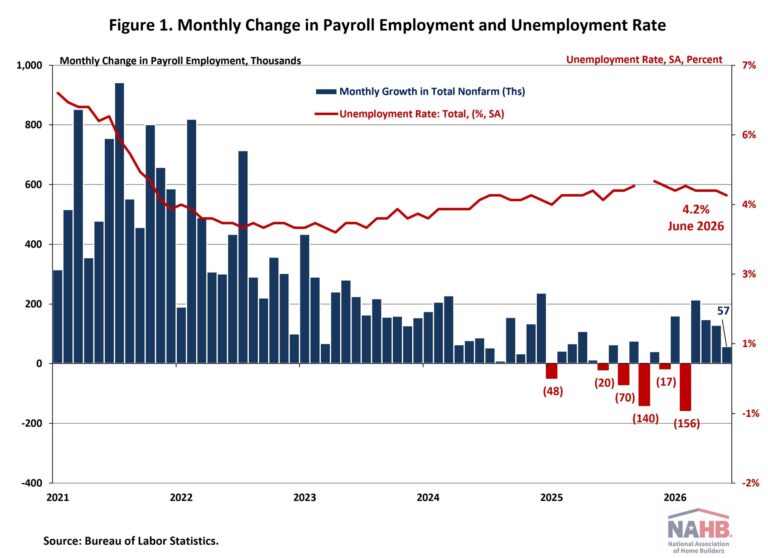
The U.S. labor market lost momentum in June, with total nonfarm payroll employment rising by just 57,000, the smallest gain since February’s outright decline. Downward revisions to April and May payroll estimates subtracted a combined 74,000 jobs from previously reported totals, reversing the sizable upward revisions reported a month earlier and suggesting underlying hiring momentum was weaker than initially reported. The unemployment rate edged down to 4.2%, essentially unchanged from a year ago, but the decline reflected a shrinking labor force rather than stronger hiring, as both overall and prime-age labor force participation fell notably in June.

Wage growth accelerated modestly in June. Average hourly earnings rose 3.5% from a year earlier to $37.64, up from a 3.4% year-over-year pace in May. This pace is 0.3 percentage points lower than a year ago. Importantly, wage growth has been outpacing inflation for nearly two years, which typically occurs as productivity increases.

National Employment

According to the Employment Situation Summary reported by the Bureau of Labor Statistics (BLS), total nonfarm payroll employment increased by 57,000 in June, following a downwardly revised gain of 129,000 in May. Revisions to prior months were broadly negative this month, a reversal from May’s positive trend. The change for April was revised down by 31,000, from +179,000 to +148,000, while the change for May was revised down by 43,000, from a preliminary +172,000 to +129,000. Combined, these revisions subtracted 74,000 jobs from previously reported totals, compared with the 93,000 upward revisions reported in the prior month.

Job growth in 2026 has moderated following a stronger spring. Through June, monthly payroll gains have averaged 92,000 on the current data vintage, down from the 114,000 pace reported through May, reflecting both June’s soft print and the downward revisions to April and May. This compares with an average of just 10,000 per month in 2025 and 122,000 per month in 2024. Over the past 12 months, total nonfarm employment has grown by 506,000, a considerably slower pace of expansion than earlier in the cycle.

The unemployment rate declined to 4.2% in June from 4.3% in May, essentially matching its year-ago level of 4.1%. However, the improvement was driven by a shrinking labor force rather than stronger hiring. Over the month, the number of unemployed persons fell by 213,000 to 7.1 million, while the number of employed persons declined by 507,000. Combined, the civilian labor force contracted by 720,000 in June.

Meanwhile, the labor force participation rate—the proportion of the population either looking for a job or already holding a job—fell 0.3 percentage points to 61.5% in June. This marks the lowest level since March 2021 and remains well below its pre-pandemic level of 63.3% recorded at the start of 2020. Among prime working-age individuals (aged 25 to 54), the participation rate dropped 0.6 percentage points to 83.3%, one of the sharpest single-month declines of this cycle and an indication that June’s pullback in labor force participation was not confined to either younger or older workers.

Job gains in June were concentrated in a handful of sectors. Employment increased by 36,000 in professional and business services, 25,000 in social assistance, and 22,000 in health care. In contrast, leisure and hospitality shed 61,000 jobs, reflecting weaker than usual seaonal hiring.

Construction Employment

Employment in the overall construction sector rose by 11,000 jobs in June, following a gain of 6,000 in May. Within the industry, residential construction employment declined by 8,600, while non-residential construction added approximately 19,900 jobs.

Residential construction employment now stands at 3.3 million in June, including 916,000 workers employed by builders and remodelers and 2.4 million residential specialty trade contractors.

The six-month moving average of job gains for residential construction employment remains negative, reflecting an average monthly loss of 3,517 jobs and declines in four of the past six months. Over the last 12 months, residential construction has shed a net of 48,800 jobs, marking the sixteenth consecutive month of annual decline and the longest stretch of annual losses since the Great Recession. However, residential construction has gained 1,283,400 positions from its post-Great Recession low.

Meanwhile, the unemployment rate for construction workers rose to 6.2% in June on a seasonally adjusted basis, up from 5.2% in May and 3.7% in April. This marks the second consecutive monthly increase and the highest reading since July 2021. A year earlier, the construction unemployment rate stood at 4.5%. The continued increase suggests softness in construction labor market conditions.


This article was originally published by a eyeonhousing.org . Read the Original article here. .


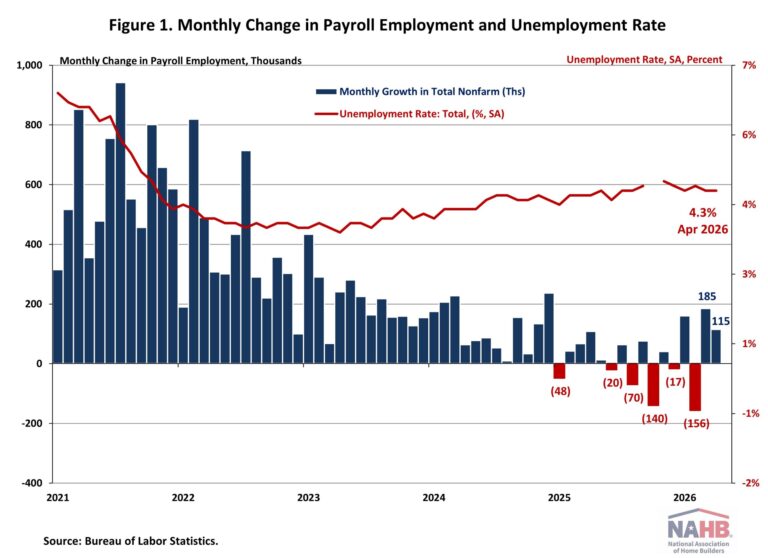
The U.S. labor market continued to show resilience in April, with job growth persisting despite elevated interest rates and rising geopolitical uncertainty related to the Iran conflict. The unemployment rate held steady at 4.3%. Hiring gains were concentrated in health care, transportation and warehousing, and retail trade, underscoring continued strength in service-oriented sectors.

Wage growth accelerated modestly in April, with average hourly earnings rising 3.6% year-over-year. This pace is 0.3 percentage points lower than a year ago. Importantly, wage growth has been outpacing inflation for nearly two years, which typically occurs as productivity increases.

National Employment

According to the Employment Situation Summary reported by the Bureau of Labor Statistics (BLS), total nonfarm payroll employment increased by 115,000 in April, following an upwardly revised gain of 185,000 jobs in March. Revisions to prior months were modest overall. The monthly change in total nonfarm payroll employment for February was revised down by 23,000 from -133,000 to -156,000, while the change for March was revised up by 7,000 from +178,000 to +185,000. Combined, these revisions reduced previously reported employment by 16,000 jobs.

Job growth in early 2026 remains well below 2024 levels but stronger than the weak pace recorded in 2025. Through April, monthly payroll gains have averaged 76,000, compared with 10,000 per month in 2025 and 122,000 in 2024.

The unemployment rate remained unchanged at 4.3% in April. Over the month, the number of persons unemployed rose by 134,000, while the number of persons employed declined by 226,000.

Meanwhile, the labor force participation rate—the proportion of the population either looking for a job or already holding a job—declined 0.1 percentage points to 61.8%. This marks the lowest level since November 2021 and remains below its pre-pandemic level of 63.3% recorded at the beginning of 2020. Among prime working-age individuals (aged 25 to 54), the participation rate held steady at 83.8%.

In April, job gains occurred in health care (+37,000), transportation and warehousing (+30,000), and retail trade (+22,000), while federal government employment continued to decline. Since reaching a peak in October 2024, federal government employment has fallen by 348,000 jobs, or 11.5%.

Construction Employment

Employment in the overall construction sector rose by 9,000 jobs in April, following a downwardly revised gain of 16,000 in March. Within the industry, residential construction shed 10,400 jobs, while non-residential construction added 19,000 jobs.

Residential construction employment now stands at 3.3 million in April, including 927,000 workers employed by builders and remodelers and nearly 2.4 million residential specialty trade contractors.

The six-month moving average of job gains for residential construction remains negative, reflecting an average monthly loss of 2,333 jobs and declines in three of the past six months. However, over the last 12 months, residential construction has shed a net of 49,200 jobs, marking the fourteenth consecutive annual decline and the longest stretch of annual losses since the Great Recession. Despite these declines, residential construction has gained 1,297,100 positions from its post-Great Recession low.

Meanwhile, the unemployment rate for construction workers declined to 3.7% in April on a seasonally adjusted basis, remaining relatively low compared with historical norms.


This article was originally published by a eyeonhousing.org . Read the Original article here. .

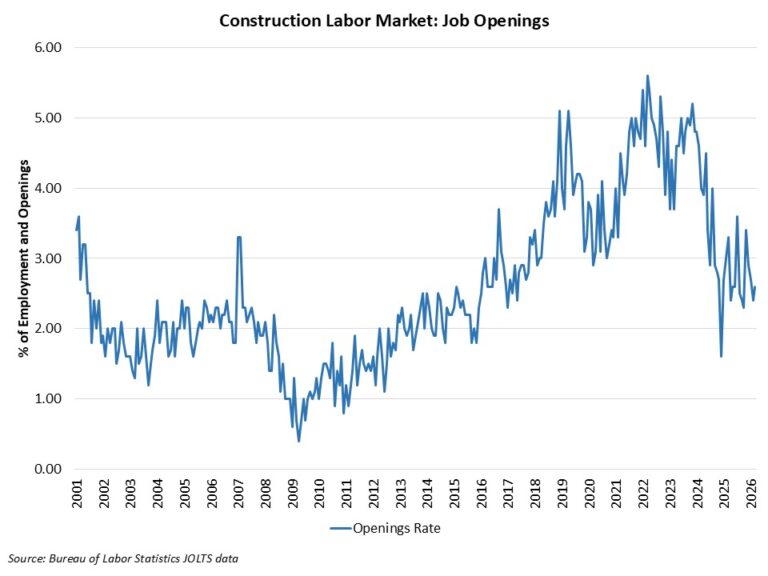
The number of open positions in the construction sector edged higher in March, per the Bureau of Labor Statistics Job Openings and Labor Turnover Survey (JOLTS). The current level of open jobs is down measurably from three years ago due to declines in construction activity, particularly in housing. However, recent gains for nonresidential construction have not fully offset soft conditions for housing with respect to the demand for construction labor.

The number of open jobs for the overall economy declined, falling from 6.92 million in February to 6.87 million in March. The March reading was down from a year ago (6.95 million) due to a cooling labor market.

Previous NAHB analysis indicated that this number had to fall below eight million on a sustained basis for the Federal Reserve to move forward on interest rate reductions. With estimates remaining below eight million for national job openings, the Fed, in theory, should be able to cut further. However, this is situation is complicated by rising energy costs due to the Iran war.

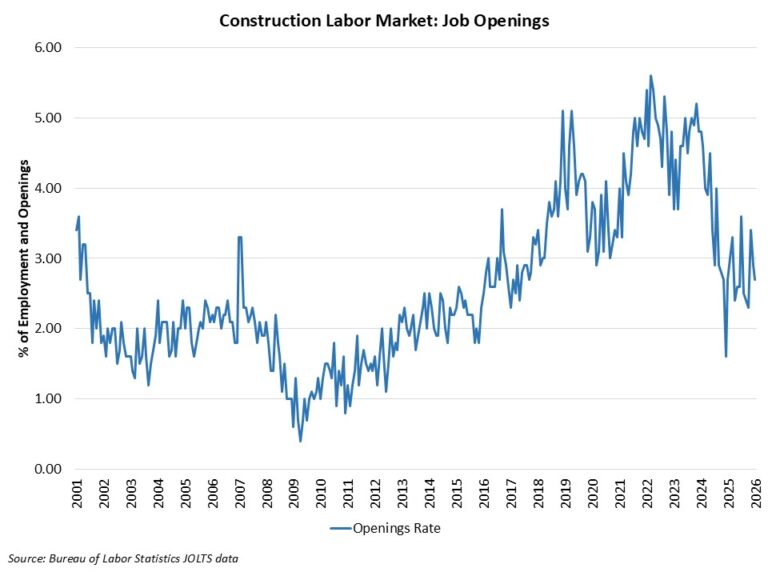
The number of open construction sector jobs increased for the month, rising slightly from 201,000 in February to 224,000 in March. This total was down compared to a year ago (278,000). The chart below notes the declining trend that has been in place for unfilled construction jobs since the Fed raised the federal funds rate and home building weakened. While home building employment was declining during the second half of 2025, other subsectors of the construction industry have expanded (e.g. data centers). This has produced volatility within a reduced range in the job openings series since 2024.

The construction job openings rate increased to 2.6% in March, down from the 3.3% rate estimated a year ago.

The layoff rate in construction declined slightly to 1.7% in March. The quits rate increased to 1.7% for the month.


This article was originally published by a eyeonhousing.org . Read the Original article here. .

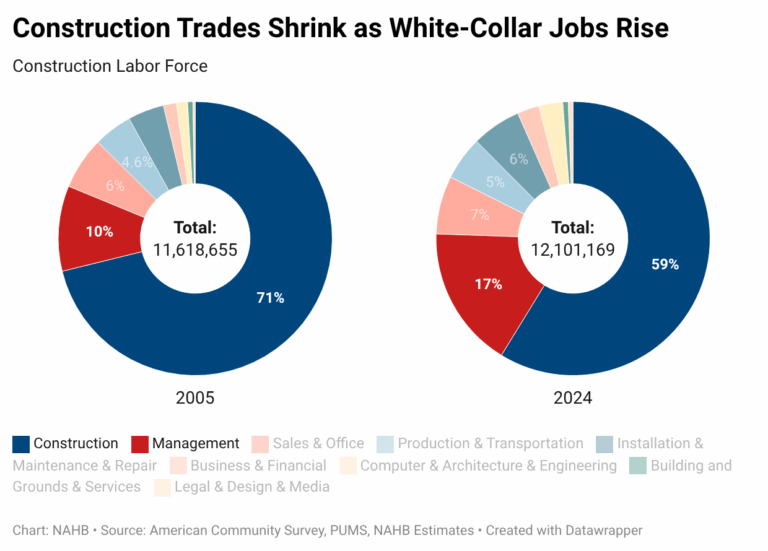
The long-running shift in the construction labor force away from construction trades and toward management, business, and technical roles is ongoing and gaining momentum, according to NAHB’s analysis of the latest 2024 data from the American Community Survey (ACS). Although total industry employment now slightly exceeds the levels reached during the 2005–2006 housing boom, the composition of that workforce has changed markedly. The share of construction trades workers has declined from 71% in 2005 to less than 59% in 2024. At the same time, the share of computer, engineering, and science occupations has more than doubled, while management and business roles have expanded by 73%.

These shifts are particularly striking in the context of persistently modest productivity growth in construction. In principle, a larger presence of engineering and technology workers should support productivity gains through improved project design, coordination, and innovation. However, the expansion of management and business roles may also reflect increasing regulatory complexity, permitting requirements, and compliance costs, all of which can lengthen project timelines and raise overhead without directly increasing output. The declining share of skilled trades workers, the group most directly responsible for on-site production, may also offset any productivity gains. Taken together, these compositional changes complicate the link between workforce structure and productivity.

As of 2024, the construction labor force exceeds 12.1 million workers, slightly above its mid-2000s peak. Construction trades, such as carpenters, electricians, painters, plumbers, laborers, and first-line supervisors, account for 7.1 million workers, or 58.8% of the total. By comparison, there were 8.5 million trade workers at the peak of 2006. The loss of more than one million tradesmen helps explain the persistent labor shortages reported in the NAHB/Wells Fargo Housing Market Index (HMI) Survey. 

Over the same period, the industry has absorbed a growing number of white-collar workers. Management ranks expanded from 1.2 million to 2 million workers, increasing its share from 10% to 17%. Business and financial occupations grew at similar rates. Meanwhile, the number of engineers, architects, and science-related occupations more than doubled, now accounting for nearly 2.8% of the workforce, up from just 1.3% in 2005. 

Even with these gains, white-collar roles remain less prevalent in construction than in the broader U.S. economy. However, their growth has outpaced national trends. For example, the share of computer, engineering, and science occupations more than doubled in construction, compared to a 48% increase across the overall U.S. workforce. Similarly, legal and design occupations doubled their share in construction, while their economy-wide presence grew only 20% since 2006. 

Several structural factors likely underpin these trends. Advances in construction technologies—including digital design, project management software, and prefabrication—have increased demand for technical expertise. At the same time, a more stringent regulatory and building code environment has raised the need for administrative, compliance, and managerial functions. The changing workforce composition also coincides with declining self-employment rates in construction, suggesting a shift toward larger firms. These firms are generally better positioned to invest in new technologies, manage regulatory complexity, and absorb rising overhead costs. 

The labor force statistics reported here are derived from the ACS Public Use Microdata Sample (PUMS), which provides comprehensive coverage of both payroll employees and the self-employed. Consistent with standard labor force definitions, these estimates include both employed individuals and those actively seeking work. 


This article was originally published by a eyeonhousing.org . Read the Original article here. .

The number of open positions in construction in January was flat year-over-year, per the Bureau of Labor Statistics Job Openings and Labor Turnover Survey (JOLTS). The current level of open jobs is down measurably from three years ago due to declines in construction activity, particularly in housing. However, recent gains for nonresidential construction combined with soft conditions for housing have left the number of job openings in construction flat.

The number of open jobs for the overall economy increased in January, rising from 5.83 million in December to 6.20 million in January. The January reading was down from a year ago (6.55 million) due to a slowing labor market.

Previous NAHB analysis indicated that this number had to fall below eight million on a sustained basis for the Federal Reserve to move forward on interest rate reductions. With estimates remaining below eight million for national job openings, the Fed, in theory, should be able to cut further.

The number of open construction sector jobs was relatively flat, declining slightly from 245,000 in December to 231,000 in January. This total was flat compared to a year ago (232,000). The chart below notes the declining trend that has been in place for unfilled construction jobs since the Fed raised the federal funds rate and home building weakened. While home building employment was declining during the second half of 2025, other subsectors of the construction industry have expanded (e.g. data centers).

The construction job openings rate decreased to 2.7% in January, equal to the 2.7% rate estimated a year ago.

The layoff rate in construction declined to 1.0% in January. The quits rate decreased to 1.7% for the month.


This article was originally published by a eyeonhousing.org . Read the Original article here. .

The U.S. labor market weakened in February, as payroll employment declined and the unemployment rate rose to 4.4%. The cooling labor market could place the Federal Reserve in a challenging position as policymakers weigh slower job growth against inflation pressures from rising oil prices.

Wage growth accelerated slightly in February, with average hourly earnings rising 3.8% year-over-year. This pace is 0.3 percentage points lower than a year ago. Importantly, wage growth has been outpacing inflation for nearly two years, which typically occurs as productivity increases.

National Employment

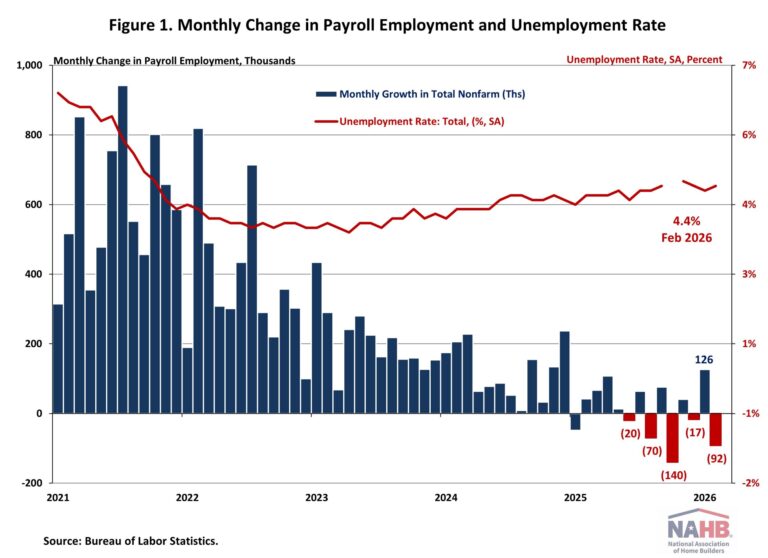
According to the Employment Situation Summary reported by the Bureau of Labor Statistics (BLS), total nonfarm payroll employment fell by 92,000 in February, following a downwardly revised gain of 126,000 jobs in January. This marks the sixth monthly decline since January 2025 and the second-largest monthly job loss during that period.

Estimates for the previous two months were revised lower. The monthly change in total nonfarm payroll employment for December was revised down by 65,000 from +48,000 to -17,000, while the change for January was revised down by 4,000 from +130,000 to +126,000. Combined, these revisions reduced previously reported employment by 69,000 jobs.

The unemployment rate ticked up to 4.4% in February from 4.3% in January. Over the month, the number of persons unemployed rose by 203,000, while the number of persons employed declined by 185,000.

Meanwhile, the labor force participation rate—the proportion of the population either looking for a job or already holding a job—declined 0.1 percentage points to 62.0%. This was the lowest rate since January 2022 and remains below its pre-pandemic level of 63.3% recorded at the beginning of 2020. Among prime working-age individuals (aged 25 to 54), the participation rate decreased to 83.9%.

Health care, which has been the primary growth driver of payroll growth in recent months, lost 28,000 jobs in February, largely due to a strike at Kaiser Permanente during the BLS survey period. Employment in the information sector also trended down, shredding 11,000 jobs, while federal government cut another 10,000 jobs.  Meanwhile, the social assistance sector added 9,000 jobs, driven by gains in individual and family services (+12,000).

Construction Employment

Employment in the overall construction sector declined by 11,000 jobs in February, following an upwardly revised gain of 48,000 in January. Within the industry, residential construction shed 7,100 jobs, while non-residential construction lost 3,800 positions.

Residential construction employment now stands at 3.3 million in February, including 929,000 workers employed by builders and remodelers and nearly 2.4 million residential specialty trade contractors.

The six-month moving average of job gains for residential construction remains negative, at a loss of 533 per month, reflecting losses in three of the past six months. Over the last 12 months, residential construction has seen a net loss of 46,100 jobs, marking the twelfth consecutive annual decline and the longest stretch of annual losses since the Great Recession. Since the low point following the Great Recession, residential construction has gained 1,306,900 positions.

In February, the unemployment rate for construction workers edged down slightly to 4.6% on a seasonally adjusted basis, remaining relatively low compared with historical norms.


This article was originally published by a eyeonhousing.org . Read the Original article here. .

The long-delayed September jobs report revealed that the U.S. economy added 119,000 jobs while the unemployment rate climbed to its highest level in nearly four years. Combined with downward revisions to previous months, this month’s data indicates a slowing of the U.S. labor market, though one that is still expanding. With the October jobs report cancelled due to the government shutdown and November’s report not scheduled for release until December 16, this September report now stands as the Federal Reserve’s final look at labor market conditions before its December meeting.

In September, wages grew at a 3.8% pace year over year, matching August’s increase. Wage growth has been outpacing inflation for nearly two years, which typically occurs as productivity increases.

National Employment

The September jobs report was delayed by more than six weeks due to the federal government shutdown. According to the long-awaited Employment Situation Summary reported by the Bureau of Labor Statistics (BLS), total nonfarm payroll employment rose by 119,000 in September, following a downwardly revised loss of 4,000 jobs in August. August’s growth was revised down by 26,000, from an initial estimate of +22,000 to -4,000, marking the second month of negative job growth since January 2010. July’s job growth was revised down by 7,000, from +79,000 to +72,000. Combined, the revisions erased 33,000 jobs from previously reported figures.

Through September, monthly job growth in 2025 has averaged 76,000, a significant slowdown compared to the 168,000 monthly average gain for 2024.

The unemployment rate rose to 4.4% in September, its highest level in nearly four years. The number of persons unemployed rose by 219,000 and the number of persons employed increased by 251,000.

Meanwhile, the labor force participation rate—the proportion of the population either looking for a job or already holding a job—edged up by 0.1 percentage points to 62.4%. This remains below its pre-pandemic level of 63.3% recorded at the beginning of 2020. Among prime working-age individuals (aged 25 to 54), the participation rate remained steady at 83.7%, the highest level since October 2024.

In September, employment gains were seen in health care (+43,000), food services and drinking places (+37,000), and social assistance (+14,000), while the transportation and warehousing sector and the federal government experienced job losses. Federal government employment fell by 3,000 positions in September and has now shed a total of 97,000 positions since peaking in January 2025. The BLS notes that “employees on paid leave or receiving ongoing severance pay are counted as employed in the establishment survey.”

Construction Employment

Employment in the overall construction sector increased by 19,000 in September, after three consecutive months of job losses. Within the industry, residential construction added 3,100 jobs, while non-residential construction gained 16,300 positions.

Residential construction employment now stands at 3.3 million in September, including 954,000 workers employed by builders and remodelers and 2.4 million residential specialty trade contractors.

The six-month moving average of job gains for residential construction remains negative at -3,767 per month, reflecting losses in four of the past six months for May through August 2025. Over the last 12 months, residential construction has seen a net loss of 44,900 jobs, marking the fifth consecutive annual decline since September 2020. Since the low point following the Great Recession, residential construction has gained 1,340,000 positions.

In September, the unemployment rate for construction workers jumped to 5.1% on a seasonally adjusted basis. The unemployment rate for construction workers has remained at a relatively lower level, after reaching 15.3% in April 2020 due to the housing demand impact of the COVID-19 pandemic.


This article was originally published by a eyeonhousing.org . Read the Original article here. .

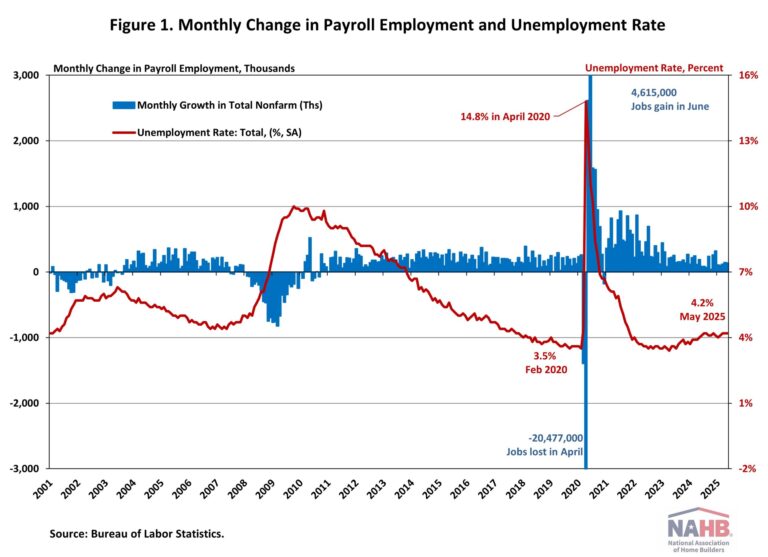
Despite ongoing economic and policy uncertainty, the labor market remains resilient, though early signs of softening are beginning to emerge. Job growth moderated in May, and employment figures for March and April were notably revised downward. The unemployment rate remained at 4.2%.

In May, wage growth remained unchanged. Year-over-year, wages grew at a 3.9% rate. Wage growth has been outpacing inflation for nearly two years, which typically occurs as productivity increases.

National Employment

According to the Employment Situation Summary reported by the Bureau of Labor Statistics (BLS), total nonfarm payroll employment rose by 139,000 in May, following a downwardly revised increase of 147,000 jobs in April. Since January 2021, the U.S. job market has added jobs for 53 consecutive months, making it the third-longest period of employment expansion on record. Monthly employment growth has averaged 124,000 per month in 2025, compared with the 168,000 monthly average gain for 2024.

The estimates for the previous two months were revised down. The monthly change in total nonfarm payroll employment for March was revised down by 65,000 from +185,000 to +120,000, while the change for April was revised down by 30,000 from +177,000 to +147,000. Combined, the revisions were 95,000 lower than previously reported.

The unemployment rate remained unchanged at 4.2% in May. Despite this stability, the overall labor force shrank with notable shifts. The number of employed persons decreased by 696,000, while the number of unemployed persons increased by 71,000.

Meanwhile, the labor force participation rate—the proportion of the population either looking for a job or already holding a job—decreased two percentage points to 62.4%. The overall labor force participation rate remains below its pre-pandemic levels of 63.3% at the beginning of 2020. Among individuals aged 25 to 54, the participation rate declined two percentage points to 83.4%. The rate for the prime working-age group (25 to 54) has been trending downward since peaking at 83.9% last summer.

In May, industries like health care (+62,000), leisure and hospitality (+48,000), and social assistance (+16,000) continued to see gains. Meanwhile, federal government lost 22,000 jobs in May and has shed 59,000 jobs since January 2025, reflecting the effects of government cutbacks. The BLS notes that “employees on paid leave or receiving ongoing severance pay are counted as employed in the establishment survey.”

Construction Employment

Employment in the overall construction sector rose by 4,000 in May, following a downwardly revised gain of 7,000 in April. While residential construction lost 7,400 jobs, non-residential construction employment added 11,300 jobs during the month.

Residential construction employment now stands at 3.3 million in May, broken down as 963,000 builders and 2.4 million residential specialty trade contractors. The six-month moving average of job gains for residential construction was -2,617 a month, reflecting job losses recorded in three of the past six months, specifically in January, March, and May of 2025. Over the last 12 months, home builders and remodelers experienced a net loss of 1,000 jobs, marking the first annual decline since September 2020. Since the low point following the Great Recession, residential construction has gained 1,360,600 positions.

In May, the unemployment rate for construction workers declined to 3.8% on a seasonally adjusted basis. The unemployment rate for construction workers has remained at a relatively lower level, after reaching 15.3% in April 2020 due to the housing demand impact of the COVID-19 pandemic.

Discover more from Eye On Housing

Subscribe to get the latest posts sent to your email.


This article was originally published by a eyeonhousing.org . Read the Original article here. .


Consistent with soft sentiment data, the count of job openings for the overall economy and construction fell in March as employers slowed hiring plans amid a broader economic slowdown, per the March Bureau of Labor Statistics Job Openings and Labor Turnover Survey (JOLTS).

The number of open jobs for the overall economy declined from 7.48 million in February to 7.19 million in March. This is notably smaller than the 8.09 million estimate reported a year ago and reflects a softened aggregate labor market. Previous NAHB analysis indicated that this number had to fall below 8 million on a sustained basis for the Federal Reserve move on interest rate reductions. With estimates remaining below 8 million for national job openings, the Fed, in theory, should be able to cut further despite a recent pause. However, tariff proposals may keep the Fed on pause in the coming quarters.

The number of open construction sector jobs fell from a revised 286,000 in February to 248,000 in March. This nonetheless marks a significant reduction of open, unfilled construction jobs than that registered a year ago (338,000) due to a slowing of construction activity. The chart below notes the recent decline for the construction job openings rate, which is now back to 2019 levels.

The construction job openings rate moved lower to 2.9% in March, significantly down year-over-year from 4%.

The layoff rate in construction stayed low (1.7%) in March. The quits rate declined to 1.8% in March.

Discover more from Eye On Housing

Subscribe to get the latest posts sent to your email.


This article was originally published by a eyeonhousing.org . Read the Original article here. .

The U.S. job market unexpectedly accelerated in March, while the figures for January and February were revised downward substantially. The unemployment rate ticked up slightly to 4.2% in March, from 4.1% the previous month. This month’s jobs report highlights the continued resilience of the labor market despite sticky inflation, a drop in consumer confidence, mass federal government layoffs, and growing economic uncertainty.

Noticeably, residential construction employment has shown signs of weakness in recent months. In March, the six-month moving average of job gains for residential construction turned negative for the first time since August 2020. It reflects three significant drops in employment: 8,400 jobs in October 2024, 6,700 jobs in January 2025, and 9,800 jobs in March 2025. Additionally, the construction job openings rate has returned to 2019 levels, driven by a slowdown in construction activity.

In March, wage growth slowed. Year-over-year, wages grew at a 3.8% rate, down 0.3 percentage points from a year ago. Wage growth has been outpacing inflation for nearly two years, which typically occurs as productivity increases.

National Employment

According to the Employment Situation Summary reported by the Bureau of Labor Statistics (BLS), total nonfarm payroll employment rose by 228,000 in March, following a downwardly revised increase of 117,000 jobs in February. Since January 2021, the U.S. job market has added jobs for 51 consecutive months, making it the third-longest period of employment expansion on record.

The estimates for the previous two months were revised down. The monthly change in total nonfarm payroll employment for January was revised down by 14,000 from +125,000 to +111,000, while the change for February was revised down by 34,000 from +151,000 to +117,000. Combined, the revisions were 48,000 lower than previously reported.

The unemployment rate rose to 4.2% in March. While the number of employed persons increased by 201,000, the number of unemployed persons increased by 31,000.

Meanwhile, the labor force participation rate—the proportion of the population either looking for a job or already holding a job—rose one percentage point to 62.5%. For people aged between 25 and 54, the participation rate decreased two percentage points to 83.3%. While the overall labor force participation rate remains below its pre-pandemic levels of 63.3% at the beginning of 2020, the rate for people aged between 25 and 54 has been trending down since it peaked at 83.9% last summer.

In March, employment rose in health care (+54,000), social assistance (+24,000), and transportation and warehousing (+23,000). Employment in retail trade also added 24,000 jobs in March, partially reflecting the return of workers from a strike. However, within the government sector, federal government employment saw a decline of 4,000, following a loss of 11,000 jobs in February. The BLS notes that “employees on paid leave or receiving ongoing severance pay are counted as employed in the establishment survey.”

Construction Employment

Employment in the overall construction sector increased by 13,000 in March, following a gain of 14,000 in February. While residential construction saw a decline of 9,800 jobs, non-residential construction employment added 22,300 jobs for the month.

Residential construction employment now stands at 3.4 million in March, broken down as 958,000 builders and 2.4 million residential specialty trade contractors. The six-month moving average of job gains for residential construction was -2,883 a month, mainly reflecting the three months’ job loss over the past six months (October 2024, January 2025 and March 2025). Over the last 12 months, home builders and remodelers added 14,000 jobs on a net basis. Since the low point following the Great Recession, residential construction has gained 1,367,600 positions.

In March, the unemployment rate for construction workers declined to 4.3% on a seasonally adjusted basis. The unemployment rate for construction workers has remained at a relatively lower level, after reaching 15.3% in April 2020 due to the housing demand impact of the COVID-19 pandemic.

Discover more from Eye On Housing

Subscribe to get the latest posts sent to your email.


This article was originally published by a eyeonhousing.org . Read the Original article here. .
Pin It