Tag

Economy

Browsing


The U.S. labor market continued to show resilience in April, with job growth persisting despite elevated interest rates and rising geopolitical uncertainty related to the Iran conflict. The unemployment rate held steady at 4.3%. Hiring gains were concentrated in health care, transportation and warehousing, and retail trade, underscoring continued strength in service-oriented sectors.

Wage growth accelerated modestly in April, with average hourly earnings rising 3.6% year-over-year. This pace is 0.3 percentage points lower than a year ago. Importantly, wage growth has been outpacing inflation for nearly two years, which typically occurs as productivity increases.

National Employment

According to the Employment Situation Summary reported by the Bureau of Labor Statistics (BLS), total nonfarm payroll employment increased by 115,000 in April, following an upwardly revised gain of 185,000 jobs in March. Revisions to prior months were modest overall. The monthly change in total nonfarm payroll employment for February was revised down by 23,000 from -133,000 to -156,000, while the change for March was revised up by 7,000 from +178,000 to +185,000. Combined, these revisions reduced previously reported employment by 16,000 jobs.

Job growth in early 2026 remains well below 2024 levels but stronger than the weak pace recorded in 2025. Through April, monthly payroll gains have averaged 76,000, compared with 10,000 per month in 2025 and 122,000 in 2024.

The unemployment rate remained unchanged at 4.3% in April. Over the month, the number of persons unemployed rose by 134,000, while the number of persons employed declined by 226,000.

Meanwhile, the labor force participation rate—the proportion of the population either looking for a job or already holding a job—declined 0.1 percentage points to 61.8%. This marks the lowest level since November 2021 and remains below its pre-pandemic level of 63.3% recorded at the beginning of 2020. Among prime working-age individuals (aged 25 to 54), the participation rate held steady at 83.8%.

In April, job gains occurred in health care (+37,000), transportation and warehousing (+30,000), and retail trade (+22,000), while federal government employment continued to decline. Since reaching a peak in October 2024, federal government employment has fallen by 348,000 jobs, or 11.5%.

Construction Employment

Employment in the overall construction sector rose by 9,000 jobs in April, following a downwardly revised gain of 16,000 in March. Within the industry, residential construction shed 10,400 jobs, while non-residential construction added 19,000 jobs.

Residential construction employment now stands at 3.3 million in April, including 927,000 workers employed by builders and remodelers and nearly 2.4 million residential specialty trade contractors.

The six-month moving average of job gains for residential construction remains negative, reflecting an average monthly loss of 2,333 jobs and declines in three of the past six months. However, over the last 12 months, residential construction has shed a net of 49,200 jobs, marking the fourteenth consecutive annual decline and the longest stretch of annual losses since the Great Recession. Despite these declines, residential construction has gained 1,297,100 positions from its post-Great Recession low.

Meanwhile, the unemployment rate for construction workers declined to 3.7% in April on a seasonally adjusted basis, remaining relatively low compared with historical norms.


This article was originally published by a eyeonhousing.org . Read the Original article here. .


Real GDP growth accelerated in the first quarter of 2026, rebounding from a weak finish at the end of 2025, as government spending recovered following a disruptive shutdown. First-quarter growth was also supported by strong gains in business investment in equipment, driven by an artificial intelligence spending boom and rapid data center construction. Meanwhile, consumer spending showed signs of softening as elevated inflation continued to weigh on household purchasing power.

According to the “advance” estimate released by the Bureau of Economic Analysis (BEA), real gross domestic product (GDP) expanded at an annual rate of 2.0% in the first quarter, up from a 0.5% increase in the fourth quarter of 2025. This growth rate came in slightly above the NAHB forecast for the quarter (1.8%).

However, the latest data from the GDP report indicates that inflationary pressures remained elevated. The price index for gross domestic purchases rose 3.6% in the first quarter, compared with an increase of 3.7% in the fourth quarter of 2025. The Personal Consumption Expenditures (PCE) Price Index, which measures inflation (or deflation) across various consumer expenses and reflects changes in consumer behavior, accelerated to 4.5%. This is higher than a 2.9% rise in the previous quarter.

Breaking down the first-quarter data further, the acceleration in real GDP primarily reflected increases in government spending, exports, and business investment, which were partially offset by a slowdown in consumer spending. Imports, which are a subtraction in the calculation of GDP, increased during the quarter.

Consumer spending, the backbone of the U.S. economy, rose at an annual rate of 1.6% in the first quarter, the slowest pace since the first quarter of 2025. Within this category, spending on services grew at a 2.4% annual rate, while spending on goods edged down 0.1%.

Gross private domestic investment contributed 1.48 percentage points to headline GDP growth, led by robust gains in equipment and intellectual property products, alongside a buildup in private inventories. These increases were partially offset by declines in both residential and nonresidential structures.

Nonresidential fixed investment rose sharply, increasing 10.4% in the first quarter. Strong gains in equipment (+17.2%) and intellectual property products (+13.0%) offset a decrease in structures (-6.7%). Meanwhile, residential fixed investment (RFI) declined 8.0% in the first quarter, marking the fifth consecutive quarterly decline. Within the residential category, single-family permanent site structures fell 8.0% at an annual rate, multifamily permanent site structures posted a modest 1.9% increase, and spending on home improvements dropped 4.6%.

Government spending provided a notable boost to growth, largely due to an increase in federal nondefense expenditures following the prior quarter’s disruptions. 

Trade activity also strengthened, with both exports and imports increasing. The increase was primarily driven by the goods trade, particularly in computers, peripherals, and related components. 

For the common BEA terms and definitions, please access bea.gov/Help/Glossary.


This article was originally published by a eyeonhousing.org . Read the Original article here. .
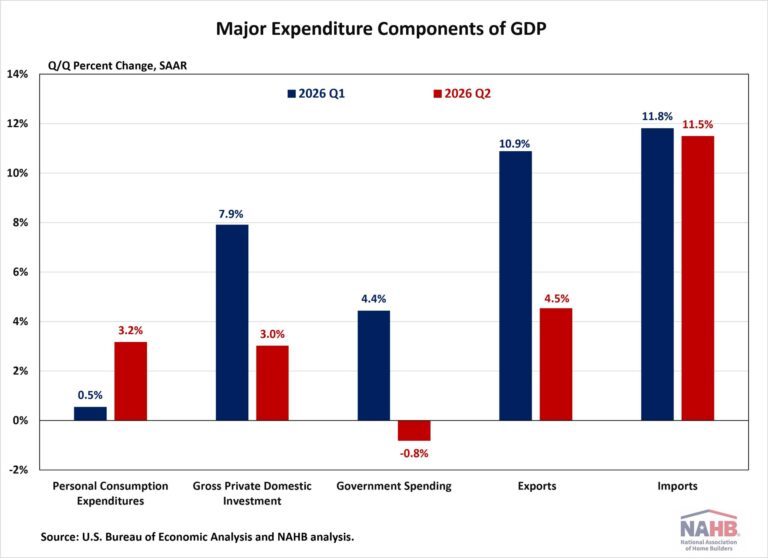

The U.S. labor market weakened in February, as payroll employment declined and the unemployment rate rose to 4.4%. The cooling labor market could place the Federal Reserve in a challenging position as policymakers weigh slower job growth against inflation pressures from rising oil prices.

Wage growth accelerated slightly in February, with average hourly earnings rising 3.8% year-over-year. This pace is 0.3 percentage points lower than a year ago. Importantly, wage growth has been outpacing inflation for nearly two years, which typically occurs as productivity increases.

National Employment

According to the Employment Situation Summary reported by the Bureau of Labor Statistics (BLS), total nonfarm payroll employment fell by 92,000 in February, following a downwardly revised gain of 126,000 jobs in January. This marks the sixth monthly decline since January 2025 and the second-largest monthly job loss during that period.

Estimates for the previous two months were revised lower. The monthly change in total nonfarm payroll employment for December was revised down by 65,000 from +48,000 to -17,000, while the change for January was revised down by 4,000 from +130,000 to +126,000. Combined, these revisions reduced previously reported employment by 69,000 jobs.

The unemployment rate ticked up to 4.4% in February from 4.3% in January. Over the month, the number of persons unemployed rose by 203,000, while the number of persons employed declined by 185,000.

Meanwhile, the labor force participation rate—the proportion of the population either looking for a job or already holding a job—declined 0.1 percentage points to 62.0%. This was the lowest rate since January 2022 and remains below its pre-pandemic level of 63.3% recorded at the beginning of 2020. Among prime working-age individuals (aged 25 to 54), the participation rate decreased to 83.9%.

Health care, which has been the primary growth driver of payroll growth in recent months, lost 28,000 jobs in February, largely due to a strike at Kaiser Permanente during the BLS survey period. Employment in the information sector also trended down, shredding 11,000 jobs, while federal government cut another 10,000 jobs.  Meanwhile, the social assistance sector added 9,000 jobs, driven by gains in individual and family services (+12,000).

Construction Employment

Employment in the overall construction sector declined by 11,000 jobs in February, following an upwardly revised gain of 48,000 in January. Within the industry, residential construction shed 7,100 jobs, while non-residential construction lost 3,800 positions.

Residential construction employment now stands at 3.3 million in February, including 929,000 workers employed by builders and remodelers and nearly 2.4 million residential specialty trade contractors.

The six-month moving average of job gains for residential construction remains negative, at a loss of 533 per month, reflecting losses in three of the past six months. Over the last 12 months, residential construction has seen a net loss of 46,100 jobs, marking the twelfth consecutive annual decline and the longest stretch of annual losses since the Great Recession. Since the low point following the Great Recession, residential construction has gained 1,306,900 positions.

In February, the unemployment rate for construction workers edged down slightly to 4.6% on a seasonally adjusted basis, remaining relatively low compared with historical norms.


This article was originally published by a eyeonhousing.org . Read the Original article here. .
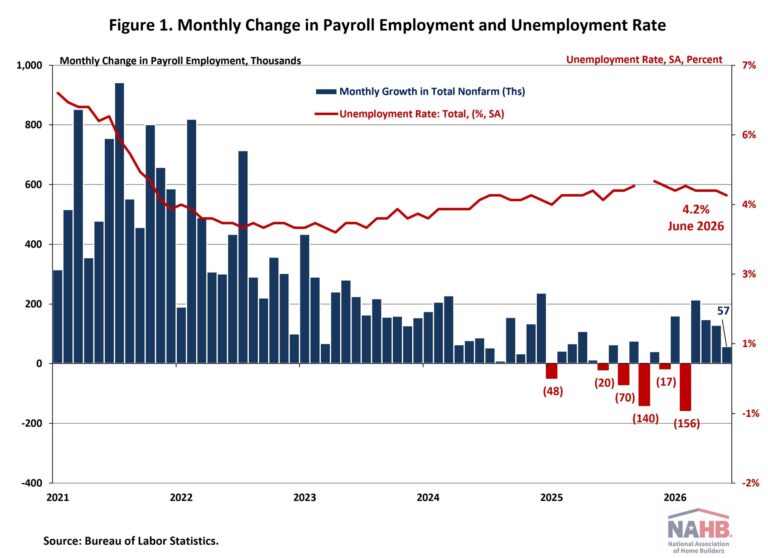

Real GDP growth slowed sharply in the fourth quarter of 2025 as the historic government shutdown weighed on economic activity. While consumer spending continued to drive growth, federal government spending subtracted over a full percentage point from overall growth.

According to the “advance” estimate released by the Bureau of Economic Analysis (BEA), real gross domestic product (GDP) expanded at an annual rate of 1.4% in the final quarter of 2025, a notable deceleration from a 4.4% increase in the third quarter. This growth rate was below the NAHB forecast for the quarter.

Furthermore, the latest data from the GDP report indicates that inflationary pressures intensified over the quarter. The price index for gross domestic purchases rose 3.7%, up from a 3.4% increase in the third quarter of 2025. The Personal Consumption Expenditures Price (PCE) Index, which measures inflation (or deflation) across various consumer expenses and reflects changes in consumer behavior, increased 2.9% in the fourth quarter. This is slightly higher than a 2.8% rise in the previous quarter.

For the full year, real GDP grew 2.2% in 2025. It marks a slowdown from the 2.8% increase in 2024 and stands as the weakest annual growth rate since the pandemic. The annual gain matched NAHB’s forecast and primarily reflected continued strength in consumer spending and gains in investment.

Breaking down the fourth-quarter data further, the increase in real GDP primarily reflected increases in consumer spending and investment, partially offset by decreases in government spending and exports. Imports, which are a subtraction in the calculation of GDP, decreased during the quarter as tariffs had measurable effects.

Consumer spending, the backbone of the U.S. economy, rose at an annual rate of 2.4% in the fourth quarter, the slowest pace since the first quarter of 2025. Spending on services remained solid, increasing at a 3.4% annual rate, while spending on goods edged down 0.1%.

Gross private domestic investment added 0.66 percentage points to headline GDP growth in the fourth quarter. The gain in investment was primarily driven by increases in intellectual property products, private inventory investment, and equipment spending.

Government spending fell, reflecting the effects of a prolonged federal government shutdown. 

Nonresidential fixed investment increased 3.7% in the fourth quarter. The increases in equipment (+3.2%) and intellectual property products (+7.4%) offset the decrease in structures (-2.4%). Meanwhile, residential fixed investment (RFI) declined 1.6% in the fourth quarter, marking the fourth consecutive quarterly decline. Within the residential category, single-family permanent site structures fell 5.2% at an annual rate, multifamily permanent site structures declined 3.6%, and spending on home improvements dropped 3.2%.

For the common BEA terms and definitions, please access bea.gov/Help/Glossary.


This article was originally published by a eyeonhousing.org . Read the Original article here. .
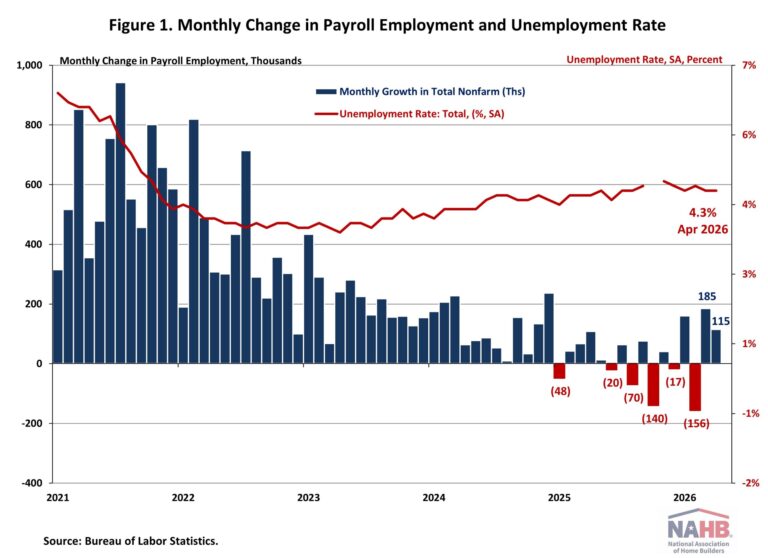

Real GDP growth rebounded in the second quarter, driven by a turnaround in the trade balance and stronger consumer spending.

According to the “advance” estimate released by the Bureau of Economic Analysis (BEA), real gross domestic product (GDP) expanded at an annual rate of 3.0% in the second quarter of 2025, following a 0.5% contraction in the first quarter.

The latest data from the GDP report suggests that inflationary pressures are easing. The GDP price index rose 2.0% for the second quarter, down from a 3.8% increase in the first quarter of 2025. The Personal Consumption Expenditures Price (PCE) Index, which measures inflation (or deflation) across various consumer expenses and reflects changes in consumer behavior, rose 2.1% in the second quarter. This is down from a 3.7% increase in the first quarter of 2025.

This quarter’s increase in real GDP primarily reflected a decrease in imports, which are a subtraction in the calculation of GDP, and increases in consumer spending.

Consumer spending, the backbone of the U.S. economy, rose at an annual rate of 1.4% in the second quarter, up from 0.5% in the first quarter but well below the 2.8% pace recorded a year earlier. Both goods and services contributed to the gain, with goods spending rising at a 2.2% annual rate and spending on services increasing at a 1.1% annual rate.

A steep drop in imports also provided a significant boost to GDP, as imports are subtracted in GDP calculations. Imports fell 30.3% in the second quarter, a sharp reversal from the 37.9% surge in the first quarter.

Nonresidential fixed investment increased 1.9% in the second quarter. The increases in equipment (+4.8%) and intellectual property products (+6.4%) offset the decrease in structures (-10.3%). Meanwhile, residential fixed investment (RFI) declined 4.6% in the second quarter, following a 1.3% decline in the previous quarter. Within the residential category, single-family structures fell 12.6% at an annual rate, multifamily structures declined 1.3%, and improvements rose 4.2%.

For the common BEA terms and definitions, please access bea.gov/Help/Glossary.

Discover more from Eye On Housing

Subscribe to get the latest posts sent to your email.


This article was originally published by a eyeonhousing.org . Read the Original article here. .


Despite ongoing economic and policy uncertainty, the labor market remains resilient, though early signs of softening are beginning to emerge. Job growth moderated in May, and employment figures for March and April were notably revised downward. The unemployment rate remained at 4.2%.

In May, wage growth remained unchanged. Year-over-year, wages grew at a 3.9% rate. Wage growth has been outpacing inflation for nearly two years, which typically occurs as productivity increases.

National Employment

According to the Employment Situation Summary reported by the Bureau of Labor Statistics (BLS), total nonfarm payroll employment rose by 139,000 in May, following a downwardly revised increase of 147,000 jobs in April. Since January 2021, the U.S. job market has added jobs for 53 consecutive months, making it the third-longest period of employment expansion on record. Monthly employment growth has averaged 124,000 per month in 2025, compared with the 168,000 monthly average gain for 2024.

The estimates for the previous two months were revised down. The monthly change in total nonfarm payroll employment for March was revised down by 65,000 from +185,000 to +120,000, while the change for April was revised down by 30,000 from +177,000 to +147,000. Combined, the revisions were 95,000 lower than previously reported.

The unemployment rate remained unchanged at 4.2% in May. Despite this stability, the overall labor force shrank with notable shifts. The number of employed persons decreased by 696,000, while the number of unemployed persons increased by 71,000.

Meanwhile, the labor force participation rate—the proportion of the population either looking for a job or already holding a job—decreased two percentage points to 62.4%. The overall labor force participation rate remains below its pre-pandemic levels of 63.3% at the beginning of 2020. Among individuals aged 25 to 54, the participation rate declined two percentage points to 83.4%. The rate for the prime working-age group (25 to 54) has been trending downward since peaking at 83.9% last summer.

In May, industries like health care (+62,000), leisure and hospitality (+48,000), and social assistance (+16,000) continued to see gains. Meanwhile, federal government lost 22,000 jobs in May and has shed 59,000 jobs since January 2025, reflecting the effects of government cutbacks. The BLS notes that “employees on paid leave or receiving ongoing severance pay are counted as employed in the establishment survey.”

Construction Employment

Employment in the overall construction sector rose by 4,000 in May, following a downwardly revised gain of 7,000 in April. While residential construction lost 7,400 jobs, non-residential construction employment added 11,300 jobs during the month.

Residential construction employment now stands at 3.3 million in May, broken down as 963,000 builders and 2.4 million residential specialty trade contractors. The six-month moving average of job gains for residential construction was -2,617 a month, reflecting job losses recorded in three of the past six months, specifically in January, March, and May of 2025. Over the last 12 months, home builders and remodelers experienced a net loss of 1,000 jobs, marking the first annual decline since September 2020. Since the low point following the Great Recession, residential construction has gained 1,360,600 positions.

In May, the unemployment rate for construction workers declined to 3.8% on a seasonally adjusted basis. The unemployment rate for construction workers has remained at a relatively lower level, after reaching 15.3% in April 2020 due to the housing demand impact of the COVID-19 pandemic.

Discover more from Eye On Housing

Subscribe to get the latest posts sent to your email.


This article was originally published by a eyeonhousing.org . Read the Original article here. .
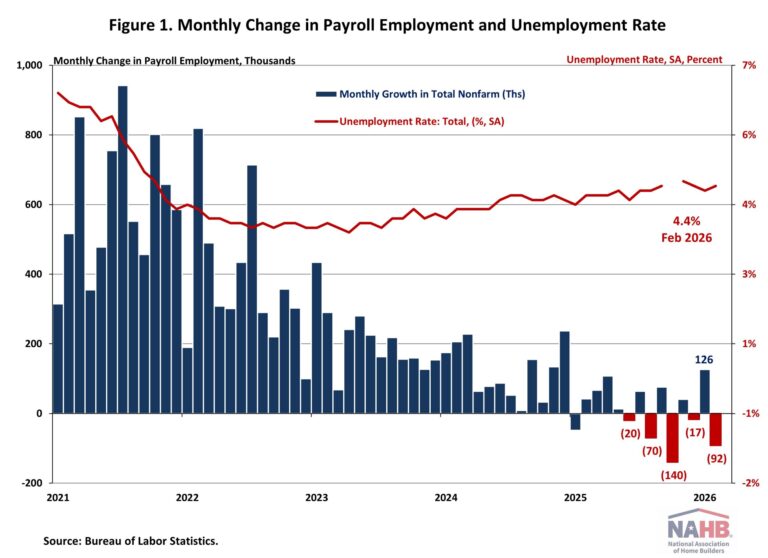

Housing’s share of the economy grew to 16.4% in the first quarter of 2025, according to the advance estimate of GDP produced by the Bureau of Economic Analysis. This is the highest reading since the third quarter of 2022 and is up 0.2 percentage points from the fourth quarter of 2024.

The more cyclical home building and remodeling component – residential fixed investment (RFI) – was 4.1% of GDP, up from 4.0% in the previous quarter. The second component – housing services – was 12.3% of GDP, up from 12.2% in the previous quarter. The graph below stacks the nominal shares for housing services and RFI, resulting in housing’s total share of the economy.

Housing service growth is much less volatile when compared to RFI due to the cyclical nature of RFI. Historically, RFI has averaged roughly 5% of GDP, while housing services have averaged between 12% and 13%, for a combined 17% to 18% of GDP. These shares tend to vary over the business cycle. However, the housing share of GDP lagged during the post-Great Recession period due to underbuilding, particularly for the single-family sector.

In the first quarter, RFI added 5 basis points to the headline GDP growth rate, marking the second straight quarter of positive contributions. RFI was 4.1% of the economy, recording a $1.216 trillion seasonally adjusted annual pace. Among the two segments of RFI, residential structures rose 1.2% while residential equipment rose 5.5%.

Breaking down the components of residential structures, single-family structure RFI grew 5.9%, while multifamily investment fell 11.5%. RFI for multifamily structures has contracted for seven consecutive quarters. Permanent site structure RFI, which is made up of single-family and multifamily RFI, grew 1.2%.  Other structures RFI rose 0.6% in the first quarter, down from 11.4% the previous period.

The second impact of housing on GDP is the measure of housing services. Similar to the RFI, housing services consumption can be broken out into two components. The first component, housing, includes gross rents paid by renters, owners’ imputed rent (an estimate of how much it would cost to rent owner-occupied units), rental value of farm dwellings, and group housing. The inclusion of owners’ imputed rent is necessary from a national income accounting approach, because without this measure, increases in homeownership would result in declines in GDP. The second component, household utilities, is composed of consumption expenditures on water supply, sanitation, electricity, and gas.

For the first quarter, housing services represented 12.4% of the economy or $3.691 trillion on a seasonally adjusted annual basis. Housing services expenditures grew 3.4% at an annual rate in the first quarter and contributed 41 basis points to GDP growth. Real personal consumption expenditures for housing grew 1.3%, while household utilities expenditures grew 18.7%. Real personal expenditures for natural gas services grew 53.1% in the first quarter, as residential consumption of natural gas recorded its highest monthly level since January 2014, at 1.035 trillion cubic feet in January 2025. Through the first two months of 2025, residential households consumed 1.833 trillion cubic feet of natural gas, higher than the 1.582 trillion in 2024 and 1.498 trillion in 2023.

Discover more from Eye On Housing

Subscribe to get the latest posts sent to your email.


This article was originally published by a eyeonhousing.org . Read the Original article here. .
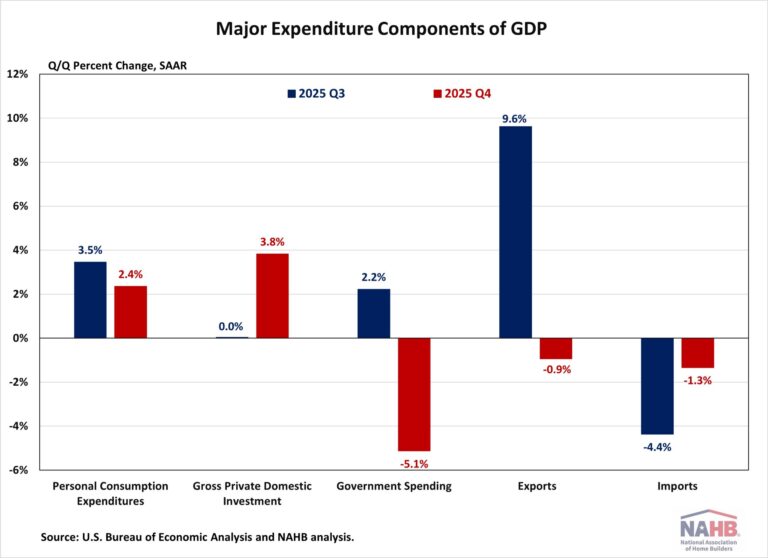

The U.S. economy contracted in the first quarter of 2025 for the first time in three years, driven by a sharp surge in pre-tariff imports, softening consumer spending, and a decline in government spending.

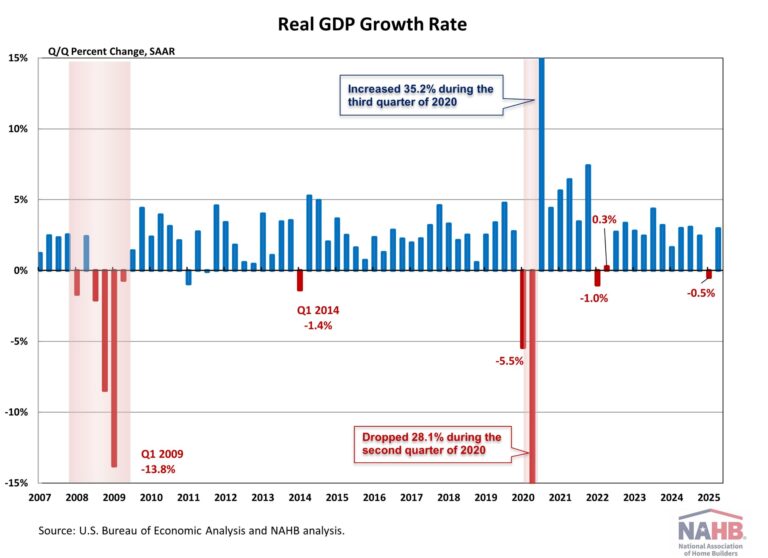
According to the “advance” estimate  released by the Bureau of Economic Analysis (BEA), real gross domestic product (GDP) decreased at an annual rate of 0.3% in the first quarter of 2025, following a 2.4% gain in the fourth quarter of 2024. This marks the first quarter of economic contraction since the first quarter of 2022. NAHB predicted a 0.2% increase for the first quarter of 2025.

Furthermore, the data from the GDP report suggests that inflationary pressure persisted. The GDP price index rose 3.4% for the first quarter, up from a 2.2% increase in the fourth quarter of 2024. The Personal Consumption Expenditures Price (PCE) Index, which measures inflation (or deflation) across various consumer expenses and reflects changes in consumer behavior, rose 3.6% in the first quarter. This is up from a 2.4% increase in the fourth quarter of 2024.

The contraction in real GDP primarily reflected a sharp increase in imports and a decrease in government spending.

Imports, which are a subtraction in the calculation of GDP, surged at an annualized rate of 41.3% in the first quarter, as businesses rushed to stockpile goods ahead of implementing tariffs. While goods imports spiked by 50.9%, services imports increased by 8.6%. The import surge contributed to a record-high trade deficit and subtracted more than five percentage points from the headline GDP figure.

Government spending decreased at an annual rate of 1.4% in the first quarter. Federal spending fell sharply by 5.1%, partially offset by a modest 0.8% increase in state and local government expenditures.

Consumer spending, a key driver of the economy, softened. It rose at an annual rate of 1.8%, the slowest pace in seven quarters. Spending on goods increased by 0.5%, while expenditure on services grew by 2.4%.

Private inventories were the largest contributor to the increase in gross private domestic investment.

Nonresidential fixed investment increased by 9.8%, with notable increases in equipment (+22.5%) and intellectual property products (+4.1%). Residential fixed investment posted a 1.3% gain, following a 5.5% increase in the previous quarter. Within residential categories, single-family structures rose 5.9%, improvements increased 3.6%, while multifamily structures fell 11.5%.

For the common BEA terms and definitions, please access bea.gov/Help/Glossary.

Discover more from Eye On Housing

Subscribe to get the latest posts sent to your email.


This article was originally published by a eyeonhousing.org . Read the Original article here. .

Consistent with soft sentiment data, the count of job openings for the overall economy and construction fell in March as employers slowed hiring plans amid a broader economic slowdown, per the March Bureau of Labor Statistics Job Openings and Labor Turnover Survey (JOLTS).

The number of open jobs for the overall economy declined from 7.48 million in February to 7.19 million in March. This is notably smaller than the 8.09 million estimate reported a year ago and reflects a softened aggregate labor market. Previous NAHB analysis indicated that this number had to fall below 8 million on a sustained basis for the Federal Reserve move on interest rate reductions. With estimates remaining below 8 million for national job openings, the Fed, in theory, should be able to cut further despite a recent pause. However, tariff proposals may keep the Fed on pause in the coming quarters.

The number of open construction sector jobs fell from a revised 286,000 in February to 248,000 in March. This nonetheless marks a significant reduction of open, unfilled construction jobs than that registered a year ago (338,000) due to a slowing of construction activity. The chart below notes the recent decline for the construction job openings rate, which is now back to 2019 levels.

The construction job openings rate moved lower to 2.9% in March, significantly down year-over-year from 4%.

The layoff rate in construction stayed low (1.7%) in March. The quits rate declined to 1.8% in March.

Discover more from Eye On Housing

Subscribe to get the latest posts sent to your email.


This article was originally published by a eyeonhousing.org . Read the Original article here. .
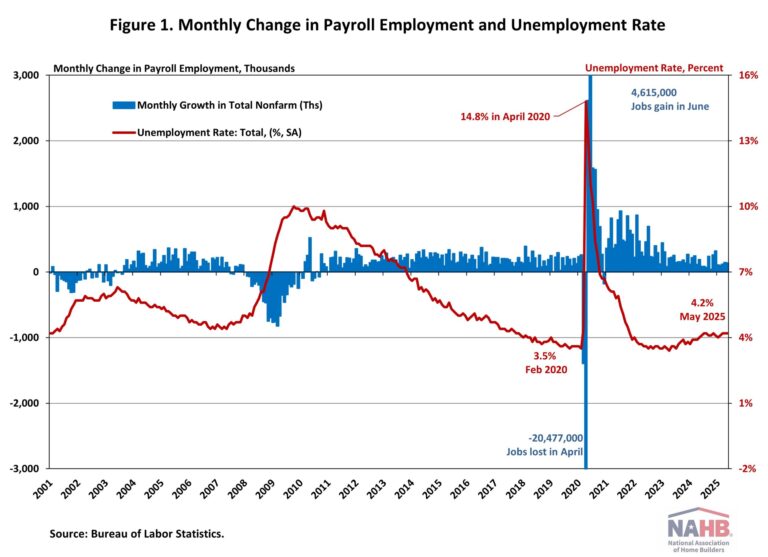

The U.S. job market unexpectedly accelerated in March, while the figures for January and February were revised downward substantially. The unemployment rate ticked up slightly to 4.2% in March, from 4.1% the previous month. This month’s jobs report highlights the continued resilience of the labor market despite sticky inflation, a drop in consumer confidence, mass federal government layoffs, and growing economic uncertainty.

Noticeably, residential construction employment has shown signs of weakness in recent months. In March, the six-month moving average of job gains for residential construction turned negative for the first time since August 2020. It reflects three significant drops in employment: 8,400 jobs in October 2024, 6,700 jobs in January 2025, and 9,800 jobs in March 2025. Additionally, the construction job openings rate has returned to 2019 levels, driven by a slowdown in construction activity.

In March, wage growth slowed. Year-over-year, wages grew at a 3.8% rate, down 0.3 percentage points from a year ago. Wage growth has been outpacing inflation for nearly two years, which typically occurs as productivity increases.

National Employment

According to the Employment Situation Summary reported by the Bureau of Labor Statistics (BLS), total nonfarm payroll employment rose by 228,000 in March, following a downwardly revised increase of 117,000 jobs in February. Since January 2021, the U.S. job market has added jobs for 51 consecutive months, making it the third-longest period of employment expansion on record.

The estimates for the previous two months were revised down. The monthly change in total nonfarm payroll employment for January was revised down by 14,000 from +125,000 to +111,000, while the change for February was revised down by 34,000 from +151,000 to +117,000. Combined, the revisions were 48,000 lower than previously reported.

The unemployment rate rose to 4.2% in March. While the number of employed persons increased by 201,000, the number of unemployed persons increased by 31,000.

Meanwhile, the labor force participation rate—the proportion of the population either looking for a job or already holding a job—rose one percentage point to 62.5%. For people aged between 25 and 54, the participation rate decreased two percentage points to 83.3%. While the overall labor force participation rate remains below its pre-pandemic levels of 63.3% at the beginning of 2020, the rate for people aged between 25 and 54 has been trending down since it peaked at 83.9% last summer.

In March, employment rose in health care (+54,000), social assistance (+24,000), and transportation and warehousing (+23,000). Employment in retail trade also added 24,000 jobs in March, partially reflecting the return of workers from a strike. However, within the government sector, federal government employment saw a decline of 4,000, following a loss of 11,000 jobs in February. The BLS notes that “employees on paid leave or receiving ongoing severance pay are counted as employed in the establishment survey.”

Construction Employment

Employment in the overall construction sector increased by 13,000 in March, following a gain of 14,000 in February. While residential construction saw a decline of 9,800 jobs, non-residential construction employment added 22,300 jobs for the month.

Residential construction employment now stands at 3.4 million in March, broken down as 958,000 builders and 2.4 million residential specialty trade contractors. The six-month moving average of job gains for residential construction was -2,883 a month, mainly reflecting the three months’ job loss over the past six months (October 2024, January 2025 and March 2025). Over the last 12 months, home builders and remodelers added 14,000 jobs on a net basis. Since the low point following the Great Recession, residential construction has gained 1,367,600 positions.

In March, the unemployment rate for construction workers declined to 4.3% on a seasonally adjusted basis. The unemployment rate for construction workers has remained at a relatively lower level, after reaching 15.3% in April 2020 due to the housing demand impact of the COVID-19 pandemic.

Discover more from Eye On Housing

Subscribe to get the latest posts sent to your email.


This article was originally published by a eyeonhousing.org . Read the Original article here. .
Pin It