Tag

April

Browsing


Elevated mortgage rates, higher inflation and economic uncertainty kept more buyers on the sidelines in April as ongoing affordability challenges continue.

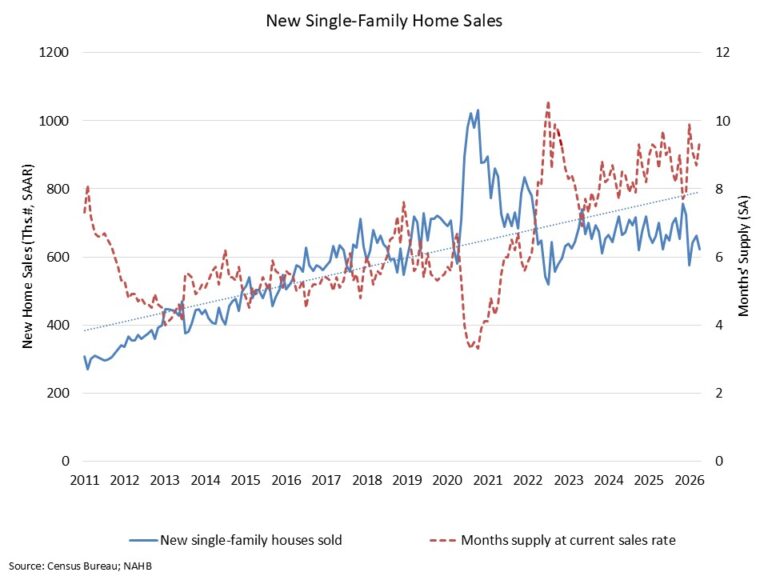
Sales of newly built single-family homes fell 6.2% in April to a seasonally adjusted annual rate of 622,000, according to data from the U.S. Department of Housing and Urban Development and the U.S. Census Bureau. The pace of new home sales is down 11.3% from a year earlier.

Mortgage interest rates increased from a monthly average of 6.18% in March to 6.33% in April per Freddie Mac, dampening homebuyer demand. Rates moved higher again in May to just above 6.4% as oil prices and short-term inflation expectations increased.

New home sales are on track to decline in 2026 as mortgage rates are expected to remain elevated in the months ahead. The Midwest remains a bright spot, with sales up 7.3% year to date, compared with declines in the rest of the country. The Midwest benefits from relative advantages for homebuyer affordability.

A new home sale occurs when a sales contract is signed, or a deposit is accepted. The home can be in any stage of construction: not yet started, under construction or completed. In addition to adjusting for seasonal effects, the April reading of 622,000 units is the number of homes that would sell if this pace continued for the next 12 months.

New single-family home inventory in April rose to 489,000 units, up 1.7% compared to the previous month. This represents an elevated 9.4 months’ supply at the current building pace. Completed, ready-to-occupy inventory accounted for 122,000 homes in April, up 6.1% from a year ago but down from the cyclical peak of 128,000 in January.

The median new home sale price was $422,500, up 8.0% from March and up 2.2% from a year ago.

Regionally, on a year-to-date basis, new home sales are up 7.3% in the Midwest. New home sales are down 9.7% in the Northeast, 7.6% in the South and 9.5% in the West.


This article was originally published by a eyeonhousing.org . Read the Original article here. .

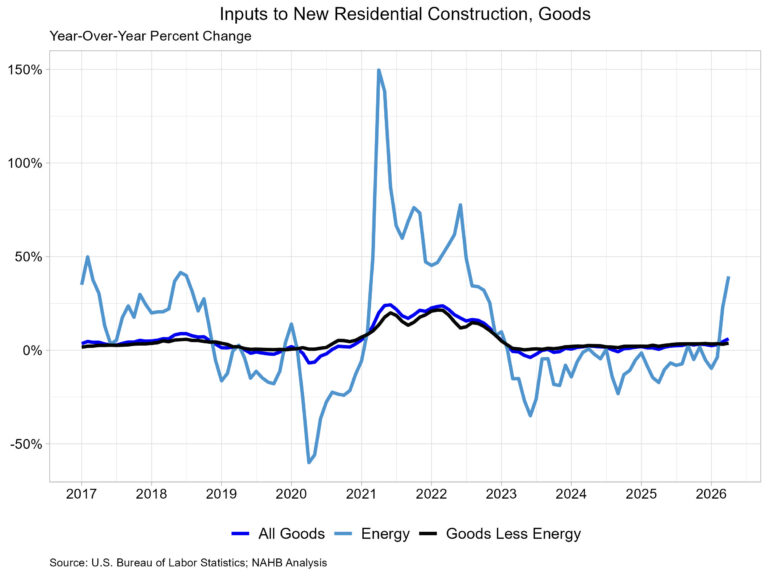
Prices rose across a host of goods and services used in residential construction. Rising energy prices were the primary driver, but transportation service prices also rose at their fastest pace since 2022. Meanwhile, building material prices, excluding energy, rose at their highest yearly rate in three years, up 3.7% from a year ago.

The Producer Price Index for final demand increased 1.4% in April, after rising 0.7% in March. Compared to a year ago, final demand prices were up 6.0%. The index for final demand services rose 1.2% in April, while the index for final demand goods rose 2.0% over the month.

The price index for inputs to new residential construction rose 1.3% in April and was up 5.9% from last year. The price of goods used in new residential construction was up 1.2% over the month and up 6.1% from last year, while the price of services was up 1.3% over the month and up 3.7% from last year.

Input Goods

The goods component has a larger importance to the inputs to residential construction price index, representing around 60% of the total. On a monthly basis, the price of input goods to new residential construction was up 1.2% in April.

The input goods to residential construction index can be further broken down into two separate components, one measuring energy inputs with the other measuring remaining goods. The latter of these two components simply represents building materials used in residential construction, which makes up around 93% of the goods index.

Energy input prices rose 13.8% in April and were 39.4% higher than a year ago. Building material prices were up 0.1% in April and up 3.7% compared to one year ago. Building material prices have continued to grow above 3.0% since July of last year.

Among input goods, the largest year-over-year increase was for No. 2 diesel fuel as prices were 74.4% higher than a year ago. Asphalt prices rose 18.0% higher than April 2025 after declining in March. Softwood lumber prices were up 1.1% in April after declining on a yearly basis for several months. Fewer materials showed yearly price declines than in March. Particleboard and fiberboard prices were down 12.0%, while softwood veneer/plywood prices were down 1.7%.

Input Services

Prices for service inputs to residential construction reported an increase of 1.3% in April. On a year-over-year basis, service input prices were up 5.6%. The price index for service inputs to residential construction can be broken out into three separate components: a trade services component, a transportation and warehousing services component, and a services excluding trade, transportation, and warehousing component (other services).

The most significant component is trade services (around 60%), followed by other services (around 29%), and finally transportation and warehousing services (around 11%). The largest component, trade services, was up 5.6% from a year ago. The price of transportation and warehousing services rose 15.3%, while prices for other services were up 1.6% over the year. Long-distance motor carrying service prices rose 10.4% in April and were 18.3% higher than a year ago, while local motor carrying service prices rose 1.4% in April and were 6.3% higher than a year ago. These are the two transportation services that are represented as inputs in the residential construction price index.


This article was originally published by a eyeonhousing.org . Read the Original article here. .

Inflation accelerated to a nearly three-year high in April, driven by continued increases in energy costs from the Iran war. Energy costs drove more than 40% of the monthly increase, with national gasoline prices soaring above $4.50 in early May for the first time since July 2022. With energy costs straining household budgets and eroding purchasing power, this marks the first time inflation has outpaced wage growth since May 2023. As the ceasefire remains tenuous, energy prices are expected to remain elevated for months, continuing to put upward pressure on inflation and complicating the Fed’s path toward its 2% target.

Meanwhile, shelter inflation in April is likely elevated due to a statistical quirk from last October government shutdown. After missing normal collection in October, the Bureau of Labor Statistics (BLS) used a six-month panel carry-forward imputation method to calculate shelter inflation, resulting in lower readings from November through March. Shelter inflation should normalize in the coming months as the BLS has resumed regular collection.

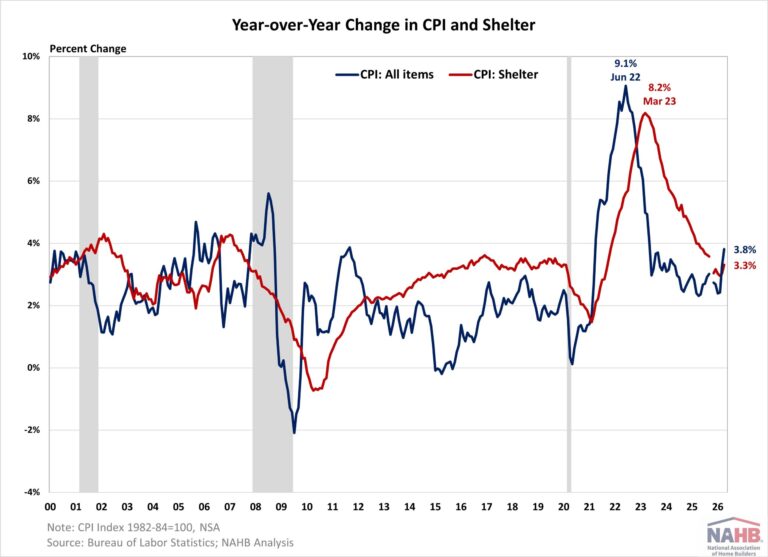
On a non-seasonally adjusted basis, the Consumer Price Index (CPI) rose by 3.8% in April from a year ago, following a 3.3% increase last month, according to the BLS latest report. This was the largest annual increase since May 2023.

The “core” CPI, excluding the volatile food and energy components, increased by 2.8% over the past twelve months, following a 2.6% increase in March. The housing shelter index, which makes up a large portion of “core” CPI, rose 3.3% over the year, following a 3.0% increase last month. Meanwhile, the component index of food rose by 3.2%, and the energy component index increased by 17.9%, the largest annual increase since September 2022.

On a monthly basis, the CPI rose by 0.6% in April (seasonally adjusted), and the “core” CPI increased by 0.4%.

The price index for a broad set of energy sources rose by 3.8% in April, with increases in fuel oil (+5.8%), gasoline (+5.4%), and electricity (+2.1%), with a minor decline in natural gas (-0.1%). Meanwhile, the food at home index rose by 0.7%, while the food away from home index increased by 0.2% in April.

Outside of energy, other top contributors that rose in April included indexes for household furnishings and operations (+0.7%), airline fares (+2.8%), personal care (+0.7%), apparel (+0.6%), and education (+0.2%). Meanwhile, the index for new vehicles (-0.2%), communication (-0.2%) and medical care (-0.1%) were among the few major indexes that decreased over the month.

The index for shelter, which makes up more than 40% of the “core” CPI, rose by 0.6% in April. The index for owners’ equivalent rent (OER) rose by 0.5%, while the index for rent of primary residence (RPR) increased by 0.5% over the month.

NAHB constructs a “real” rent index to indicate whether inflation in rents is faster or slower than core inflation. It provides insight into the supply and demand conditions for rental housing. When inflation in rents is rising faster than core inflation, the real rent index rises and vice versa. The real rent index is calculated by dividing the price index for rent by the core CPI (to exclude the volatile food and energy components). In April, the Real Rent Index rose by 0.2%.


This article was originally published by a eyeonhousing.org . Read the Original article here. .

Existing home sales edged up in April after reaching a nine-month low in March, but sales remained at historically low levels. Elevated mortgage rates and reignited inflation driven by the Iran war continued to weigh on affordability as economic uncertainty pushed up long-term rates, while rising energy costs strained household budgets. Despite inventory improving in recent months, it remains below pre-COVID levels and continues to push home prices to a record high for April as demand outpaces supply.

Total existing home sales, including single-family homes, townhomes, condominiums, and co-ops, rose 0.2% to a seasonally adjusted annual rate of 4.02 million in April, according to the National Association of Realtors (NAR). On a year-over-year basis, sales were unchanged from a year ago.

The existing home inventory level was 1.5 million units in April, up 5.8% from March and 1.4% from a year ago. At the current sales rate, April unsold inventory sits at a 4.4-months’ supply, up from 4.2-months in March and 4.3-months a year ago. Inventory between 4.5 to 6 months’ supply is generally considered a balanced market.

Homes stayed on the market for a median of 32 days in April, down from 41 days in the previous month but up from 29 days in April 2025.

The first-time buyer share was 33% in April, up from 32% in March but down slightly from 34% a year ago.

The April all-cash sales share was 25% of transactions, down from 27% in March but unchanged from a year ago. All-cash buyers are less affected by changes in interest rates.

The April median sales price of all existing homes was $417,700, up 0.9% from last year. This marks the 34th consecutive month of year-over-year increases. The median condominium/co-op price in March was up 1.1% from a year ago at $374,100. Recent gains for home inventory will put downward pressure on resale home prices in most markets in 2026.

Existing home sales in April were mixed across the four major regions. Sales rose in the Midwest (+2.2%) and South (+0.5%), fell in the West (-2.6%), and remained unchanged in the Northeast. On a year-over-year basis, sales were flat in the West, declined in the Northeast (-8.2%) and Midwest (-1.0%) but increased in the South (+2.7%).

The Pending Home Sales Index (PHSI) is a forward-looking indicator based on signed contracts. The PHSI rose from 72.6 to 73.7 in March due to improved inventory. On a year-over-year basis, pending sales were 1.1% lower than a year ago, according to the National Association of Realtors’ data. However, resurgence in mortgage rates driven by the Iran war could reverse the increase.


This article was originally published by a eyeonhousing.org . Read the Original article here. .

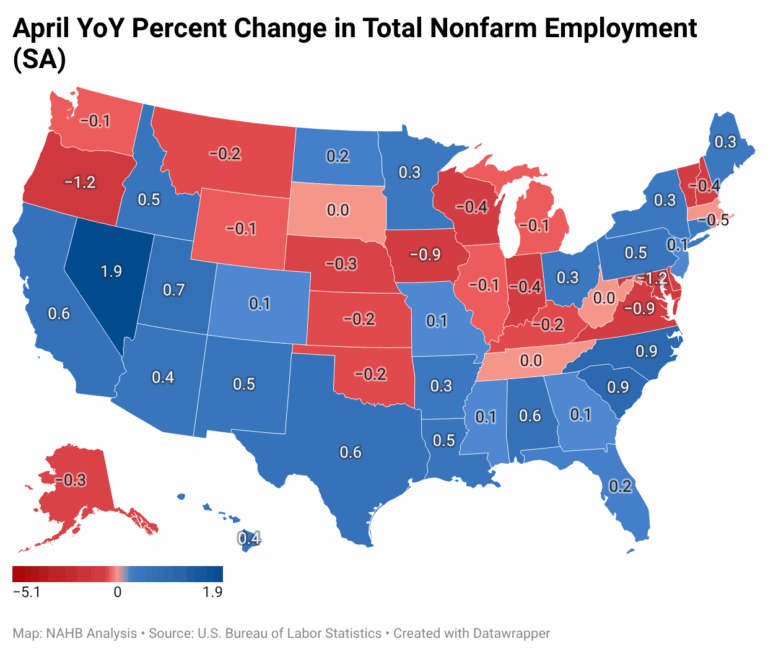
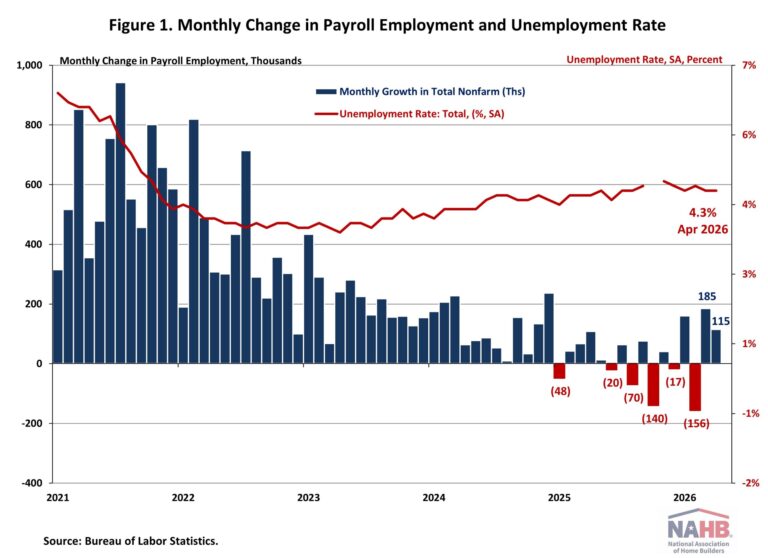
The U.S. labor market continued to show resilience in April, with job growth persisting despite elevated interest rates and rising geopolitical uncertainty related to the Iran conflict. The unemployment rate held steady at 4.3%. Hiring gains were concentrated in health care, transportation and warehousing, and retail trade, underscoring continued strength in service-oriented sectors.

Wage growth accelerated modestly in April, with average hourly earnings rising 3.6% year-over-year. This pace is 0.3 percentage points lower than a year ago. Importantly, wage growth has been outpacing inflation for nearly two years, which typically occurs as productivity increases.

National Employment

According to the Employment Situation Summary reported by the Bureau of Labor Statistics (BLS), total nonfarm payroll employment increased by 115,000 in April, following an upwardly revised gain of 185,000 jobs in March. Revisions to prior months were modest overall. The monthly change in total nonfarm payroll employment for February was revised down by 23,000 from -133,000 to -156,000, while the change for March was revised up by 7,000 from +178,000 to +185,000. Combined, these revisions reduced previously reported employment by 16,000 jobs.

Job growth in early 2026 remains well below 2024 levels but stronger than the weak pace recorded in 2025. Through April, monthly payroll gains have averaged 76,000, compared with 10,000 per month in 2025 and 122,000 in 2024.

The unemployment rate remained unchanged at 4.3% in April. Over the month, the number of persons unemployed rose by 134,000, while the number of persons employed declined by 226,000.

Meanwhile, the labor force participation rate—the proportion of the population either looking for a job or already holding a job—declined 0.1 percentage points to 61.8%. This marks the lowest level since November 2021 and remains below its pre-pandemic level of 63.3% recorded at the beginning of 2020. Among prime working-age individuals (aged 25 to 54), the participation rate held steady at 83.8%.

In April, job gains occurred in health care (+37,000), transportation and warehousing (+30,000), and retail trade (+22,000), while federal government employment continued to decline. Since reaching a peak in October 2024, federal government employment has fallen by 348,000 jobs, or 11.5%.

Construction Employment

Employment in the overall construction sector rose by 9,000 jobs in April, following a downwardly revised gain of 16,000 in March. Within the industry, residential construction shed 10,400 jobs, while non-residential construction added 19,000 jobs.

Residential construction employment now stands at 3.3 million in April, including 927,000 workers employed by builders and remodelers and nearly 2.4 million residential specialty trade contractors.

The six-month moving average of job gains for residential construction remains negative, reflecting an average monthly loss of 2,333 jobs and declines in three of the past six months. However, over the last 12 months, residential construction has shed a net of 49,200 jobs, marking the fourteenth consecutive annual decline and the longest stretch of annual losses since the Great Recession. Despite these declines, residential construction has gained 1,297,100 positions from its post-Great Recession low.

Meanwhile, the unemployment rate for construction workers declined to 3.7% in April on a seasonally adjusted basis, remaining relatively low compared with historical norms.


This article was originally published by a eyeonhousing.org . Read the Original article here. .


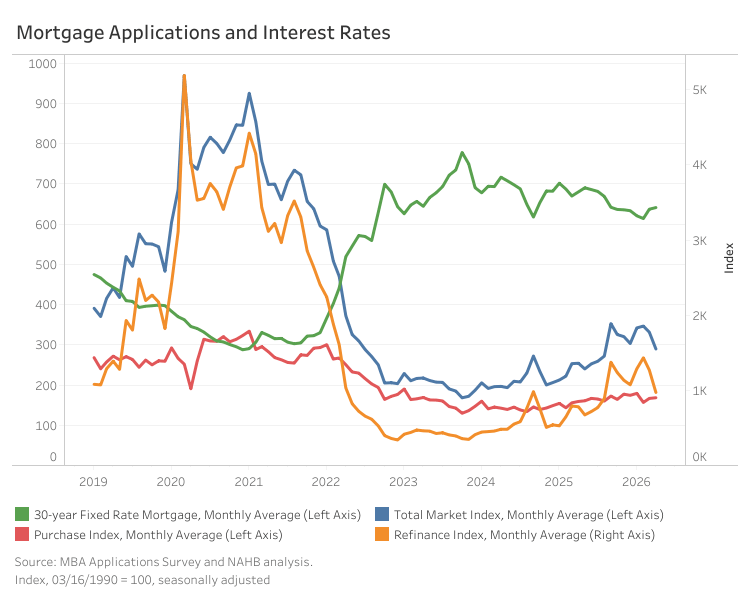
Mortgage application activity decreased month-over-month as the 30-year fixed mortgage rate rose. The Mortgage Bankers Association’s (MBA) Market Composite Index, a measure of total mortgage application volume, declined 12.4% month-over-month in April on a seasonally adjusted basis. However, overall activity remained 14.2% higher than a year earlier. Applications for adjustable-rate mortgages (ARM) also fell 12.4% month-over-month, while the ARM share of total applications was unchanged at 8.3%.

The average contract rate for a 30-year fixed-rate mortgage increased four basis points (bps) to 6.41% as the conflict in Iran pushed yields higher. Nonetheless, the rate remained 39 bps lower than its level a year ago. Refinance applications fell sharply by 23.5% from March, while purchase applications held steady. Relative to April 2025, refinance and purchase activities were up 24.5% and 5.7%, respectively.

By loan type, applications for both adjustable-rate mortgages (ARMs) and fixed-rate mortgages (FRMs) decreased approximately 12.4% month-over-month. On a year-over-year basis, FRM applications were up 13.9%, while ARM applications rose 13.2%. As of April 2026, ARMs applications, including both purchase and refinance loans, accounted for 8.3% of total applications on a non-seasonally adjusted basis, unchanged from the prior month and a year earlier. The average contract interest rate for 5/1 ARMs was 5.6% in April.

Loan sizes declined across all categories except purchase loans in April, edging the overall average loan size down 0.9% to $397,800. The average purchase loan size increased marginally by 0.9% to $454,800, while the average refinance loan size fell 7.1% to $326,000. The average ARM loan size declined 1.1% to $919,500.


This article was originally published by a eyeonhousing.org . Read the Original article here. .

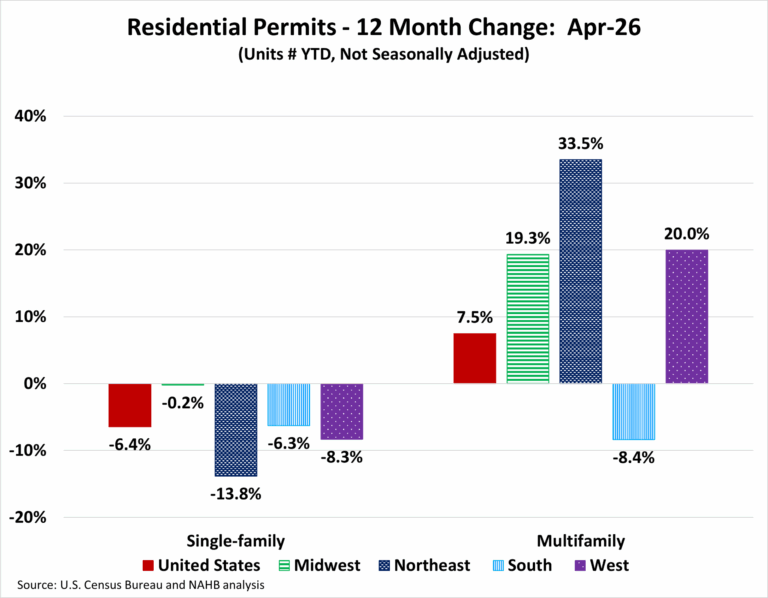
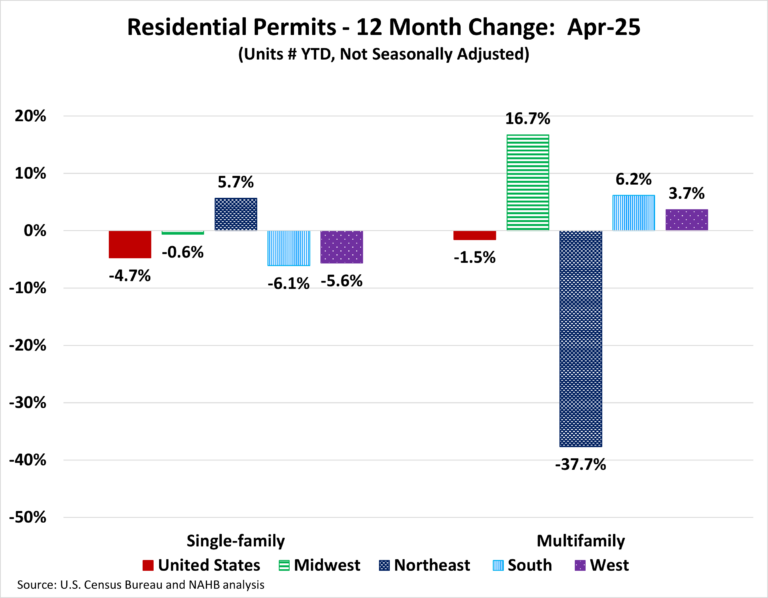
Housing permits continued a downhill trend for the fourth month in a row, pointing to a broader residential construction slowdown for 2025. Over the first four months of 2025, the total number of single-family permits issued year-to-date (YTD) nationwide reached 320,259. On a year-over-year (YoY) basis, this is a decline of 4.7% over the April 2024 level of 336,124. For multifamily, the total number of permits issued nationwide reached 154,668. This is 1.5% below the April 2024 level of 157,076.

Year-to-date ending in April, single-family permits were down in three out of the four regions. The Northeast posted an increase of 5.7%. The Midwest was down by 0.6%, the West was down by 5.6%, and the South was down by 6.1% in single-family permits during this time. For multifamily permits, three out of the four regions posted increases. The Midwest was up by 16.7%, the South was up by 6.2%, and the West was up by 3.7%. Meanwhile, the Northeast declined steeply by 37.7%.

Between April 2025 YTD and April 2024 YTD, 18 states posted an increase in single-family permits. The range of increases spanned 27.0% in Hawaii to 0.2% in Maine. The remaining 32 states and the District of Columbia reported declines in single-family permits with New Mexico reporting the steepest decline of 27.5%.

The ten states issuing the highest number of single-family permits combined accounted for 63.6% of the total single-family permits issued. Texas, the state with the highest number of single-family permits, issued 52,654 permits over the first four months of 2025; This is a decline of 7.4% compared to the same period last year. The second highest state, Florida, decreased by 9.3%, while the third highest, North Carolina, posted a decline of 1.5%.

Between April 2025 YTD and April 2024 YTD, 26 states recorded growth in multifamily permits, while 24 states and the District of Columbia recorded a decline. Alaska (+312.5%) led the way with a sharp rise in multifamily permits from 24 to 99, while New York had the biggest decline of 58.7% from 14,389 to 5,946.

The ten states issuing the highest number of multifamily permits combined accounted for 61.1% of the multifamily permits issued. Over the first four months of 2025, Florida, the state with the highest number of multifamily permits issued, experienced an increase of 18.7%. Texas, the second-highest state in multifamily permits, saw an increase of 6.8%. California, the third largest multifamily issuing state, increased by 0.2%.

At the local level, below are the top ten metro areas that issued the highest number of single-family permits.

For multifamily permits, below are the top ten local areas that issued the highest number of permits.

Discover more from Eye On Housing

Subscribe to get the latest posts sent to your email.


This article was originally published by a eyeonhousing.org . Read the Original article here. .

The count of open, unfilled positions in the construction industry held steady amid a slowdown for housing, per the April Bureau of Labor Statistics Job Openings and Labor Turnover Survey (JOLTS).

The number of open jobs for the overall economy increased slightly from 7.20 million in March to 7.39 million in April. This is notably smaller than the 7.62 million estimate reported a year ago and reflects a softened aggregate labor market. Previous NAHB analysis indicated that this number had to fall below 8 million on a sustained basis for the Federal Reserve to move forward on interest rate reductions. With estimates remaining below 8 million for national job openings, the Fed, in theory, should be able to cut further despite a recent pause. However, tariff proposals may keep the Fed on pause in the coming quarters.

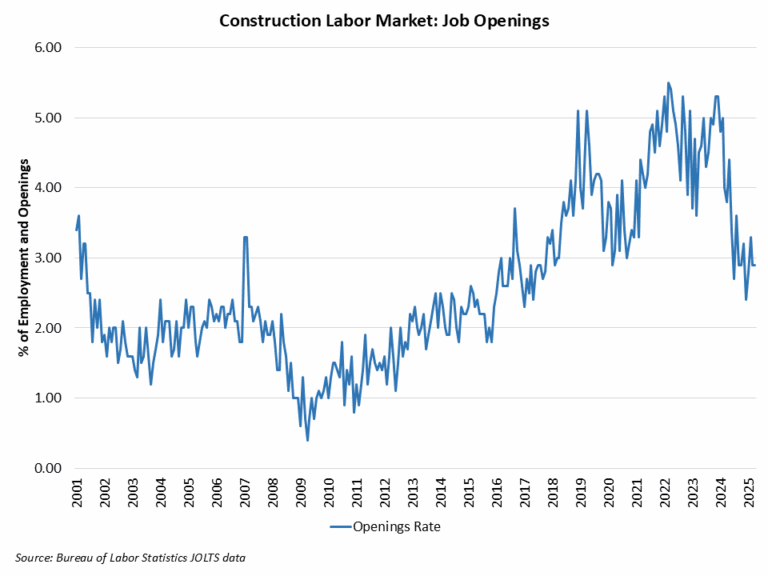
The number of open construction sector jobs was effectively unchanged from a revised 251,000 in March to 248,000 in April. This nonetheless marks a significant reduction of open, unfilled construction jobs than that registered a year ago (326,000) due to a slowing of construction activity. The chart below notes the recent decline for the construction job openings rate, which is now back to the lows of 2019.

The construction job openings rate was unchanged at 2.9% in April, although significantly lower year-over-year from 3.8%.

The layoff rate in construction ticked higher to 1.9% in April. The quits rate dipped to 1.8% for the month.

Discover more from Eye On Housing

Subscribe to get the latest posts sent to your email.


This article was originally published by a eyeonhousing.org . Read the Original article here. .

Private residential construction spending fell by 0.9% in April, marking the third consecutive monthly decline. This decrease was primarily driven by reduced spending in single-family construction and home improvements. Compared to a year ago, total spending was down 4.8%, as the housing sector continues to navigate the economic uncertainty stemming from ongoing tariff concerns and elevated mortgage rates.

According to the latest U.S. Census Construction Spending data, single-family construction spending declined by 1.1% in April. This decrease aligns with the weakness in the April single-family starts and NAHB/Wells Fargo Housing Market Index (HMI). The April data ends seven months of growth in single-family construction spending, making it 2.2% lower than a year ago. Meanwhile improvement spending was down 0.8% in April and was 5.5% lower on a year-over-year basis. Multifamily construction spending edged down 0.1% in April, staying in the downward trend that began in December 2023. Compared to April 2024, multifamily spending was down 11.3%.

The NAHB construction spending index is shown in the graph below. The index illustrates how   spending on single-family construction has slowed since early 2024 under the pressure of elevated interest rates and concerns over building material tariffs. Multifamily construction spending growth has also slowed down after the peak in July 2023. Improvement spending has also been weakening since the beginning of 2025.

Spending on private nonresidential construction was up 1% over a year ago. The annual private nonresidential spending increase was mainly due to higher spending for the class of power ($7.9 billion), followed by the office category ($3.3 billion).

Discover more from Eye On Housing

Subscribe to get the latest posts sent to your email.


This article was originally published by a eyeonhousing.org . Read the Original article here. .

Prices for inputs to new residential construction—excluding capital investment, labor, and imports—fell 0.4% in April, following a (revised) increase of 0.8% in March. These figures are taken from the most recent Producer Price Index (PPI) report published by U.S. Bureau of Labor Statistics. The PPI measures prices that domestic producers receive for their goods and services; this differs from the Consumer Price Index which measures what consumers pay and includes both domestic products as well as imports.

The inputs to the New Residential Construction Price Index grew 0.6% from April of last year. The index can be broken into two components­—the goods component also increased 0.6% over the year, with services increasing 0.6% as well. For comparison, the total final demand index, which measures all goods and services across the economy, increased 2.4% over the year, with final demand with respect to goods up 0.5% and final demand for services up 3.3% over the year.

Input Goods Prices

The goods component has a larger importance to the total residential construction inputs price index, representing around 60%. For the month, the price of input goods to new residential construction was down 0.2% in April.

The input goods to residential construction index can be further broken down into two separate components, one measuring energy inputs with the other measuring goods less energy inputs. The latter of these two components simply represents building materials used in residential construction, which makes up around 93% of the goods index.

Energy input prices were up 0.1% between March and April but were 17.6% lower than one year ago. Building material prices were down 0.3% between March and April but up 2.2% compared to one year ago. Energy costs have continued to fall on a year-over-year basis, as this marks the ninth consecutive month of lower input energy costs.

Input Services Prices

Prices for service inputs to residential construction reported its first monthly decline in five months, down 0.6% in April. On a year-over-year basis, service input prices are up 0.6%.

The price index for service inputs to residential construction can be broken out into three separate components: a trade services component, a transportation and warehousing services component, and a services excluding trade, transportation and warehousing component (other services). The most significant component is trade services (around 60%), followed by other services (around 29%), and finally transportation and warehousing services (around 11%). The largest component, trade services, was up 0.2% from a year ago. The other services component was up 1.4% over the year. Lastly, prices for transportation and warehousing services advanced 0.6% compared to April last year.

Discover more from Eye On Housing

Subscribe to get the latest posts sent to your email.


This article was originally published by a eyeonhousing.org . Read the Original article here. .
Pin It