Artificial intelligence (AI) is rapidly changing how work gets done, but its impact varies considerably across occupations. For most construction occupations, near-term exposure to AI remains relatively low. An NAHB analysis of U.S. Bureau of Labor Statistics (BLS) data finds that 45 of 47 selected construction-related occupations—or about 96%—are classified as having “low” or “moderate” relative AI exposure. Only two occupations are classified as having “high” exposure, and none are classified as “very high”. These findings suggest that although AI is likely to change how construction work is performed, its current iteration has a less direct impact on many of the industry’s frontline occupations.
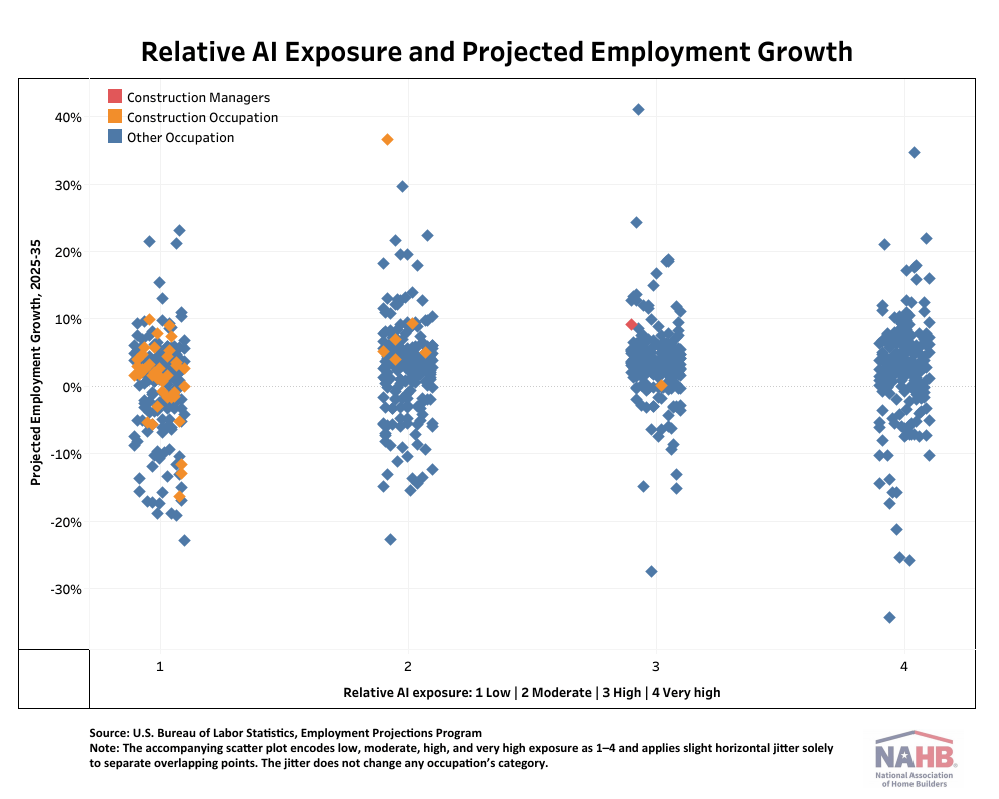
The chart compares relative AI exposure with projected employment growth from 2025 to 2035, illustrating that greater AI exposure does not necessarily correspond to faster or slower employment growth. Among construction occupations, construction managers and construction and building inspectors are the only two classified as having high relative AI exposure. Employment for these occupations is projected to grow 9% and remain essentially unchanged, respectively, from 2025 to 2035. By contrast, employment for solar photovoltaic installers, classified as having moderate exposure, is projected to grow 37%, making it the fastest-growing construction occupation in the group.
Among the selected construction occupations, the low-exposure group includes many hands-on trades and field roles, such as carpenters, construction laborers, roofers, and operating engineers. These jobs rely heavily on physical execution, changing jobsite conditions, safety judgment, coordination with other trades, and interaction with materials and equipment. These characteristics limit the direct reach of current software-based AI into many of the tasks performed in these roles. By contrast, construction managers and construction and building inspectors are classified as high-exposure exceptions, reflecting the greater role of planning, documentation, scheduling, compliance, reporting, and communication in these occupations. This distinction is consistent with findings from NAHB’s Housing Market Index (HMI) special questions, which show that builders primarily use AI for information-intensive tasks such as advertising and marketing, project planning, and project design. These findings complement the occupation-level AI exposure classifications, highlighting the greater applicability of AI to information-intensive functions than to hands-on construction activities.
Relatively low current AI exposure does not mean that construction is insulated from technological change. Instead, AI adoption may initially augment existing work through faster estimating and planning, improved document management, safety analysis, progress monitoring, and decision support. Changes to field operations may emerge more gradually through AI-enabled equipment, robotics, and computer vision. Recent findings from NAHB’s Housing Market Index (HMI) special questions show that builders identified technological advances as a positive long-term force for the housing industry.
Source:
U.S. Bureau of Labor Statistics, Employment Projections Program, “AI Exposure Categories and Employment Projections, 2025–35,” with definitions and limitations documented in the workbook’s Field Descriptions tab.
The BLS supplemental table, AI Exposure Categories and Employment Projections, 2025–35, combines five publicly available data sources to compare detailed occupations based on their theoretical and observed exposure to AI. The measure indicates whether AI technology could be, or has been, used to assist with or complete some tasks performed in an occupation. Importantly, it does not predict job losses, automation, productivity gains, or wage effects. This analysis focuses on 47 SOC construction occupations, excluding extraction occupations, plus construction managers. It does not represent the full workforce employed by construction firms, which also includes adjacent occupations such as architects, engineers, cost estimators, accountants, sales professionals, technology staff, and administrators. In addition, occupations are counted regardless of the industry in which workers are employed.
This article was originally published by a eyeonhousing.org . Read the Original article here. .