Tag

Occupations

Browsing


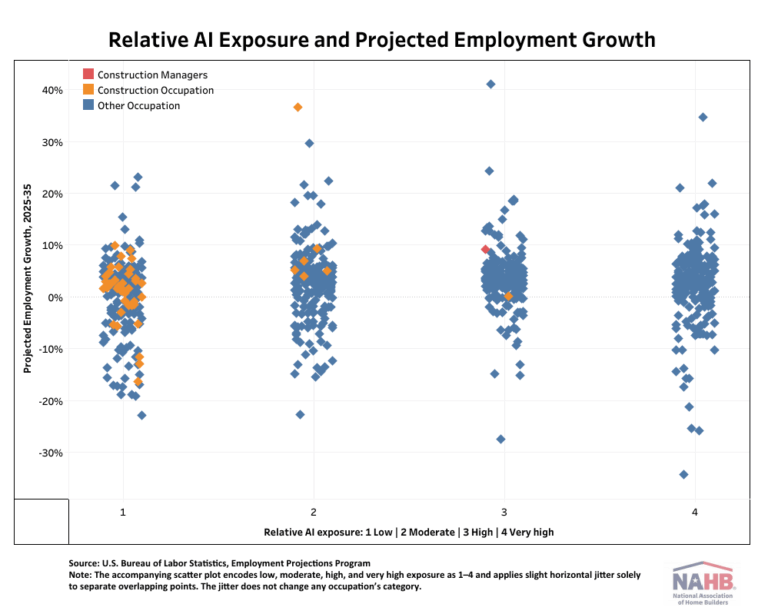
Artificial intelligence (AI) is rapidly changing how work gets done, but its impact varies considerably across occupations. For most construction occupations, near-term exposure to AI remains relatively low. An NAHB analysis of U.S. Bureau of Labor Statistics (BLS) data finds that 45 of 47 selected construction-related occupations—or about 96%—are classified as having “low” or “moderate” relative AI exposure. Only two occupations are classified as having “high” exposure, and none are classified as “very high”. These findings suggest that although AI is likely to change how construction work is performed, its current iteration has a less direct impact on many of the industry’s frontline occupations.

The chart compares relative AI exposure with projected employment growth from 2025 to 2035, illustrating that greater AI exposure does not necessarily correspond to faster or slower employment growth. Among construction occupations, construction managers and construction and building inspectors are the only two classified as having high relative AI exposure. Employment for these occupations is projected to grow 9% and remain essentially unchanged, respectively, from 2025 to 2035. By contrast, employment for solar photovoltaic installers, classified as having moderate exposure, is projected to grow 37%, making it the fastest-growing construction occupation in the group.

Among the selected construction occupations, the low-exposure group includes many hands-on trades and field roles, such as carpenters, construction laborers, roofers, and operating engineers. These jobs rely heavily on physical execution, changing jobsite conditions, safety judgment, coordination with other trades, and interaction with materials and equipment. These characteristics limit the direct reach of current software-based AI into many of the tasks performed in these roles. By contrast, construction managers and construction and building inspectors are classified as high-exposure exceptions, reflecting the greater role of planning, documentation, scheduling, compliance, reporting, and communication in these occupations. This distinction is consistent with findings from NAHB’s Housing Market Index (HMI) special questions, which show that builders primarily use AI for information-intensive tasks such as advertising and marketing, project planning, and project design. These findings complement the occupation-level AI exposure classifications, highlighting the greater applicability of AI to information-intensive functions than to hands-on construction activities.

Relatively low current AI exposure does not mean that construction is insulated from technological change. Instead, AI adoption may initially augment existing work through faster estimating and planning, improved document management, safety analysis, progress monitoring, and decision support. Changes to field operations may emerge more gradually through AI-enabled equipment, robotics, and computer vision. Recent findings from NAHB’s Housing Market Index (HMI) special questions show that builders identified technological advances as a positive long-term force for the housing industry.

Source:

U.S. Bureau of Labor Statistics, Employment Projections Program, “AI Exposure Categories and Employment Projections, 2025–35,” with definitions and limitations documented in the workbook’s Field Descriptions tab.

The BLS supplemental table, AI Exposure Categories and Employment Projections, 2025–35, combines five publicly available data sources to compare detailed occupations based on their theoretical and observed exposure to AI. The measure indicates whether AI technology could be, or has been, used to assist with or complete some tasks performed in an occupation. Importantly, it does not predict job losses, automation, productivity gains, or wage effects. This analysis focuses on 47 SOC construction occupations, excluding extraction occupations, plus construction managers. It does not represent the full workforce employed by construction firms, which also includes adjacent occupations such as architects, engineers, cost estimators, accountants, sales professionals, technology staff, and administrators. In addition, occupations are counted regardless of the industry in which workers are employed.


This article was originally published by a eyeonhousing.org . Read the Original article here. .

The median wage of payroll workers in construction was $61,370 in 2025, with the top 25% earning at least $83,480. In comparison, the U.S. median annual wage was $50,980, while workers in the top quartile (the highest paid 25%) earned at least $80,520. These estimates come from the latest release of the Bureau of Labor Statistics Occupational Employment and Wage Statistics (OEWS) and do not include premium pay (stock and year-end bonuses, overtime pay, weekend premium pay, etc.).

The OEWS publishes wage data for nearly 400 occupations in construction. Of these, only 46 are construction trades. The remaining workers are in finance, sales, administration, and other off-site activities.

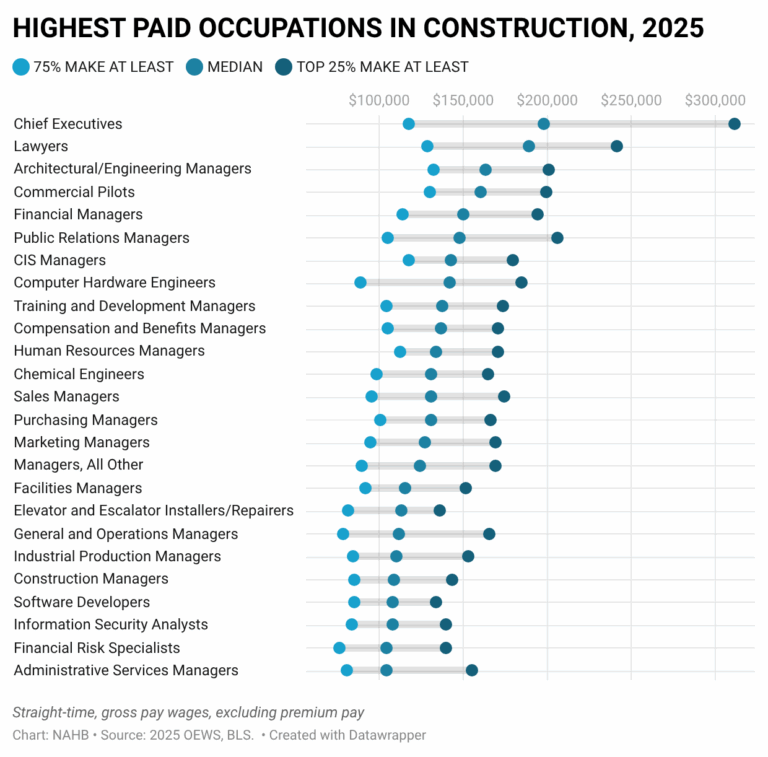
In 2025, the highest-paid occupation in construction was Chief Executive Officer (CEO). Half of CEOs earned more than $198,000 in straight-time wages, and the top 25% earned over $312,000. CEOs in construction also had the widest pay scale spread in the industry, measured as the percentage difference between pay at the bottom and top quartiles. The highest-paid 25% of CEOs earned more than 2.6 times as much as those in the lowest-paid quartile. This wide scale likely reflects a broader range of responsibilities and differences in operational scope.

Lawyers working in construction ranked second, with a median annual wage of about $190,000. Lawyers in the top quartile earned at least $242,000, or 1.9 times more than lawyers in the lowest-paid quartile. This is also a relatively wide pay scale for the industry, reflecting differences in responsibilities and diverse opportunities for career advancement among lawyers in construction.

Of the twenty-five highest-paid occupations in construction, sixteen were managerial roles. The highest-paid managers in the industry were architectural and engineering managers, with half earning more than $163,290 and the top 25% earning over $201,300 annually. Architectural and engineering managers also stand out for having a narrower salary range. Only computer and information systems (CIS) managers and human resources (HR) managers had similarly narrow pay ranges among construction managers.

Among construction trades, elevator installers and repairers remained at the top of the median-wage list, with half earning over $113,710 a year and the highest 25% making at least $136,320. This is the only construction trade that made the industry’s overall top 20 highest-paid occupations list.

First-line supervisors of construction trades are next on the trade list with a median wage of $80,000, and the top 25% earning at least $101,220.

In general, construction trades that require more years of formal education tend to offer higher annual wages. The median wage of construction and building inspectors was $74,460, and the top quartile was $95,290. This is also a trade with a relatively wider pay scale, with the top 25% earning at least 66% more than the bottom quartile, potentially reflecting greater variance in educational attainment, professional responsibilities, and expertise of building inspectors.

Carpenters are one of the most prevalent skilled trades in the construction industry. The occupation typically requires less formal education than many other professions, yet carpenters working in construction still earn wages well above the national median for all occupations. In 2025, half of carpenters earned more than $60,950 annually, while the top 25% made at least $77,390.

Plumbers and electricians, trades that typically require specialized training and licensing, had even higher annual wages. The median wage of plumbers in construction was $63,270, with the top quartile making over $83,360. Electricians’ wages are similarly high.

Terrazzo workers and pile-driver operators, fourth and fifth on the highest-paid trade list, registered especially wide wage ranges. The top 25% of pile-drivers earned at least $106,660, more than 80% above the earnings of the bottom quartile. This broad pay scale presumably reflects a greater variety of opportunities and geographic locations (including offshore rigs), as well as differences in technical expertise and training. Some pile-driving equipment comes with computerized controls and requires additional knowledge of electronics.

In contrast, solar photovoltaic installers, a relatively new construction trade, had a much narrower pay scale. The difference between the annual pay of the top 25 percent ($67,970) and the bottom quartile ($47,880) was 42%, likely reflecting less variation in expertise, training, and geographic prevalence.

Typically, construction trades that require less skill not only offer lower wages but also have less variation. Apprentice workers (helpers of painters, plumbers, electricians, roofers, carpenters, and other construction trades) illustrate this point. These are the six lowest-paid construction occupations that simultaneously show the narrowest variation. For example, the highest-paid quartile of carpenters’ helpers made at least $49,420 a year, while the bottom quartile earned at most $36,750, a 34% difference.


This article was originally published by a eyeonhousing.org . Read the Original article here. .

Half of payroll workers in construction earn more than $60,320 and the top 25% make at least $81,510, according to the latest May 2024 Bureau of Labor Statistics Occupational Employment and Wage Statistics (OEWS) and analysis by the National Association of Home Builders (NAHB). In comparison, the U.S. median annual pay is $49,500, while the top quartile (the highest paid 25%) makes at least $78,810.

The OEWS publishes wages for almost 400 occupations in construction. Out of these, only 46 are construction trades. The other construction industry workers are in finance, sales, administration and other off-site activities.

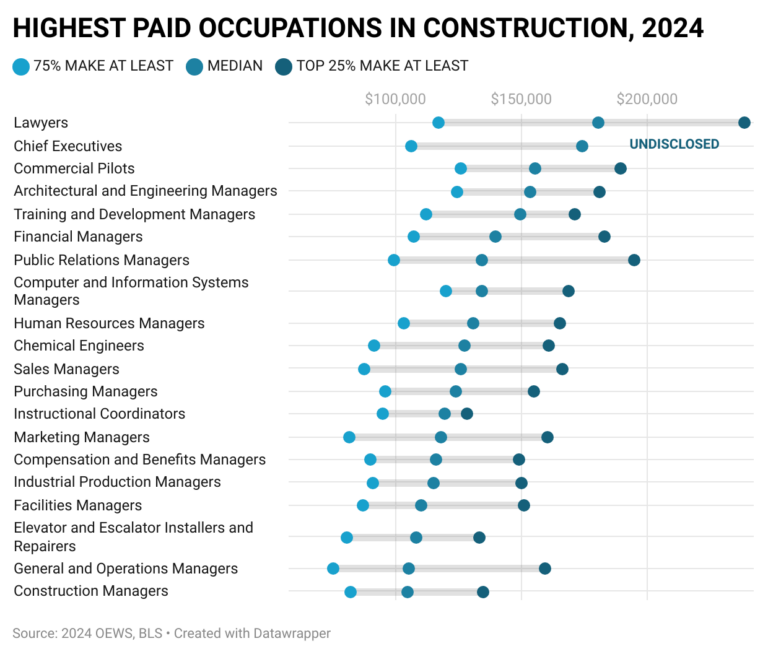
In 2024, the highest paid occupation in construction is lawyers with wages of $180,520 per year, and the top 25 percent making over $238,720. Traditionally, Chief Executive Officer (CEO) occupy the top paid position in the industry, but in 2024, they are second on the list, with half of CEOs making over $174,030, while the wages of the top quartile remain undisclosed.

Out of the top twenty highest paid occupations in construction, fourteen are various managers. The highest paid managers in construction are architectural and engineering managers, with half of them making over $153,510 and the top 25 percent on the pay scale earning over $181,150 annually.

The architectural and engineering managers also stand out for having a smaller salary range spread, measured as a percentage difference between the bottom and top 25 percent pay levels. Only computer and information systems (CIS) managers have a narrower pay range among managers in construction. The annual pay of the highest paid 25 percent CIS managers in construction is at least $168,850, which is 40% higher than the top earnings of the lowest paid quartile ($119,990). In contrast, higher-level positions, such as lawyers and CEOs, have a noticeably wider pay scale spread. The top 25 percent highest paid lawyers make more than double of the bottom quartile pay, potentially reflecting a greater range of responsibilities and opportunities for career advancement for lawyers in construction.

Among construction trades, elevator installers and repairers top the median wages list with half of them earning over $108,130 a year, and the top 25% making at least $133,370. This is also the only construction trade that made the industry overall top 20 highest paid occupations list. 

First-line supervisors of construction trades are next on the trade list; their median wages are $78,900, with the top 25% highest paid supervisors earning more than $100,150.  

In general, construction trades that require more years of formal education tend to offer higher annual wages. Median wages of construction and building inspectors are $66,340 and the top quartile is $89,550. This is also the trade with a relatively wide pay scale spread, with the top 25 percent making at least 74% more than the bottom quartile, potentially reflecting a wider variance in educational attainment, professional responsibilities and expertise of building inspectors.

Carpenters are one of the most prevalent construction crafts in the industry. The trade requires less formal education. Nevertheless, the median wages of carpenters working in construction exceed the national median. Half of these craftsmen earn over $59,890 and the highest paid 25 percent bring in at least $76,290.

Plumbers and electricians, trades that typically require specialized training and licensing, earn higher annual wages. Half of plumbers in construction earn over $62,820, with the top quartile making over $81,740. Electricians’ wages are similarly high.

The construction trade with the greatest pay range spread is pile driver operators. The top 25 percent highest paid operators earn at least $105,100, over 100% more than the bottom quartile. This wide pay scale presumably reflects a greater variety of opportunities and geographic locations (some pile driver operators work on offshore rigs), as well as varying degree of technical expertise and training (some equipment comes with computerized controls and requires additional knowledge of electronics).

In contrast, solar photovoltaic installers, a relatively new construction trade, have a much narrower pay scale. The difference between the annual pay of the top 25 percent ($65,850) and the bottom quartile ($48,350) is 36%, likely reflecting less variation in expertise, training, and geographic prevalence.

Typically, construction trades that require less skill not only offer lower wages but also show less variation in pay. Apprentice workers (helpers of painters, plumbers, electricians, roofers, carpenters, and other construction trades) illustrate this point. These are the six lowest paid construction occupations that simultaneously show the narrowest variation in pay. For example, the highest paid quartile of carpenters’ helpers makes at least $46,720 a year, while the bottom quartile earns at most $35,870, only a 30% difference.

Discover more from Eye On Housing

Subscribe to get the latest posts sent to your email.


This article was originally published by a eyeonhousing.org . Read the Original article here. .

With the end of 2024 approaching, NAHB’s Eye on Housing is reviewing the posts that attracted the most readers over the last year. In April, Natalia Siniavskaia shared wages by occupation in construction including the median salaries and top 25% salaries.

Half of payroll workers in construction earn more than $58,500 and the top 25% make at least $79,450, according to the latest May 2023 Bureau of Labor Statistics Occupational Employment and Wage Statistics (OEWS) and analysis by the National Association of Home Builders (NAHB). In comparison, the U.S. median wage is $48,060, while the top quartile (top 25%) makes at least $76,980.

The OES publishes wages for almost 400 occupations in construction. Out of these, only 46 are construction trades. The other industry workers are in finance, sales, administration and other off-site activities.

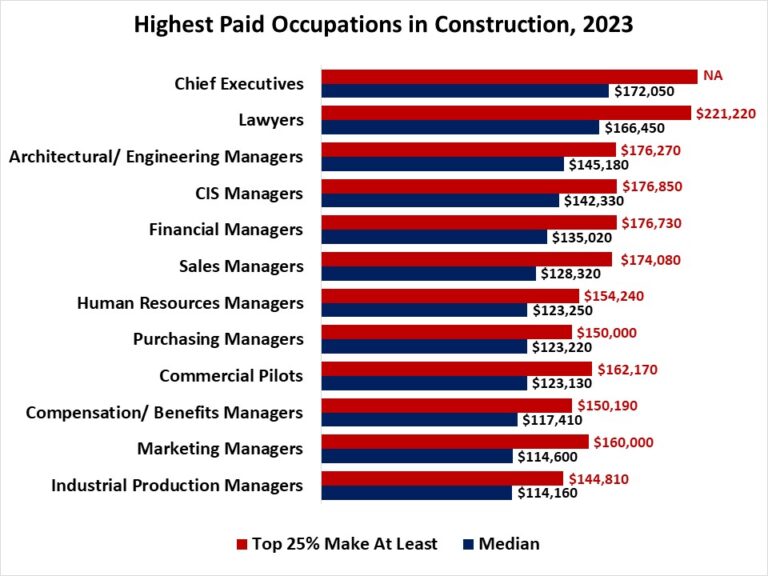
The highest paid occupation in construction is Chief Executive Officer (CEO) with half of CEOs making over $172,000 per year. Lawyers working in construction are next on the list with the median wages of $166,450, and the top 25 percent highest paid lawyers making over $221,220. Out of the next ten highest paid trades in construction, eight are various managers. The highest paid managers in construction are architectural and engineering managers, with half of them making over $145,180 and the top 25 percent on the pay scale earning over $176,270 annually.

Among construction trades, elevator installers and repairers top the median wages list with half of them earning over $103,340 a year, and the top 25% making at least $129,090. First-line supervisors of construction trades are next on the list; their median wages are $76,960, with the top 25% highest paid supervisors earning more than $97,500.

In general, construction trades that require more years of formal education, specialized training or licensing tend to offer higher annual wages. Median wages of construction and building inspectors are $65,790 and the wages in the top quartile of the pay scale exceed $88,800. Half of plumbers in construction earn over $61,380, with the top quartile making over $80,300. Electricians’ wages are similarly high.

Carpenters are one of the most prevalent construction crafts in the industry. The trade requires less formal education. Nevertheless, the median wages of carpenters working in construction exceed the national median. Half of these craftsmen earn over $57,300 and the highest paid 25% bring in at least $73,800.

The OEWS program adopted a new estimation methodology in 2021. As a result, the previously published estimates are not directly comparable to the post-pandemic editions.  Nevertheless, comparing the median wages in construction over the last two years reveals that, on average, lower-paid occupations experienced a somewhat faster wage growth. Median wages of drywall installers, for example, grew 11%. Moreover, the overall construction median increased 7.3%, one of the largest increases among all industries.  

Discover more from Eye On Housing

Subscribe to get the latest posts sent to your email.


This article was originally published by a eyeonhousing.org . Read the Original article here. .
Pin It