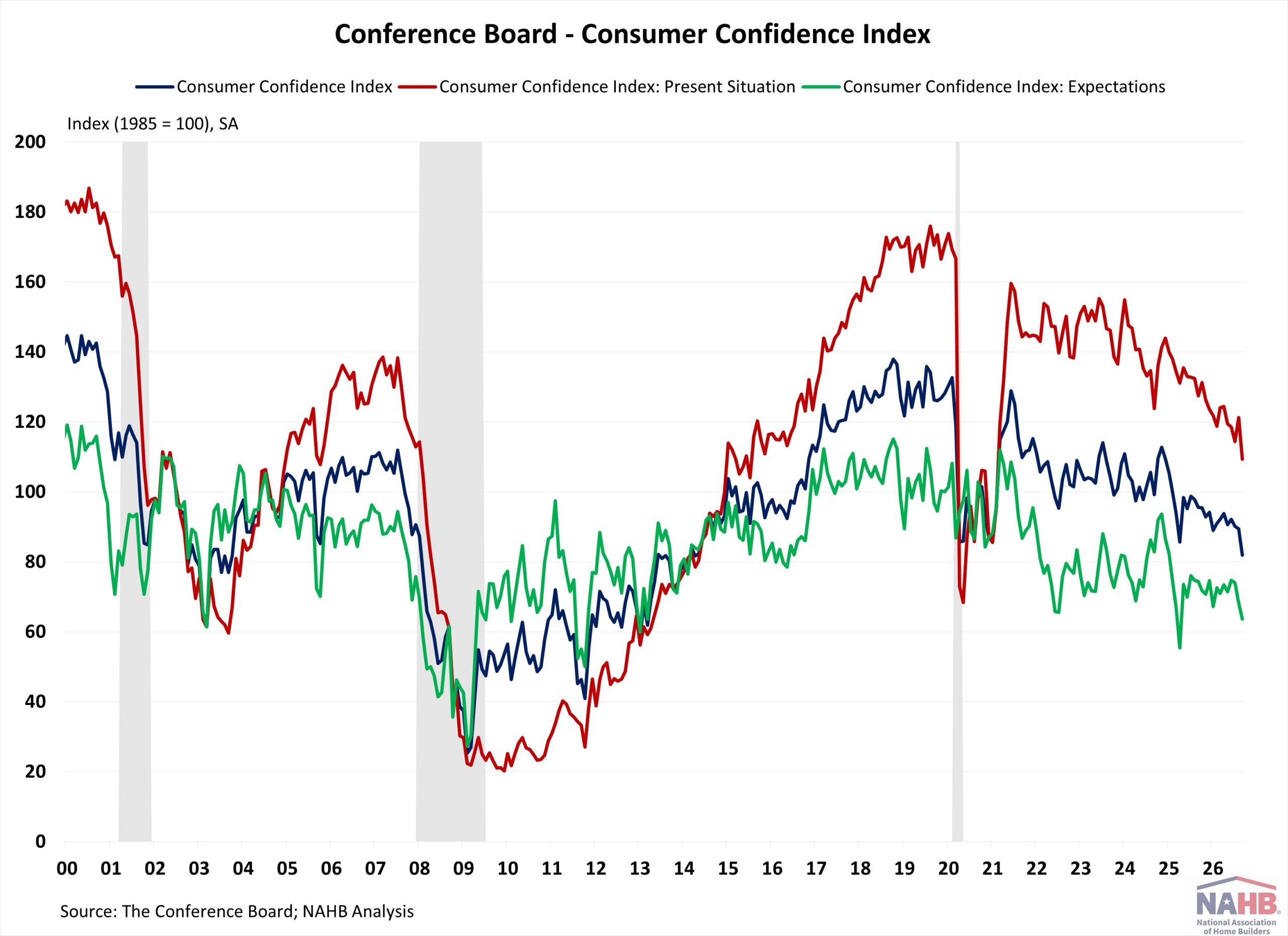
Consumer confidence in September plunged to the lowest level since April 2014 as consumers grew more pessimistic about current conditions and the economic outlook. This report captured consumer sentiment following the Fed’s first rate hike since 2023 and ongoing geopolitical tensions. Consumer views of business conditions turned negative for the first time in two years, while the labor market outlook continued to worsen. The labor market differential, which measures the gap between consumers viewing jobs as plentiful and hard-to-get, remained narrow and reached its lowest level since February 2021.
The Consumer Confidence Index, reported by the Conference Board, is a survey measuring how optimistic or pessimistic consumers feel about their financial situation. This index fell from 89.4 to 81.9 in September, the lowest level since April 2014. The Consumer Confidence Index consists of two components: how consumers feel about their present situation and their expected situation. In September, the Present Situation Index decreased 11.9 points to 109.3, the lowest level since February 2021; the Expectation Situation Index declined 4.6 points to 63.6, marking a third consecutive monthly decline and the lowest level since April 2025. This is the twentieth consecutive month for which the Expectation Index has been below 80, a threshold that often signals a recession within a year.
Consumers’ assessment of current business conditions worsens in September. The share of respondents rating business conditions as “good” decreased by 0.4 percentage points to 18.5%, while those claiming business conditions as “bad” rose by 2.8 percentage points to 20.4%. Meanwhile, consumers’ assessments of the labor market were more negative in September. The share of respondents reporting that jobs were “plentiful” fell by 3.4 percentage points to 23.6%, the lowest level since February 2021; meanwhile, those who saw jobs as “hard to get” increased by 2.4 percentage points to 21.9%, the highest level since January 2021.
Consumers were more pessimistic about the short-term outlook. The share of respondents expecting business conditions to improve decreased from 16.8% to 15.9%, while those expecting business conditions to deteriorate increased from 23.1% to 25.4%. Meanwhile, expectations of employment over the next six months were more negative. The share of respondents expecting “more jobs” fell from 14.6% to 14.0%, and those anticipating “fewer jobs” rose by 2.3 percentage points to 28.4%.
The Conference Board also reported the share of respondents planning to buy a home within six months. The share of respondents planning to buy a home rose slightly to 5.4% in September. Of those, the shares planning to buy a newly constructed home and an existing home decreased to 0.4% and 2.4%, respectively. The remaining 2.6% were planning to buy a home but were undecided between new or existing homes.
This article was originally published by a eyeonhousing.org . Read the Original article here. .