Vinyl siding was the most used principle exterior wall material for homes started construction in 2025. This material held just over a quarter share of homes, surpassing stucco for the second time since 2018. The declining share for stucco reflected the slowdown for home building in parts of the Sun Belt.
For homes started in 2025, 27.7% had vinyl siding as the principal exterior wall material. Vinyl siding was followed closely by stucco at 24.1%, and by fiber cement siding (such as Hardiplank or Hardiboard) at 22.6%. Each of these materials held about a quarter share of the market, with another sliver held by brick or brick veneer at 16.8%. Far smaller shares of single-family homes started last year had wood or wood products (5.9%) as the principal exterior wall material, while all other materials had a less than 2% share.
As shown in the graph above, while vinyl has historically held a much larger share, at a high of almost 40% in 2001, the share fell rapidly between 2010 to 2015 by over 10 percentage points. However, this share has remained fairly steady since, at around 25%. Meanwhile, stucco rose rapidly from 17% in 2010 until recently peaking at 28% in 2021.
However, the strongest trend has been the growing popularity in fiber cement siding, growing in share by almost 20 percentage points in the past 25 years. Also notable is the decline of brick siding, from almost a quarter of homes in 2012, to just under 17% in 2025.
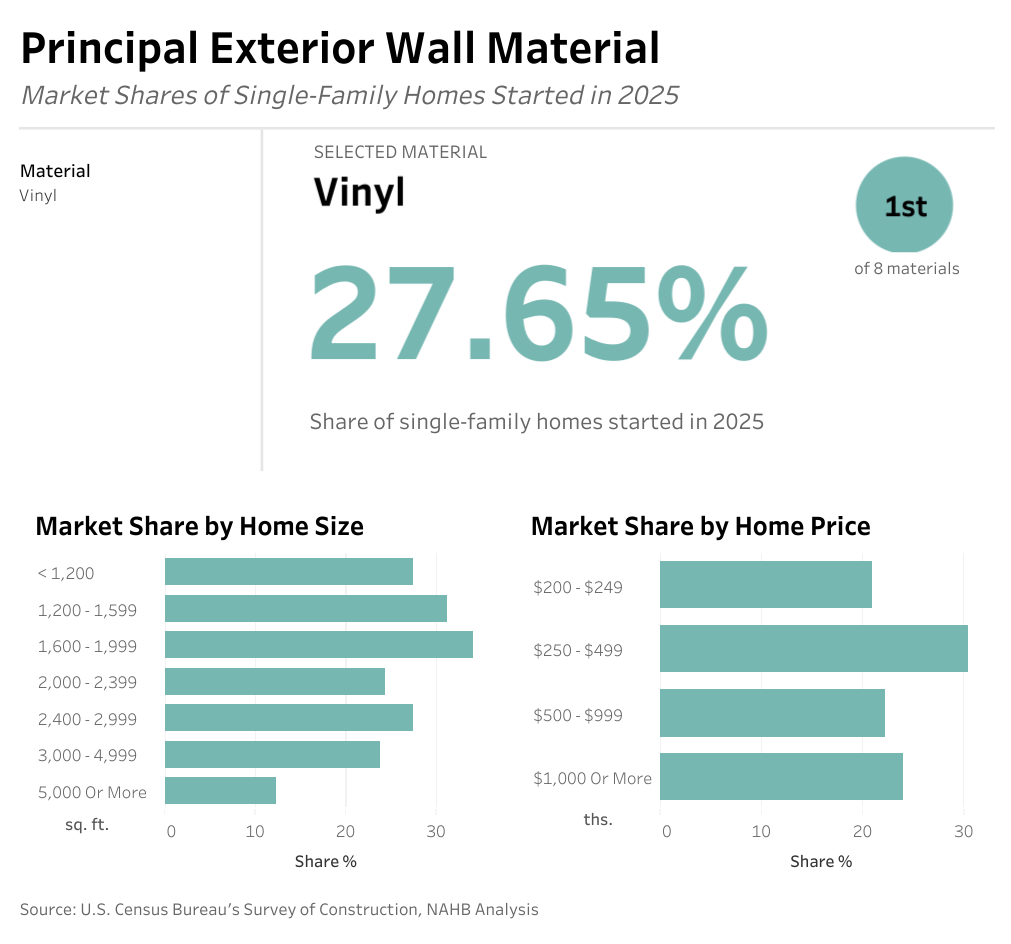
As shown in the dashboard above, exterior material preferences varied by both home size and price. Vinyl siding had the largest market share among smaller homes (under 2,000 square feet), while fiber cement was most common in larger homes (3,000 square feet or more). Stucco was widely used across all home sizes but was most prevalent in midsized homes (2,000–2,999 square feet).
A majority of homes started in 2025 were priced between $250,000-$499,000, where vinyl was most prevalent. Meanwhile, stucco was the most common material in home priced above $500,000. Interestingly, although brick siding was most common in lower-priced homes, it also had a relatively high market share among larger homes. This apparent contradiction highlights the most important factor influencing exterior material choices: geography.
Climate, regional building practices, material availability, and architectural styles create substantial differences in siding preferences across the country. In 2025, brick or brick veneer was the most common exterior siding material in the West South Central division at 54%. As the South tends to build larger and more affordable homes, this helps explain why brick siding is associated with both larger and lower-priced homes.
In 2025, vinyl siding was the most widely used primary exterior material in five out of nine census divisions. Vinylsidingwas used on 73% of the new homes started in the Middle Atlantic, 72% in New England, 71% in the East North Central, 47% in the West North Central and the East South Central at 39%. Notably, this was the first time since 2020 that vinyl siding surpassed brick siding in the East South Central division.
Stucco was the most used primary exterior wall material in the Pacific and South Atlantic divisions in 2025, at 65% and 33% of the new single-family homes started in those areas. Fiber Cement siding slightly surpassed stucco this year in the Mountain division with a 42% market share for the first time based on data available back to 2000.
The highest market share for wood exterior siding was in the West North Central division at 23% of homes started in 2025. Meanwhile, stone, concrete block, and other siding materials held similary small shares across all divisions.
This article was originally published by a eyeonhousing.org . Read the Original article here. .