Homeownership continues to play an important role for household wealth accumulation in the United States. Beyond providing stability, owning a home allows households to build equity over time and accumulate a valuable financial asset. As highlighted in a previous blog post, the benefits of homeownership extend beyond wealth accumulation to include greater financial security, retirement stability, and broader household and community well-being.
The latest Federal Reserve Survey of Consumer Finances (SCF)1 underscores the importance of housing in household finances. In 2025, primary residences accounted for more than one-quarter of total household assets, with an aggregate value of $47.2 trillion. The data also reveal a substantial wealth gap between homeowners and renters and show how important home equity varies across income and age groups.
Primary Residences Remain an Important Household Asset
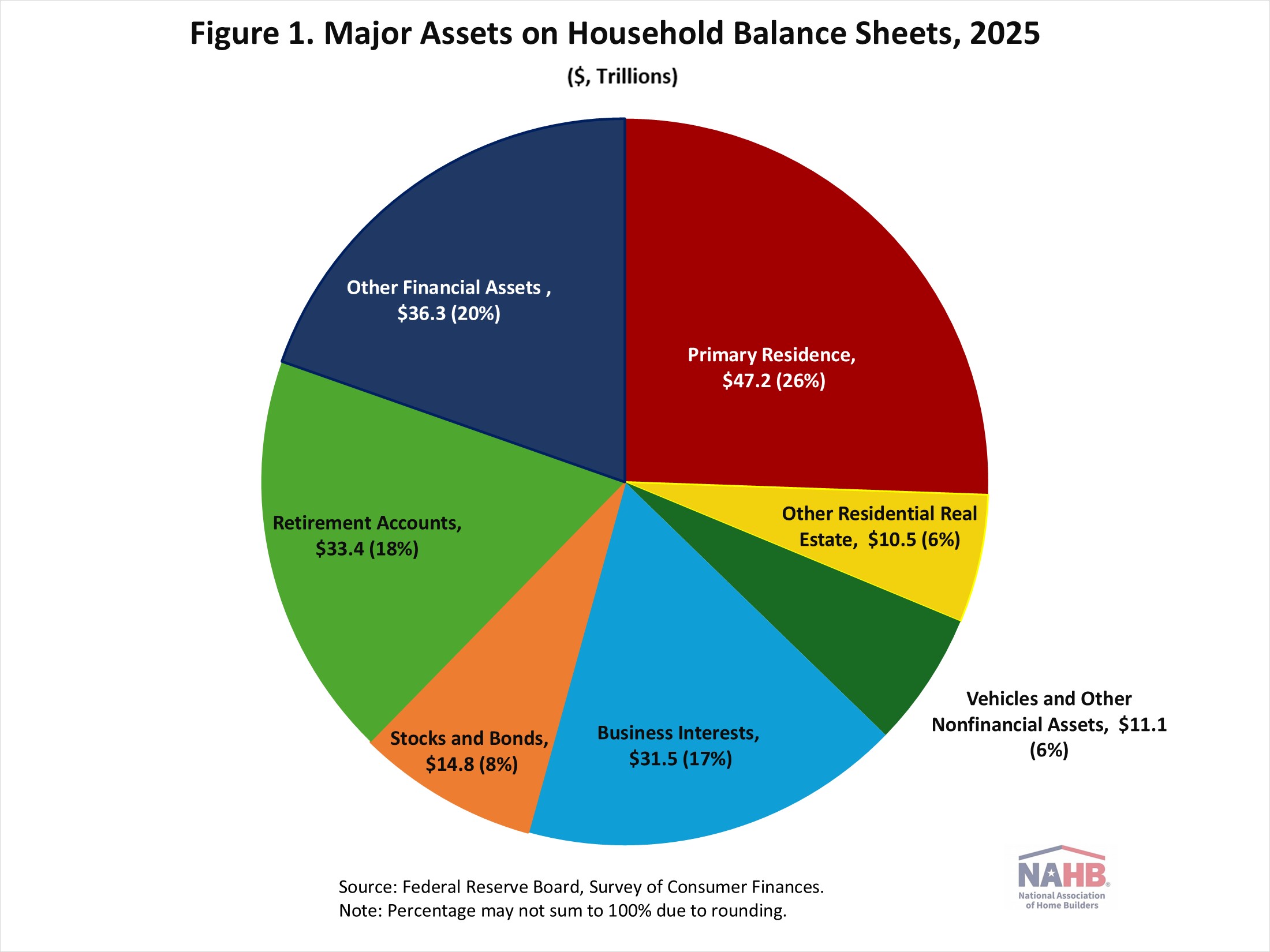
Primary residences represent one of the largest components of U.S. household assets, exceeding several major financial and investment asset categories (Figure 1).
In 2025, the aggregate value of primary residences reached $47.2 trillion, accounting for 26% of total household assets. This exceeded the value of other financial assets2 (20%, or $36.3 trillion), retirement accounts (18%, or $33.4 trillion), and business interests (17%, or $31.5 trillion).
Homeownership is also widely distributed among U.S. households. Nearly two-thirds (66%) owned their primary residence in 2025. By comparison, 55% of households held retirement accounts, while 20% owned stocks or bonds.
Although other financial assets were held by 99% of households, this broad category includes checking accounts, money market accounts, and prepaid debit cards, which are often used primarily for everyday financial transactions rather than long-term wealth accumulation. The substantial share of household assets represented by primary residences highlights the importance of housing in the overall financial well-being of American households.
Homeowners Continue to be Wealthier than Renters
The importance of housing as a household asset is also reflected in the substantial wealth difference between homeowners and renters (Figure 2).
In 2025, the median net worth of homeowner households was $458,900, compared with just $10,600 for renter households. This means that the median homeowner household had approximately 43 times the net worth of the median renter household. Between 2022 and 2025, median net worth among homeowners increased by 6%, while renters’ median net worth declined by 7%.
The wealth gap extends beyond home equity. Homeowners also tend to hold greater amounts of financial assets, including retirement accounts, stocks, and other investments. In 2025, median financial assets among homeowners who held financial assets were $109,800, compared with $5,300 among renters who held financial assets. This difference suggests that the wealth advantage associated with homeownership is reflected in broader household balance sheets, not just housing wealth.
It is worth noting that income, age, education, and other household characteristics also contribute to the observed wealth gap. These findings therefore illustrate the strong association between homeownership and greater household wealth rather than establishing homeownership as the sole cause of the difference.
Home Equity Plays an Important Role for Lower-income and Older Households
While homeowners generally have greater wealth than renters, the contribution of home equity to household wealth varies considerably across income and age groups (Figure 3). For many households, particularly those approaching or in retirement, accumulated home equity represents a substantial share of their overall wealth.
The median share of wealth held in home equity generally increases with age and decreases with income. Among households age 75 and older, home equity accounts for 62% of wealth in the lowest-income group, compared with just 16% among those in the highest-income group. A similar pattern appears among households age 65–74, where the median home equity share ranges from 40% for the lowest-income group to 15% for the highest-income group.
These findings highlight the importance of housing equity as a source of financial security later in life. For lower-income older households, accumulated home equity can represent a particularly important store of wealth and a potential source of financial flexibility during retirement.
However, this pattern is not universal across all age and income groups. Several younger, lower-income groups have a median home equity share of zero, reflecting the fact that many households in these groups do not own a home. This variation illustrates how differences in access to homeownership, as well as the ability to accumulate housing equity, shape the composition of household wealth.
Mortgage-free Homeowners have Accumulated More Housing Equity and Wealth
The extent of housing wealth also depends on where households are in the mortgage repayment process. Comparing homeowners with and without outstanding mortgage debt provides another perspective on how home equity relates to overall household wealth (Figure 4).
In 2025, almost two-thirds of homeowners had outstanding home-secured debt, while just over one-third owned their homes free of mortgage debt. As expected, homeowners who had paid off their mortgages held greater housing equity and higher overall net worth than those still carrying a mortgage.
The median primary residence equity among mortgage-free homeowners was $300,000, compared with $205,000 among homeowners with outstanding mortgages. The difference was also evident in overall household wealth: mortgage-free homeowners had a median net worth of $605,700, compared with $417,730 for homeowners who still carried mortgage debt.
These differences highlight the role of mortgage repayment in building home equity over the life cycle of homeownership. As households pay down their mortgage principal, they increase their ownership stake in their homes, potentially strengthening their overall financial position.
However, carrying a mortgage does not mean households are not building wealth. Homeowners with outstanding mortgages also accumulate equity as they repay their loans and may benefit from rising home values.
Conclusion
The 2025 Survey of Consumer Finances reinforces the important role of homeownership in household wealth accumulation. Although differences in household characteristics and financial circumstances shape the wealth gap, homeownership provides an important opportunity to accumulate assets through a property that serves an essential housing need. For American households, homeownership remains more than a housing choice: it can be a meaningful pathway toward building wealth and achieving long-term financial security.
Note:
This article was originally published by a eyeonhousing.org . Read the Original article here. .