Tag

Household

Browsing


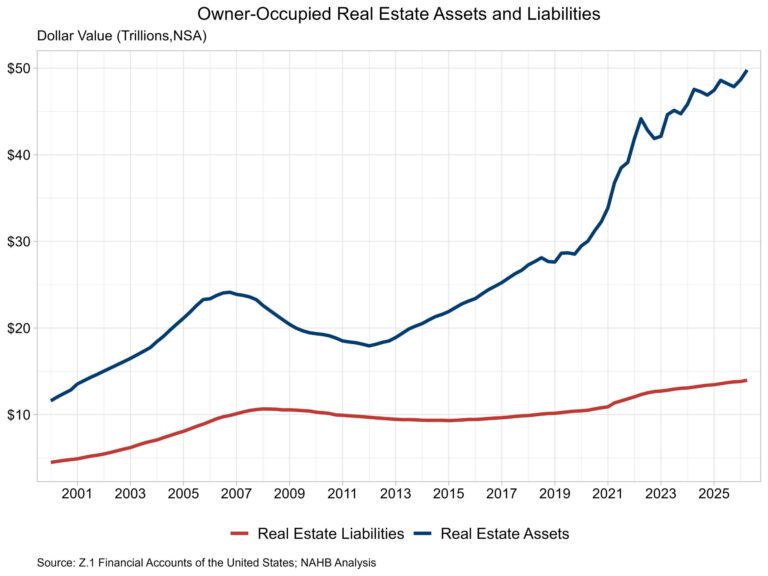
The market value of households’ real estate assets rose to a new high in the first quarter reaching $48.7 trillion, according to the most recent release of U.S. Federal Reserve Z.1 Financial Accounts. This level is 1.7% higher than in the fourth quarter and is 2.6% higher than a year ago.

This measure of market value estimates the value of all owner-occupied real estate nationwide. The calculation combines repeat-home sales data with estimates of additions to the housing stock, essentially measuring both price changes and the change in quantity of housing assets. This approach explains why household real estate wealth can continue to rise even as other measures may show a slowing in home price growth.

Real estate secured liabilities of households’ balance sheets, i.e. mortgages, home equity loans, and HELOCs, increased 0.2% in the first quarter to $13.8 trillion. This level is 2.8% higher compared to the first quarter of 2025.

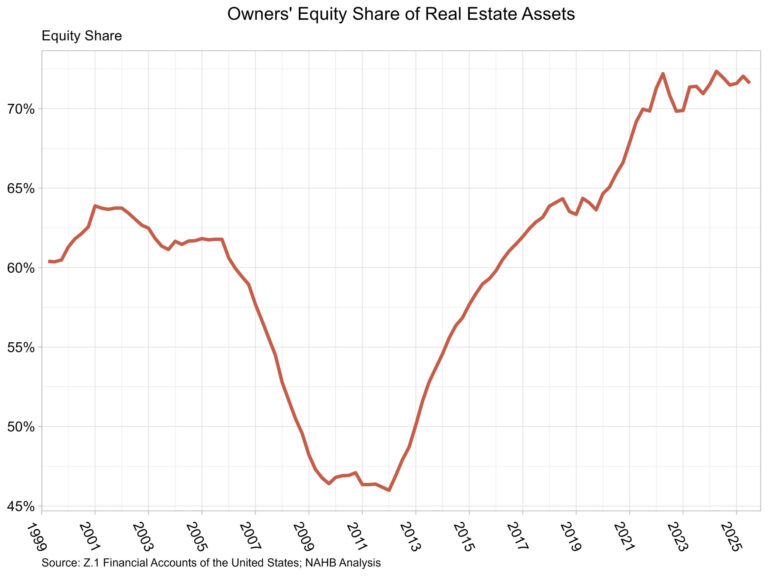
Owners’ equity share of real estate assets was 71.6% in the first quarter. This was the twelfth consecutive quarter where this share was over 70%. Owners’ equity in real estate totaled $34.9 trillion in the first quarter.

Distributional Financial Accounts 

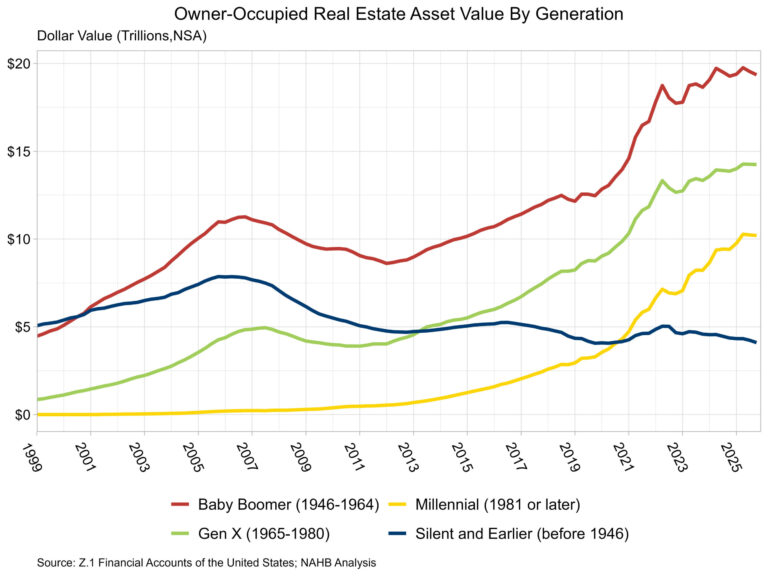
The quarterly release of the financial accounts by the Federal Reserve includes extensive balance sheet data. As a supplement to the main release, additional data regarding households is released in the distributional financial accounts a few weeks after the main release. This data contains the level and share of aggregate household wealth by income, age, generation, education, and race. The section below focuses on real estate assets value by generation for households and is current through the fourth quarter of 2025.

In the fourth quarter, households in the Baby Boomer generation held the largest level of real estate assets, totaling $19.4 trillion. Baby Boomers have owned the most real estate wealth since the fourth quarter of 2000. The generation with the second-largest level of real estate assets was Gen X at $14.3 trillion. Millennials held the third most, at $10.2 trillion, while the Silent Generation held $4.1 trillion. Notably, despite owning the least amount of aggregate real estate, households in the Silent Generation were second when the data is adjusted to a per household measure.

While every generation has seen remarkable gains in real estate assets since 2020, households in the Baby Boomer generation have experienced higher gains in terms of value while Millennials have gained the most on a percentage basis. Households in the Baby Boomer generation between the fourth quarter of 2020 to 2025 gained $15,454 in real estate asset value per household, a 47.1% increase. Meanwhile, Millennials gained $9,136 over the same period, an astounding 80.4% increase from 2020. Since these measures are at a per household level, they are smaller than current home prices given not every household owns real estate assets.


This article was originally published by a eyeonhousing.org . Read the Original article here. .

The market value of household real estate assets fell for the second consecutive quarter to $47.9 trillion in the fourth quarter of 2025, according to the most recent release of U.S. Federal Reserve Z.1 Financial Accounts. The fourth quarter level is 0.7% lower than the third quarter but is 2.1% higher than a year ago.

This measure of market value estimates the value of all owner-occupied real estate nationwide. The calculation combines both repeat-home sales data with estimates of additions to the housing stock, essential measuring both price changes and the change in quantity of housing assets. This approach explains why household real estate wealth can continue to rise even as other measures may show a slowing in home price growth.

Real estate secured liabilities of households’ balance sheets, i.e. mortgages, home equity loans, and HELOCs, increased 0.7% in the fourth quarter to $13.8 trillion. This level is 2.9% higher compared to the fourth quarter of 2024.

Owners’ equity share of real estate assets was 71.3% in the fourth quarter. This share also fell for the second consecutive quarter and was slightly lower than a year ago. Even with the quarterly decline, this share has been above 70% for 11 consecutive quarters, the longest stretch since the 1950s. Owners’ equity in real estate totaled $34.1 trillion in the fourth quarter.


This article was originally published by a eyeonhousing.org . Read the Original article here. .


The market value of household real estate assets fell to $48.0 trillion in the third quarter of 2025, according to the most recent release of U.S. Federal Reserve Z.1 Financial Accounts. The third quarter value is 0.7% lower than the second quarter but is 1.5% higher than a year ago.

This measure of market value estimates the value of all owner-occupied real estate nationwide. The calculation combines both repeat-home sales data with estimates of additions to the housing stock, essential measuring both price changes and the change in quantity of housing assets. This approach explains why household real estate wealth can continue to rise even as other measures may show a slowing in home price growth.

Real estate secured liabilities of households’ balance sheets, i.e. mortgages, home equity loans, and HELOCs, increased 0.8% in the third quarter to $13.6 trillion. This level is 2.8% higher compared to the third quarter of 2024.

Owners’ equity share of real estate assets was 71.6% in the third quarter, slightly lower than the second quarter due to the decline in real estate asset values. The share in the third quarter of 2024 was 72.0% and has been above 70% for 15 consecutive quarters, the longest stretch since the 1950s. Owners’ equity in real estate was $34.4 trillion in the third quarter.


This article was originally published by a eyeonhousing.org . Read the Original article here. .

The market value of household real estate assets fell from $48.1 trillion to $47.9 trillion in the first quarter of 2025, according to the most recent release of U.S. Federal Reserve Z.1 Financial Accounts. The value of household real estate assets declined for three consecutive quarters after peaking at $48.8 trillion in the second quarter of 2024 but remains 2.1% higher over the year.

Real estate secured liabilities of households’ balance sheets, i.e. mortgages, home equity loans, and HELOCs, increased 0.3% over the first quarter to $13.4 trillion. This level is 2.9% higher compared to the first quarter of 2024.

Owners’ equity share of real estate assets was 72.0% in the first quarter, marking a small decline in owners’ equity share which matches the decline in the market value of households real estate assets. The share in the first quarter of 2024 was 72.2%.

Discover more from Eye On Housing

Subscribe to get the latest posts sent to your email.


This article was originally published by a eyeonhousing.org . Read the Original article here. .
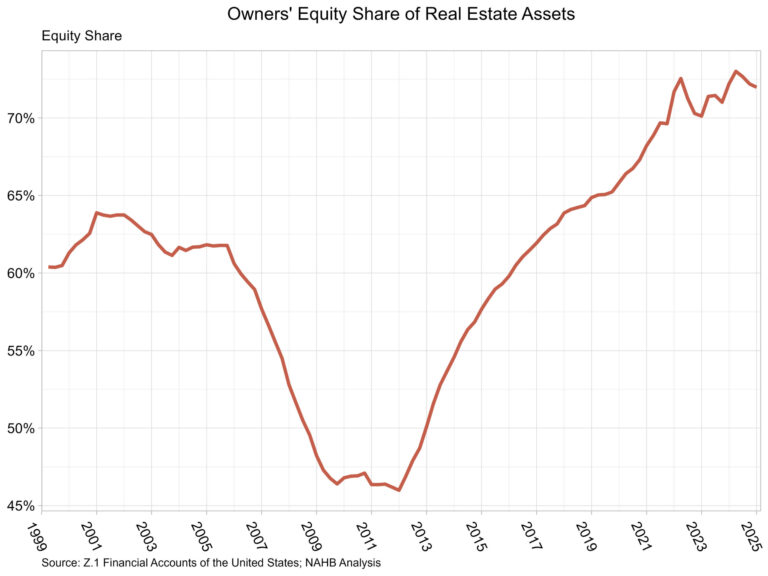

Owners’ equity share of household real estate assets remained above 70% for the tenth straight quarter, continuing to mark the highest levels of this share since the late 1950s. The share in the second quarter of 2024 was 72.7%, up from a year ago when it stood at 71.4%. Notably, this is the highest reading of owners’ equity share since the fourth quarter of 1958, when it was 73.3%.

Household real estate assets represent all types of owner-occupied housing including farm houses and mobile homes, as well as second homes that are not rented, vacant homes for sale, and vacant land at current market value. Household real estate liabilities represent all outstanding residential mortgages as well as loans made under home equity lines of credit and home equity loans secured by junior liens. Owners’ equity is the difference between the current market value of the household’s property and the existing debt secured by the property (assets – liabilities).

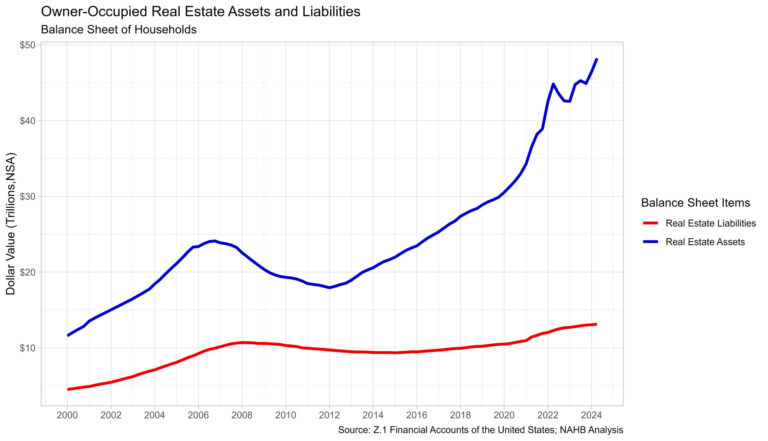
The market value of household real estate assets rose from $46.4 trillion to $48.2 trillion in the second quarter of 2024 according to the most recent release of U.S. Federal Reserve Z.1 Financial Accounts. Over the year, household real estate assets were 7.7% higher in the second quarter following a 9.2% increase in the first quarter.

Household real estate secured liabilities, i.e. mortgages, home equity loans, and HELOCs, increased 0.8% over the second quarter to $13.1 trillion. This level is 2.6% higher than the second quarter of 2023, the same as the increase in the first quarter of 2.6%.

Discover more from Eye On Housing

Subscribe to get the latest posts sent to your email.


This article was originally published by a eyeonhousing.org . Read the Original article here. .
Pin It