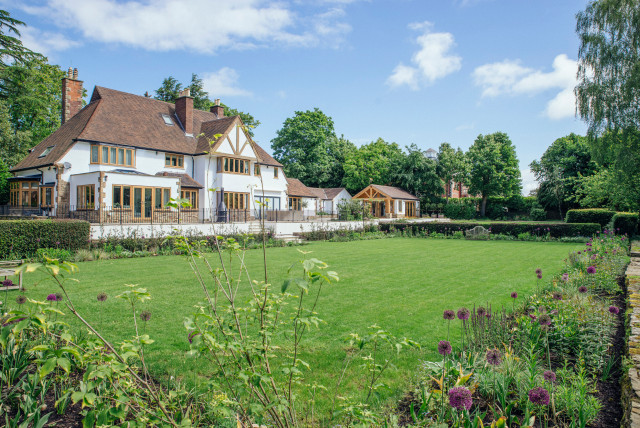
The couple wanted a space where they could site a tent for summer parties, so Philpott retained the big lawn immediately behind the house (seen here in summer looking toward the pool that’s behind the wood fence), but added borders all around to create a beautiful floral backdrop.
“I’d call my style naturalistic and quite romantic — I like to use lots of perennials and have softness in my planting,” she says. “Here, I went for a really soft feel, because when you cross the lawn and go down stone steps [on the left], you enter a more naturalistic area. I wanted to create a transition from formal planting to that wilder feel as you move away from the house.”
The Arts and Crafts-inspired plantings around the lawn include ‘Twilight’ purple asters (Eurybia x herveyi ‘Twilight’, USDA zones 3 to 9; find your zone) and white fireweed (Chamerion angustifolium ‘Album’, zones 3 to 7). “It’s often considered a weed because it gets everywhere, but this is a cultivated variety. It does self seed, but it’s actually clumped up very quickly,” Philpott says. “It’s a good choice when you’re establishing planting and you have gaps, as it fills out the space and gives the soft, romantic feel I was going for.”
Also seen growing here are purple ‘Caradonna’ sage (Salvia nemorosa ‘Caradonna’, zones 4 to 9), white ‘Madame Emile Mouillère’ bigleaf hydrangeas (Hydrangea macrophylla ‘Madame Emile Mouillère’, zones 5 to 9) and burgundy ‘Raven’ beardtongue (Penstemon ‘Raven’, zones 5 to 9). The dense holly hedges at either side were existing. “They provide a fantastic evergreen backdrop for planting: the purple asters look almost luminous against them,” Philpott says.
Retaining existing plants, such as these hedges, is important to Philpott. “I never want to go in, especially with a garden like this that’s been here since the early 20th century, and rip everything out, because it’s unnecessary,” she says. “It’s about seeing what’s there and what’s worth keeping and maybe reshaping it if necessary, but it would take decades to get new hedges to look like these because they’re so thick.”


“I’d call my style naturalistic and quite romantic — I like to use lots of perennials and have softness in my planting,” she says. “Here, I went for a really soft feel, because when you cross the lawn and go down stone steps [on the left], you enter a more naturalistic area. I wanted to create a transition from formal planting to that wilder feel as you move away from the house.”
The Arts and Crafts-inspired plantings around the lawn include ‘Twilight’ purple asters (Eurybia x herveyi ‘Twilight’, USDA zones 3 to 9; find your zone) and white fireweed (Chamerion angustifolium ‘Album’, zones 3 to 7). “It’s often considered a weed because it gets everywhere, but this is a cultivated variety. It does self seed, but it’s actually clumped up very quickly,” Philpott says. “It’s a good choice when you’re establishing planting and you have gaps, as it fills out the space and gives the soft, romantic feel I was going for.”
Also seen growing here are purple ‘Caradonna’ sage (Salvia nemorosa ‘Caradonna’, zones 4 to 9), white ‘Madame Emile Mouillère’ bigleaf hydrangeas (Hydrangea macrophylla ‘Madame Emile Mouillère’, zones 5 to 9) and burgundy ‘Raven’ beardtongue (Penstemon ‘Raven’, zones 5 to 9). The dense holly hedges at either side were existing. “They provide a fantastic evergreen backdrop for planting: the purple asters look almost luminous against them,” Philpott says.
Retaining existing plants, such as these hedges, is important to Philpott. “I never want to go in, especially with a garden like this that’s been here since the early 20th century, and rip everything out, because it’s unnecessary,” she says. “It’s about seeing what’s there and what’s worth keeping and maybe reshaping it if necessary, but it would take decades to get new hedges to look like these because they’re so thick.”