Tag

Rooms

Browsing


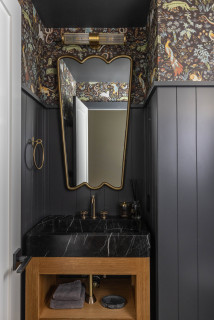
Designer: Nadia Shapiro of HarmoniQ Design Studio
Location: Los Gatos, California
Size: 20 square feet (1.9 square meters)

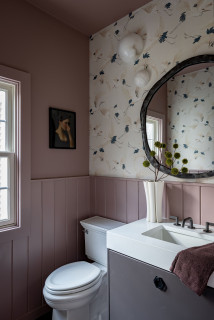
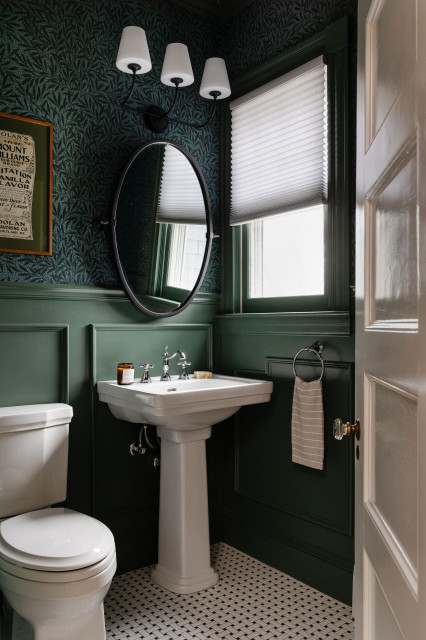
Homeowners’ request. “This home was originally built in the 1960s, and before we joined the project our clients had already rebuilt the house and reworked the overall layout with their architects,” says designer Nadia Shapiro. “We were invited to refine and elevate several areas, including this powder room. Since the powder room serves as a hallway bathroom for guests and our clients love to entertain, we wanted it to feel memorable, moody and expressive. More like a little jewel box than a purely functional space. The client is a stage designer and loves the romance and drama of the Victorian era, so our goal was to translate that inspiration in a way that felt fresh, sophisticated and connected to the rest of the home.”

Special features. “One of the most important decisions was rethinking the layout,” Shapiro says. “We followed the principle that when you open the door, your eye should be drawn toward something beautiful. By adjusting the layout we were able to make the vanity and mirror the main focal point, which immediately gave the room a stronger sense of intention. We then layered whimsical animal wallpaper with wainscoting to bring in personality and a subtle Victorian-inspired feeling. The room also features a stone sink, custom cabinetry, brass finishes and a patterned floor, all of which helped create that moody, collected, jewel box atmosphere.”

Designer tip. “Powder rooms are the perfect place to take a design risk,” Shapiro says. “Because they are smaller and often used by guests, you can be more expressive with wallpaper, pattern, color and lighting. The key is to balance the drama with architectural details like wainscoting so the space still feels grounded and timeless.”

Wallpaper: Trematonia in Onyx, House of Hackney; mirror: Garvey, Anthropologie; wainscoting and ceiling paint: Wrought Iron, Benjamin Moore


This article was originally published by a www.houzz.com . Read the Original article here. .


Lindy Design BuildSave Photo
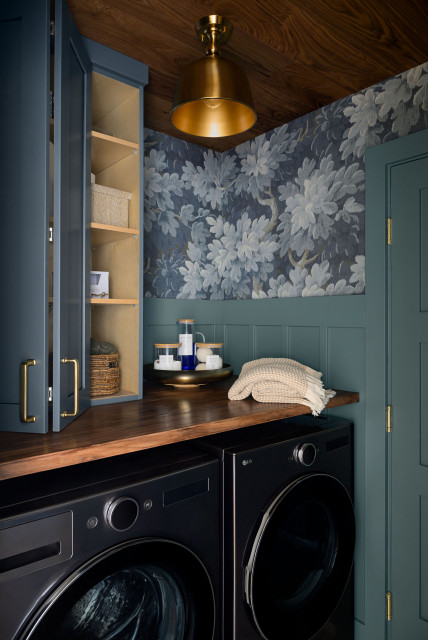
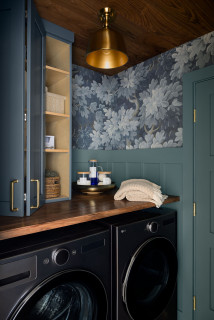
Designer tip. “By keeping our color palette simple with a collection of shades of blues and wood tones, we gave ourselves the opportunity to play with the patterns and textures without overwhelming this little laundry,” Christensen says.

“Uh-oh” moment. “Taking the wallpaper plunge was a big leap for our client,” Christensen says. “She didn’t have wallpaper anywhere else in her home and was worried her laundry room would feel out of place. We explored a few different directions together with variations of paint and wallpaper, and ultimately we all fell in love with this bold little laundry room design that was dripping in personality. Laundry rooms can be the perfect space to try something a little different.”

Christensen uses Houzz Pro software, especially for finish material selections. “It makes it super simple for our clients — including on this project — to approve finishes and leave us comments on individual items,” she says.

Wallpaper: Vintage Foliage in dark blue, Rebel Walls; floor tile: Annie Selke Flora in Vapor Blue, The Tile Shop; light: Berg in warm brass, Savoy House

See why you should hire a professional who uses Houzz Pro software


This article was originally published by a
www.houzz.com . Read the Original article here. .


2. Moody Meets Practical

Designer: Amy Leferink of Interior Impressions
Location: Minnesota
Size: 360 square feet (33 square meters); 18 by 20 feet

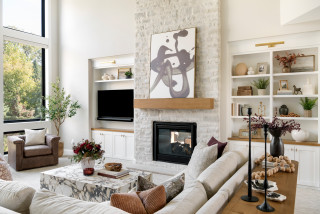
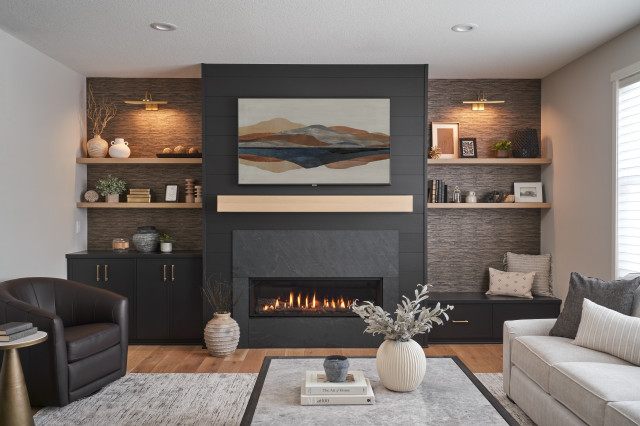
Homeowners’ request. “The homeowners wanted their living room to feel more intentional, cohesive and elevated while still being comfortable for everyday use,” says designer Amy Leferink. “The existing space felt a bit disjointed, with a traditional fireplace that didn’t align with their desired aesthetic, and lacked both visual impact and functional storage. Our goal was to create a strong focal point while adding warmth, texture and purpose. We reimagined the fireplace wall entirely, incorporating built-ins and layered materials to bring both beauty and functionality into the space.”

Built-in details. “The built-ins were designed as an extension of the architecture rather than feeling like added furniture,” Leferink says. “We incorporated custom cabinetry in a rich black painted finish (Caviar by Sherwin-Williams) to anchor the fireplace wall and provide concealed storage. Flanking the fireplace, rift-sawn white oak floating shelves add warmth and contrast, creating a balanced mix of light and dark tones.

“A substantial wood mantel ties the composition together, while the cabinetry and shelving provide both display space and everyday functionality. This approach was chosen over standalone furniture to create a more cohesive, built-in look that feels intentional and tailored to the home. It allows the entire wall to function as a unified design feature rather than a collection of separate pieces.”

Other special features. “The fireplace itself was updated to a sleek linear design, surrounded by a minimal black granite stone for a clean, modern look,” Leferink says. “The entire wall was wrapped in horizontal shiplap and painted in a deep black to create contrast and depth. To soften the darker elements, we introduced a textured grasscloth wallpaper on the adjacent walls, which adds subtle warmth and dimension without competing with the focal point. Throughout the space we layered warm wood tones, soft neutrals and aged brass accents to create a refined yet inviting palette. Updated lighting, including picture lights above the shelving, adds both function and a warm ambient glow.”

Designer tip. “Don’t be afraid to use contrast,” Leferink says. “Pairing darker architectural elements with warm wood tones and soft textures creates depth and balance, helping a space feel both grounded and inviting rather than flat or one-dimensional.”

“Uh-oh” moment. “One of the biggest challenges was balancing the scale of the fireplace wall,” Leferink says. “We knew we wanted it to feel impactful, but there was a moment during the design phase where we questioned if going dark and full height would overwhelm the room. Creating 3D renderings of the space helped us work through that hesitation. Seeing the proportions, materials and contrast come together digitally gave both us and the homeowners confidence to move forward — and ultimately it became the defining feature of the space.”

Leferink uses Houzz Pro software to manage projects. “We utilize features such as the 3D Floor Planner and renderings to help clients visualize their space early in the design process,” she says. “For this project, renderings of the fireplace wall were especially helpful in communicating scale, materiality and overall design intent, allowing the client to feel confident in their decisions before construction began.”

Wall paint: Drift of Mist, Sherwin-Williams

See why you should hire a professional who uses Houzz Pro software


This article was originally published by a www.houzz.com . Read the Original article here. .


Sundial DesignsSave Photo
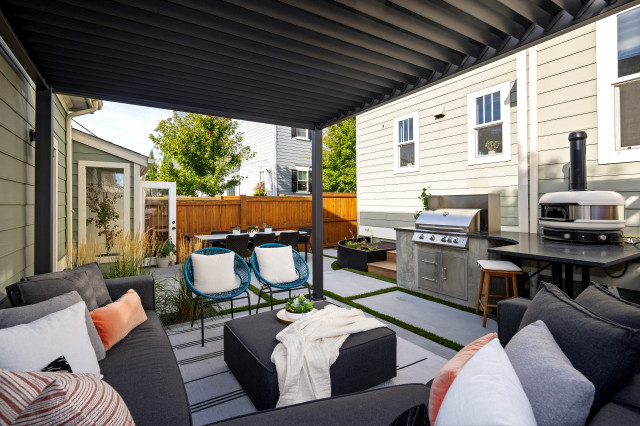
In addition to composing the different backyard zones in a pleasing way, the designer wanted the concrete pads to work within those spaces. “We planned these lines of turf so carefully,” Robinson says. For example, she determined where the dining chairs would be placed, then ran a line of turf between them. This ensured that all the chair legs would sit atop concrete.

For homeowners deciding where to save and splurge, Robinson recommends prioritizing vertical surfaces over paving. “Using the concrete separated by turf kept the patio interesting and on budget,” she says. “It saved a lot of money over choosing something like a porcelain patio surface.”

Custom powder-coated steel planters, including a curved piece that echoes the bar’s countertop, were among the splurges. “A squared-off planter would have felt too hard-edged, and it would have impeded traffic,” Robinson says.

This versatile feature — which can be used to grow herbs, veggies or ornamentals — anchors the design. The turf lines and concrete pads ripple out from the planter, integrating it into the landscape.


This article was originally published by a
www.houzz.com . Read the Original article here. .


Sundial DesignsSave Photo
In addition to composing the different backyard zones in a pleasing way, the designer wanted the concrete pads to work within those spaces. “We planned these lines of turf so carefully,” Robinson says. For example, she determined where the dining chairs would be placed, then ran a line of turf between them. This ensured that all the chair legs would sit atop concrete.

For homeowners deciding where to save and splurge, Robinson recommends prioritizing vertical surfaces over paving. “Using the concrete separated by turf kept the patio interesting and on budget,” she says. “It saved a lot of money over choosing something like a porcelain patio surface.”

Custom powder-coated steel planters, including a curved piece that echoes the bar’s countertop, were among the splurges. “A squared-off planter would have felt too hard-edged, and it would have impeded traffic,” Robinson says.

This versatile feature — which can be used to grow herbs, veggies or ornamentals — anchors the design. The turf lines and concrete pads ripple out from the planter, integrating it into the landscape.


This article was originally published by a
www.houzz.com . Read the Original article here. .


apartmentjeanieSave Photo
8. Moody Glam Vibes

Designers: Jeanie Engelbach and Ryan Romanowski of apartmentjeanie
Location: New York City
Size: 168 square feet (16 square meters); 12 by 14 feet

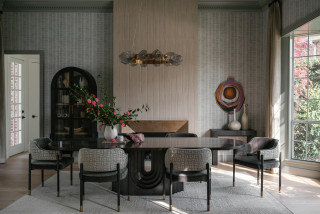
Homeowners’ request. “When the homeowners purchased this apartment, it was a complete white box, devoid of color, warmth and vibrancy,” says designer Jeanie Engelbach. “The dining area, and the rest of the open floor plan, did not accurately reflect our clients’ edgy, energetic and gothic yet glam aesthetic. As self-identified homebodies who love to entertain, they wanted a space that felt like them and was inviting to their guests. Having worked with them previously, we knew they trusted our instincts and ability to integrate their style and passions into the overall design concept and weren’t at all shocked when we suggested we use our client’s bright magenta-colored hair and black wardrobe as the inspiration.”

Special features. “To bring this vision to life, we fully committed to color drenching the entire open-floor living and dining room in a rich aubergine — Benjamin Moore Plum Royale — that transformed the space from generic white box to something far more regal and cinematic,” Engelbach says. “We carried the graphic metallic Art Deco-inspired wallpaper from the living room as a frieze to add contrast and structure, while the warm walnut custom-built bar and matching record stand introduces depth and acts as visual divider from living to dining area.

“The bar’s mirrored backsplash reflects light and creates an illusion of multiple windows. We inherited the polished live-edge dining table with lucite base from the apartment’s previous owner, then softened the room with curved velvet chairs that play off the plum tones. The chairs’ matte black steel tube frame anchors the hand-knotted wool rug in black with streaks of white . The dramatic Italian cascading crystal beaded chandelier brings movement and glamour.”

Designer tip. “When working with an open-floor-plan living space, it’s important to delineate designated areas within the larger floor plan,” Engelbach says. “However, implementing one consistent decorative element throughout — in this case, the paint and wallpaper — creates a sense of cohesion and continuity.”

Wallpaper: Art Deco Glamour, Spoonflower; chairs: Inesse in Iced Blue velvet, CB2

More on Houzz
Read more stories
Browse photos for ideas
Find home professionals


This article was originally published by a
www.houzz.com . Read the Original article here. .


Victoria Philpott GardensSave Photo
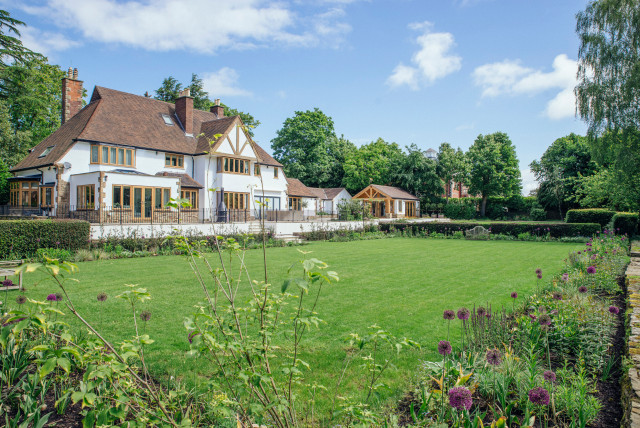
The couple wanted a space where they could site a tent for summer parties, so Philpott retained the big lawn immediately behind the house (seen here in summer looking toward the pool that’s behind the wood fence), but added borders all around to create a beautiful floral backdrop.

“I’d call my style naturalistic and quite romantic — I like to use lots of perennials and have softness in my planting,” she says. “Here, I went for a really soft feel, because when you cross the lawn and go down stone steps [on the left], you enter a more naturalistic area. I wanted to create a transition from formal planting to that wilder feel as you move away from the house.”

The Arts and Crafts-inspired plantings around the lawn include ‘Twilight’ purple asters (Eurybia x herveyi ‘Twilight’, USDA zones 3 to 9; find your zone) and white fireweed (Chamerion angustifolium ‘Album’, zones 3 to 7). “It’s often considered a weed because it gets everywhere, but this is a cultivated variety. It does self seed, but it’s actually clumped up very quickly,” Philpott says. “It’s a good choice when you’re establishing planting and you have gaps, as it fills out the space and gives the soft, romantic feel I was going for.”

Also seen growing here are purple ‘Caradonna’ sage (Salvia nemorosa ‘Caradonna’, zones 4 to 9), white ‘Madame Emile Mouillère’ bigleaf hydrangeas (Hydrangea macrophylla ‘Madame Emile Mouillère’, zones 5 to 9) and burgundy ‘Raven’ beardtongue (Penstemon ‘Raven’, zones 5 to 9). The dense holly hedges at either side were existing. “They provide a fantastic evergreen backdrop for planting: the purple asters look almost luminous against them,” Philpott says.

Retaining existing plants, such as these hedges, is important to Philpott. “I never want to go in, especially with a garden like this that’s been here since the early 20th century, and rip everything out, because it’s unnecessary,” she says. “It’s about seeing what’s there and what’s worth keeping and maybe reshaping it if necessary, but it would take decades to get new hedges to look like these because they’re so thick.”


This article was originally published by a www.houzz.com . Read the Original article here. .


Designer: Clare Donohue of One to One Studio
Location: New York City
Size: 15 square feet (1.4 square meters)

Homeowners’ request. “The clients dreamed of a swank loo for guests, but the old powder room was in desperate shape, additionally serving as the HVAC center and laundry room — all in a truly tiny space,” says designer Clare Donohue. “The new HVAC system required a much larger footprint, so we relocated the laundry to a separate space. I had to come up with a creative way to hide all those ugly machines and still make it special. Current visitors would never guess what lies behind the satiny paneled walls of the finished space: a mechanical closet filled with ugly machinery.”

Special features. “The renovated powder room is kitted out with custom wood panels that lift off to service the hidden HVAC equipment,” Donohue says. “Making use of every available inch, we created recessed display shelves from a small leftover niche. A beveled mirror spans the main wall. A floating sink with a wall-mounted faucet makes the most of the small space. The lower portion of the sink and toilet walls are protected from splashes with inset stone panels. Marble hex tiles cover the floor. All are color-matched to a rich charcoal color.”

Designer tip. “Don’t let small size stop you from making it special,” Donohue says. “The odds were against us here, but I was convinced we could make it beautiful despite the room being, in reality, a giant air handler.”

“Uh-oh” moment. “This one was nothing but challenges,” Donohue says. “The HVAC system went through a dozen revisions, each requiring adjustments to the room design. It ended up eating up extra ceiling and floor space and requiring the brick of the exterior wall to be opened up many floors up in a narrow outside courtyard filled with irreplaceable leaded glass windows. The engineers and co-op board feuded over what type of insulation would work, for weeks, while holding up framing and install. While we waited for the final room size to be determined, we couldn’t place the order for the custom sink, which had a huge lead time. In the end, we lucked out and were able to use a stocked size for much less money and faster delivery time.

“The room backs up to the elevator shaft, requiring us to fur out the wall for plumbing lines, making a small room even smaller. The Caesarstone wall inserts we had spec’d were based on a color sample that it turned out had been sold out without notice, and replaced with a much darker color, without a name change. So the contractor arrived with black, not gray, panels to install, at which point we had to get the whole of Caesarstone’s corporate offices involved to find a solution, all while the move-in date loomed. I swear, it felt like everything was against this design. I had to be really stubborn to get it to end up as envisioned. And we had a great team of engineers and project managers to pull it together.”

Custom cabinetry: NR Wood Design; paint: Whale Gray, Benjamin Moore


This article was originally published by a www.houzz.com . Read the Original article here. .


Designer: Janiece Lonvelin of Velène Design House
Location: La Mirada, California
Size: 400 square feet (37 square meters)

Homeowners’ request. “This was a special request from the clients — they wanted this room to evoke a subtle ‘Mad Men’ vibe,” says designer Janiece Lonvelin. “Not in a literal sense but in a way that felt a bit nostalgic, dramatic, fun and intentional. This room serves as a hangout space for the family, designed primarily for adults, especially with the bar located across the room.”

Special features. “We immediately fell in love with the walnut wall paneling and made it a priority to preserve and thoughtfully incorporate it into the new design,” Lonvelin says. “The existing beams were also kept to maintain character. To ground the space, we selected large-scale floor tile and layered in furnishings that play off one another, ultimately creating a room that feels moody, sexy and full of personality.

“We selected a striking art piece that felt contemporary yet carried a subtle retro influence. The olive sofa was an intentional choice, bringing in color, creating depth and standing out beautifully against the dark wood panelling. We layered in a rich mix of textures through the rug, bouclé chair and leather accent chairs to set the tone for the space. Thoughtful pops of color, along with glass and varied wood tones in the decor, helped tie everything together.”

Designer tip. “When working with dark walls, add contrast and texture in the pieces you bring in to prevent the space from feeling flat,” Lonvelin says. “Mix in different shapes like curved furniture or decor, especially if your room has a lot of squared-off corners. This creates balance, depth and visual interest throughout the space.”

“Uh-oh” moment. “The initial challenge was during the design process and getting the clients on board with the amount of color and texture in the space,” Lonvelin says. “While it wasn’t a lot overall, when you’re working primarily with neutrals, a large olive sofa becomes a significant pop of color. To help, we used 3D renders to showcase the completed look, showing how all colors worked together. This gave them a full sense of the space and helped ease their concerns.”

Wall paint: Swiss Coffee, Benjamin Moore


This article was originally published by a www.houzz.com . Read the Original article here. .


3. Built-In Sorting Systems

Designer: Erica Peale Design
Location: Arlington, Virginia
Size: 108 square feet (10 square meters); 9 by 12 feet

Homeowner’s request. “The homeowner wanted a more functional, well-organized space with dedicated storage for laundry and cleaning supplies,” says designer Erica Peale. “Previously, the room lacked proper laundry hampers, causing baskets to pile up on the floor, and there was no storage for linens or cleaning supplies, leaving the space cluttered. Painted a jarring orange, the room felt anything but inviting.”

Peale uses Houzz Pro software to help run her business. “We use Houzz for website hosting, 3D floor planning, project library and client reviews,” she says. “Houzz is an invaluable tool to help with our projects.”

Storage strategies. “Thoughtful design transformed this laundry room into a highly functional and organized space,” Peale says. “Open cubbies were created to house rolling laundry hampers, keeping them accessible yet neatly tucked away. Pullout drying racks add convenience for air-drying garments, while custom cabinetry provides ample storage for cleaning supplies, detergents and household linens. Additional features such as adjustable shelving, a built-in ironing board, concealed waste bins and dedicated folding surfaces ensure everything has a place, making daily laundry tasks more efficient and enjoyable.”

Other special features. “The custom cabinetry was painted in a soft, soothing spa-like blue, (Sherwin-Williams’ Stardew), bringing a calm and refined feel to the space,” Peale says. “Large-format 12-by-18-inch travertine floor tiles ground the room with warmth and texture, while a polished marble 1-inch hexagon backsplash adds a timeless, elevated touch. Floating shelves with brass ceiling-mounted brackets introduce both style and function, complemented by brass cabinet hardware that adds warmth and subtle contrast. A full-size utility sink enhances everyday usability, while Steele Canvas laundry baskets provide an efficient system for separating whites, darks and dry cleaning.”

Designer tip. “A key design approach we recommend is choosing a softer, more restful color palette and prioritizing closed storage to minimize visual clutter,” Peale says. “Layering a mix of textures and varying sheens not only reflects light throughout the space but also creates depth and visual interest, transforming a functional room into one that feels calm, polished and intentional.”

General contractor: Connor Bentley; wall paint: White Dove, Benjamin Moore

25 Home Design Trends Defining How We’ll Live in 2026


This article was originally published by a www.houzz.com . Read the Original article here. .
Pin It