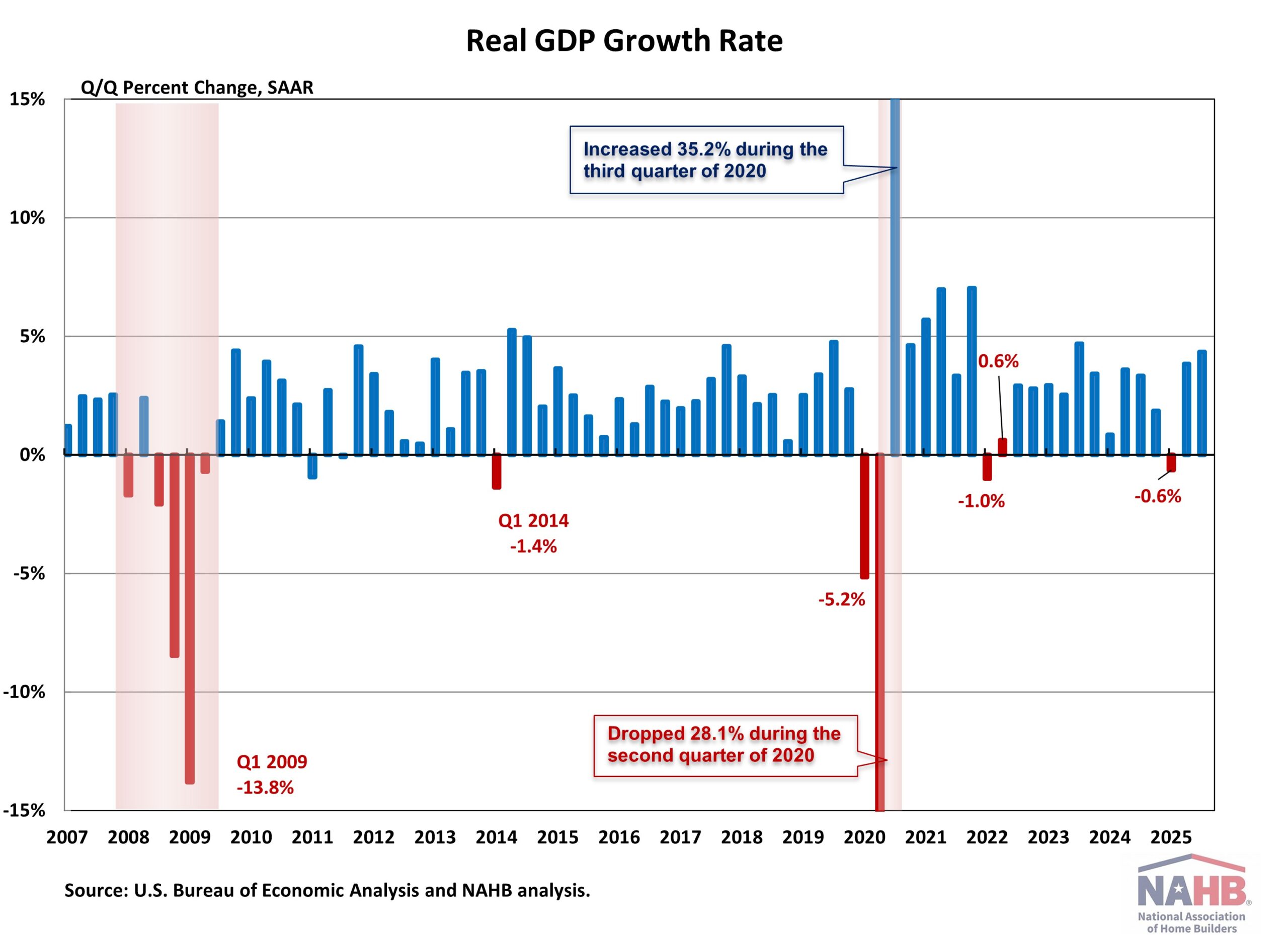
A belated GDP report shows that the U.S. economy expanded at a strong pace in the third quarter–July through September–before signs of cooling appeared in the labor market and consumer confidence weakened.
According to the “advance” estimate released by the Bureau of Economic Analysis (BEA), real gross domestic product (GDP) expanded at an annual rate of 4.3% in the third quarter of 2025, accelerating from a 3.5% increase in the second quarter. This marks the strongest pace of annual economic growth in the past two years. This growth rate was above the NAHB forecast for the quarter as well.
Furthermore, the latest data from the GDP report indicates that inflationary pressures intensified over the quarter. The GDP price index rose 3.8% for the third quarter, up from a 2.1% increase in the second quarter of 2025. The Personal Consumption Expenditures Price (PCE) Index, which measures inflation (or deflation) across various consumer expenses and reflects changes in consumer behavior, increased 2.8% during the quarter. This is higher than a 2.1% rise in the previous quarter.
This quarter’s increase in real GDP primarily reflected stronger consumer spending, exports, and government spending, which were partially offset by a decrease in investment. Imports, which are a subtraction in the calculation of GDP, decreased during the quarter as tariffs had measurable effects.
Consumer spending, the backbone of the U.S. economy, rose at an annual rate of 3.5% in the third quarter, its strongest rate since the fourth quarter of 2024. Both goods and services contributed to the gain, with spending on goods rising at a 3.1% annual rate and spending on services increasing 3.7%.
Government spending also added to economic growth, reflecting increases in both state and local government spending (led by higher consumption expenditures) as well as increased federal government spending, driven by defense consumption expenditures.
Nonresidential fixed investment increased 2.8% in the third quarter. The increases in equipment (+5.4%) and intellectual property products (+5.4%) offset the decrease in structures (-6.3%). Meanwhile, residential fixed investment (RFI) continued to contract, declining 5.1% for the second consecutive quarter. Within the residential category, single-family structures fell 8.9% at an annual rate, multifamily structures declined 2.9%, and spending on home improvements dropped 7.6%.
For the common BEA terms and definitions, please access bea.gov/Help/Glossary.
This article was originally published by a eyeonhousing.org . Read the Original article here. .