Tag

State

Browsing


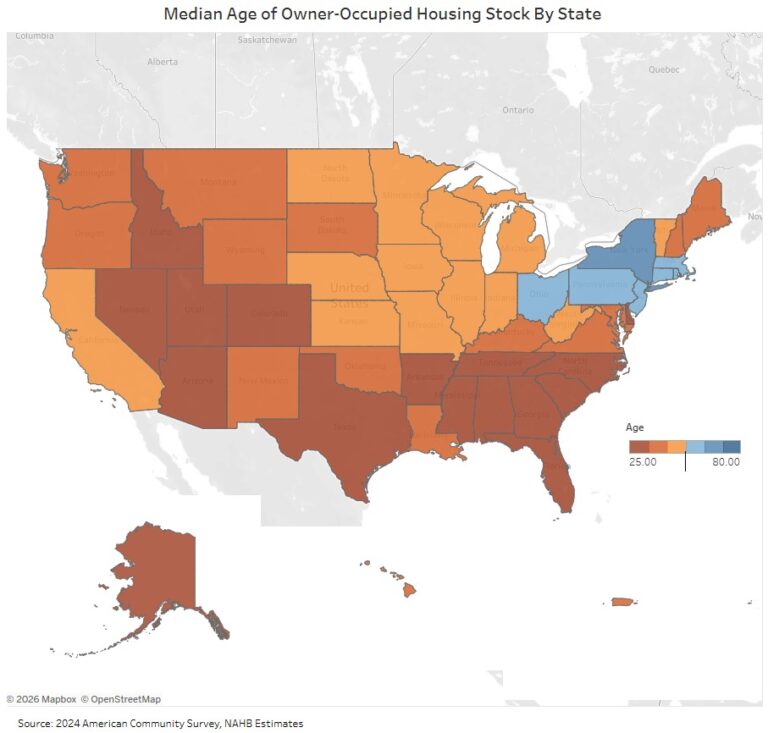
According to the latest data from the 2024 American Community Survey (ACS), the median age of owner-occupied homes has reached 42 years old. The age of the housing stock is an important remodeling market indicator. Older homes tend to be less energy-efficient than newly built homes and are more likely to require repairs, upgrades, and renovations in the future. At the same time, as people increasingly use their homes for multiple purposes and demand additional space, older housing represents an investment opportunity for homeowners.

The age of the owner-occupied housing stock varies greatly across 50 states. New York has the oldest owner-occupied homes with a median age of 64 years, followed by Massachusetts (59), and Rhode Island (59). Half of all owner-occupied houses in the District of Columbia were built more than 80 years ago. However, D.C. is generally not a representative market, given its smaller size and highly urbanized environment.

In contrast, newer owner-occupied housing is particularly concentrated in the Sun Belt states where 14 out of 15 states, the exception being California (45), have a median owner-occupied housing stock age below the national median (42 years). The median age of owner-occupied homes in Nevada is only 25 years, followed by Texas at 28 years. South Carolina, Georgia and Arizona also rank among the states with the newer homes, where half of owner-occupied homes have been built within the past 29 years. 

The geographic distribution of owner-occupied housing stock age reflects underlying population changes. Population growth, including both natural growth and net migration, signals rising demands for housing and typically leads to more new construction. As a result, the rapid population growth states, like Idaho, Nevada, South Carolina, Texas Florida, tend to have newer owner-occupied housing stock.  However, states experiencing slower or even negative population growth tend to have older housing. In states such as Pennsylvania, Vermont, and New York, the owner-occupied housing stock is older than the national median.


This article was originally published by a eyeonhousing.org . Read the Original article here. .

Residential improvement activity remained solid in 2024, though growth has moderated from the surge seen in 2022. The market continues to be supported by an aging housing stock, elevated homeowner equity, and a growing need for aging-in-place improvements. According to the 2024 Home Mortgage Disclosure Act (HMDA) data, the number of home improvement loan applications declined 3% from a year earlier, while the total dollar volume of these loans held steady at approximately $144 billion, essentially unchanged from 2023.

In this article, NAHB’s analysis of the 2024 HMDA data provides insight into remodeling trends across states and counties nationwide. The 2024 HMDA data, published by Consumer Financial Protection Bureau (CFPB), includes detailed information on residential mortgage lending, such as loan purpose and type, loan characteristics, and demographic information about loan applicants.

State-Level Analysis:

Remodeling activity varies not only by borrowers’ age but also across geographic areas, reflecting differences in cost of living, local economic conditions, and house prices.

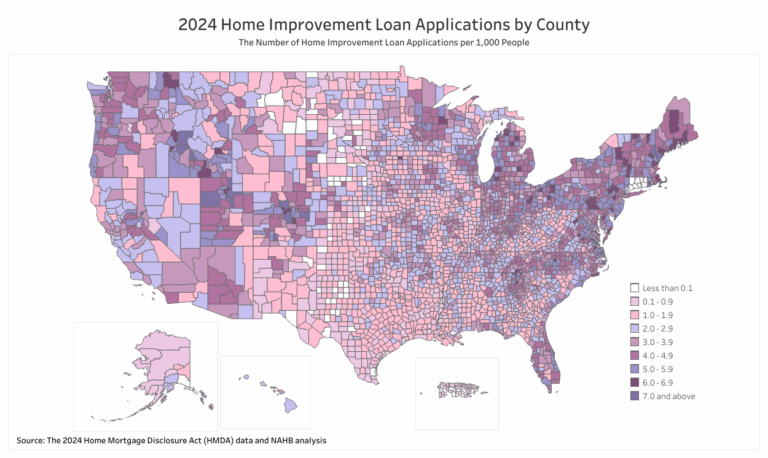
With respect to the total number of home improvement loan applications, California recorded the highest number in 2024, with 120,167 applications. Florida ranked second with 94,901 home improvement loan applications. At the other end of the spectrum, Wyoming, Alaska, and Puerto Rico had the lowest total numbers of home improvement loan applications, with 212, 1,397, and 1,600 applications, respectively.

When adjusting for population size, smaller states stand out. Rhode Island and New Hampshire recorded the highest number of home improvement loan applications per 1,000 people, at 6.0 and 5.6, respectively. Maine and Idaho ranked third and fourth, followed by Utah with 5.3 applications per 1,000 people.

Nationally, there were 3.5 home improvement loan applications for every 1,000 people in 2024. California, the nation’s most populous state, reported 3.0 applications per 1,000 people, which is lower than the national average.

County-Level Analysis:

The analysis of county-level home improvement loan applications per 1,000 people reveals that overall population size is not strongly correlated with per capita remodeling loan activity. In 2024, the ten most populous counties in the United States had an average of 2.6 home improvement loan applications per 1,000 people. Los Angeles County in California, one of the nation’s largest counties, reported 2.7 applications per 1,000 people. 

In contrast, several counties with a lower population had higher levels of home improvement loan applications relative to their population. For example, Rich County in Utah, with roughly 3,000 people, had the highest level nationwide at 12.0 applications per 1,000 people. Camas County in Idaho, with approximately 1,000 people, ranked higher than 99.9% of U.S. counties on this measure.

Additionally, the analysis finds that home improvement loan applications are relatively more common in the Mountain and New England divisions. In total, there were 30 counties that reported 7 or higher home improvement loan applications per 1,000 people, and about 73% of these counties were located in the Mountain and New England divisions. None of these 30 counties were in the West South Central, or Pacific divisions.

The five counties with the highest number of home improvement loan applications relative to their population in 2024 were: Washington County (WI), Rich County (UT), Camas County (ID), Boise County (ID), and Nantucket County (MA).


This article was originally published by a eyeonhousing.org . Read the Original article here. .


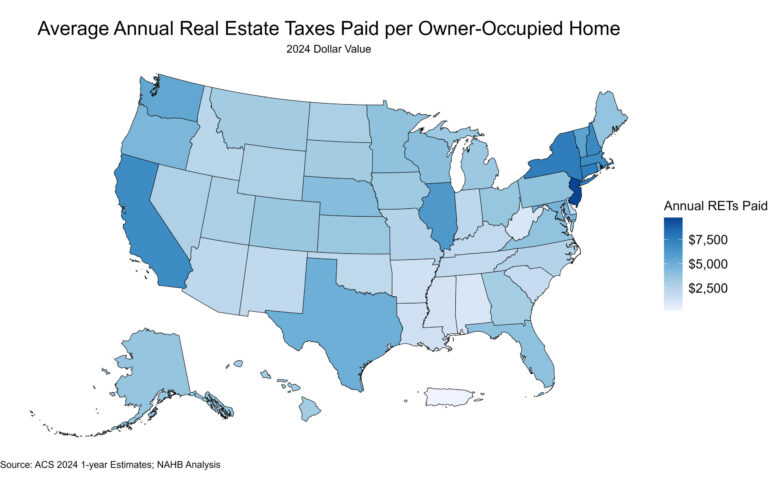
Nationally, across the 87 million owner-occupied homes in the U.S., the average amount of annual real estate taxes paid in 2024 was $4,271, according to NAHB analysis of the 2024 American Community Survey. Homeowners in New Jersey continued to pay the highest real estate taxes, paying an average of $9,767, $2,194 more than the next closest state, New York, at $7,573. On the other end of the distribution, homeowners in West Virginia paid the lowest average amount of real estate taxes at $1,044. The map below shows the geographic variation of average annual real estate taxes (RETs) paid.

The 2024 data indicate that there is no state where real estate taxes paid were on average less than $1,000, the first time in the ACS data. There continues to be noticeable differences in the average amount of taxes paid based on geographic location. States in the Northeast, where home values tend to be higher, pay more on average in real estate taxes compared to states in other parts of the nation.

Average Effective Property Tax Rates

While average annual real estate taxes paid is important, it provides an incomplete picture. Property values vary across states, which explains some, if not most, of the variation across the nation in average annual real estate taxes. To control for property values and create a more informative state-by-state analysis, NAHB calculates the average effective property tax rates by dividing aggregate real estate taxes paid by aggregate value of owner-occupied housing within each state. For example, the aggregate real estate taxes paid across the U.S. was $370.0 billion with an aggregate value of owner-occupied real estate totaling $41.7 trillion in 2024. Using these two amounts, the average effective property tax rate nationally was $8.88 ($370.0 billion/$41.7 trillion) per $1,000 in home value. This effective rate can be expressed as a percentage of home value or as a dollar amount taxed per $1,000 of a home’s value. The map below displays the effective rate by state.

Illinois, for the second consecutive year, had the highest effective property tax rate at $17.93 per $1,000 of home value. Hawaii continued to have the lowest effective property tax rate at $3.08 per $1,000 of home value. Hawaii also had the highest average home value, at $1.05 million in 2024. Notably, the average effective property tax rate tends to be higher in the Northeast, in addition to the presence of higher home values.


This article was originally published by a eyeonhousing.org . Read the Original article here. .


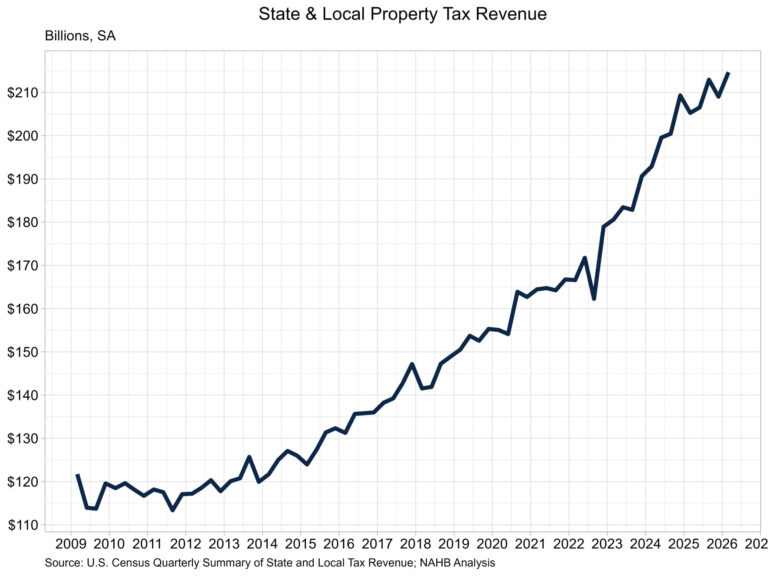
In the first quarter of 2025, state and local governments experienced an increase in property tax revenue growth. On a seasonally adjusted basis, state and local government property tax revenue grew 1.1% over the quarter, according to the Census Bureau’s quarterly summary of state and local tax revenue. Meanwhile, total tax revenue for state and local governments grew 1.3% over the quarter, with corporate income tax revenue up 6.6%, sales tax revenue up 0.9% and individual income tax revenue up 0.2%.

Property tax revenue stood at $203.4 billion in the first quarter, a slight increase from $201.1 billion in the fourth quarter. While this does show growth over the quarter, growth has notably slowed over the past year. The quarterly growth in the first quarter of 2024 was almost double (2.1%) the current rate. On a year-over-year basis, property tax revenue was 5.2% higher, up from $193.3 billion.

Property taxes typically make up the largest share of the total tax revenue for state and local governments, accounting for over one-third at 37.8% in the first quarter. The second highest revenue source was sales tax at 27.7%, totaling $148.9 billion, followed closely by individual income tax at 26.1% ($140.5 billion). Corporate income tax rounded out the remaining 8.4% at $45.4 billion.

Discover more from Eye On Housing

Subscribe to get the latest posts sent to your email.


This article was originally published by a eyeonhousing.org . Read the Original article here. .

House price growth slowed in the first quarter of 2025, partly due to a decline in demand and an increase in supply. Persistent high mortgage rates and increased inventory combined to ease upward pressure on house prices. These factors signaled a cooling market, following rapid gains seen in previous years.

Nationally, according to the quarterly all-transactions House Price Index (HPI) released by the Federal Housing Finance Agency (FHFA), U.S. house prices rose 4.7% in the first quarter of 2025, compared to the first quarter of 2024. This year-over-year (YoY) rate was lower than the previous quarter’s rate of 5.5%. The FHFA’s all-transactions HPI tracks average price changes based on repeat sales and refinancings of the same single-family properties. It offers insights not only at the national level but also across states and metropolitan areas.

Between the first quarter of 2024 and the first quarter of 2025, all 50 states and the District of Columbia experienced positive house price appreciation, ranging from 1.0% to 8.4%. Connecticut and Rhode Island topped the house price appreciation list with an 8.4% gain each, followed by New Jersey with a 7.8% gain. On the opposite end, Louisiana recorded the lowest house price appreciation at 1.0%. Out of all 50 states and the District of Columbia, 26 states exceeded the national YoY growth rate of 4.7%. However, on a quarterly basis, home price appreciation slowed in 39 states compared to the fourth quarter of 2024, highlighting a broad-based deceleration in the housing market.

House price growth widely varied across U.S. metro areas year-over-year, ranging from -7.0% to +23.0%. Rome, GA recorded the largest decline in house prices, whereas Johnstown, PA posted the highest increase over the previous four quarters. In the first quarter of 2025, 28 metro areas, in reddish color on the map above, experienced negative house price appreciation. Meanwhile, 356 metro areas experienced price increases.

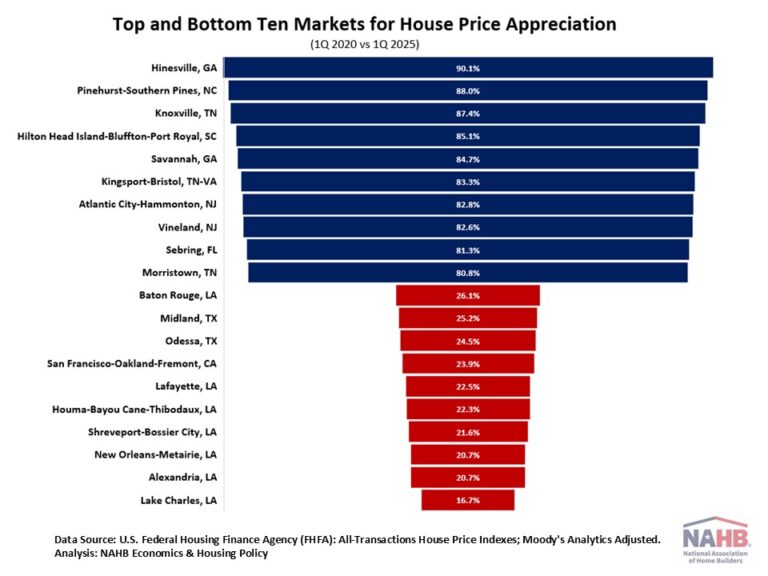
Since the onset of the COVID-19 pandemic, house prices have surged nationally. Between the first quarter of 2020 and the first quarter of 2025, house prices rose by 54.9% nationwide. More than half of metro areas outpaced this national price growth rate of 54.9%.

The table below highlights the top ten and bottom ten markets for house price appreciation during this five-year period. Among all the metro areas, house price appreciation ranged from 16.7% to 90.1%. Hinesville, GA led the nation with the highest house price appreciation. Lake Charles, LA recorded the lowest appreciation, marking its fourth consecutive quarter at the bottom.

Discover more from Eye On Housing

Subscribe to get the latest posts sent to your email.


This article was originally published by a eyeonhousing.org . Read the Original article here. .

Following two straight quarters of deceleration, house price appreciation accelerated slightly in the fourth quarter of 2024 due to the persistent high mortgage rates and low inventory. Although inventories of existing homes have improved from a year ago, the current 3.5-month supply remains below the 4.5- to 6-month supply that considered a balanced housing market.

Nationally, according to the quarterly all-transactions House Price Index (HPI) released by the Federal Housing Finance Agency (FHFA), U.S. house prices rose 5.4% in the fourth quarter of 2024, compared to the fourth quarter of 2023. The year-over-year rate has decreased from a high of 20.6% in the second quarter of 2022, but is higher than the previous quarter’s rate of 5.2%.

The quarterly FHFA HPI not only reports house prices at the national level but also provides insights about house price fluctuations at the state and metro area levels. The FHFA HPI used in this article is the all-transactions index, measuring average price changes in repeat sales or refinancings on the same single-family properties.  

Between the fourth quarter of 2023 and the fourth quarter of 2024, 49 states and the District of Columbia had positive house price appreciation. Vermont topped the house price appreciation list with an 8.9% gain, followed by New Jersey and Connecticut both with 8.3% gains. At the other end, Louisiana had the lowest house price appreciation (+2.1%), while Hawaii was the only state to experience a price decline (-4.3%). Among all 50 states and the District of Columbia, 31 states reached or exceeded the national growth rate of 5.4%. Compared to the third quarter of 2024, 32 out of the 50 states had an acceleration in house price appreciation in the fourth quarter.

House price growth widely varied across U.S. metro areas year-over-year, ranging from -4.9% to +24.7%. In the fourth quarter of 2024, 18 metro areas, in reddish color on the map above, had negative house price appreciation, while the remaining 366 metro areas experienced positive price appreciation. Punta Gorda, FL had the largest decline in house prices, while Cumberland, MD-WV saw the highest increase over the previous four quarters.

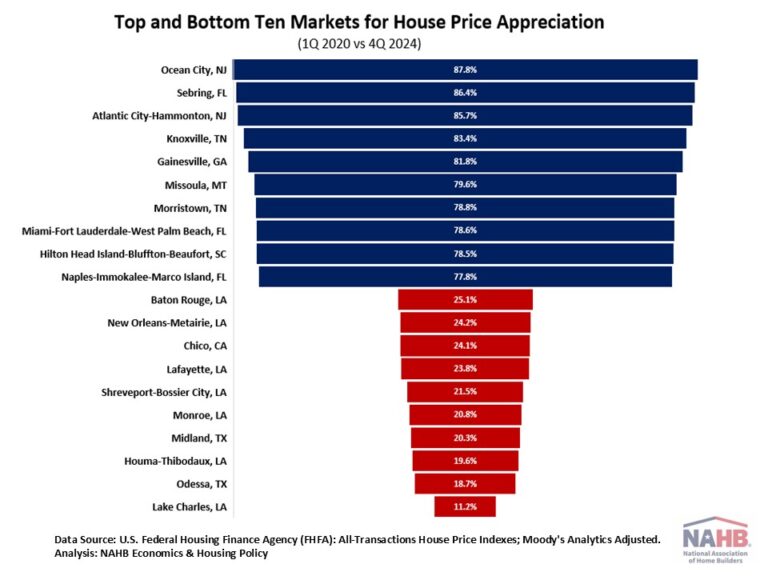
Additionally, house prices have increased dramatically since the COVID-19 pandemic. Nationally, house prices rose 53% between the first quarter of 2020 and the fourth quarter of 2024. More than half of metro areas saw house prices rise by more than the national price growth rate of 53%.

The table below shows the top and bottom ten markets for house price appreciation between the first quarter of 2020 and the fourth quarter of 2024. Among all the metro areas, house price appreciation ranged from 11.2% to 87.8%. Ocean City, NJ experienced the highest house price appreciation. Lake Charles, LA had the lowest appreciation for the third quarter in a row.

Discover more from Eye On Housing

Subscribe to get the latest posts sent to your email.


This article was originally published by a eyeonhousing.org . Read the Original article here. .

With the end of 2024 approaching, NAHB’s Eye on Housing is reviewing the posts that attracted the most readers over the last year. In October, Jesse Wade shared the average real estate tax by state and also an effective rate controlling for home value.

Nationally, across the 86 million owner-occupied homes in the U.S., the average annual real estate taxes paid in 2023 was $4,112, according to NAHB analysis of the 2023 American Community Survey. Homeowners in New Jersey continued to pay the highest real estate taxes, paying an average of $9,572, 30.6% higher than the second highest, New York, at $7,329 . On the other end of the distribution, homeowners in Alabama paid the lowest average amount of real estate taxes at $978. The map below shows the geographic variation of average annual real estate taxes (RETs) paid.

Compared to 2022, every state saw increases in the average amount of real estate taxes paid. The largest percentage increase was in Hawaii, up 21.1% from $2,541 to $3,078.  The smallest increase was in New Hampshire, up 1.1% from $6,385 to $6,453.

Average Effective Property Tax Rates

While average annual real estate taxes paid is important, it provides an incomplete picture. Property values vary across states, which explains some, if not most, of the variation across the nation in average annual real estate taxes. To control for property values and create a more informative state-by-state analysis, NAHB calculates the average effective property tax rate by dividing aggregate real estate taxes paid by aggregate value of owner-occupied housing within each state. For example, the aggregate real estate taxes paid across the U.S. was $352.3 billion with an aggregate value of owner-occupied real estate totaling $38.8 trillion in 2023. Using these two amounts, the average effective property tax rate nationally was $9.09 ($352.3 billion/$38.8 trillion) per $1,000 in home value. This effective rate can be expressed as a percentage of home value or as a dollar amount taxed per $1,000 of a home’s value. The map below displays the effective rate by state below.  

Illinois, a change from New Jersey in 2022 , had the highest effective property tax rate at $18.25 per $1,000 of home value. Consistent with 2022, Hawaii had the lowest effective property tax rate at $3.18 per $1,000 of home value. Additionally, Hawaii had the largest increase over the year, up 18.8% from $2.68 in 2022. Twenty states saw their effective property tax rates fall between 2022 and 2023, with the largest decrease occurring in West Virginia where it fell 6.0%, from $5.06 to $4.75 per $1,000.

Intrastate Variation: Examples from New York

While property taxes clearly vary by state, there also exists variation within states themselves. The latest county level data available comes from 2022 5-year ACS estimates. Analyzing these data , New York showed the highest degree of variation of average property taxes paid and effective real estate tax rates across the counties of any state. Home owners in Westchester County on average paid $14,156 in real estate taxes in 2022, the highest of any county in New York. The lowest amount was in Hamilton County, where home owners paid on average $2,827 in real estate taxes.

For effective property tax rates, New York continues to tell the story of intrastate variation. As shown above, Westchester County paid the higher average annual real estate taxes in 2022, but looking at effective property tax rate, which accounts for home value, Westchester’s effective property tax rate is near the middle at $18.34.  Home owners in Monroe County seem to get the short end of the stick, paying at a rate of $26.27 per $1,000 of home value, the highest in New York. The lowest effective property tax rate was in Kings County, paying a mere $5.30 per $1,000 of home value in taxes.

Discover more from Eye On Housing

Subscribe to get the latest posts sent to your email.


This article was originally published by a eyeonhousing.org . Read the Original article here. .


House prices posted modest annual growth for the third quarter of 2024, as elevated mortgage rates kept many potential home buyers away from the housing market. Nonetheless, housing inventory has improved in recent months.

Nationally, house price appreciation has decelerated for two straight quarters. According to the quarterly all-transactions House Price Index (HPI) released by the Federal Housing Finance Agency (FHFA), U.S. house prices rose 5.1% in the third quarter of 2024, compared to the third quarter of 2023.

The quarterly FHFA HPI not only reports house prices at the national level, but also provides insights about house price fluctuations at the state and metro area levels. The FHFA HPI used in this article is the all-transactions index, measuring average price changes in repeat sales or refinancings on the same single-family properties.  

Between the third quarter of 2023 and the third quarter of 2024, all 50 states and the District of Columbia had positive house price appreciation, ranging from 1.2% to 8.8%. New Jersey and Connecticut topped the house price appreciation list with an 8.8% gain. They were followed by Rhode Island with an 8.4% gain. Meanwhile, the District of Columbia had the lowest price growth (+1.2%). Among all 50 states and the District of Columbia, 29 states exceeded the national growth rate of 5.1%. Compared to the second quarter of 2024, 40 out of the 50 states had a deceleration in house price appreciation in the third quarter.

House prices have changed unevenly across U.S. metro areas, from the third quarter of 2023 to the third quarter of 2024. House price appreciation ranged from -9.0% to +19.1%. In the third quarter of 2024, 21 metro areas, in reddish color on the map above, had negative house price appreciation, while the remaining 363 metro areas experienced positive price appreciation.

Additionally, house prices have increased dramatically since the COVID-19 pandemic. Nationally, house prices rose 50.4% between the first quarter of 2020 and the third quarter of 2024. More than half of the metro areas saw house prices rise by more than the national price growth rate of 50.4%.

The table below shows the top and bottom ten markets for house price appreciation between the first quarter of 2020 and the third quarter of 2024. Among all the metro areas, house price appreciation ranged from 13.1% to 81.4%. Knoxville, TN has experienced the highest house price appreciation. Lake Charles, LA had the lowest appreciation.

Discover more from Eye On Housing

Subscribe to get the latest posts sent to your email.


This article was originally published by a eyeonhousing.org . Read the Original article here. .

Nonfarm payroll employment increased in 41 states and the District of Columbia in September compared to the previous month, while eight states saw a decrease. Nevada reported no change. According to the Bureau of Labor Statistics, nationwide total nonfarm payroll employment increased by 254,000 in September, following a gain of 159,000 jobs in August.

On a month-over-month basis, employment data was most favorable in Texas, which added 29,200 jobs. New Jersey came in second (+19,200), followed by Florida (+17,000). A total of 17,400 jobs were lost across eight states, with Iowa reporting the steepest job losses at 4,800. In percentage terms, employment increased the highest in Idaho at 0.7%, while Iowa saw the biggest decline at 0.3% between August and September.

Year-over-year ending in September, 2.4 million jobs have been added to the labor market across all 50 states and the District of Columbia. The range of job gains spanned from 2,000 jobs in Louisiana to 327,400 jobs in Texas. In percentage terms, the range of job growth spanned 3.4% in Idaho to 0.1% in Louisiana.

Across the nation, construction sector jobs data   —which includes both residential and non-residential construction—showed that 24 states and the District of Columbia reported an increase in September compared to August, while 23 states lost construction sector jobs. The three remaining states reported no change on a month-over-month basis. Texas, with the highest increase, added 8,100 construction jobs, while Tennessee, on the other end of the spectrum, lost 1,600 jobs. Overall, the construction industry added a net 25,000 jobs in September compared to the previous month. In percentage terms, Ohio reported the highest increase at 2.7% and North Dakota reported the largest decline at 2.1%.

Year-over-year, construction sector jobs in the U.S. increased by 238,000, which is a 3.0% increase compared to the September 2023 level. Texas added 42,300 jobs, which was the largest gain of any state, while New York lost 6,900 construction sector jobs. In percentage terms, Alaska had the highest annual growth rate in the construction sector at 21.1%. Over this period, Oregon reported the largest decline of 4.1%.

Discover more from Eye On Housing

Subscribe to get the latest posts sent to your email.


This article was originally published by a eyeonhousing.org . Read the Original article here. .

Nationally, across the 86 million owner-occupied homes in the U.S., the average annual real estate taxes paid in 2023 was $4,112, according to NAHB analysis of the 2023 American Community Survey. Homeowners in New Jersey continued to pay the highest real estate taxes, paying an average of $9,572, 30.6% higher than the second highest, New York, at $7,329 . On the other end of the distribution, homeowners in Alabama paid the lowest average amount of real estate taxes at $978. The map below shows the geographic variation of average annual real estate taxes (RETs) paid.

Compared to 2022, every state saw increases in the average amount of real estate taxes paid. The largest percentage increase was in Hawaii, up 21.1% from $2,541 to $3,078.  The smallest increase was in New Hampshire, up 1.1% from $6,385 to $6,453.

Average Effective Property Tax Rates

While average annual real estate taxes paid is important, it provides an incomplete picture. Property values vary across states, which explains some, if not most, of the variation across the nation in average annual real estate taxes. To control for property values and create a more informative state-by-state analysis, NAHB calculates the average effective property tax rate by dividing aggregate real estate taxes paid by aggregate value of owner-occupied housing within each state. For example, the aggregate real estate taxes paid across the U.S. was $352.3 billion with an aggregate value of owner-occupied real estate totaling $38.8 trillion in 2023. Using these two amounts, the average effective property tax rate nationally was $9.09 ($352.3 billion/$38.8 trillion) per $1,000 in home value. This effective rate can be expressed as a percentage of home value or as a dollar amount taxed per $1,000 of a home’s value. The map below displays the effective rate by state below.  

Illinois, a change from New Jersey in 2022 , had the highest effective property tax rate at $18.25 per $1,000 of home value. Consistent with 2022, Hawaii had the lowest effective property tax rate at $3.18 per $1,000 of home value. Additionally, Hawaii had the largest increase over the year, up 18.8% from $2.68 in 2022. Twenty states saw their effective property tax rates fall between 2022 and 2023, with the largest decrease occurring in West Virginia where it fell 6.0%, from $5.06 to $4.75 per $1,000.

Intrastate Variation: Examples from New York

While property taxes clearly vary by state, there also exists variation within states themselves. The latest county level data available comes from 2022 5-year ACS estimates. Analyzing these data , New York showed the highest degree of variation of average property taxes paid and effective real estate tax rates across the counties of any state. Home owners in Westchester County on average paid $14,156 in real estate taxes in 2022, the highest of any county in New York. The lowest amount was in Hamilton County, where home owners paid on average $2,827 in real estate taxes.

For effective property tax rates, New York continues to tell the story of intrastate variation. As shown above, Westchester County paid the higher average annual real estate taxes in 2022, but looking at effective property tax rate, which accounts for home value, Westchester’s effective property tax rate is near the middle at $18.34.  Home owners in Monroe County seem to get the short end of the stick, paying at a rate of $26.27 per $1,000 of home value, the highest in New York. The lowest effective property tax rate was in Kings County, paying a mere $5.30 per $1,000 of home value in taxes.

Discover more from Eye On Housing

Subscribe to get the latest posts sent to your email.


This article was originally published by a eyeonhousing.org . Read the Original article here. .
Pin It