Tag

Persist

Browsing


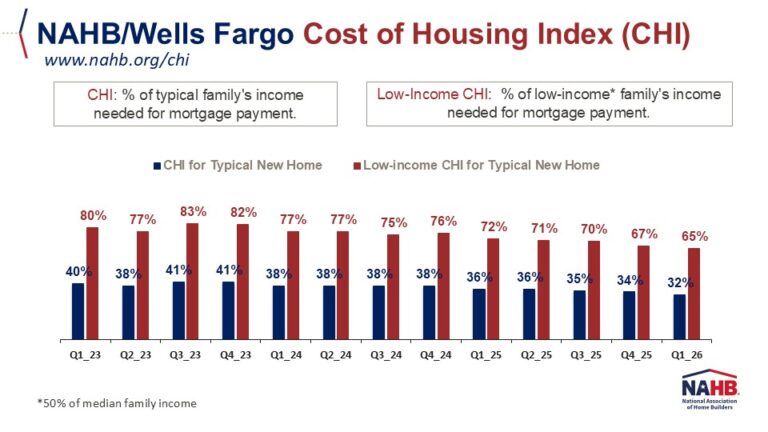
While housing affordability remains out of reach for millions of Americans, particularly first-time and entry-level buyers, conditions have improved modestly in the last year, according to the latest data from the National Association of Home Builders (NAHB)/Wells Fargo Cost of Housing Index (CHI). The CHI results from the first quarter of 2026 show that a family earning the nation’s median income of $106,800 needed 32% of its income to cover the mortgage payment on a median-priced new home. Low-income families, defined as those earning only 50% of median income, would have to spend 65% of their earnings to pay for the same new home.

In the last year, the income share needed to buy a new home declined from 36% in the second quarter of 2025, to 35% in the third quarter, 34% in the fourth quarter, and to 32% in the first quarter of 2026. Although home buyers continue to grapple with elevated mortgage rates and economic uncertainty, these figures indicate a modest improvement in affordability.

The same trend holds true for existing homes. A typical family would have had to pay 37% of their income for a median-priced existing home in the second quarter of 2025, 36% in the third quarter, 34% in the fourth quarter, and 32% in the first quarter of 2026. A low-income family would have needed to pay 65% of their earnings to make the same mortgage payment on an existing home in the first three months of 2026.

The U.S. data for the percentage of earnings needed to purchase a new home in the first quarter is based on a national median new home price of $403,200 and median income of $106,800. The first quarter median new home price is down slightly from $405,300 in the fourth quarter of 2025. Meanwhile, the corresponding price for an existing home fell more sharply in the first quarter to $404,300 from $414,900 in the previous quarter. The average 30-year mortgage rate edged slightly lower from 6.32% in the fourth quarter to 6.20% in the first quarter.

CHI is also available for 175 metropolitan areas, calculating the percentage of a family’s income needed to make the mortgage payment on an existing home based on the local median home price and median income in those markets.

In seven out of 175 markets in the first quarter, the typical family is severely cost-burdened (must pay more than 50% of their income on a median-priced existing home). In 59 other markets, such families are cost-burdened (need to pay between 31% and 50%). There are 109 markets where the CHI is 30% of earnings or lower.

The Top 5 Severely Cost-Burdened Markets

San Jose-Sunnyvale-Santa Clara, Calif., was the most severely cost-burdened market in the CHI, where 79% of a typical family’s income is needed to make a mortgage payment on an existing home. This was followed by:

Urban Honolulu, Hawaii (68%)

San Diego-Chula Vista-Carlsbad, Calif. (65%)

San Francisco-Oakland-Fremont, Calif. (63%)

Naples-Marco Island, Fla. (58%)

Low-income families would have to pay between 115% and 158% of their income in all five of the above markets to cover a mortgage.

The Top 5 Least Cost-Burdened Markets

By contrast, Decatur, Ill., was the least cost-burdened markets on the CHI, where typical families needed to spend just 12% of their income to pay for a mortgage on an existing home. Rounding out the least burdened markets are:

Peoria, Ill. (15%)

Elmira, N.Y. (16%)

Springfield, Ill. (17%)

Davenport-Moline-Rock Island, Iowa-Ill. (18%)

Low-income families in these markets would have to pay between 25% and 37% of their income to cover the mortgage payment for a median-priced existing home.

Visit nahb.org/chi for tables and details.


This article was originally published by a eyeonhousing.org . Read the Original article here. .


Builder confidence posted a modest gain in May even as buyers grapple with rising mortgage rates and economic uncertainty while builders continue to contend with elevated land, labor and construction costs.

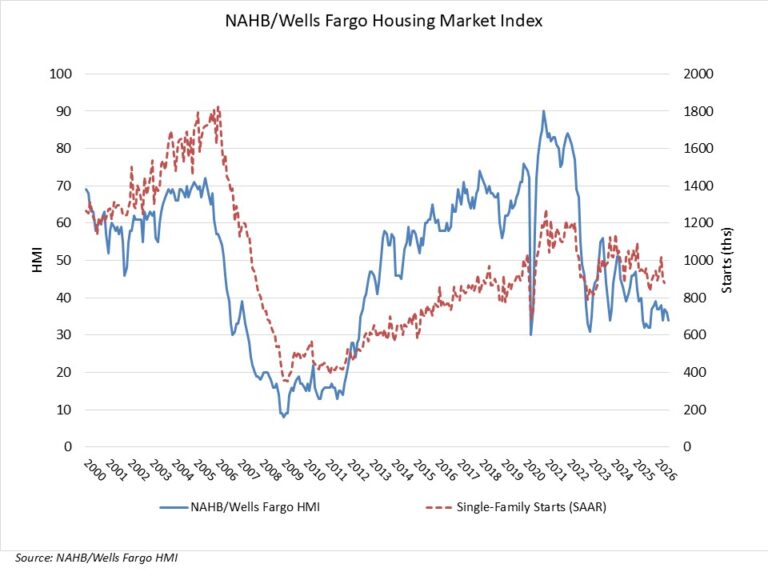
Builder confidence in the market for newly built single-family homes increased three points to 37 in May, according to the National Association of Home Builders (NAHB)/Wells Fargo Housing Market Index (HMI).

Recent increases for long-term interest rates will continue to hold back home buyer demand. Although some regional markets, including parts of the Midwest, are showing relative strength, the housing market continues to face significant affordability challenges.

On the policy front, efforts in the House to modify the 21st Century ROAD to Housing Act could increase the nation’s housing supply and help ease builder concerns. In particular, the revision in the House bill with respect to the harmful built-to-rent proposal is a positive development.

The latest HMI survey also revealed that 32% of builders cut prices in May, down from 36% in April. The average price reduction was 6%, up from the 5% figure in April. The use of sales incentives was 61% in May, up slightly from 60% in April, and marking the 14th consecutive month this share has reached 60% or higher.

Derived from a monthly survey that NAHB has been conducting for more than 40 years, the NAHB/Wells Fargo HMI gauges builder perceptions of current single-family home sales and sales expectations for the next six months as “good,” “fair” or “poor.” The survey also asks builders to rate traffic of prospective buyers as “high to very high,” “average” or “low to very low.” Scores for each component are then used to calculate a seasonally adjusted index where any number over 50 indicates that more builders view conditions as good than poor.

All three of the major HMI indices posted gains in May, as some buyers who had been holding back decided to move forward this spring. The HMI index gauging current sales conditions rose three points to 40 from April to May, the index measuring future sales increased three points to 45 and the index charting traffic of prospective buyers posted a three-point gain to 25.

Looking at the three-month moving averages for regional HMI scores, the Midwest registered a one-point gain to 43, the Northeast rose one point to 42, the South held constant at 35 and the West fell one point to 28.

The HMI tables can be found at nahb.org/hmi.


This article was originally published by a eyeonhousing.org . Read the Original article here. .

Builder sentiment inched up in March even as builders continue to express affordability concerns stemming from elevated construction costs and shortages of buildable lots and labor.

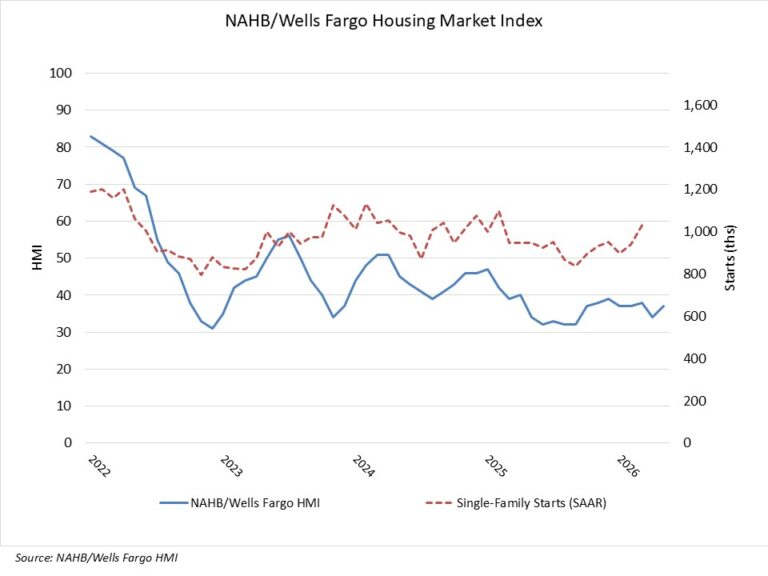
Builder confidence in the market for newly built single-family homes rose one point to 38 in March, following a revised upward one-point revision in February, according to the National Association of Home Builders (NAHB)/Wells Fargo Housing Market Index (HMI). All responses to the March survey were received after the conflict with Iran started.

Affordability for buyers and builders remains a top concern. Many buyers remain on the fence waiting for lower interest rates and due to economic uncertainty.

While the Freddie Mac 30-year fixed rate mortgage averaged 6.05% in February, the lowest since August 2022, downpayment hurdles and uncertainty from the conflict with Iran and the price of oil will be headwinds going forward. The administration’s executive orders issued last week to reduce regulatory burdens associated with home building are a positive step toward increasing attainable housing supply.

The latest HMI survey also revealed that 37% of builders cut prices in March, up slightly from 36% in February. The average price reduction remained stable at 6%. The use of sales incentives was 64% in March, down one percentage point from February, and marking the 12th consecutive month this share exceeded 60%.

Derived from a monthly survey that NAHB has been conducting for more than 40 years, the NAHB/Wells Fargo HMI gauges builder perceptions of current single-family home sales and sales expectations for the next six months as “good,” “fair” or “poor.” The survey also asks builders to rate traffic of prospective buyers as “high to very high,” “average” or “low to very low.” Scores for each component are then used to calculate a seasonally adjusted index where any number over 50 indicates that more builders view conditions as good than poor.

All three of the major HMI indices posted gains in March. The HMI index gauging current sales conditions increased one point to 42 from February to March, the index measuring future sales gained two points to 49 and the index charting traffic of prospective buyers posted a three-point increase to 25.

Looking at the three-month moving averages for regional HMI scores, the Northeast held steady at 44, the Midwest was unchanged at 43, the South held constant at 35 and the West fell two points to 31. The HMI tables can be found at nahb.org/hmi.


This article was originally published by a eyeonhousing.org . Read the Original article here. .

Market uncertainty exacerbated by the government shutdown along with economic uncertainty stemming from tariffs and rising construction costs kept builder confidence firmly in negative territory in November.

Builder confidence in the market for newly built single-family homes rose one point to 38 in November, according to the National Association of Home Builders (NAHB)/Wells Fargo Housing Market Index (HMI).

While lower mortgage rates are a positive development for affordability conditions, many buyers remain hesitant because of the recent record-long government shutdown and concerns over job security and inflation. We continue to see demand-side weakness as a softening labor market and stretched consumer finances are contributing to a difficult sales environment. After a decline for single-family housing starts in 2025, NAHB is forecasting a slight gain in 2026 as builders continue to report future sales conditions  in marginally positive territory.

In a further sign of ongoing challenges for the housing market, the latest HMI survey also revealed that 41% of builders reported cutting prices in November, a record high in the post-Covid period and the first time this measure has passed 40%. Meanwhile, the average price reduction was 6% in November, the same rate as the previous month. The use of sales incentives was 65% in November, tying the share in September and October.

Derived from a monthly survey that NAHB has been conducting for more than 40 years, the NAHB/Wells Fargo HMI gauges builder perceptions of current single-family home sales and sales expectations for the next six months as “good,” “fair” or “poor.” The survey also asks builders to rate traffic of prospective buyers as “high to very high,” “average” or “low to very low.” Scores for each component are then used to calculate a seasonally adjusted index where any number over 50 indicates that more builders view conditions as good than poor.

The HMI index gauging current sales conditions increased two points to 41, the index measuring future sales fell three points to 51 and the gauge charting traffic of prospective buyers posted a one-point gain to 26.

Looking at the three-month moving averages for regional HMI scores, the Northeast rose two points to 48, the Midwest fell one point to 41, the South increased three points to 34 and the West gained two points to 30. HMI tables can be found at nahb.org/hmi.


This article was originally published by a eyeonhousing.org . Read the Original article here. .
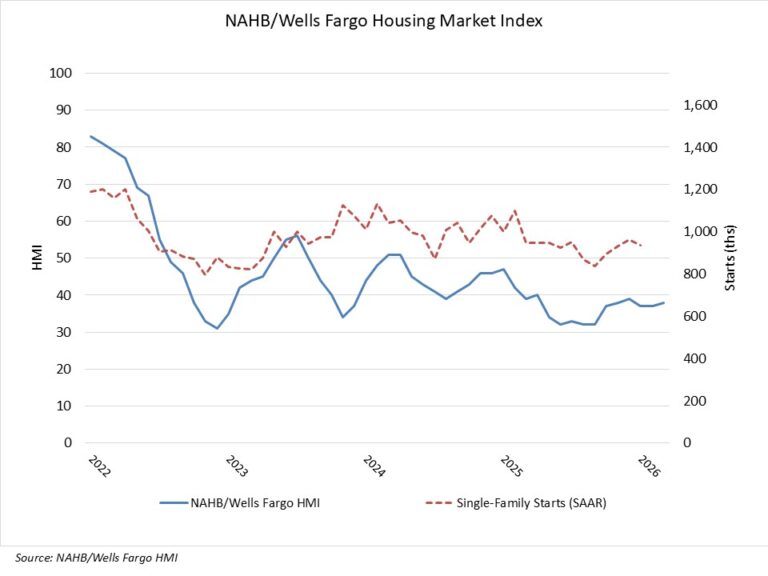

Single-family housing starts posted a modest gain in July as builders continue to contend with challenging housing affordability conditions and a host of supply-side headwinds, including labor shortages, elevated construction costs and inefficient regulatory costs.

Led by solid multifamily production, overall housing starts increased 5.2% in July to a seasonally adjusted annual rate of 1.43 million units, according to a report from the U.S. Department of Housing and Urban Development and the U.S. Census Bureau.

The July reading of 1.43 million starts is the number of housing units builders would begin if development kept this pace for the next 12 months. Within this overall number, single-family starts increased 2.8% to a 939,000 seasonally adjusted annual rate and are down 4.2% on a year-to-date basis. The multifamily sector, which includes apartment buildings and condos, increased 9.9% to an annualized 489,000 pace.

The slowdown in single-family home building has narrowed the home building pipeline. There are currently 621,000 single-family homes under construction, down 1% in July and 3.7% lower than a year ago. This is the lowest level since early 2021 as builders pull back on supply.

On a regional and year-to-date basis, combined single-family and multifamily starts were 10.2% higher in the Northeast, 17.7% higher in the Midwest, 2.4% lower in the South and 0.5% lower in the West.

Overall permits decreased 2.8% to a 1.35-million-unit annualized rate in July. Single-family permits increased 0.5% to an 870,000-unit rate and are down 5.8% on a year-to-date basis. Multifamily permits decreased 8.2% to a 484,000 pace.

Looking at regional permit data on a year-to-date basis, permits were 16.6% lower in the Northeast, 9.1% higher in the Midwest, 3.4% lower in the South and 5.1% lower in the West.

Discover more from Eye On Housing

Subscribe to get the latest posts sent to your email.


This article was originally published by a eyeonhousing.org . Read the Original article here. .


Single-family housing starts declined in June to the lowest rate since July 2024 as elevated interest rates, rising inventories and ongoing supply-side issues continue to act as headwinds for the housing sector.

Due to a solid increase in multifamily production, overall housing starts increased 4.6% in June to a seasonally adjusted annual rate of 1.32 million units, according to a report from the U.S. Department of Housing and Urban Development and the U.S. Census Bureau.

The June reading of 1.32 million starts is the number of housing units builders would begin if development kept this pace for the next 12 months. Within this overall number, single-family starts decreased 4.6% to an 883,000 seasonally adjusted annual rate and are down 10% compared to June 2024. The multifamily sector, which includes apartment buildings and condos, increased 30% to an annualized 438,000 pace.

Single-family building conditions continued to weaken in June as housing affordability challenges caused builder traffic to move lower as buyers moved to the sidelines. Rising levels of resale inventory are also a headwind for the industry.

Single-family home building in the South is down 12.4% on a year-to-date basis, far outpacing declines in the Northeast and the West. However, single-family home building is up 10% on a year-to-date basis in the Midwest, where housing affordability conditions are generally better than much of the nation.

On a regional and year-to-date basis, combined single-family and multifamily starts were 28.8% higher in the Northeast, 13.1% higher in the Midwest, 8.1% lower in the South and 0.6% lower in the West.

Overall permits increased 0.2% to a 1.40-million-unit annualized rate in June. Single-family permits decreased 3.7% to an 866,000-unit rate and are down 8.4% compared to June 2024. Multifamily permits increased 7.3% to a 531,000 pace.

Looking at regional permit data on a year-to-date basis, permits were 16.9% lower in the Northeast, 8.2% higher in the Midwest, 3.3% lower in the South and 3.7% lower in the West.

The declines for single-family home building have caused the number of single-family homes under construction to level off. There are currently 622,000 single-family homes under construction, which is 6% lower than a year ago. The number of apartments under construction in June, 739,000, is 18.8% lower than a year ago.

Discover more from Eye On Housing

Subscribe to get the latest posts sent to your email.


This article was originally published by a eyeonhousing.org . Read the Original article here. .
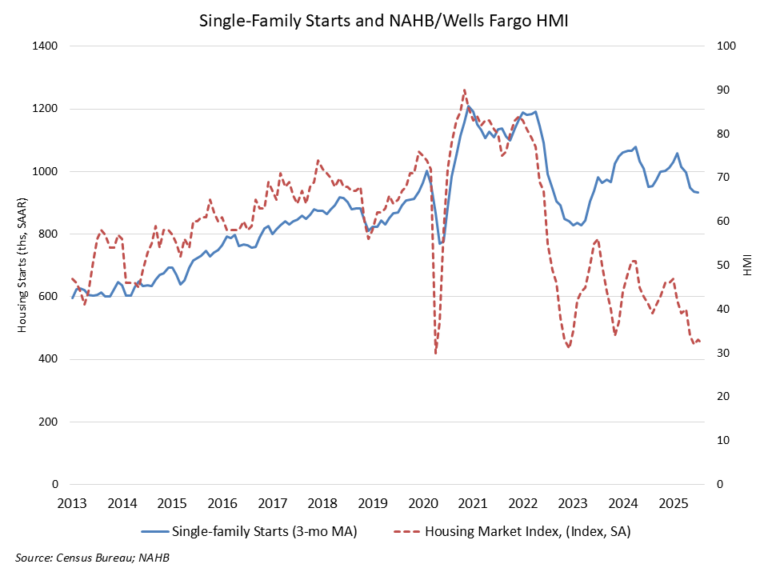

With mortgage rates declining by more than one-half of a percentage point from early August through mid-September, per Freddie Mac, builder sentiment edged higher this month even as builders continue to grapple with rising costs.

Builder confidence in the market for newly built single-family homes was 41 in September, up two points from a reading of 39 in August, according to the National Association of Home Builders (NAHB)/Wells Fargo Housing Market Index (HMI). This breaks a string of four consecutive monthly declines.

Due to lower interest rates, builders now have a positive view for future new home sales for the first time since May 2024. However, builders will face competition from rising existing home inventory in many markets as the mortgage rate lock-in effect softens with lower rates.

With inflation moderating, the Federal Reserve is expected to begin a cycle of monetary policy easing this week, which will produce downward pressure on mortgage interest rates and also lower the interest rates on land development and home construction business loans. Lowering the cost of construction is critical to confront persistent challenges for housing affordability.

The latest HMI survey also revealed that the share of builders cutting prices dropped in September for the first time since April, down one point to 32%. Moreover, the average price reduction was 5%, the first time it has been below 6% since July 2022. Meanwhile, the use of sales incentives fell to 61% in September, down from 64% in August.

Derived from a monthly survey that NAHB has been conducting for more than 35 years, the NAHB/Wells Fargo HMI gauges builder perceptions of current single-family home sales and sales expectations for the next six months as “good,” “fair” or “poor.” The survey also asks builders to rate traffic of prospective buyers as “high to very high,” “average” or “low to very low.” Scores for each component are then used to calculate a seasonally adjusted index where any number over 50 indicates that more builders view conditions as good than poor.

All three HMI indices were up in September. The index charting current sales conditions rose one point to 45, the component measuring sales expectations in the next six months increased four points to 53 and the gauge charting traffic of prospective buyers posted a two-point gain to 27.

Looking at the three-month moving averages for regional HMI scores, the Northeast fell three points to 49, the Midwest edged one-point higher to 40, the South decreased one point to 41 and the West increased two points to 39.

The HMI tables can be found at nahb.org/hmi.

Discover more from Eye On Housing

Subscribe to get the latest posts sent to your email.


This article was originally published by a eyeonhousing.org . Read the Original article here. .
Pin It