
Tag

People

Browsing


We all have friends or family members who live in tidy, well-kept homes despite having full, busy lives. No matter what the occasion, nothing appears to be out of place. You might wonder how seemingly ordinary people with jobs, partners, children and pets can maintain a tranquil, clutter-free environment.

As a professional organizer, I work with people who have a wide variety of personalities, and I see closets, drawers, cabinets, basements, garages and even spaces under beds. Through my intimate observations, I have learned the secrets of maintaining an orderly home, and in this article I share eight with you.

Jennifer Grey Interiors Design & Color SpecialistSave Photo
A special note to those of you who are not naturally organized: Please don’t despair as you read this list. I have yet to meet a person who has implemented all of the ideas perfectly. So pick the strategies that work for you, and forget about the others. Even if you can implement only one or two, you’ll still move closer to your goal of living in a beautifully organized home.

Find a home professional on Houzz

AM Interior DesignSave Photo
1. They Make Decisions Quickly

My clients who successfully maintain organized homes all make decisions quickly. They are good about getting rid of items that they no longer use, and they try to let go of things that they might use … someday. They let go of clothes that no longer fit or are excessively worn. They get rid of expensive clothes that might come back in style someday, because they understand that even if a style does come back, it is usually slightly different. And yes, these clients may need to hire a professional organizer to manage the decluttering and organizing process, but they quickly take suggestions to heart.

OLSON LEWIS + ArchitectsSave Photo
For the majority of my clients, decisive or not, sentimental items and gifts are the hardest things to part with. But decisive people are able to avoid wallowing in the guilt that might surround getting rid of these items. They choose to keep only things they truly love. On that note, they do not save every piece of their child’s art or schoolwork. Instead, they may take pictures of their children’s work and create a beautiful — and compact — photo book from them.

If making decisions quickly does not come naturally to you, try to focus on your goal of living in a clutter-free home. Create a Houzz ideabook and save photos of rooms that inspire you. You may find that the more you practice letting go of things, the easier it gets.

Bethesda ContractingSave Photo
2. They Move Donation and Disposal Items Quickly

Organized people do not let donation and disposal bags linger in their closet, hallway, or garage. Instead, they get these items out of the house in a timely manner. They take bags to a donation drop-off location the same day the bags are filled (confirming first that the site is open). If items are too big for their cars, they schedule a charity pickup as soon as possible. For excess trash, they contact their local waste management company or hauling service for removal.

My most organized clients do not worry about finding the perfect home for their donations or spend excess time trying to offload unwanted items on family members or friends. They move things quickly out of the house so they have a sense of accomplishment that fuels further progress.

If you have a problem moving donation items or trash bags out of your house, try to make it part of the decluttering process. I recommend not finishing the day without deciding how items to be donated and discarded will leave your house.

Eclectic Designs LLCSave Photo
3. They Store Music, Movies, Books and Recipes Electronically

Owning less stuff helps keep a home from becoming cluttered. Many organized people rent or buy music, movies and books from a cloud-based service and store them on electronic devices. They also tend to save recipes to their hard drives instead of owning a multitude of cookbooks. They take pictures of their favorite recipes and search for new ones online.

Of course, electronic storage doesn’t work for everyone. Some of us find turning the paper pages of a good book a total pleasure — one not quite matched by reading a novel on a cold electronic device. Others have extensive vinyl record collections that bring great enjoyment. Choose the suggestions that work for you, and don’t feel any pressure to get rid of something you truly love.

See why you should hire a professional who uses Houzz Pro software

kelly mcguill homeSave Photo
4. They Edit Clothing and Accessories Frequently

Organized people cull their wardrobes regularly. I recommend that you follow their lead and at the end of each season look at your apparel and get rid of anything you haven’t worn. Give yourself permission to toss stained or torn items, to donate ill-fitting or uncomfortable ones, and even to let go of items you simply don’t wear because they are no longer your favorites.

Many people demote clothing to being “house clothing” because they don’t want to make any real decisions. As a result, they end up with a large quantity of clothing they wear only when relaxing at home. I recommend you try to avoid this delay tactic. Instead, allow yourself one to three house outfits and donate the rest.

Also, if you want to keep sentimental clothing such as college sweatshirts, old sports uniforms or concert T-shirts that you really don’t wear, consider removing them from your primary clothing storage spaces and placing them in an attic, a basement or at the back of your closet. Alternatively, you might consider taking photos of sentimental clothing and then letting them go.

Kate Savitch DesignSave Photo
5. They Declutter the Pantry and Refrigerator Regularly

My clients who are organized get rid of old food regularly. To adopt this habit, I recommend you have a regular time — perhaps once a week — when you clean out your fridge and toss wilted vegetables, spoiled fruit and old leftovers. Also, notice what you toss. If you didn’t get around to eating something before it went bad, I recommend you don’t buy that item again for a while, as it may not be top of mind for you to consume.

I also recommend going through your pantry every six months and discarding any stale or expired food. If you have unopened packages or cans of food that you know you won’t eat, consider donating them to a local food bank.

Albertsson Hansen Architecture and Interior DesignSave Photo
6. They Are Mindful of Purchases and Free Samples

Organized people are thoughtful about what they bring into their homes. To be like them, I recommend you consider your storage situation before making a purchase. Ask yourself, “Do I have room?” You might also consider getting rid of one thing for every item you buy. And if you do not have enough space to store large-quantity items from warehouse stores, simply don’t buy them.

Another good tip is to look at what you already own before you shop so that you don’t buy duplicates. For instance, I often see clients with duplicate spices, condiments and sunscreens. Further, try to avoid bringing home free makeup or laundry samples or complimentary notepads and pens, which tend to clutter up drawers. Before you buy any new small appliance, consider whether you have the countertop space for it. Also, try to avoid buying small appliances or gadgets that have only a single purpose, like strawberry hullers. Instead, collect items that can be used for multiple purposes — like paring knives, which you can also use to hull strawberries.

Check out our guide to get started on your home project

Herlong ArchitectsSave Photo
7. They Aren’t Afraid to Outsource Tasks

Many of my organized clients outsource their yard work or housecleaning so they can focus on keeping their home decluttered and organized. They also aren’t afraid to hire a professional home organizer to help them get a handle on the clutter and dispose of unwanted items in the first place. A follow-up appointment every six months with an organizer can help them keep clutter at bay.

I realize that many people do not have the budget to hire outside help, and of course I wouldn’t advocate spending beyond one’s means. However, there are people who do have the financial resources but feel guilty about outsourcing housework or yardwork because they feel they should do it all. If you fall into this category, consider the stress reduction of bringing a housecleaner in every other week. The cost may even be less than a therapy session and may help you feel a sense of calm when you come home after a long day.

Studiolo Design LLCSave Photo
8. They Put Things Away After Each Use

My most organized clients put things away after they have used them — and in fact, putting things away is the best secret for keeping a house tidy.

But it’s also true that many of my clients struggle with putting things away. If you can’t seem to keep up throughout the day or in the evening after you return home from work, consider putting everything away at night before you go to bed. That way, you’ll wake up to a tidier house, and clutter won’t become overwhelming. To help you develop this habit, I recommend reading How to Form New Habits That Keep Your Home Clutter-Free.

Eurodale Developments IncSave Photo
Again, remember that no one is perfect! Most everyone has some part of his or her home that is not organized. For example, many people simply shove clutter into boxes and hide the boxes in the closet before hosting a party. This creates a semblance of organization for guests but may leave you feeling bad about your house. When it comes to organizing, please don’t compare yourself to others. Everyone is unique and has different limitations, whether budget, time, a messy spouse or health problems. And that’s OK.

Still, your home should be a place where you can relax and recharge, and many of us cannot do that with clutter everywhere. So do your best to make your home comfortable without becoming a slave to organization. When your home is reasonably organized, be sure to take time to enjoy it.

Your turn: How do you stay organized at home? Share your tips and advice in the Comments.

More on Houzz
Read more stories
Browse photos for ideas
Find home professionals


This article was originally published by a
www.houzz.com . Read the Original article here. .
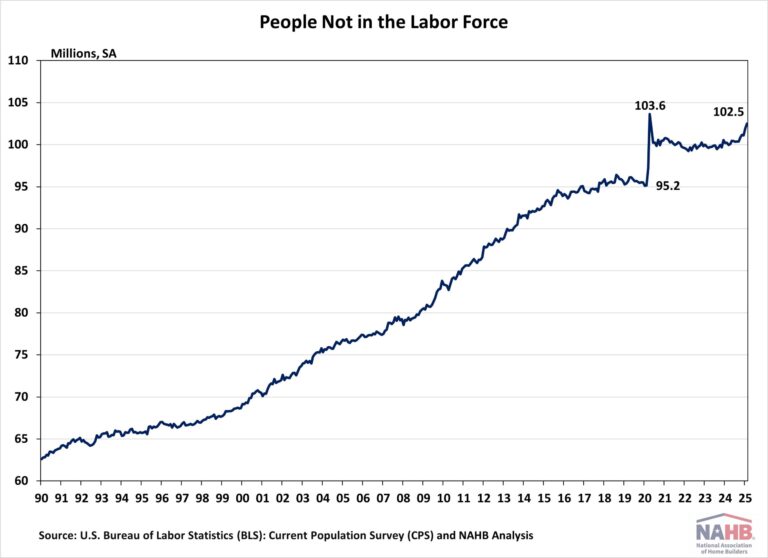

According to the U.S. Bureau of Labor Statistics (BLS), people who are neither working nor looking for work are counted as “not in the labor force”. Understanding the size and characteristics of individuals not in the labor force is crucial for a comprehensive assessment of the job market and overall economic health, as it provides insights into potential labor supply and demand issues.

Size

The number of people not in the labor force has been steadily increasing. As of February 2025, data from the BLS indicates that 102.5 million people, aged 16 or older, were not in the labor force. During the COVID-19 pandemic, this figure surged sharply, rising from 95.2 million in February 2020 to a historically high 103.6 million in April 2020. Since then, the number has remained around 100 million, with a noticeable upward trend over the past year.

Characteristics

Data from the 2024 Current Population Survey (CPS) and the Annual Social and Economic Supplement (ASEC) offer valuable insights into why individuals are not in the labor force. The ASEC gathers information on employment and unemployment experienced during the previous calendar year. The data used in this article focus on individuals aged 16 years and older who neither worked nor looked for a job in 2023.

According to the analysis of the data from the 2024 CPS and ASEC, approximately 93.6 million people aged 16 or older were not in the labor force in 2023. Among this group, nearly 39 million (42%) were men, and 54.6 million (58%) were women.

In terms of age distribution, about 49% of those not in the labor force were aged 65 years or older. Additionally, 13% were between the ages of 55 and 64, 21% were between the ages of 25 and 54, and the remaining 17% were aged 24 or younger. Intuitively, people aged 65 years and older represented the largest share of individuals who were not in the labor force.

Regarding educational attainment, 51% of individuals not in the labor force had a high school diploma or lower. Those with some college education made up 24%, while individuals with a bachelor’s degree or higher accounted for 25%.

The racial breakdown of those not in the labor force is as follows: 58.2 million were non-Hispanic white, 15.4 million were Hispanic, 11.7 million were Black, 5.9 million were Asian, and the remaining 2.5 million identified as other races.

Main Reason for Not Working

The group of people not in the labor force is diverse, and the reasons why individuals are not in the labor force vary widely.

In the CPS and ASEC data, the respondents were asked the main reason for not working. The reasons included: ill or disabled, retired, taking care of home or family, going to school, could not find work and other.

In 2023, a total of 93.6 million individuals aged 16 and older neither worked nor looked for work at any time during the year. Among this group, 48.6 million people reported retirement as their main reason for not working. Approximately 14.9 million individuals stated that they were attending school, while 14.7 million cited illness or disability as the main factor. Additionally, 12.7 million people indicated that taking care of home or family was the main reason for not working in 2023. Nearly 1.8 million individuals selected “other reasons,” and roughly 1.0 million cited “could not find work.”

Retirement is the main reason for not working for about half of the individuals not in the labor force in 2023. Among those aged 65 years and older, 91% of individuals in this group cited retirement as the main reason for not working. Overall, about 44% of individuals not in the labor force were due to the self-reported reason of retirement and aged 65 years and older. Individuals in this 44% share are unlikely to return to the labor force.

While an aging population is a major driver behind the growth of individuals not participating in the labor force, other reasons people give for not engaging in the workforce also play an important role.

For individuals aged 16 to 24, the majority cited going to school as the main reason not working in 2023. In other words, for those citing going to school, 87% were between the ages of 16 and 24. Overall, about 14% of the not-in-labor-force population was due to the self-reported reason of going to school and aged 16 to 24. This group is likely to enter the labor force after graduation, although younger individuals will likely replace them in education settings.

Prime-age workers, aged 25 to 54, historically represent a larger share of the labor force compared to other age groups. However, men and women in this age group have different reasons for not working in 2023. More than half of women (62%) reported taking care of home or family as the main reason for not working, while 48% of men cited illness or disability as their primary reason.

Among prime-age individuals, those with less education were more likely to be out of the labor force than their more educated counterparts. In 2023, 15% of prime-age men with a high school diploma or less were not in the labor force, compared to 10% of those with some college and 5% of those with a bachelor’s degree or higher. The trend was similar among prime-age women, with 33% of those with a high school diploma or less not in the labor force, compared to 20% of those with some college and 13% of those with a bachelor’s degree or more.

It is difficult to predict with certainty whether prime-age individuals currently not in the labor force will enter it. However, several factors could encourage individuals to enter or return to the labor market, including improved economic conditions, the availability of remote work, workplace policies, and retraining opportunities.

Last, based on the CPS and ASEC data, only a small proportion of the remaining population reported the main reasons for not working were that they could not find work and other reasons.

Conclusion

These numbers highlight both challenges and opportunities in expanding the labor force to support construction employment. According to the BLS’s monthly job report, approximately 6% of individuals currently not in the labor force and aged 16 to 64 could potentially be recruited into the workforce. Furthermore, the construction labor force is aging. The building industry must recruit the next generation of workers as industry activity grows in the years ahead, given the growth in population not in the labor force.

Discover more from Eye On Housing

Subscribe to get the latest posts sent to your email.


This article was originally published by a eyeonhousing.org . Read the Original article here. .


Kelley Design GroupSave Photo
6. Streamline the Routine

Think about all the morning’s tasks and the order in which you might complete them. Try to line them up so they work with your schedule and the layout of your house. This will allow you to follow a logical path around your home, accomplishing key goals in each space before moving on.

So you might get up, go to the kitchen for coffee and breakfast, then head back upstairs to shower, dress, dry hair and put on makeup. This simple course prevents doubling back and time-wasting.

If you’re not organized, you could make coffee, then zoom back up for a shower, then gobble breakfast with your hair in a towel, then race back up to dry it, then break off to feed the dog before running upstairs again to get dressed. Which method is more efficient?


This article was originally published by a
www.houzz.com . Read the Original article here. .



8. Light It Right

Lighting can make or break the mood in your kitchen, so it’s worth taking the time to get it right. A layered lighting scheme that includes a mix of task, ambient and accent lights will create a warm and inviting environment that’s perfect for socializing, whether you’re hosting a large-scale festive get-together or an intimate meal.

Think about adding undercabinet LEDs to brighten your work surfaces, a pendant light on a dimmer over the kitchen island so it can transition smoothly from prep zone to meals area, and wall sconces or directional downlights to highlight special features such as art.

How to Properly Light Your Kitchen Counters


This article was originally published by a www.houzz.com . Read the Original article here. .


It was huge news at the time: the National Association of Realtors (NAR) agreed in March to pay $418 million and make changes to how the home-buying process works in order to settle a class-action lawsuit that alleged the industry conspired to make agent commissions higher than they needed to be.

The provisions of the settlement go into effect on Aug. 17. For now, what consumers can expect is more paperwork, and potentially more confusion. 

“This is a grand social experiment,” says Leo Pareja, the CEO of exp Realty, one of the biggest real-estate brokerages in the country. “None of us know what’s about to happen.” 

Buyers now have to sign a contract

Here’s how the process used to work: a seller’s agent would list a home on an MLS, or multiple listing service, which is a database of properties for sale. Those listings would state that the seller of a home would pay a certain amount to compensate the buyer’s agent. This compensation was often about 3% of the sales price, which was also about what the seller’s agent would get from the seller. (The average amount ranges between jurisdictions and even from sale to sale; some agents were also paid flat fees.) 

Technically, those fees were negotiable. But most homeowners either didn’t know that or feel they could negotiate. In addition, home sellers allege, real-estate agents would sometimes “steer” buyers to specific homes based on the amount of compensation they could receive. As of Aug. 17, real-estate agents cannot list any sort of agent compensation when they put a house on multiple listing services, a change designed to eliminate steering.

Read More: Stop Looking For Your Forever Home.

In addition, both buyers and sellers are now required to sign a written agreement with their agent before the agent shows them a property or assists with a transaction. The buyer’s side of this is more consequential—most sellers have signed these contracts in the past, but few buyers did. In the new buyers’ contract, sometimes called an “exclusive representation agreement,” the buyer agrees to work with the agent for a certain period of time. Most importantly, the buyer and agent also agree on how the agent will be compensated, whether through a flat fee, a specific share of the purchase price, or another method. Agents must also make clear in this contract that broker commissions are fully negotiable, a change that consumer advocates hope will drive commissions—and prices—down.

Many real-estate agents say the changes are positive, including Jennifer Stevenson, a real-estate agent in upstate New York and a regional vice president for the National Association of Realtors. “This makes the process better,” she says. “Clients are going to understand exactly what is expected of me and what I am offering them as a service.”

But others aren’t so sure that the changes will be positive for consumers. Realtor associations across the country have been releasing drafts of contracts that are extremely lengthy and written in legal terms that are difficult to understand, says Tanya Monestier, a law professor at the University of Buffalo. The draft buyer agreement from the North Carolina Association of Realtors, for instance, is seven pages long.

Read More: When Should I Buy A House?

Monestier analyzed the draft agreement by the California Association of Realtors (CAR) for the Consumer Federation of America, and issued a report criticizing the agreement for being opaque—so opaque, in fact, that Monestier says she had trouble getting through the document. “No seller will read this monster of a document—much less be able to understand it,” she concluded. 

Not all new buyer forms are so dense. Monestier says she reviewed a few forms that were clear; those from Exp Realty, for instance, are just two pages long and explicitly spell out buyer and seller responsibilities. Exp has made these forms available to any company that wants to use them, says Pareja, the CEO. 

Compensation may be changing

Before the NAR settlement, it was standard for the seller to pay for both the seller and the buyer’s agents. That may not be the case going forward.

In tight housing markets, sellers could refuse to pay for the buyer’s agent because they have so much interest in their home. Instead, agent’s fees may become a bigger part of the negotiation when people are buying homes. If a buyer really wants a house, for instance, they could offer to pay the seller’s agent fees, and include that provision in their offer letter. Conversely, if a seller in a slow market is desperate to unload their home, they could offer to pay the buyer’s agent fees—though the agent could not disclose that on the listing. 

Monestier says she also expects there will be more buyers who choose not to have an agent at all, because they don’t want to be on the hook for the agent’s fee. That could lead to less potential work for many of the real-estate agents out there.

Most of all, the settlement could lower compensation for both buyer’s and seller’s agents. Academic papers have predicted that fees could decline by 30-50% as a result, which would end up lowering home prices as well.

Of course, it’s possible that old habits are hard to break, and that not much will change at all. Sellers are accustomed to paying for buyers’ broker fees, and they may continue to do so. Even if everyone involved knows they can negotiate. 


This article was originally published by a time.com . Read the Original article here. .

Pin It