Tag

multifamily

Browsing


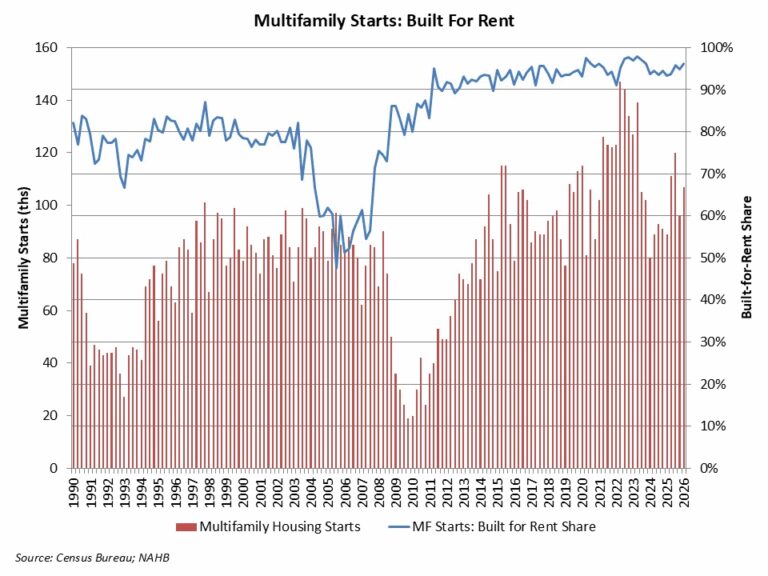
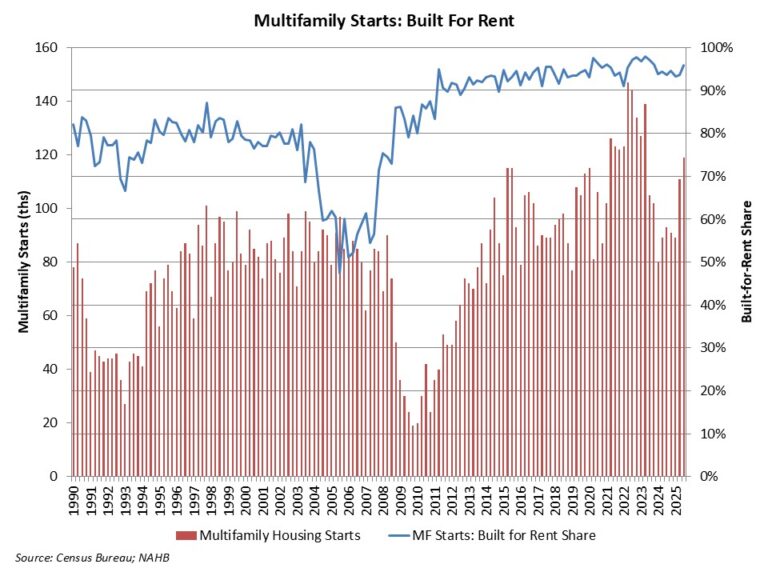
According to NAHB analysis of quarterly Census data, the count of multifamily, for-rent housing starts increased year-over-year during the first quarter of 2026. For the quarter, 107,000 multifamily residences started construction. Of this total, 103,000 were built-for-rent. This built-for-rent total was 21% higher than in the first quarter of 2025. Prior NAHB analysis suggests this expansion primarily occurred in smaller metro areas and lower density markets, given ongoing weakness in urban core areas.

The market share of rental units of multifamily construction starts was 96% for the first quarter. A historical low market share of 47% for built-for-rent multifamily construction was set during the third quarter of 2005, during the condo building boom. An average share of 80% was registered during the 1980-2002 period.

For the first quarter, there were 4,000 multifamily condo unit construction starts, down significantly from a year ago (7,000) given ongoing housing affordability challenges.

An elevated rental share of multifamily construction is holding typical apartment size below levels seen during the pre-Great Recession period. According to the first quarter 2026 data, the average square footage of multifamily construction starts declined to 1,047 square feet. The median, or typical unit, posted a large decline to 960 square feet, the lowest on record. These measures are consistent with the elevated share of multifamily built-for-rent construction.


This article was originally published by a eyeonhousing.org . Read the Original article here. .


Overall confidence in the market for new multifamily housing held steady year-over-year in the first quarter, according to the Multifamily Market Survey (MMS) by the National Association of Home Builders (NAHB). The MMS produces two separate indices. The Multifamily Production Index (MPI) had a reading of 44, unchanged year-over-year, while the Multifamily Occupancy Index (MOI) had a reading of 69, dropping 13 points year-over-year.

Multifamily developer sentiment is roughly where it was at this time last year, although the combination of regulatory hurdles, interest rates, insurance costs and volatility in material prices is threatening the viability of some projects. Also, in some markets, developers are reporting that it has become more difficult to obtain permits for unsubsidized projects.

The MPI and MOI continue to show that the market for garden and low-rise apartments typical of outlying areas is stronger than the market for mid- and high-rise apartments. The gap is narrowing year-over-year for new multifamily construction (i.e., blue line), while widening for the occupancy of existing apartments (i.e., orange line). NAHB is projecting that multifamily starts will increase slightly in 2026, but current production rates are unlikely to be sustained through 2027.

Multifamily Production Index (MPI)

The MMS asks multifamily developers to rate the current conditions as “good”, “fair”, or “poor” for multifamily starts in markets where they are active. The index and all its components are scaled so that a number above 50 indicates that more respondents report conditions as good rather than poor. The MPI is a weighted average of four key market segments: three in the built-for-rent market (garden/low-rise, mid/high-rise, and subsidized) and the built-for-sale (or condominium) market.

There were two components which experienced increases year-over-year, while the other two experienced decreases during the first quarter. The component measuring mid/high-rise rose seven points to 35, while the component measuring subsidized units increased six points to 56. On the other hand, the component measuring garden/low-rise fell six points to 48 while the component measuring built-for-sale units inched down one point to 37. Only the component measuring subsidized units was above the break-even point of 50.

Multifamily Occupancy Index (MOI)

The survey also asks multifamily property owners to rate the current conditions for occupancy of existing rental apartments in markets where they are active as “good”, “fair”, or “poor”.  Like the MPI, the MOI and all its components are scaled so that a number above 50 indicates more respondents report that occupancy is good than poor. The MOI is a weighted average of three built-for-rent market segments (garden/low-rise, mid/high-rise, and subsidized). 

All three MOI components experienced year-over-year decreases in the first quarter of 2026; the mid/high-rise component dropped 17 points to 59, the garden/low-rise component fell 11 points to 71, and the subsidized component decreased nine points to 80. Nevertheless, all three MOI components remain well above the break-even point of 50.

For more recent information about the market, the survey contains a separate question asking multifamily developers to compare current market conditions to conditions three months earlier. In the first quarter of 2026, 21% of respondents said the current market is better, and 19% said it is worse. However, the majority of developers—60%—said that the market is currently about the same as it was three months ago.

The MMS was re-designed in 2023 to produce results that are easier to interpret and consistent with the proven format of other NAHB industry sentiment surveys. Until there is enough data to seasonally adjust the series, changes in the MMS indices should only be evaluated on a year-over-year basis.

Please visit NAHB’s MMS web page for the full report.


This article was originally published by a eyeonhousing.org . Read the Original article here. .


According to NAHB analysis of quarterly Census data, the count of multifamily, for-rent housing starts increased year-over-year during the fourth quarter of 2025. For the quarter, 96,000 multifamily residences started construction. Of this total, 91,000 were built-for-rent. This built-for-rent total was 18% higher than in the fourth quarter of 2024. This marks a significant increase, and it is possible these numbers will be revised lower in future Census data given other multifamily data reporting.

The market share of rental units of multifamily construction starts was 95% for the fourth quarter. A historical low market share of 47% for built-for-rent multifamily construction was set during the third quarter of 2005, during the condo building boom. An average share of 80% was registered during the 1980-2002 period.

For the fourth quarter, there were 6,000 multifamily condo unit construction starts, flat from a year ago.

An elevated rental share of multifamily construction is holding typical apartment size below levels seen during the pre-Great Recession period. According to the fourth quarter 2025 data, the average square footage of multifamily construction starts increased to 1,068 square feet. The median increased to 1,048 square feet. These measures are consistent with the elevated share of multifamily built-for-rent construction.


This article was originally published by a eyeonhousing.org . Read the Original article here. .

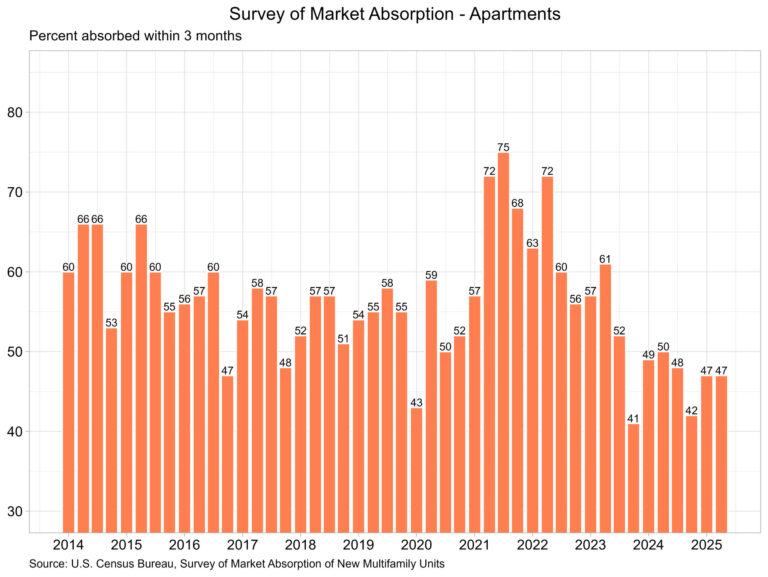
The percentage of new apartment units that were absorbed within three months after completion was unchanged for new units completed in the second quarter, according to the Census Bureau’s latest release of the Survey of Market Absorption of New Multifamily Units (SOMA). The survey covers new units in multifamily residential buildings with five or more units. The number of new multifamily units completed rose marginally in the second quarter and remained above 90,000 units for the seventh consecutive quarter.

Apartments

The percentage of apartments absorbed within three months has remained below 50% for four straight quarters. The SOMA data has never featured more than two consecutive quarters with under 50% absorption rates. Currently, the rate stands at 47%, meaning that 47% of the 93,680 units completed in the second quarter were rented within three months of completion. The median asking rent in the second quarter was $1,860, up 5.3% from $1,766 last year. The SOMA data has also displayed two quarters of median rent declines, as the asking rent has fallen from $1,941 for completions in the fourth quarter of 2024.

Along with the three-month absorption rate and completions, SOMA also reports absorption rates at six, nine, and twelve months after completion. For apartments completed six months ago (93,400 units), 70% have been absorbed into the market. Of the 125,100 apartments completed nine months ago, 85% have been absorbed. For those completed twelve months ago (142,700 units), 91% were absorbed into the multifamily market.

Condominiums and Cooperative Units

The three-month absorption rate for new condominiums and cooperative units rose to 69%. Total completions of new condominiums and cooperative units, according to SOMA, doubled in the second quarter from 2,551 to 5,167.


This article was originally published by a eyeonhousing.org . Read the Original article here. .

Even though garden/low-rise continues to be strong, overall confidence in the market for new multifamily housing decreased year-over-year in the fourth quarter, according to the Multifamily Market Survey (MMS) released today by the National Association of Home Builders (NAHB). The MMS produces two separate indices. The Multifamily Production Index (MPI) had a reading of 45, down three points year-over-year, while the Multifamily Occupancy Index (MOI) had a reading of 74, down seven point year-over-year.

Multifamily developers are somewhat less optimistic than they were at this time last year, except in the market segment for garden/low-rise apartments. This suggests that the 2025 trend of gains in multifamily market share for outlying metro and non-metro counties—where garden and low-rise structures are more common—is likely to continue in 2026.

Elevated construction costs and the local regulatory environment continue to be major headwinds to faster growth. While interest rates eased slightly in 2025, they still need to come down further to significantly spur new construction.

Multifamily Production Index (MPI)

The MMS asks multifamily developers to rate the current conditions as “good”, “fair”, or “poor” for multifamily starts in markets where they are active.  The index and all its components are scaled so that a number above 50 indicates that more respondents report conditions as good rather than poor. The MPI is a weighted average of four key market segments: three in the built-for-rent market (garden/low-rise, mid/high-rise, and subsidized) and the built-for-sale (or condominium) market.

The component measuring garden/low-rise was the only one to experience an increase year-over-year in the fourth quarter of 2025, rising two points to 54. This component has been above 50 every quarter in 2025. The other three components experienced year-over-year declines during the quarter. The component measuring mid/high-rise fell eight points to 31, the component measuring built-for-sale units dropped six points to 36, and the component measuring subsidized units decreased five points to 47.

Multifamily Occupancy Index (MOI)

The survey also asks multifamily property owners to rate the current conditions for occupancy of existing rental apartments in markets where they are active as “good”, “fair”, or “poor”.  Like the MPI, the MOI and all its components are scaled so that a number above 50 indicates more respondents report that occupancy is good than poor.  The MOI is a weighted average of three built-for-rent market segments (garden/low-rise, mid/high-rise, and subsidized). 

All three MOI components experienced year-over-year decreases in the fourth quarter of 2025; the mid/high-rise component plummeted 12 points to 62, the garden/low-rise component decreased five points to 76, and the subsidized component dipped three points to 88. Nevertheless, all three MOI components remain well above the break-even point of 50.

The MMS was re-designed in 2023 to produce results that are easier to interpret and consistent with the proven format of other NAHB industry sentiment surveys. Until there is enough data to seasonally adjust the series, changes in the MMS indices should only be evaluated on a year-over-year basis.

Please visit NAHB’s MMS web page for the full report.


This article was originally published by a eyeonhousing.org . Read the Original article here. .

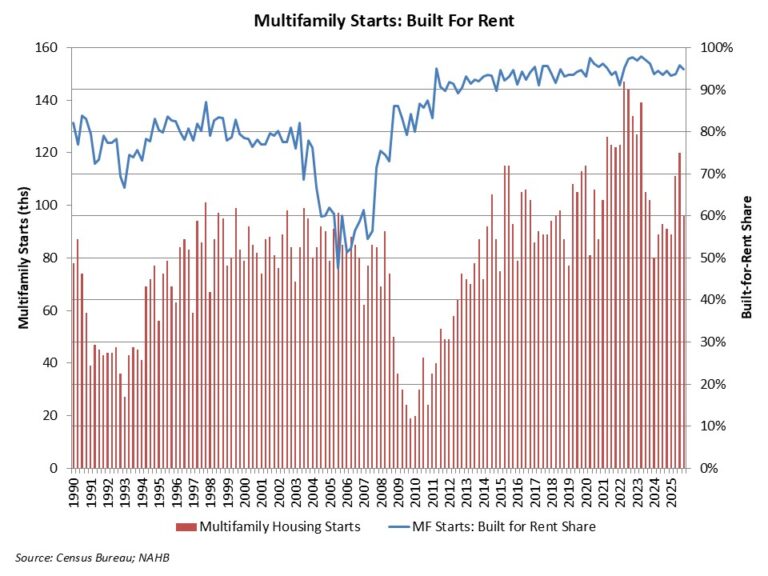
According to NAHB analysis of quarterly Census data, the count of multifamily, for-rent housing starts increased during the third quarter of 2025. For the quarter, 119,000 multifamily residences started construction. Of this total, 114,000 were built-for-rent. This built-for-rent total was 31% higher than the third quarter of 2024. This marks a significant increase, and it is possible these numbers will be revised lower in future Census data given other multifamily data reporting.

The market share of rental units of multifamily construction starts was 95% for the third quarter. A historical low market share of 47% for built-for-rent multifamily construction was set during the third quarter of 2005, during the condo building boom. An average share of 80% was registered during the 1980-2002 period.

For the third quarter, there were 5,000 multifamily condo unit construction starts, a decrease from a year ago.

An elevated rental share of multifamily construction is holding the typical apartment size below levels seen during the pre-Great Recession period. According to the third quarter 2025 data, the average square footage of multifamily construction starts decreased to 1,052 square feet. The median declined to 1,006 square feet. These measures are consistent with the elevated share of multifamily built-for-rent construction.


This article was originally published by a eyeonhousing.org . Read the Original article here. .

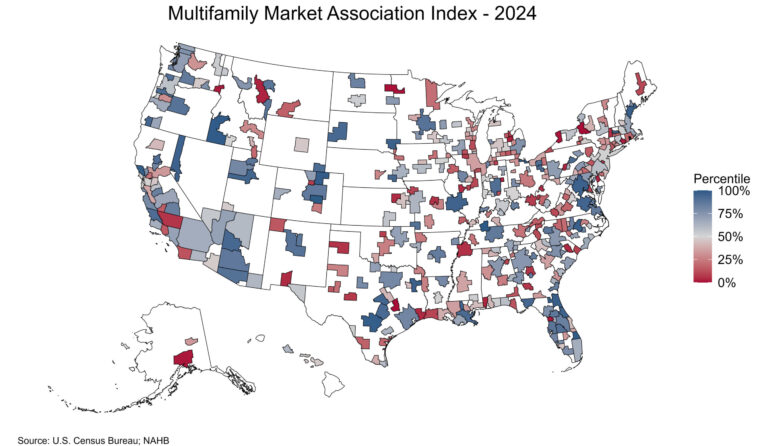
Following the release of the 2024 single-family MAI last week, the National Association of Home Builders developed the Multifamily Market Association Index (MAI) to measure how closely multifamily building permits in metro areas follow national patterns. By comparing local and national trends, the MAI helps industry leaders and forecasters better understand and predict housing market activity.

Nationally, multifamily permits displayed little variation over the second half of the 2010s. Permit levels began growing significantly during the pandemic and peaked at nearly 700,000 in 2022. However, both 2023 and 2024 reported declines, with 2024 having 496,000 units permitted, closer to pre-2020 levels.

The MAI uses 2015-2024 multifamily permit data to create five- and ten-year correlations for each metropolitan statistical area (MSA), showing their similarity to national patterns. The five- and ten-year correlations are then averaged, with more weight given to the five-year correlation. The resulting correlation coefficient ranges from negative one to positive one, indicating the strength and direction of the relationship between local and national trends.

The MSA that had the highest associations with the national trend was Clarksville, TN-KY with a correlation of 0.97, while the MSA that recorded the lowest association with the national trend was College Station-Bryan, TX. The scatter plot below illustrates the linear relationship between these MSAs and the national trend. For example, when national permit levels rose near 700,000, Clarksville (positive correlation) also had relatively high permit levels of around 2,500. At the same time, College Station-Bryan (negative correlation) had relatively low permits of about 230.

Of the 387 metro areas included in the multifamily MAI, the average correlation is 0.17. In total, 241 MSAs had a correlation greater than zero, and 145 MSAs had less than zero. One MSA had an average correlation of zero (Morgantown, WV), with no multifamily permits in the last five years. A positive correlation is expected as MSAs in total accounted for almost 95% of all multifamily permits in the U.S. on average between 2015 and 2024. A complete list of the MSA correlations is found here and shown on the map below.

Additionally, below are the top ten and bottom ten in terms of the Multifamily MAI.

Discover more from Eye On Housing

Subscribe to get the latest posts sent to your email.


This article was originally published by a eyeonhousing.org . Read the Original article here. .

Confidence in the market for new multifamily housing increased year-over-year in the third quarter, according to the Multifamily Market Survey (MMS) released today by the National Association of Home Builders (NAHB). The MMS produces two separate indices. The Multifamily Production Index (MPI) had a reading of 46, up six points year-over-year, while the Multifamily Occupancy Index (MOI) had a reading of 74, down one point year-over-year.

The MPI and MOI are giving a mixed picture, creating a bifurcation of the multifamily market.  While MPI is still in negative territory, developers of low-rise market-rate and subsidized rental properties express increased optimism, with both components above 50 for the quarter.  Weakness is concentrated in the mid-to-high-rise and condominium developments which tend to be common in high-density metro areas.  This is consistent with NAHB’s Home Building Geography Index where multifamily construction activity is growing in areas with low population densities but weakening in the larger metros. 

Even though MOI is in positive territory and existing apartment owners are positive about occupancy overall, this is the lowest reading since NAHB redesigned the survey starting in Q1 2023.  Sentiment for mid/high-rise apartment occupancy is noticeably weaker than it is for the other two rental market segments.

Multifamily Production Index (MPI)

The MMS asks multifamily developers to rate the current conditions as “good”, “fair”, or “poor” for multifamily starts in markets where they are active.  The index and all its components are scaled so that a number above 50 indicates that more respondents report conditions as good rather than poor. The MPI is a weighted average of four key market segments: three in the built-for-rent market (garden/low-rise, mid/high-rise, and subsidized) and the built-for-sale (or condominium) market.

All four components experienced year-over-year increases in the third quarter of 2025: both the components measuring mid/high rise and subsidized units jumped up nine points to 37 and 55, respectively, the component measuring built-to-sale units increased six points to 35, and the component measuring garden/low-rise units increased three points to 51.

Multifamily Occupancy Index (MOI)

The survey also asks multifamily property owners to rate the current conditions for occupancy of existing rental apartments, in markets where they are active, as “good”, “fair”, or “poor”.  Like the MPI, the MOI and all its components are scaled so that a number above 50 indicates more respondents report that occupancy is good than as poor.  The MOI is a weighted average of three built-for-rent market segments (garden/low-rise, mid/high-rise and subsidized). 

Two of the three MOI components experienced year-over-year decreases in the third quarter of 2025; the component measuring subsidized units fell by five points to 81 and the garden/low-rise component dipped one point to 76.  Meanwhile, the component measuring mid/high-rise units was unchanged at 66.  All three MOI components remain well above the break-even point of 50.

The MMS was re-designed in 2023 to produce results that are easier to interpret and consistent with the proven format of other NAHB industry sentiment surveys.  Until there is enough data to seasonally adjust the series, changes in the MMS indices should only be evaluated on a year-over-year basis.

Please visit NAHB’s MMS web page for the full report.

Discover more from Eye On Housing

Subscribe to get the latest posts sent to your email.


This article was originally published by a eyeonhousing.org . Read the Original article here. .


Single-family housing starts posted a modest gain in July as builders continue to contend with challenging housing affordability conditions and a host of supply-side headwinds, including labor shortages, elevated construction costs and inefficient regulatory costs.

Led by solid multifamily production, overall housing starts increased 5.2% in July to a seasonally adjusted annual rate of 1.43 million units, according to a report from the U.S. Department of Housing and Urban Development and the U.S. Census Bureau.

The July reading of 1.43 million starts is the number of housing units builders would begin if development kept this pace for the next 12 months. Within this overall number, single-family starts increased 2.8% to a 939,000 seasonally adjusted annual rate and are down 4.2% on a year-to-date basis. The multifamily sector, which includes apartment buildings and condos, increased 9.9% to an annualized 489,000 pace.

The slowdown in single-family home building has narrowed the home building pipeline. There are currently 621,000 single-family homes under construction, down 1% in July and 3.7% lower than a year ago. This is the lowest level since early 2021 as builders pull back on supply.

On a regional and year-to-date basis, combined single-family and multifamily starts were 10.2% higher in the Northeast, 17.7% higher in the Midwest, 2.4% lower in the South and 0.5% lower in the West.

Overall permits decreased 2.8% to a 1.35-million-unit annualized rate in July. Single-family permits increased 0.5% to an 870,000-unit rate and are down 5.8% on a year-to-date basis. Multifamily permits decreased 8.2% to a 484,000 pace.

Looking at regional permit data on a year-to-date basis, permits were 16.6% lower in the Northeast, 9.1% higher in the Midwest, 3.4% lower in the South and 5.1% lower in the West.

Discover more from Eye On Housing

Subscribe to get the latest posts sent to your email.


This article was originally published by a eyeonhousing.org . Read the Original article here. .

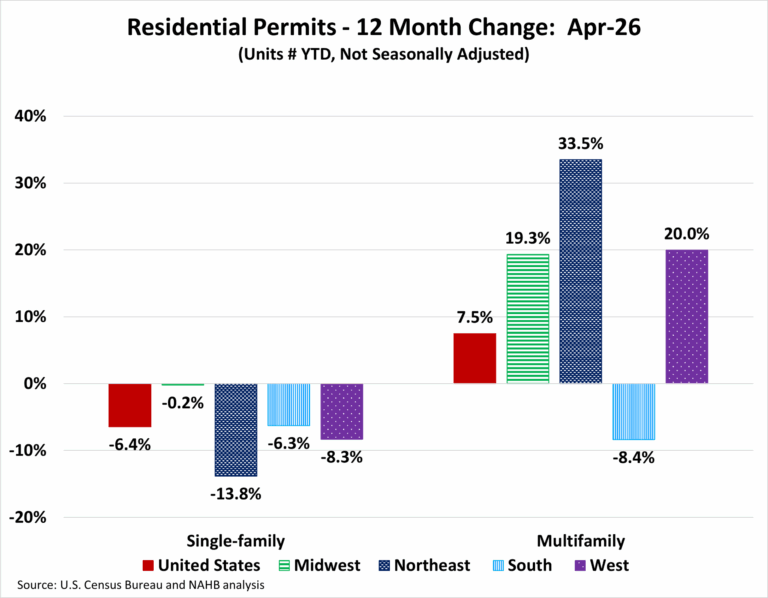
Single-family housing permits continued a downhill trend for the sixth month in a row. The continuous decline in single-family permits highlights persistently weak housing demand, tied to affordability challenges like high mortgage rates. Builders appear cautious amid economic uncertainty, labor constraints, and rising inventories. The uptick in multi-family permits suggests a potentially stabilizing trend, though it’s important to note its volatility. The housing market’s mixed signals—weak single-family coupled with some resilience in multi-family—could mean continued drag on residential investment and the broader economy this year.

Over the first six months of 2025, the total number of single-family permits issued year-to-date (YTD) nationwide reached 485,935. On a year-over-year (YoY) basis, this is a decline of 5.6% over the June 2024 level of 514,728. For multifamily, the total number of permits issued nationwide reached 244,812. This is 2.9% higher compared to the June 2024 level of 237,935.

Year-to-date ending in June, single-family permits were up in one out of the four regions. The Midwest posted a small increase of 1.8%. The Northeast was 1.7% lower, the South was down by 6.5%, and the West was down by 8.1% in single-family permits during this time. For multifamily permits, three out of the four regions posted increases. The Midwest was up by 22.4%, the West was up by 8.0%, and the South was up by 7.1%, Meanwhile, the Northeast declined steeply by 30.0%, driven by the New York-Newark-Jersey City, NY-NJ MSA which declined by 40.0%.

Between June 2025 YTD and June 2024 YTD, 15 states posted an increase in single-family permits. The range of increases spanned 19.9% in Hawaii to 0.2% in Kentucky. The remaining 35 states and the District of Columbia reported declines in single-family permits with the District of Columbia reporting the steepest decline of 24.2%.

The ten states issuing the highest number of single-family permits combined accounted for 63.0% of the total single-family permits issued. Texas, the state with the highest number of single-family permits, issued 78,104 permits over the first six months of 2025; this is a decline of 8.0% compared to the same period last year. The second highest state, Florida, decreased by 10.6%, while the third highest, North Carolina, posted a decline of 0.9%.

Between June 2025 YTD and June 2024 YTD, 29 states recorded growth in multifamily permits, while 21 states and the District of Columbia recorded a decline. Iowa (+165.5%) led the way with a sharp rise in multifamily permits from 1,178 to 3,128, while Alabama had the largest decline of 49.6% from 1,788 to 901.

The ten states issuing the highest number of multifamily permits combined accounted for 61.8% of the multifamily permits issued. Over the first six months of 2025, Florida, the state with the highest number of multifamily permits issued, experienced an increase of 25.0%. Texas, the second-highest state in multifamily permits, saw an increase of 14.1%. California, the third largest multifamily issuing state, increased by 11.5%.

At the local level, below are the top ten metro areas that issued the highest number of single-family permits.

For multifamily permits, below are the top ten local areas that issued the highest number of permits.

Discover more from Eye On Housing

Subscribe to get the latest posts sent to your email.


This article was originally published by a eyeonhousing.org . Read the Original article here. .
Pin It