Tag

Falls

Browsing


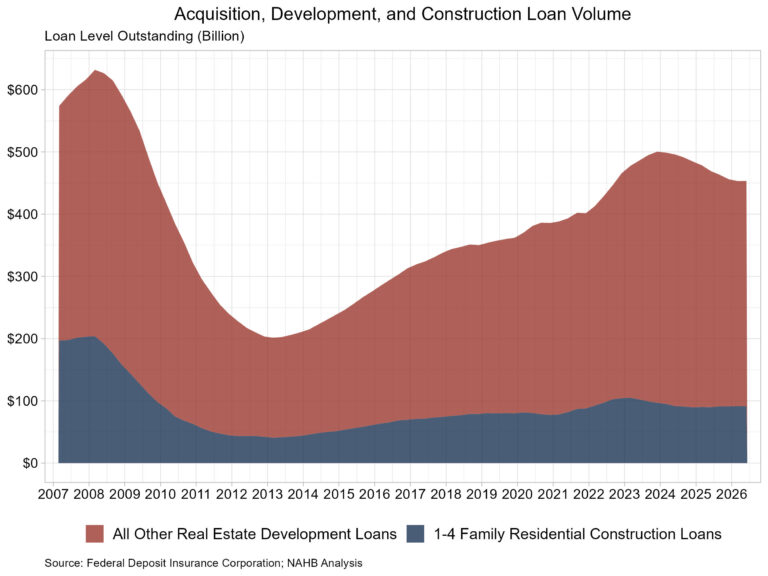
Single-family construction lending fell in the fourth quarter, according to data released by the Federal Deposit Insurance Corporation (FDIC). The decline in the outstanding volume of acquisition, development and construction (AD&C) loans occurred even with two Federal Reserve rate cuts in the fourth quarter. Additionally, NAHB’s AD&C Financing Survey points to continued tightening in credit conditions in the fourth quarter notwithstanding the latest decline in financing rates. Economic uncertainty remains a leading factor behind the persistence of tighter financing conditions for residential construction.

In the fourth quarter of 2025, the total level of outstanding AD&C loans fell to $456.3 billion, down 1.5% from the third quarter. The quarterly decline was led by a drop in other real estate development loans, which decreased 1.8% over the quarter to $365.2 billion. Meanwhile, the volume of 1-4 family residential construction and land development loans declined to $91.1 billion in the fourth quarter, down 0.2% from a quarter earlier. Although the volume of 1-4 family residential construction loans fell over the quarter, the outstanding amount was up 1.7% from last year. This marked the second straight quarter showing a year-over-year increase.

It is worth noting that the FDIC data represent only the stock of loans, not changes in the underlying flows, so it is an imperfect data source. Nonetheless, lending remains much reduced compared with years past. The current amount of existing 1-4 family residential AD&C loans now stands 56% lower than the peak level of residential construction lending of $204 billion reached during the first quarter of 2008. Alternative sources of financing, including equity partners, have supplemented this capital market in recent years.

Quality Metrics of Construction Loans

The volume of loans that are 30+ days past due or nonaccrual status fell for the third consecutive quarter, to $985.3 million. As a share of the total 1-4 family residential construction loan volume, this accounts for 1.1%.

Breaking this out further, the level of loans 30-89 days past due was $414.6 million, while the volume in nonaccrual status was $522.1 million. The nonaccrual loan volume fell from $593.4 million in the third quarter and the 30-89 past due volume fell from $418.5 million.

Loans are classified as nonaccrual when one or more of the following conditions apply: the loan is 90 days or more past due on principal or interest (unless it is well-secured and in the process of collection); the bank no longer expects full repayment of principal and interest; or the borrower’s financial condition has significantly deteriorated, warranting cash-basis accounting.

Which Size Banks are Lending?

Of the outstanding $91.1 billion in 1-4 family residential constructions loans, banks between $1 billion and $10 billion in total assets held the largest share at $32.2 billion (35.3%) at the end of 2025. Banks with assets between $10 and $250 held the next largest share at $30.1 billion (33.0%). The smallest banks, those with under $1 billion in assets, held $19.8 billion (21.7%) while the largest banks, with over $250 billion in total assets, had $9.0 billion (9.9%).

The distribution of banks holding 1-4 family residential construction loans is significantly different from the composition of all bank assets. At the end of 2025, the total amount of assets held by FDIC-insured banks was $25.26 trillion. Most of the banking industry’s assets are held by banks with over $250 billion in total assets, at 60.3%. This large bank asset group is comprised of just 16 banks as of the fourth quarter of 2025. Banks with between $10 billion and $250 billion in total assets held 25.3% of the industry’s total assets, as banks with $1 billion to $10 billion held 10.1%. Banks with under $1 billion in total assets had a market share of 4.3%.


This article was originally published by a eyeonhousing.org . Read the Original article here. .

Personal income rose 0.3% in November 2025, following a 0.1% increase in October, according to the latest data from the Bureau of Economic Analysis. Gains were largely driven by higher wages and dividend income. However, income growth has cooled noticeably from peaking at a monthly increase of 1.1% in July 2022 to 0.3% now.

Real disposable income, the amount remaining after adjusted for taxes and inflation, was up 0.1% in November, reversing a 0.1% decline in October. On a year-over-year basis, real (inflation-adjusted) disposable income rose 1%, down from a 7.2% year-over-year recent peak recorded in June 2023.

Consumer spending, meanwhile, remained robust but showed signs of softening. Personal consumption expenditures rose 0.5% in November. Real spending, adjusted to remove inflation, increased 0.3% in November, with expenditures on goods climbing 0.6% and spending on services up 0.2%.

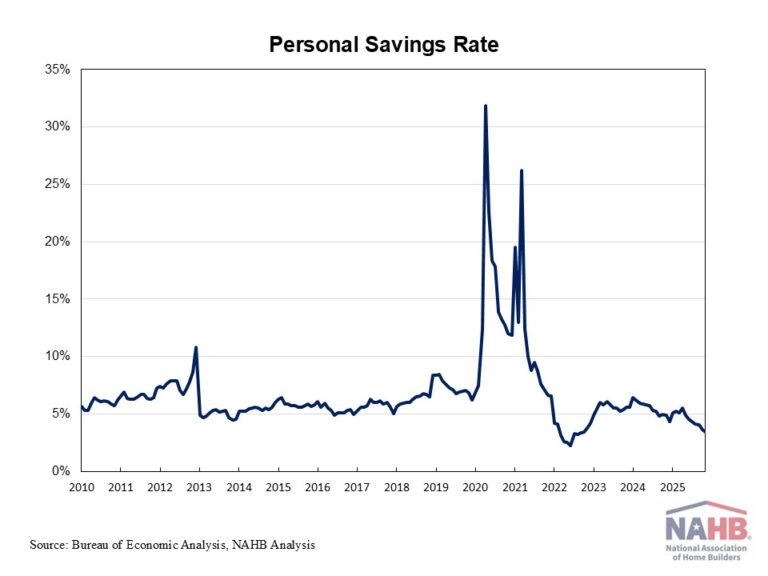
With spending growth outpacing income growth, the personal saving rate decreased to 3.5% in November, the lowest level since late 2022, when core CPI was around the peak. With inflation eroding compensation gains, households are dipping into savings to support spending, especially during the period when some payments were disrupted by the government shutdown. This trend will ultimately lead to a slowing of consumer spending.


This article was originally published by a eyeonhousing.org . Read the Original article here. .


After a rapid expansion of residential swimming pool and spa construction following the pandemic, permit levels in the latest monthly index for December fell to their lowest level since 2020.

The Pool Construction Permit Index, created by NAHB using proprietary data from Construction Monitor, can be used to track pool and spa construction projects nationwide. Perhaps intuitively, the raw data used to create the index has strong seasonality. Most permits are submitted during warmer months, like May and June, while there are typically few pool construction permits collected in November and December.

As of December 2025, pool construction permits were 34.3% lower than the January 2020 reading, our baseline for this index. The index was down 25.5% from the month prior and down 34.7% from one year ago.

As previously mentioned, the raw data displays strong seasonality across months. Due to this seasonality, it is difficult to determine the true trend of residential pool construction. To account for this, a seasonally adjusted index was created to account for the seasonal changes.

For the seasonally adjusted estimates, pool construction permits continued to peak in 2021 but have steadily declined to lower levels. The current December reading is 23.4% lower than our index base of January 2020 and down 26.8% from a month ago and 37.3% lower than last year. The seasonally adjusted data, shown in red below, allows for a clear visualization of how the Pool Construction Permit Index has changed over the past five years. December data was the lowest in the data series.

Geographic Analysis

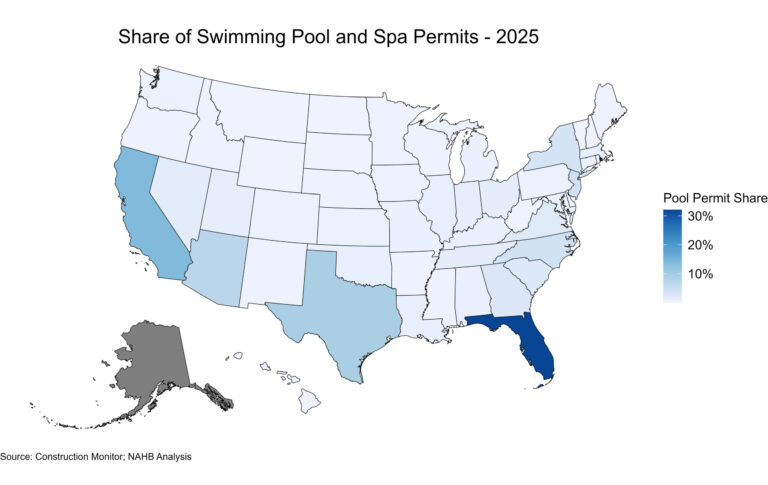
The index is dependent on where pool construction is most likely to take place. For 2025, almost 1/3rd of pool construction permits were in Florida. The next closest state was California with a 14% share of pool construction. New York and New Jersey were the only states in the Northeast to break the top ten in terms of pool permit shares in 2025.


This article was originally published by a eyeonhousing.org . Read the Original article here. .


The market value of household real estate assets fell from $48.1 trillion to $47.9 trillion in the first quarter of 2025, according to the most recent release of U.S. Federal Reserve Z.1 Financial Accounts. The value of household real estate assets declined for three consecutive quarters after peaking at $48.8 trillion in the second quarter of 2024 but remains 2.1% higher over the year.

Real estate secured liabilities of households’ balance sheets, i.e. mortgages, home equity loans, and HELOCs, increased 0.3% over the first quarter to $13.4 trillion. This level is 2.9% higher compared to the first quarter of 2024.

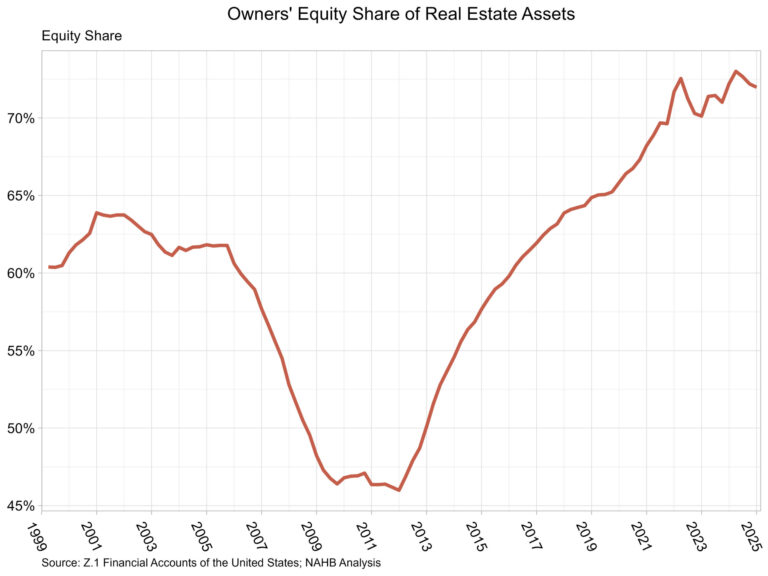
Owners’ equity share of real estate assets was 72.0% in the first quarter, marking a small decline in owners’ equity share which matches the decline in the market value of households real estate assets. The share in the first quarter of 2024 was 72.2%.

Discover more from Eye On Housing

Subscribe to get the latest posts sent to your email.


This article was originally published by a eyeonhousing.org . Read the Original article here. .

Multifamily developers are starting the year in a cautious state, according to Q1 2025 results from the Multifamily Market Survey (MMS) released today by the National Association of Home Builders (NAHB).  The MMS produces two separate indices.  The Multifamily Production Index (MPI) decreased three points to 44 year-over-year, marking the seventh consecutive quarter below the break-even point of 50.  The Multifamily Occupancy Index (MOI) had a reading of 82, slightly lower than the 83 reading it recorded in the first quarter of 2024.

The current MPI reading is consistent with NAHB’s forecast for a modest decline in the rate of multifamily production for the remainder of 2025, followed by a modest recovery in 2026. Multifamily builders and developers continue to experience major headwinds from rising construction costs, regulatory barriers, and availability of financing.

Like remodelers and single-family builders, multifamily developers are also being affected by economic policy uncertainty.  In this quarter’s MMS, more than half of the developers reported that their suppliers have increased prices due to announced, enacted or anticipated tariffs.

Multifamily Production Index (MPI)

The MMS asks multifamily developers to rate the current conditions as “good”, “fair”, or “poor” for multifamily starts in markets where they are active.  The index and all its components are scaled so that a number above 50 indicates that more respondents report conditions as good rather than poor. The MPI is a weighted average of four key market segments: three in the built-for-rent market (garden/low-rise, mid/high-rise, and subsidized) and the built-for-sale (or condominium) market.

Three of the four components experienced year-over-year decreases: the component measuring mid/high-rise units fell eight points to 28 and the components measuring garden/low-rise and built-for-sale units both dipped by one point to 54 and 38, respectively.   The component measuring subsidized units was unchanged at 50 year-over-year.

Multifamily Occupancy Index (MOI)

The survey also asks multifamily property owners to rate the current conditions for occupancy of existing rental apartments, in markets where they are active, as “good”, “fair”, or “poor”.  Like the MPI, the MOI and all its components are scaled so that a number above 50 indicates more respondents report that occupancy is good than report it as poor.  The MOI is a weighted average of three built-for-rent market segments (garden/low-rise, mid/high-rise and subsidized). 

Two of the three MOI components experienced year-over-year declines in the first quarter of 2025.  The component measuring subsidized units dropped by five points to 89 and the garden/low-rise component decreased two points to 82.  Meanwhile, the component measuring mid/high-rise units rose two points to 76.  Despite the declines, all three MOI components remain well above the break-even point of 50.

The MMS was re-designed in 2023 to produce results that are easier to interpret and consistent with the proven format of other NAHB industry sentiment surveys.  Until there is enough data to seasonally adjust the series, changes in the MMS indices should only be evaluated on a year-over-year basis.

Please visit NAHB’s MMS web page for the full report.

Discover more from Eye On Housing

Subscribe to get the latest posts sent to your email.


This article was originally published by a eyeonhousing.org . Read the Original article here. .

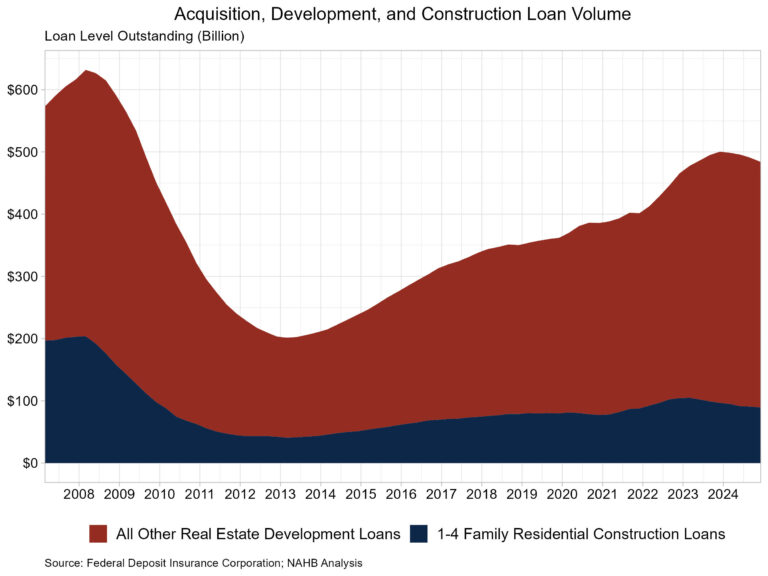
Higher interest rates and tight financial lending conditions have led to a decline in loans for new home construction. The total volume of acquisition, development, and construction (AD&C) loans outstanding from FDIC-insured institutions fell 1.02% to $490.7 billion, the third straight quarterly decline. The level of 1-4 residential construction loans, which include loans for the construction of single-family homes and townhomes, has fallen for seven consecutive quarters. Coincidingly, the volume of 1-4 family residential construction has moved to its lowest level since 2021.

The volume of 1-4 family residential construction and land development loans totaled $89.5 billion in the fourth quarter, down 7.6% from one year ago. This is also down after reaching a recent high of $105.0 billion in the first quarter of 2023.

To end the year, a plurality of outstanding loans was held by smaller banking institutions, those with $1 billion-$10 billion in total assets, totaling $30.2 billion (33.7%). Banks with $10 billion- $250 billion in assets held the second largest share at $29.8 billion (33.3%), followed by the smallest banks with under $1 billion in assets, holding $20.7 billion (23.1%). The largest banks with over $250 billion in assets held the smallest amount at $8.8 billion (9.8%).

Notably, 56.9% of 1-4 family residential construction and development loans were held by banks with under $10 billion in assets to end 2024. Small community banks play a vital role ensuring financial and lending opportunities for builders across the United States. The data below shows the year-ending level of outstanding 1-4 family residential construction loans broken out by bank asset sizes.

All Other Real Estate Development Loans

Excluding 1-4 family residential construction loans, the level of all other outstanding real estate construction loans totaled $394.6 billion and was down 2.2% from the previous year This is also down from a peak in the second quarter of 2024 of $404.2 billion.

The banks that held the most loans were those with total assets between $10-$250 billion totaling $163.2 billion (41.4%) to end 2024. Banks with $1-$10 billion in assets held $107.1 billion (27.3%), banks with more than $250 billion in assets held $86.6 billion (21.9%) and the smallest banks, those with less than $1 billion in assets, held $37.7 billion (9.6%).

For the end of 2024, larger banks ($10 billion or more in assets) had more activity in the other construction and land development loan arena compared to 1-4 family residential construction holding 63.3% of the outstanding volume.

It is worth noting, the FDIC data represent only the stock of loans, not changes in the underlying flows, so it is an imperfect data source. Nonetheless, lending remains much reduced from years past. The current amount of existing 1-4 family residential AD&C loans now stands 56% lower than the peak level of residential construction lending of $204 billion reached during the first quarter of 2008. Alternative sources of financing, including equity partners, have supplemented this capital market in recent years.

Discover more from Eye On Housing

Subscribe to get the latest posts sent to your email.


This article was originally published by a eyeonhousing.org . Read the Original article here. .

Economic uncertainty, the threat of tariffs and elevated construction costs pushed builder sentiment down in March even as builders express hope that a better regulatory environment will lead to an improving business climate.

Builder confidence in the market for newly built single-family homes was 39 in March, down three points from February and the lowest level in seven months, according to the National Association of Home Builders (NAHB)/Wells Fargo Housing Market Index (HMI).

Builders continue to face elevated building material costs that are exacerbated by tariff issues, as well as other supply-side challenges that include labor and lot shortages. At the same time, builders are starting to see relief on the regulatory front to bend the rising cost curve, as demonstrated by the Trump administration’s pause of the 2021 IECC building code requirement and move to implement the regulatory definition of ‘waters of the United States’ under the Clean Water Act consistent with the U.S. Supreme Court’s Sackett decision.

Construction firms are facing added cost pressures from tariffs. Data from the HMI March survey reveals that builders estimate a typical cost effect from recent tariff actions at $9,200 per home. Uncertainty on policy is also having a negative impact on home buyers and development decisions.

The latest HMI survey also revealed that 29% of builders cut home prices in March, up from 26% in February. Meanwhile, the average price reduction was 5% in March, the same rate as the previous month. The use of sales incentives was 59% in March, unchanged from February.

Derived from a monthly survey that NAHB has been conducting for more than 35 years, the NAHB/Wells Fargo HMI gauges builder perceptions of current single-family home sales and sales expectations for the next six months as “good,” “fair” or “poor.” The survey also asks builders to rate traffic of prospective buyers as “high to very high,” “average” or “low to very low.” Scores for each component are then used to calculate a seasonally adjusted index where any number over 50 indicates that more builders view conditions as good than poor.

The HMI index gauging current sales conditions fell three points to 43 in March, its lowest point since December 2023. The gauge charting traffic of prospective buyers dropped five points to 24 while the component measuring sales expectations in the next six months held steady at 47.

Looking at the three-month moving averages for regional HMI scores, the Northeast fell three points in March to 54, the Midwest moved three points lower to 42, the South dropped four points to 42 and the West posted a two-point decline to 37. The HMI tables can be found at nahb.org/hmi.

Discover more from Eye On Housing

Subscribe to get the latest posts sent to your email.


This article was originally published by a eyeonhousing.org . Read the Original article here. .

The market value of household real estate assets fell from $48.5 trillion to $48.1 trillion in the fourth quarter of 2024, according to the most recent release of U.S. Federal Reserve Z.1 Financial Accounts. Household real estate assets value have fallen for two consecutive quarters after peaking at $48.7 trillion in the second quarter of 2024. However, household real estate assets were 7.0% higher over the year in the fourth quarter following a 7.1% increase in the third quarter.

Real estate secured liabilities of households’ balance sheets, i.e. mortgages, home equity loans, and HELOCs, increased 0.8% over the fourth quarter to $13.3 trillion. This level is 2.6% higher compared to the fourth quarter of 2023, the same year-over-year increase as the third quarter.

Owners’ equity share of real estate assets remained above 72% for the fourth straight quarter. The share in the fourth quarter of 2024 was 72.2%, down from a peak of 73.0% just two quarters ago.

Discover more from Eye On Housing

Subscribe to get the latest posts sent to your email.


This article was originally published by a eyeonhousing.org . Read the Original article here. .

Single-family built-for-rent construction posted year-over-year declines for the fourth quarter of 2024, as a higher cost of financing crowded out development activity. This slowdown is similar to the deceleration of multifamily construction in recent quarters.

According to NAHB’s analysis of data from the Census Bureau’s Quarterly Starts and Completions by Purpose and Design, there were approximately 15,000 single-family built-for-rent (SFBFR) starts during the fourth quarter of 2024. This is 38% lower than the fourth quarter of 2023. Over the last four quarters (2024 as a whole), 83,000 such homes began construction, which is an 8% increase compared to the 77,000 estimated SFBFR starts in the four quarters prior to that period (2023 as a whole).

The SFBFR market is a source of inventory amid challenges over housing affordability and downpayment requirements in the for-sale market, particularly during a period when a growing number of people want more space and a single-family structure. Single-family built-for-rent construction differs in terms of structural characteristics compared to other newly-built single-family homes, particularly with respect to home size. However, investor demand for single-family homes, both existing and new, has cooled with higher interest rates.

Given the relatively small size of this market segment, the quarter-to-quarter movements typically are not statistically significant. The current four-quarter moving average of market share (8%) is nonetheless higher than the historical average of 2.7% (1992-2012).

Importantly, as measured for this analysis, the estimates noted above include only homes built and held by the builder for rental purposes. The estimates exclude homes that are sold to another party for rental purposes, which NAHB estimates may represent another three to five percent of single-family starts based on industry surveys.

The Census data notes an elevated share of single-family homes built as condos (non-fee simple), with this share averaging more than 4% over recent quarters. Some, but certainly not all, of these homes will be used for rental purposes. Additionally, it is theoretically possible some single-family built-for-rent units are being counted in multifamily starts, as a form of “horizontal multifamily,” given these units are often built on a single plat of land. However, spot checks by NAHB with permitting offices indicate no evidence of this data issue occurring.

With the onset of the Great Recession and declines for the homeownership rate, the share of built-for-rent homes increased in the years after the recession. While the market share of SFBFR homes is small, it has clearly expanded. Given affordability challenges in the for-sale market, the SFBFR market will likely retain an elevated market share. However, in the near-term, SFBFR construction is likely to slow until the return on new deals improves.

Discover more from Eye On Housing

Subscribe to get the latest posts sent to your email.


This article was originally published by a eyeonhousing.org . Read the Original article here. .


Builder sentiment fell sharply in February over concerns on tariffs, elevated mortgage rates and high housing costs.

Builder confidence in the market for newly built single-family homes was 42 in February, down five points from January and the lowest level in five months, according to the National Association of Home Builders (NAHB)/Wells Fargo Housing Market Index (HMI).

While builders hold out hope for pro-development policies, particularly for regulatory reform, policy uncertainty and cost factors created a reset for 2025 expectations in the most recent HMI. Uncertainty on the tariff front helped push builders’ expectations for future sales volume down to the lowest level since December 2023.

With 32% of appliances and 30% of softwood lumber coming from international trade, uncertainty over the scale and scope of tariffs has builders further concerned about costs. Reflecting this outlook, builder responses collected prior to a pause for the proposed tariffs on goods from Canada and Mexico yielded a lower HMI reading of 38, while those collected after the announced one-month pause produced a score of 44. Addressing the elevated pace of shelter inflation requires bending the housing cost curve to enable adding more attainable housing.

Incentive use may also be weakening as a sales strategy as elevated interest rates reduce the pool of eligible home buyers. The latest HMI survey also revealed that 26% of builders cut home prices in February, down from 30% in January and the lowest share since May 2024. Meanwhile, the average price reduction was 5% in February, the same rate as the previous month. The use of sales incentives was 59% in February, down from 61% in January.

Derived from a monthly survey that NAHB has been conducting for more than 35 years, the NAHB/Wells Fargo HMI gauges builder perceptions of current single-family home sales and sales expectations for the next six months as “good,” “fair” or “poor.” The survey also asks builders to rate traffic of prospective buyers as “high to very high,” “average” or “low to very low.” Scores for each component are then used to calculate a seasonally adjusted index where any number over 50 indicates that more builders view conditions as good than poor.

All three of the major HMI indices posted losses in February. The HMI index gauging current sales conditions fell four points to 46, the component measuring sales expectations in the next six months plunged 13 points to 46, and the gauge charting traffic of prospective buyers posted a three-point decline to 29.

Looking at the three-month moving averages for regional HMI scores, the Northeast fell three points in February to 57, the Midwest moved two points lower to 45, the West edged one-point lower to 39 and the South held steady at 46. The HMI tables can be found at nahb.org/hmi.

Discover more from Eye On Housing

Subscribe to get the latest posts sent to your email.


This article was originally published by a eyeonhousing.org . Read the Original article here. .
Pin It