The U.S. labor market began the year on firmer footing, with job growth rebounding in January after a subdued performance in 2025. Employment gains were widespread across most states, though underlying trends remain uneven, with pockets of weakness persisting in certain regions and sectors.
In January, nonfarm payroll employment increased in 45 states compared to December, while five states and the District of Columbia recorded declines. According to the Bureau of Labor Statistics, total U.S. nonfarm payroll employment rose by 160,000 in January, following a weaker performance in 2025. For all of 2025, monthly job growth averaged just 49,000, well below the 168,000 average monthly gain recorded in 2024.
On a month-over-month basis, employment gains were led by California (+93,500), followed by Texas (+40,100) and New York (+23,800). In contrast, a total of 9,700 jobs were lost across five states and the District of Columbia, with the District of Columbia posting the largest decline (-5,400). In percentage terms, California recorded the strongest increase (+0.5 percent), while the District of Columbia experienced the largest decrease (-0.7 percent) between December and January.
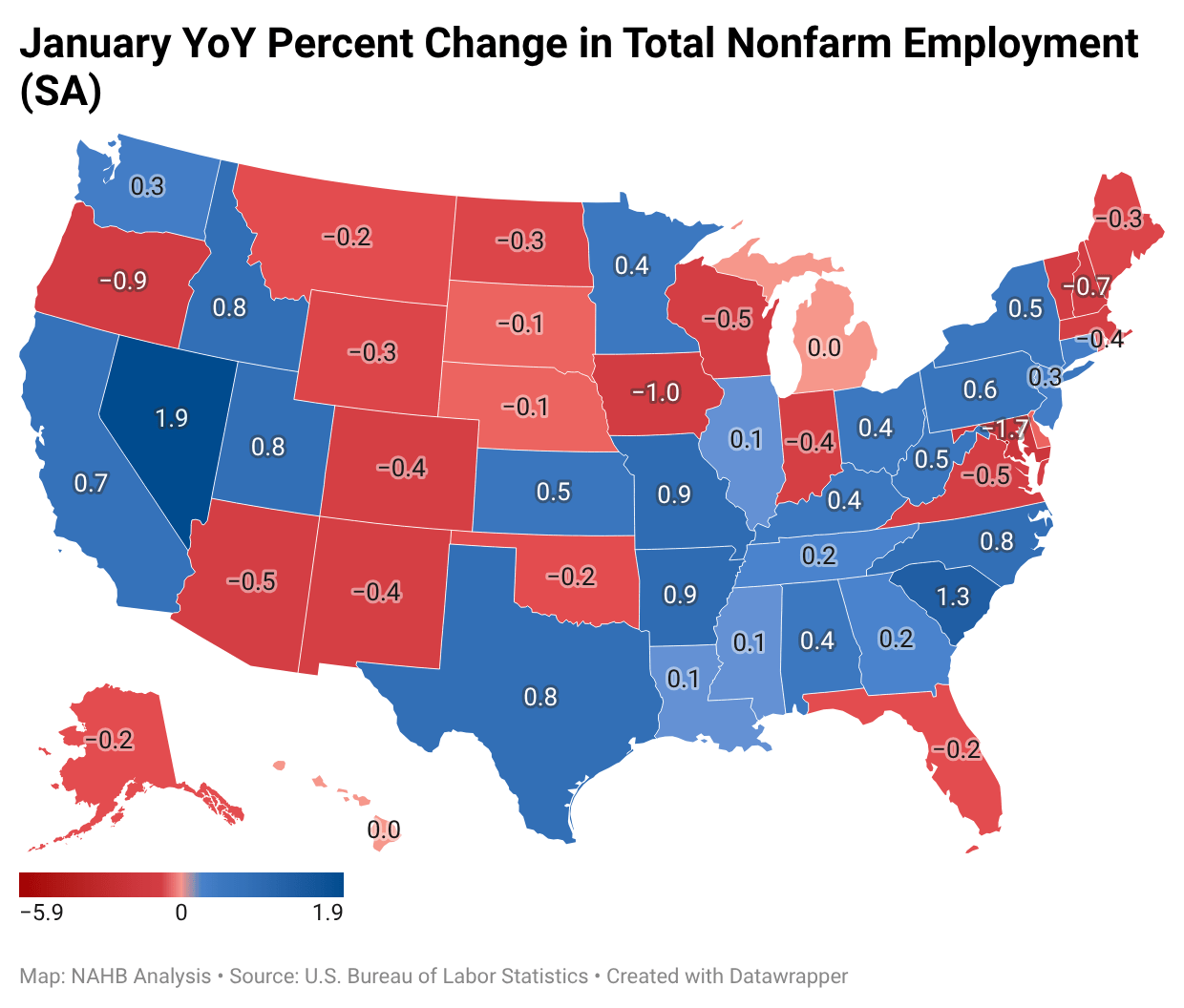
On a year-over-year basis ending in January, total nonfarm employment increased by 324,000 jobs nationwide, representing a 0.2 percent gain relative to January 2025. Job gains ranged from 100 in Hawaii to 131,200 in California. Twenty-three states and the District of Columbia collectively lost 263,900 jobs over the past 12 months, with Maryland experiencing the largest decline (-49,300). In percentage terms, job growth ranged from 0.1 percent in Illinois, Mississippi, and Louisiana to 1.9 percent in Nevada. Among states with losses, declines ranged from 0.1 percent in Delaware, South Dakota, and Nebraska to 1.7 percent in Maryland; the District of Columbia, however, recorded a substantially larger decline of 5.9 percent.
Construction Employment
Construction employment —which includes both residential and non-residential construction—showed positive results in January. Forty states added construction jobs compared to December, while nine states experienced declines; New Hampshire and the District of Columbia reported no change. Illinois posted the largest monthly gain, adding 13,500 jobs, while Idaho recorded the largest loss (-3,400). Overall, the construction sector added a net 45,000 jobs nationwide in January. In percentage terms, West Virginia recorded the strongest monthly increase (+5.9 percent), while Idaho experienced the steepest decline (-4.4 percent).
Year-over-year, construction employment increased by 53,000 jobs nationwide, a 0.6 percent gain compared to January 2025. Texas led all states with an increase of 30,100 construction jobs, while California recorded the largest loss (-15,400). In percentage terms, West Virginia posted the strongest annual growth in construction employment (+15.0 percent), while Oregon experienced the largest decline (-3.4 percent).
State Unemployment Rate
The state unemployment rate is a key economic indicator that reflects the health of local labor markets, measuring the percentage of the workforce actively seeking work but unable to find it. High unemployment signals a weakening state economy, while low unemployment suggests a tight labor market that may contribute to rising wage pressures.
Hawaii and South Dakota had the lowest unemployment rates at 2.2 percent, while the District of Columbia had the highest rate at 6.7 percent. This elevated rate reflects significant federal workforce reductions and layoffs, exceeding 300,000 positions, which disproportionately affected the District in 2025. Michigan, Washington, New Jersey, Oregon, Nevada, California, and Delaware all recorded unemployment rates at or above 5.0 percent.
This article was originally published by a eyeonhousing.org . Read the Original article here. .