Tag

Weakness

Browsing


Second quarter 2026 data reveal softer conditions for townhouse construction as housing affordability challenges affect homebuyer demand, particularly in larger metropolitan markets.

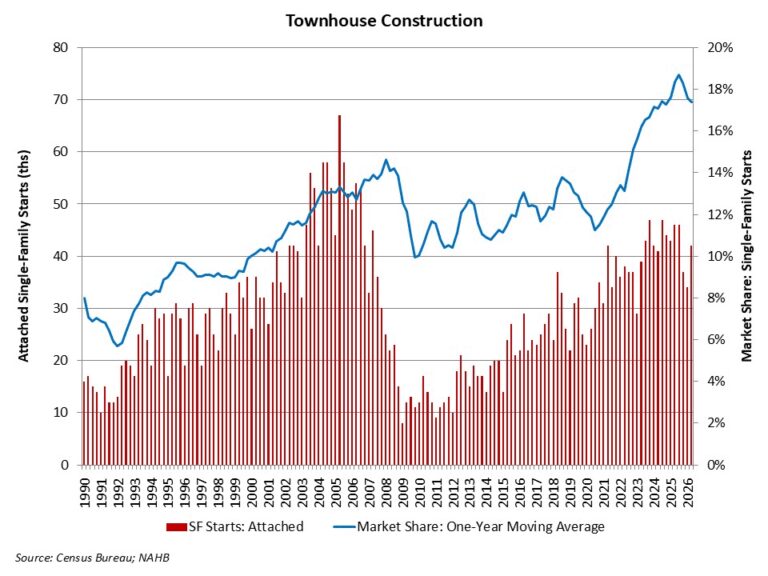
According to NAHB analysis of the most recent Census data of Starts and Completions by Purpose and Design, during the second quarter of 2026, single-family attached starts totaled 42,000, down 9% from the second quarter of 2025.

Over the last four quarters, townhouse construction starts totaled 159,000 homes, down 12% from the prior four quarter period (180,000). Townhouses made up 17% of all of single-family housing starts for the second quarter of the year.

Using a one-year moving average, the market share fell back to 17.4%, after reaching an all time high in the third quarter of 2025 (18.7%).

Prior to the current cycle, the peak market share of the last two decades for townhouse construction was set during the first quarter of 2008, when the percentage reached 14.6% on a one-year moving average basis. This high point was set after a fairly consistent increase in the share beginning in the early 1990s.

The long-run prospects for townhouse construction remain positive given growing numbers of homebuyers looking for medium-density residential neighborhoods, such as urban villages that offer walkable environments and other amenities. Where it can be zoned, it can be built.


This article was originally published by a eyeonhousing.org . Read the Original article here. .


First quarter 2026 data reveal softer conditions for townhouse construction volume as housing affordability challenges affect homebuyer demand.

According to NAHB analysis of the most recent Census data of Starts and Completions by Purpose and Design, during the first quarter of 2026, single-family attached starts totaled 34,000, down 21% from the first quarter of 2025. This was the weakest quarter since the first quarter of 2023.

Over the last four quarters, townhouse construction starts totaled 163,000 homes, down 7% from the prior four quarter period (175,000). Townhouses made up almost 16% of all of single-family housing starts for the first quarter of the year.

Using a one-year moving average, the market share fell back to 17.6%, after reaching an all time high in the third quarter of 2025 (18.7%).

Prior to the current cycle, the peak market share of the last two decades for townhouse construction was set during the first quarter of 2008, when the percentage reached 14.6% on a one-year moving average basis. This high point was set after a fairly consistent increase in the share beginning in the early 1990s.

The long-run prospects for townhouse construction are positive given growing numbers of homebuyers looking for medium-density residential neighborhoods, such as urban villages that offer walkable environments and other amenities. Where it can be zoned, it can be built.


This article was originally published by a eyeonhousing.org . Read the Original article here. .

The missing middle construction sector includes development of medium-density housing, such as townhouses, duplexes and other small multifamily properties.

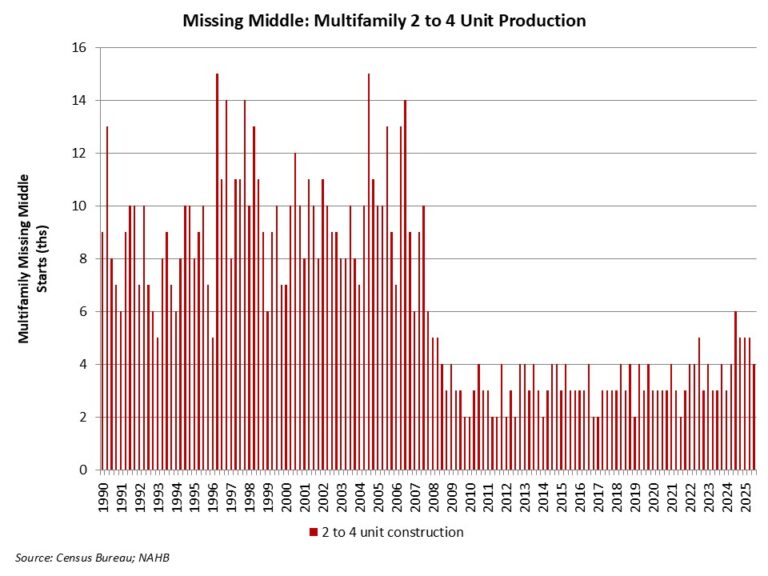
The multifamily segment of the missing middle (apartments in 2- to 4-unit properties) has generally disappointed since the Great Recession. For the third quarter of 2025, there were 4,000 2- to 4-unit housing unit construction starts. This represents a small decrease relative to the third quarter of 2024.

Over the last four quarters this type of construction totaled 19,000 units, up 12% over the four quarters prior to that period (17,000). Nonetheless, this subsector of residential construction continues to underperform relative to its potential, due in part to zoning restrictions.

As a share of all multifamily production, 2- to 4-unit development was just 3% of total multifamily development for the third quarter. This remains lower than recent historic trends. From 2000 to 2010, such home construction made up a little less than 11% of total multifamily construction.

Construction of the missing middle has clearly lagged during the post-Great Recession period and will continue to do so without zoning reform focused on light-touch density. Despite some acceleration in late 2024 and early 2025, the sector continues to lag.


This article was originally published by a eyeonhousing.org . Read the Original article here. .
Pin It