Tag

Top

Browsing


Remote work may no longer dominate the U.S. labor force as it did during the height of the pandemic in 2020, but it still represents a substantial share of employment today. According to the latest data from the Current Population Survey (CPS), approximately 34.3 million employed people teleworked or worked at home for pay in April 2025. The telework rate, which represents the number of people who teleworked as a percentage of people who were working, was 21.6% in April, and it has consistently ranged between 17.9% and 23.8% between October 2022 and April 2025.

Of those who teleworked in April, more than half teleworked for all their working hours, while the remaining teleworked for some, but not all, of their work hours.

The distribution of telework across the U.S. workforce continues to reflect deeper patterns shaped by gender, age, education, occupation, and industry. The following insights are based on an analysis of monthly CPS data.

Gender: Women Lead in Telework

Women continue to outpace men in remote work participation.

Nearly 25% of employed women worked from home in April 2025.

In contrast, about 19% of employed men teleworked.

This gender gap reflects employment trends. Many women are employed in professional, administrative, or office-based roles. These fields transitioned smoothly to remote work during the pandemic and have largely maintained hybrid or fully remote options. Additionally, the growing rate of college completion among women1 has pushed more women into positions that are structurally suited to telework. Flexibility remains a priority, especially for women balancing work and caregiving responsibilities, further reinforcing the demand for work-from-home arrangements.

Age: Older Workers Are More Likely to Telework

Age also plays a major role in who works remotely. Workers aged 25 and older are more likely to telework than their younger counterparts.

Ages 16–24: Only 6.2% worked from home.

Ages 25–54: About 24% reported teleworking.

Ages 55+: Around 23% worked remotely.

Younger workers tend to fill entry-level roles in retail, hospitality, and service sectors that require in-person attendance. Meanwhile, older workers are more likely to have progressed in their careers into managerial or specialized roles where remote work is feasible or even expected.

Education: Higher Degrees, Higher Telework Rates

Education remains one of the strongest indicators of telework status. Higher educational attainment is positively associated with a higher telework rate.

No high school diploma: Just 3.1% worked remotely.

High school graduates, no college: 8.4% teleworked.

Some college or associate degree: 17.3% reported working from home.

Bachelor’s degree or higher: 38.3% worked remotely.

Higher educational attainment often leads to employment in knowledge-based sectors such as finance, information technology, consulting, and research. These roles often depend on digital communication tools and independent project-based tasks, making them well-suited for remote settings.

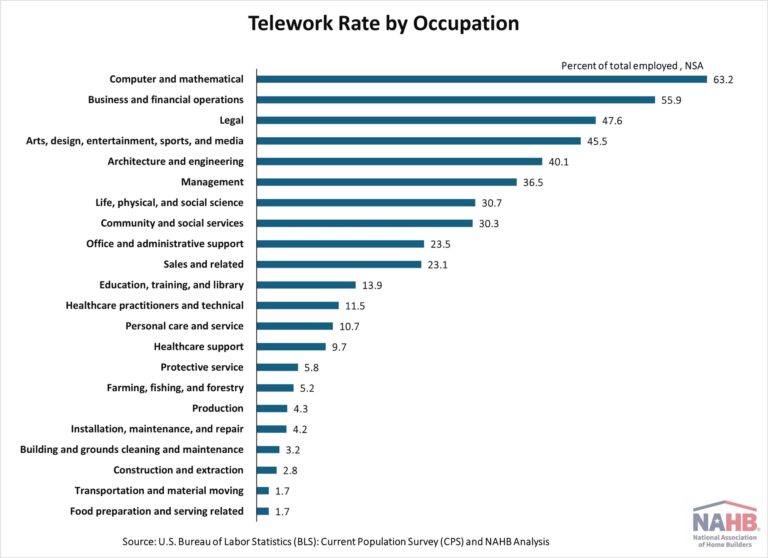
Occupation: Business and Financial Operations, and Professionals Dominate Remote Work

Not surprisingly, occupation heavily influences access to teleworking. Jobs that require physical presence, such as those in food service, transportation, manufacturing, and construction, naturally offer limited remote opportunities. In contrast, people employed in professional and technical fields report the highest telework rate, especially those working in computer and mathematical roles.

Industry trends mirror these occupational divisions. Certain sectors have fully embraced telework, particularly finance, information services, and professional and business services. These industries often prioritize flexibility and are structured in ways that make remote work not only possible but efficient. On the other hand, industries like construction, leisure and hospitality remain firmly grounded in physical spaces and in-person involvement. In these fields, work is inherently tied to locations and equipment that cannot be replicated remotely. The construction industry had a telework rate of just 9.8% in April, and leisure and hospitality reported an even lower rate of 8.1%.

Looking Ahead:

Remote work is not disappearing; it is evolving. The opportunity to work from home is increasingly concentrated among individuals with higher education levels, white-collar job titles, and positions in tech-driven or office-based industries. Meanwhile, those who are younger, have less educational attainments, or work in manual or service-based roles remain largely tied to traditional, in-person work.

For the future, we don’t know if telework will expand to become more inclusive or continue reinforcing existing divides in education and job roles. For now, the data suggests that remote work is here to stay, but only for some.

Note:

“U.S. women are outpacing men in college completion, including in every major racial and ethnic group”, Pew Research Center.

Connor Borkowski and Rifat Kaynas, “Telework trends,” Beyond the Numbers: Employment & Unemployment, vol. 14, no. 2 (U.S. Bureau of Labor Statistics, March 2025),
This article was originally published by a eyeonhousing.org . Read the Original article here. .


Despite historically low self-employment rates and the rising market share of top ten builders, residential construction remains an industry dominated by independent entrepreneurs, with nearly 80% of home builders and specialty trade contractor firms being self-employed independent contractors. Even among firms with paid employees, the industry continues to be dominated by small businesses, with 63% of homebuilders and two out of three specialty trade contractors generating less than one million dollars in total business receipts. The new estimates are based on the 2022 Economic Census and Nonemployer Statistics data.

The Economic Census covers several construction subsectors within the home building industry:

 Residential Building Construction (RBC)

Single-family general contractors (excluding for-sale builders)

Multifamily general contractors (excluding for-sale builders)

For-sale new housing builders

Residential remodelers

Land Subdivision (or land developers)

Specialty Trade Contractors (STC)

The 2022 statistics show that the majority of residential construction businesses are self-employed independent contractors.  There are over 813,000 nonemployer firms in residential building construction (RBC), accounting for close to 80% of all establishments. In land subdivision, more than 9,000 independent contractors account for 68% of land subdivision firms.  Over 1.9 million specialty trade independent contractors make up 79% of all STC establishments. These nonemployer firms also account for almost half of the full-time employees (FTE) in residential building construction, 26% in land subdivision, and 28% in STC. 

Most of these self-employed mom-and-pop firms are very small, with annual receipts averaging under $103,000 for residential building construction, and under $70,000 for specialty trade contractors. Self-employed independent contractors in land subdivision average around $288,000 in annual business receipts. As a result, these nonemployer firms make up only 12% of all sales and receipts generated by residential building construction and land subdivision, and 9% of specialty trade contractors’ revenue.

Among residential construction businesses with paid employees, remodeling, land subdivision, and specialty trade subcontractors (STC) companies tend to be smaller.  Three out of four remodeling establishments, 63% of land developers, and 59% of STC companies generate under $1 million in receipts.  

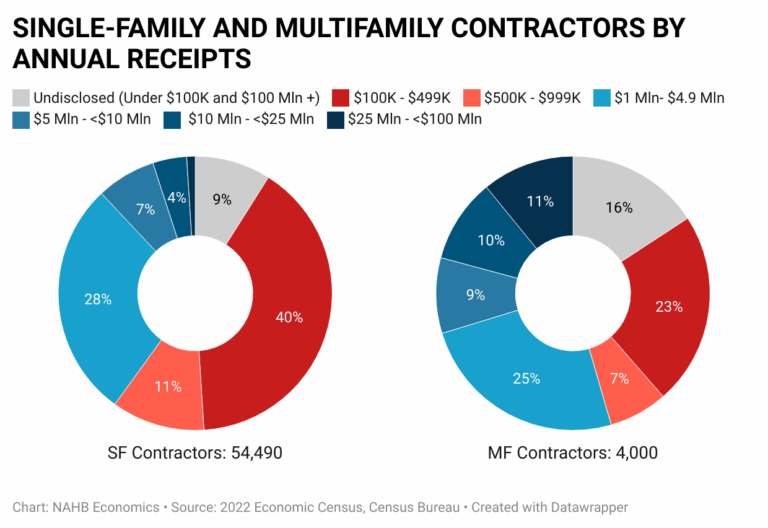
Home builders are typically somewhat larger, with about 45% of companies reporting annual sales over $1 million. Among homebuilders, multifamily general contractors tend to be the largest. However, the Census Bureau did not disclose the number of the largest (with revenue over $100 million) and smallest (with revenue under $100K) multifamily and single-family custom builders in 2022. As a result, the revenue spectrum for MF and SF contractors is incomplete and is presented in a separate chart. 

Multifamily contractors are typically larger compared to single-family contractors and for-sale builders (who build on land they own and control). Ten percent of multifamily contractors reported annual sales between $10 million and 25 million, and an additional 11% earned between $25 million and $100 million in 2022.  

Under the most recent U.S. Small Business Administration (SBA) size standards, the vast majority of residential construction companies qualify as small businesses. The most recent small business size limits for all types of builders are $45 million, $34 million for land subdivision, and $19 million for specialty trade contractors. By these standards, almost all remodelers and single-family contractors, and at least 98% of land developers, and 96% of specialty trade contractors, easily qualify as small businesses. 


This article was originally published by a eyeonhousing.org . Read the Original article here. .


This Trending Now story features the most-saved exterior photos uploaded to Houzz since Jan. 1, 2025.

​​This countdown of the year’s most popular home exteriors highlights a strong pull toward character-rich architecture and noteworthy curb appeal. The collection spans crisp contemporary forms, modernized farmhouses, new builds that feel rooted in history and even a storybook cottage. What unites them is how the designers blended clean lines, natural materials and thoughtful massing to create homes that look inviting from every angle. Take a look and see which ideas might spark inspiration for your own exterior refresh.

Nakamoto ForestrySave Photo
10. Rustic Modern

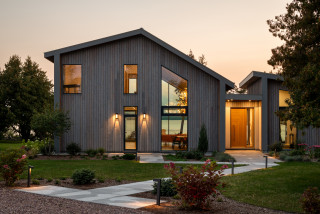
Perched above Vermont’s Lake Champlain, with views of the Adirondack Mountains, this home by Godefroy Meyer of Studio MMA Architecture + Design pairs sharp modern lines with minimalist forms. Shou-sugi-ban siding from Nakamoto Forestry adds rustic texture, with the charred Japanese cypress contributing deep, variegated tones that bring warmth and character to the exterior.

Find an architect on Houzz

Crisp ArchitectsSave Photo
9. Timeless Farmhouse

Crisp Architects gave this new Dutchess County, New York, farmhouse a harmonious composition with a clever massing scheme. Porches, a two-story breezeway and a garage disguised as a barn break up the home’s large scale, while varied siding and roof materials make the new build feel like a historic home that has evolved over time.

Gina Fitzsimmons ASID NKBASave Photo
8. Storybook Cottage

Multiple gables, a welcoming front porch and meticulously tended landscaping give this Annapolis, Maryland, home by designer Gina Fitzsimmons abundant cottage charm. Details such as Doric columns, louvered pediments and cobbled paving further enhance its inviting, storybook look.

9 Ways to Boost Winter Curb Appeal

Home Sweet Home Construction LLCSave Photo
7. Dark Country

“Modern farmhouse” usually evokes bright white exteriors, but this Boston-area home by Home Sweet Home Construction takes a bold turn with charcoal lap siding. A porch, gables and a bay break up the facade, while wood accents on the porch posts and ceiling add warmth and rustic charm.

Find a general contractor on Houzz

Kaplan Thompson ArchitectsSave Photo
5. Efficient Homestead

Kaplan Thompson Architects designed this Durham, New Hampshire, home to combine traditional farmhouse elements with cutting-edge passive-home technology. Thoughtful siting and energy-efficient systems enhance performance, while simple forms, gabled rooflines, a breezeway, a barn-like garage and classic materials evoke the nostalgia of New England’s original farmsteads.

Holder Parlette Architecture + LandscapesSave Photo
4. Elevated Views

Holder Parlette Architecture + Landscapes transformed this 1960s mountaintop cabin in California by raising the roof by 5 feet and adding expansive steel windows and doors, maximizing panoramic views of Napa Valley. A new, modern courtyard frames sightlines through the house, creating an engaging sense of anticipation along the approach.

Classic Custom Homes of WaunakeeSave Photo
2. Shingle Revival

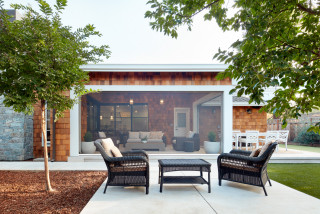
By carefully incorporating historic Shingle-style details, this new Lake Minnetonka home by Pillar Homes feels as if it has been handed down through generations. A harmonious mix of shingles, siding, stone, an oval window, gambrel gables, X-shaped muntins and railings, corbels and a welcoming front porch creates a residence that evokes a bygone era.

New Leaf Custom HomesSave Photo


This article was originally published by a
www.houzz.com . Read the Original article here. .


Outdoor renovations typically begin with a similar wish list: places to kick back, room for gathering and spaces for cooking and dining outdoors. For ideas on weaving those elements into your own backyard, explore this countdown of the five most-viewed outdoor makeovers of the year. Each project shows how architects and designers thoughtfully integrated flexible seating, fire features, outdoor kitchens and more into welcoming landscapes that feel like natural extensions of the home.

Changras & Frey Construction Inc.Save Photo
5. Indoor-Outdoor Dream

Outdoor seating areas that echo the comforts of indoors — cushy furnishings, shade, heat and bug control — tend to be the spaces people use most in a yard. In this inviting Los Altos, California, backyard, KNR Design Studio and Changras & Frey Construction created multiple flexible seating zones with varying levels of comfort to make indoor-outdoor living feel effortless. A covered veranda just off the living room can be fully enclosed with motorized screens or opened wide through black-frame sliding glass doors. Nearby, an outdoor dining table enjoys partial shade, while an adjacent lounge area offers views of a putting green.

Read more about this backyard

Find a landscape contractor on Houzz

Himsben Design Studio, LLCSave Photo
4. Flexible Urban Patio

In compact city gardens, every square inch counts, and an adaptable design can greatly expand how a space functions. This Chicago backyard, tucked between the house and garage, once served mainly as a pass-through. Landscape architect Benjamin Himschoot of Himsben Design Studio reimagined it as a versatile patio framed by lush plantings. Lightweight plastic Adirondack chairs and a portable smoke-free fire pit allow for quick rearranging. When the seating area isn’t in use, the homeowners’ two children can clear the furniture and set up a soccer net.

Read more about this yard

See why you should hire a professional who uses Houzz Pro software

Rock Paper Scissors Landscape, Inc.Save Photo
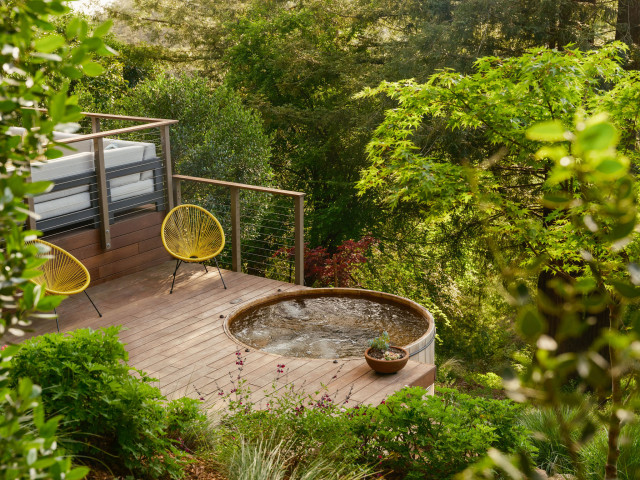
3. Sloped Sanctuary

This serene hot tub, part of an Oakland, California, landscape designed and built by Barry Sacher of Rock Paper Scissors Landscape, gives the homeowners a peaceful retreat within their sloped backyard. Once short on level, usable space, the yard now features a series of decks and terraces that work with the grade rather than against it. The 7-foot-diameter Alaskan cedar tub sits in a prime spot facing redwood trees, with an outdoor shower tucked close by. A few steps up, a larger deck provides lounge seating beneath an umbrella, while additional stairs lead farther up the slope to an outdoor kitchen and dining area conveniently close to the house.

Read more about this yard

Before and After: 3 Creative Solutions to a Sloped Yard

Lindgren LandscapeSave Photo
2. Backyard Built for Enjoyment

This Timnath, Colorado, backyard, designed and built by Lindgren Landscape, has plenty of features packed into a modest footprint. After downsizing, the homeowners wanted to replace a patchy lawn with a space built for lounging, dining and entertaining nearly year-round. Landscape designer Jamie McCarn delivered a highly functional layout, adding a solid-roof shade structure that covers both dining and lounge areas, along with a nearby fire pit patio for cozy evenings. Just off the back door, a slightly elevated deck houses an outdoor kitchen with a grill and smoker, while a kit-built barrel sauna beside the fire pit offers a relaxing all-season retreat.

Read more about this backyard

New to home remodeling? Learn the basics

Stucchi Landscape & DesignSave Photo
1. Elegant Retreat

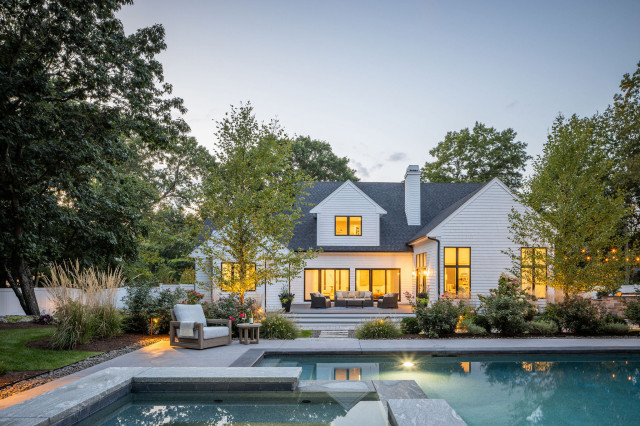
This striking backyard in Needham, Massachusetts, claimed the top spot as the most-viewed outdoor space of 2025. When the homeowners first consulted landscape designer Jim Stucchi, they were considering buying the home and installing a pool. Stucchi ultimately reimagined the entire backyard, adding a pool, a cabana, a spa, a dining terrace and an outdoor kitchen. The landscape’s modern-meets-traditional style complements the home’s architecture, while carefully chosen plants soften the hardscape’s clean lines, adding color and other visual interest at every turn.

Read more about this backyard

More on Houzz
Read more landscape stories
Browse outdoor photos for ideas
Find a home professional


This article was originally published by a
www.houzz.com . Read the Original article here. .


This article was originally published by a
www.houzz.com . Read the Original article here. .


This article was originally published by a
www.houzz.com . Read the Original article here. .


This Trending Now story features the most-saved new patio and deck photos uploaded to Houzz since Jan. 1, 2025.

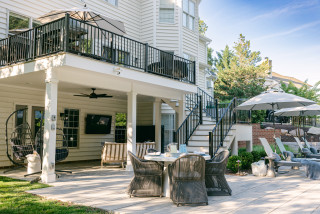
If you’re looking to refresh your outdoor space, you’ll find plenty of inspiration in this countdown of 2025’s most-saved patios and decks. The spaces are in a range of sizes and styles, but all are designed to draw people outside and invite lingering. Open-air kitchens, alfresco dining zones, cozy fire pit lounges and serene hot tub retreats show how to seamlessly blur the line between indoors and out. Take a tour of the top picks and see which standout features might spark ideas for your own outdoor space.


This article was originally published by a www.houzz.com . Read the Original article here. .


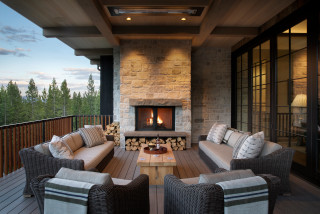
3. Handsome Outdoor Hearth

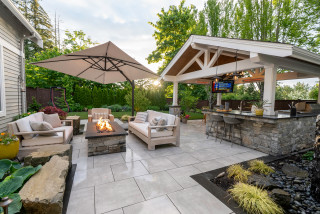
This elevated indoor-outdoor lounge is positioned on the back side of a luxury mountain home in Big Sky, Montana, just outside of Yellowstone National Park. The team at interior design firm Hive Home brought the same attention to detail to the outdoor space as they did to the home’s interiors, with a rich, earth-tone color palette and a focus on natural materials. A stone hearth serves as the focal point of the outdoor lounge, anchoring the seating arrangement. Overhead, integrated lighting and a heating element keep the lounge warm and inviting on cool evenings.

See why you should hire a professional who uses Houzz Pro software


This article was originally published by a www.houzz.com . Read the Original article here. .


Is your yard a little too sunny for comfort? The right mix of shade sources not only can cool things down and make your outdoor spaces more inviting, but also can enhance the overall design of your landscape. To help you find the best approach, eight landscape experts share their take on the pros and cons of shade options ranging from quick fixes to long-term investments.

A few themes stand out in their advice: Umbrellas are hard to beat for instant shade and flexibility, pergolas and other structures deliver the most reliable coverage for outdoor living, and planting a shade tree is the best investment for natural shade.


This article was originally published by a www.houzz.com . Read the Original article here. .


An earlier post described how the top 10 builders in the country captured a record 44.7% of new single-family closings in 2024. BUILDER Magazine has now released additional data on the top ten builders within each of the 50 largest new home markets in the U.S., ranked by single-family permits. It is important to note that this post does not focus on the top ten largest home builders nationally; instead, it analyzes the top ten list within each of the largest 50 new housing markets.

The 2024 data show that the top 10 builder concentration in the 50 largest markets ranged from 38.9% in Kansas City, MO-KS to 97.8% in Cincinnati, OH. In 11 metro areas, the top ten builders’ market share exceeded 90%. Across all 50 metro areas, the average market share of the top 10 builders was 79.3%, up from 78.2% in 2023.  

Looking at the results on a map reveals that southern California, South Carolina, Florida, and parts of the Midwest include multiple highly concentrated markets, while Texas and the Northwest include markets with lower levels of concentration (figure 1).

Lennar and D.R. Horton each made the top ten builder list in 46 markets, the most among all builders. PulteGroup was next with 36 metro markets, followed by NVR and Meritage Homes with 22 and 20 metro markets, respectively.

From 2023 to 2024, 27 metro areas saw an increase in their top 10 builders’ market share, compared with 36 increases from 2022 to 2023. Seven metro areas experienced a double-digit increase in 2024:

Oklahoma City, OK (+20.7 percentage points, 82.8%)

Atlanta-Sandy Springs-Alpharetta, GA (+14.7 percentage points, 76.8%)

Punta Gorda, FL (+11.5 percentage points, 85.9%)

Philadelphia-Camden-Wilmington, PA-NJ-DE-MD (+10.7 percentage points, 87.5%)

Greenville-Anderson, SC (+10.6 percentage points, 89.3%)

Salt Lake City, UT (+10.5 percentage points, 69.8%)

Charleston-North Charleston, SC (+10.4 percentage points, 92.3%)

Meanwhile, 20 metro areas saw a decline in their top 10 builders’ market share from 2023 to 2024, up from only 9 decreases from 2022 to 2023. The largest decreases were seen in:

Miami-Fort Lauderdale-Pompano Beach, FL (-18.1 percentage points, 72.4%)

Los Angeles-Long Beach-Anaheim, CA (-14.7 percentage points, 75.6%)

Orlando-Kissimmee-Sanford, FL (-11.6 percentage points, 76.8%)

Tucson, AZ (-10.4 percentage points, 82.4%

Of the remaining three largest markets, Cape Coral-Fort Myers, FL saw no change in its top ten builder concentration (96.2%) from 2023 to 2024, while Fresno, CA and Spartanburg, SC are new to the top 50 market list in 2024.

Discover more from Eye On Housing

Subscribe to get the latest posts sent to your email.


This article was originally published by a
eyeonhousing.org . Read the Original article here. .

Pin It