Tag

Residential

Browsing


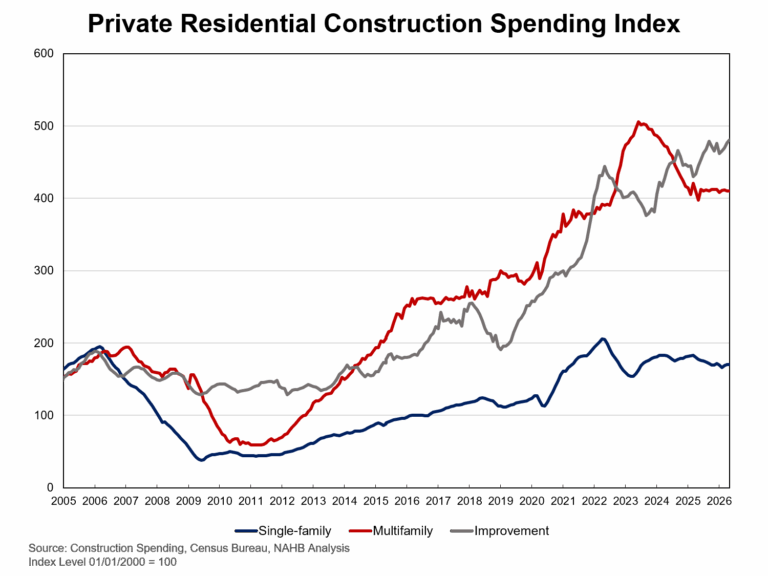
Private residential construction spending was up 0.8% in April 2026, following the monthly gain of 0.6% in March. This increase was largely driven by gains in single-family, and home improvement spending. Moreover, total private residential construction spending was 1.7% higher than a year ago. 

According to the latest construction spending data from the U.S. Census, single-family construction spending increased 1.4% in April, consistent with the steady builder confidence reflected in the NAHB/Wells Fargo Housing Market Index (HMI). Despite the monthly gain, single-family construction spending was down 2.9% over a year ago. Improvement spending (remodeling) also increased in April, rising 0.4% for the month. Remodeling remained a bright spot on a year-over-year basis, with spending up 7.5% from April 2025. Meanwhile, multifamily construction spending edged down 0.3% in April. This marks the first monthly decrease after two consecutive months of modest gains. Compared to a year earlier, multifamily spending was 1.1% higher.  

The NAHB construction spending index is shown in the graph below. The index illustrates how   spending on single-family construction has slowed since early 2024, reflecting the impacts of elevated interest rates and ongoing uncertainty over building material tariffs. Multifamily construction spending growth has also slowed down after the peak in July 2023, with the index largely plateauing since late 2024. In contrast, improvement spending has been on an upward trend since the beginning of 2025, supported in part by the aging housing stock and sustained demand for renovation. 

Spending on private nonresidential construction was down 2.1% over a year ago. The annual private nonresidential spending decrease was driven by a $41.8 billion drop in manufacturing construction spending


This article was originally published by a eyeonhousing.org . Read the Original article here. .

Lending standards and demand for most types of residential mortgages were essentially in the first quarter of 2026, according to the recent release of the Senior Loan Officer Opinion Survey (SLOOS). For commercial real estate (CRE) loans, lending standards for multifamily construction & development were essentially unchanged as well. Compared to the previous quarter, demand for construction & development loans was weaker, while demand for multifamily loans was essentially unchanged. 

The Federal Reserve has maintained its key short-term interest rate (i.e., Fed Funds) unchanged during the first three meetings of 2026. There has been growing division between FOMC participants on the appropriate trajectory of the Fed Funds rate that will satisfy their dual mandate of maximum employment and stable prices (i.e., inflation). Along with the arrival of a new Chair and the exogenous shocks to the global economy caused by the ongoing conflict in Iran, this has created a “wait-and-see” approach to monetary policy. As a result, NAHB does not forecast any changes to the Fed Funds rate until the end of the year.

Residential Mortgages

In the first quarter of 2026, three of seven residential mortgage loan categories: GSE-eligible, Qualified Mortgage (QM) non-jumbo non-GSE eligible, and Government saw a positive net easing index for lending conditions. An additional two (QM jumbo and non-QM jumbo) recording a neutral reading (i.e., 0). Subprime and non-QM non-jumbo loans continued to experience tighter lending conditions, as evidenced by a negative value, -6.3 and -2.0, respectively.

Four of the seven residential mortgage loan categories (GSE-eligible, QM Jumbo, non-QM jumbo, and Government) reported demand essentially unchanged in the first quarter of 2026. Two categories (non-QM non-jumbo and QM non-jumbo non-GSE eligible) experienced modestly weaker demand. However, the weakest demand continues to be for subprime loans, which has experienced weaker demand for 23 consecutive quarters.

Commercial Real Estate (CRE) Loans

For the CRE loan categories, multifamily registered a net easing index of 0.0, while the net easing index for construction & development loans was -4.8 in the first quarter of 2026. The Fed classifies changes between -5.0% and +5.0% as essentially unchanged.

The net percentage of banks reporting stronger demand was -11.7% for construction & development loans, with a negative number indicating weaker demand. This was a reversal for construction & development from last quarter, which saw stronger demand (+8.9%). For multifamily loans, demand was +3.3% in the first quarter of 2026, which is essentially unchanged according to the Fed’s classification scheme,  as it has been for six consecutive quarters.


This article was originally published by a eyeonhousing.org . Read the Original article here. .


Prices rose across a host of goods and services used in residential construction. Rising energy prices were the primary driver, but transportation service prices also rose at their fastest pace since 2022. Meanwhile, building material prices, excluding energy, rose at their highest yearly rate in three years, up 3.7% from a year ago.

The Producer Price Index for final demand increased 1.4% in April, after rising 0.7% in March. Compared to a year ago, final demand prices were up 6.0%. The index for final demand services rose 1.2% in April, while the index for final demand goods rose 2.0% over the month.

The price index for inputs to new residential construction rose 1.3% in April and was up 5.9% from last year. The price of goods used in new residential construction was up 1.2% over the month and up 6.1% from last year, while the price of services was up 1.3% over the month and up 3.7% from last year.

Input Goods

The goods component has a larger importance to the inputs to residential construction price index, representing around 60% of the total. On a monthly basis, the price of input goods to new residential construction was up 1.2% in April.

The input goods to residential construction index can be further broken down into two separate components, one measuring energy inputs with the other measuring remaining goods. The latter of these two components simply represents building materials used in residential construction, which makes up around 93% of the goods index.

Energy input prices rose 13.8% in April and were 39.4% higher than a year ago. Building material prices were up 0.1% in April and up 3.7% compared to one year ago. Building material prices have continued to grow above 3.0% since July of last year.

Among input goods, the largest year-over-year increase was for No. 2 diesel fuel as prices were 74.4% higher than a year ago. Asphalt prices rose 18.0% higher than April 2025 after declining in March. Softwood lumber prices were up 1.1% in April after declining on a yearly basis for several months. Fewer materials showed yearly price declines than in March. Particleboard and fiberboard prices were down 12.0%, while softwood veneer/plywood prices were down 1.7%.

Input Services

Prices for service inputs to residential construction reported an increase of 1.3% in April. On a year-over-year basis, service input prices were up 5.6%. The price index for service inputs to residential construction can be broken out into three separate components: a trade services component, a transportation and warehousing services component, and a services excluding trade, transportation, and warehousing component (other services).

The most significant component is trade services (around 60%), followed by other services (around 29%), and finally transportation and warehousing services (around 11%). The largest component, trade services, was up 5.6% from a year ago. The price of transportation and warehousing services rose 15.3%, while prices for other services were up 1.6% over the year. Long-distance motor carrying service prices rose 10.4% in April and were 18.3% higher than a year ago, while local motor carrying service prices rose 1.4% in April and were 6.3% higher than a year ago. These are the two transportation services that are represented as inputs in the residential construction price index.


This article was originally published by a eyeonhousing.org . Read the Original article here. .

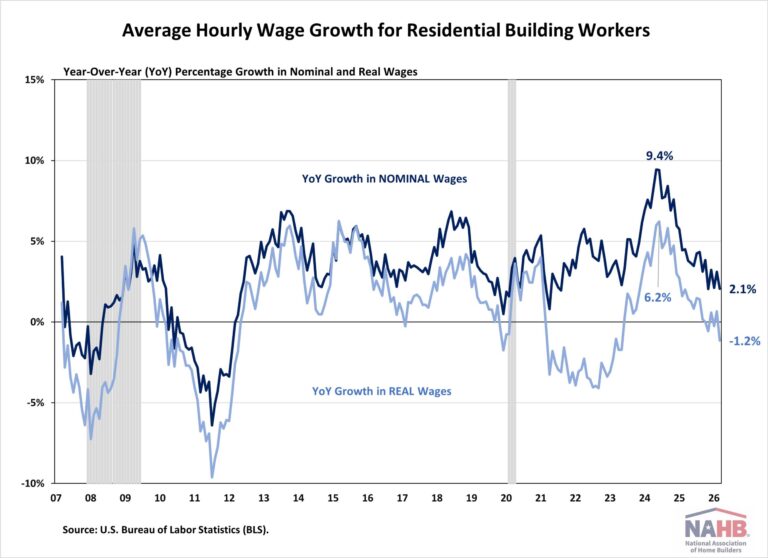
Wage growth for residential building workers remained subdued during the first quarter of 2026, reflecting continued softness in housing construction activity and easing labor demand. According to the latest data from the U.S. Bureau of Labor Statistics, both nominal and inflation-adjusted wage gains moderated further, marking a clear transition from the rapid post-pandemic expansion toward a slower labor market.

In nominal terms, average hourly earnings (AHE) for residential building workers increased 2.1% year-over-year in March 2026, down notably from the 9.4% peak reached in mid-2024 and continuing the broader cooling trend observed throughout 2025.

After accounting for inflation, real wages declined 1.2% year-over-year in March 2026, indicating that wage gains have not fully kept pace with broader price increases. Real wage growth strengthened temporarily during parts of 2024, reaching a peak of 6.2%, but has since softened alongside the slowdown in residential construction activity.

Meanwhile, the number of open, and unfilled construction sector jobs has continued to trend downward, consistent with weaker housing demand and slower construction hiring.

Despite the slowdown in wage growth, residential building workers’ wages remain competitive relative to other industries:

8.4% higher than the manufacturing sector ($36.54 per hour)

22.4% higher than the transportation and warehousing sector ($32.34 per hour)

3.6% lower than the mining and logging sector ($41.10 per hour)

Note:

Data used in this post relates to all employees in the residential building industry. This group includes both new single-family housing construction (excluding for-sale builders) and residential remodelers but does not include specialty trade contractors.


This article was originally published by a eyeonhousing.org . Read the Original article here. .


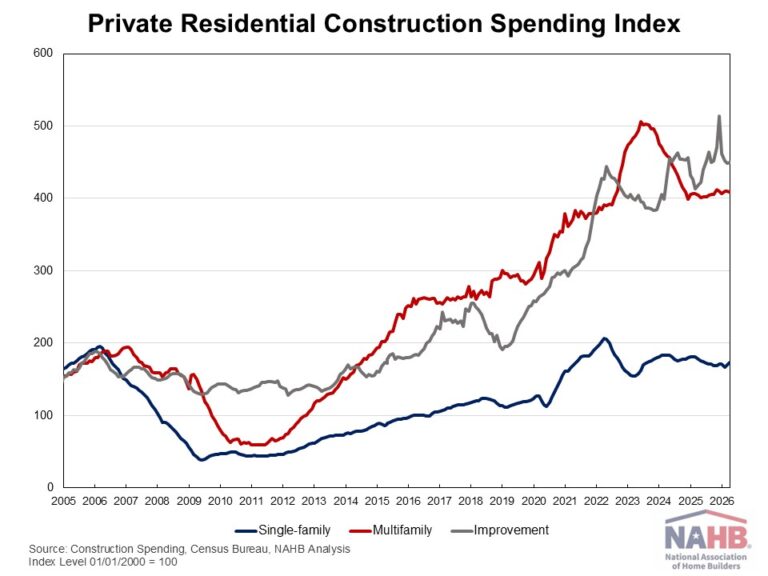
Private residential construction spending was up 1.7% in March 2026, following two straight months of declines. The increase was broad-based, with gains in single-family, multifamily construction, and home improvement spending. Moreover, total private residential construction spending was 3.6% higher than a year ago.

According to the latest construction spending data from the U.S. Census, single-family construction spending increased 2.7% in March, consistent with the steady builder confidence reflected in the NAHB/Wells Fargo Housing Market Index (HMI). Despite the monthly gain, single-family construction spending was down 4.2% over a year ago. Meanwhile, multifamily construction spending edged up 0.3% in March. This marks the second monthly increase after two consecutive months of modest declines. Compared to a year earlier, multifamily spending was 0.5% higher. Improvement spending (remodeling) also increased in March, rising 0.9% for the month. Remodeling remained a bright spot on a year-over-year basis, with spending up 14.3% from March 2025.

The NAHB construction spending index is shown in the graph below. The index illustrates how spending on single-family construction has slowed since early 2024, reflecting the impacts of elevated interest rates and ongoing uncertainty over building material tariffs. Multifamily construction spending growth has also slowed down after the peak in July 2023, with the index largely plateauing since late 2024. In contrast, improvement spending has been on an upward trend since the beginning of 2025, supported in part by the aging housing stock and sustained demand for renovation.

Spending on private nonresidential construction was down 2.1% over a year ago. The annual private nonresidential spending decrease was driven by a $39 billion drop in manufacturing construction spending.


This article was originally published by a eyeonhousing.org . Read the Original article here. .
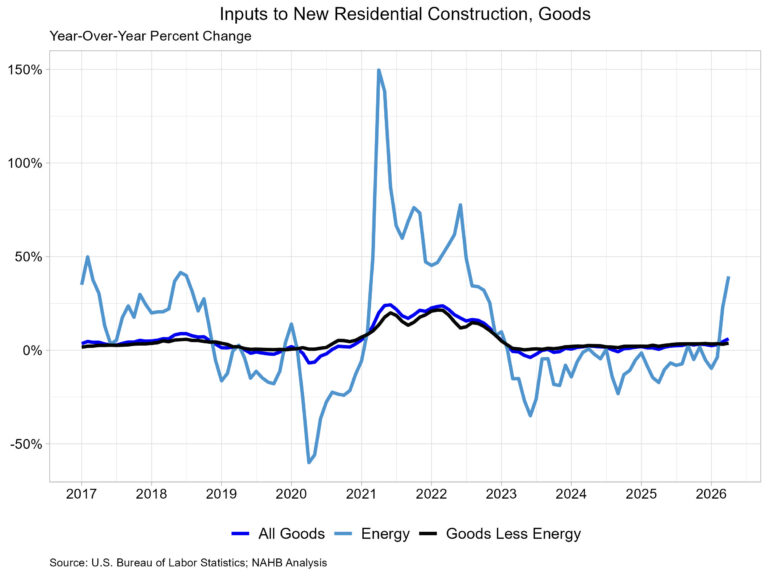

Energy input prices increased in March at their fastest pace since June of 2020 as the conflict in Iran shocked critical global supply chains. Building material prices, excluding energy, rose for the eleventh straight month. Price growth for trade services slowed while transportation and warehousing price growth accelerated.  

The Producer Price Index for final demand increased 0.5% in March, after rising 0.5% in February. The index for final demand services was unchanged in March, while the index for final demand goods rose 1.6% over the month.

The price index for inputs to new residential construction rose 1.2% in March and was up 3.8% from last year. The price of goods used in new residential construction was up 1.8% over the month and up 4.3% from last year, while the price of services was up 0.3% over the month and up 3.1% from last year.

Input Goods

The goods component has a larger importance to the inputs to residential construction price index, representing around 60% of the total. On a monthly basis, the price of input goods to new residential construction was up 1.8% in March.

The input goods to residential construction index can be further broken down into two separate components, one measuring energy inputs with the other measuring remaining goods. The latter of these two components simply represents building materials used in residential construction, which makes up around 93% of the goods index.

Energy input prices rose 21.4% in March and were 20.8% higher than one year ago. The monthly increase in March was the largest since prices rose 30.6% in June 2020. Building material prices were up 0.4% in March and up 3.1% compared to one year ago.

Among input goods, the largest year-over-year increase was for No. 2 diesel fuel as prices were 51.2% higher than a year ago. Metal molding and trim continued to show high price increases, as there were up 45.5% from last year. On the opposite end, the largest yearly declines in prices were for particleboard and fiberboard with prices down 15.7%. Notably, asphalt reported a price decline of 12.3% in March. For key inputs, ready-mix concrete prices were 0.5% higher than a year ago while softwood lumber prices were 7.8% lower than a year ago.

Input Services

Prices for service inputs to residential construction reported an increase of 0.3% in March. On a year-over-year basis, service input prices were up 3.1%. The price index for service inputs to residential construction can be broken out into three separate components: a trade services component, a transportation and warehousing services component, and a services excluding trade, transportation, and warehousing component (other services).

The most significant component is trade services (around 60%), followed by other services (around 29%), and finally transportation and warehousing services (around 11%). The largest component, trade services, was up 3.3% from a year ago. The price of transportation and warehousing services rose 6.2%, while prices for other services were up 1.5% over the year.

Expanded Inputs to New Construction Data

Within the PPI that BLS publishes, new experimental data was recently published regarding inputs to new construction. The data expands existing inputs to industry indexes by incorporating import prices with prices for domestically produced goods and services. With this additional data, users can track how industry input costs are changing among domestically produced products and imported products. This data focuses on new construction, but the complete dataset includes indices across numerous industries that can be found here on BLS website.

New construction input prices are primarily influenced by domestically produced goods and services, with domestic products accounting for 90% of the weight of the industry index for new construction. Imported goods make up the remaining 10% of the index.

The latest available data, for January 2026, showed that domestically produced goods continue to show price growth compared to imported goods used in new construction. On a year-over-year basis, the index for domestic goods increased 2.6%, while prices for imported goods have fallen 2.7%.


This article was originally published by a eyeonhousing.org . Read the Original article here. .

Private residential construction spending declined 0.8% in January 2026, following two months of gains. This decline was driven by lower spending across single-family, multifamily construction, and home improvement.  Despite the monthly decline, total residential construction spending remained 2.3% higher than a year ago.

According to the latest construction spending data from the U.S. Census, single-family construction spending edged down by 0.2% in January, consistent with the softer builder confidence reflected in the NAHB/Wells Fargo Housing Market Index (HMI). Compared to a year ago, single-family construction spending was down 5.8%. Meanwhile, multifamily construction spending also decreased mildly, falling 0.7% in January. This marks the second monthly decrease following six consecutive months of modest gains. Compared to a year earlier, multifamily spending was 0.4% higher. Improvement spending (remodeling) declined 1.4% for the month but remained a bright spot on a year-over-year basis, rising 12.5%.

The NAHB construction spending index is shown in the graph below. The index illustrates how   spending on single-family construction has slowed since early 2024, reflecting the impacts of elevated interest rates and ongoing uncertainty over building material tariffs. Multifamily construction spending growth has also slowed down after the peak in July 2023, with the index largely plateauing since late 2024. In contrast, improvement spending has been on an upward trend since the beginning of 2025, supported in part by the aging housing stock and sustained demand for renovation.

Spending on private nonresidential construction was down 3% over a year ago. The annual private nonresidential spending decrease was primarily driven by a $35 billion drop in manufacturing construction spending, followed by a $0.8 billion decrease in commercial construction spending.


This article was originally published by a eyeonhousing.org . Read the Original article here. .
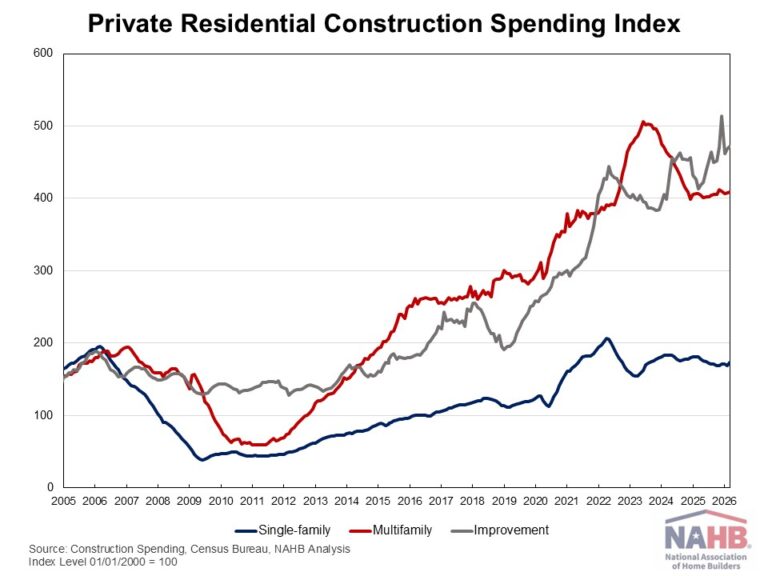

Private residential construction spending was up 1.5% for the last month of 2025. This modest gain was driven primarily by increased spending on home improvements and single-family construction. Despite this increase, total spending remained 1.3% lower than a year ago, reflecting the continued impact of housing affordability challenges facing the sector.

According to the latest construction spending data from the U.S. Census, single-family construction spending was up by 1.6% in December, consistent with the soft builder confidence reflected in the NAHB/Wells Fargo Housing Market Index (HMI). Compared to a year ago, single-family construction spending decreased 3.6%. Meanwhile, multifamily construction spending edged up 0.1% in December, marking a seventh consecutive month of modest gains. Compared to a year earlier, multifamily spending was 2.9% higher. Improvement spending (remodeling) rose 1.8% for the month but stayed flat relative to a year ago.

The NAHB construction spending index is shown in the graph below. The index illustrates how   spending on single-family construction has slowed since early 2024 under the pressure of elevated interest rates and concerns over building material tariffs. Multifamily construction spending growth has also slowed down after the peak in July 2023, with the index largely plateauing since late 2024. In contrast, improvement spending has been on an upward trend since the beginning of 2025.

Spending on private nonresidential construction was down 1.8% over a year ago. The annual private nonresidential spending decrease was primarily driven by a $26 billion drop in manufacturing construction spending, followed by a $2 billion decrease in healthcare construction spending.


This article was originally published by a eyeonhousing.org . Read the Original article here. .


Wage growth for residential building workers moderated notably in 2025, reflecting a broader cooling in housing activity and construction labor demand. According to the latest data from the U.S. Bureau of Labor Statistics (BLS), both nominal and real wages remained modest during the fourth quarter, signaling a shift from the rapid post-pandemic expansion to a slower-growth phase.

In nominal terms, average hourly earnings (AHE) for residential building workers rose to $39.63 in December 2025, up 3.3% from $38.37 a year ago. While this marked a modest acceleration from November’s 2.0% year-over-year gain, wage growth has slowed considerably from the peak of 9.4% recorded in June 2024. Elevated mortgage rates, ongoing affordability challenges, and persistently high construction costs constrained home building activity over the past year. As a result, labor demand eased accordingly. Meanwhile, the number of open, and unfilled construction sector jobs continued to trend downward, consistent with the overall slowdown in housing activity.

Despite the slowdown in wage growth, residential building workers’ wages remain competitive relative to other industries:

9.9% higher than the manufacturing sector ($36.07 per hour)

23.3% higher than the transportation and warehousing sector ($32.14 per hour)

2.6% lower than the mining and logging sector ($40.69 per hour)

Note:

Data used in this post relate to all employees in the residential building industry. This group includes both new single-family housing construction (excluding for-sale builders) and residential remodelers but does not include specialty trade contractors.


This article was originally published by a eyeonhousing.org . Read the Original article here. .
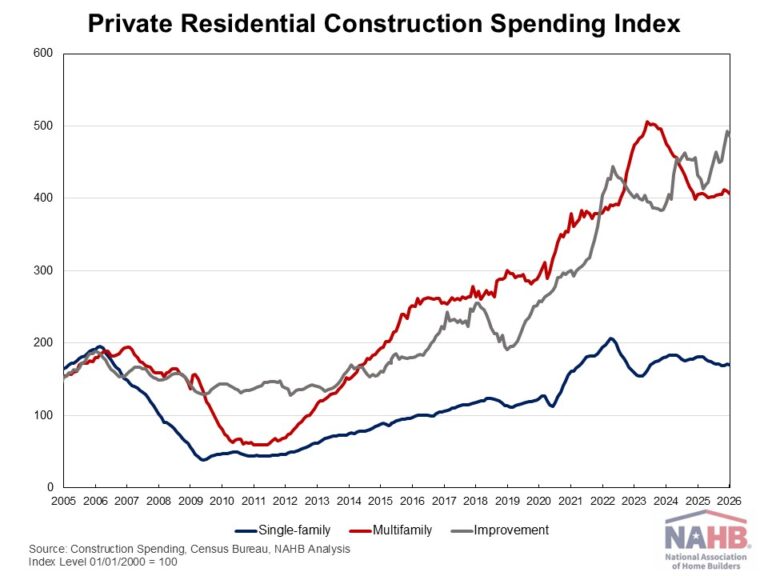

Lending standards for most types of residential mortgages were essentially unchanged but overall demand was weaker in the fourth quarter of 2025, according to the recent release of the Senior Loan Officer Opinion Survey (SLOOS). However, for commercial real estate (CRE) loans, lending standards for multifamily were looser, while standards for construction & development were essentially unchanged. Demand for construction & development loans was stronger, while demand for multifamily loans was essentially unchanged for the quarter. 

After three consecutive 25 basis point cuts to finish 2025, the Federal Reserve decided to maintain its key short-term interest rate (i.e., Federal Funds) unchanged during its first meeting of 2026. Participants on the Federal Open Market Committee (FOMC) continue to assess how to weigh the components of its dual mandate, as inflation continues to be above the stated target of 2% (i.e., the case for higher rates) while the economy is experiencing further deceleration in job growth (i.e., the case for lower rates). Given the current macroeconomic landscape and a change in leadership at the Fed as Jerome Powell’s term as Chair ends in May, NAHB anticipates that any further rate cuts will occur in the latter half of this year.

Residential Mortgages

In the fourth quarter of 2025, three of seven residential mortgage loan categories; GSE-eligible, Qualified Mortgage (QM) non-jumbo non-GSE eligible, and Government, saw a positive net easing index for lending conditions with an additional two (non-QM non-jumbo and QM jumbo) recording a neutral reading (i.e., 0). Subprime and non-QM jumbo loans experienced tighter lending conditions, as evidenced by a negative value, -8.3 and -4.2 respectively.

All seven residential mortgage loan categories reported weaker demand in the fourth quarter of 2025, with the weakest demand coming from subprime loans. This category has experienced weaker demand for 22 consecutive quarters.

Commercial Real Estate (CRE) Loans

For the CRE loan categories, multifamily registered a net easing index of +5.5 for the fourth quarter of 2025, indicating looser credit conditions for the first time since Q1 2022. As a reminder, this was when the Federal Reserve began their aggressive rate hiking path, which saw the Federal Funds rate increase by 525 basis points over a year and a half period. For construction & development loans, the net easing index was -1.8, or essentially unchanged.

The net percentage of banks reporting stronger demand was 8.9% for construction & development loans, with a positive number indicating stronger demand. This is the first time construction & development has been positive since Q4 2021. For multifamily loans, demand was -1.9% in the fourth quarter of 2025, which is essentially unchanged according to the Fed’s classification scheme (i.e., between -5.0% and +5.0%).


This article was originally published by a eyeonhousing.org . Read the Original article here. .
Pin It