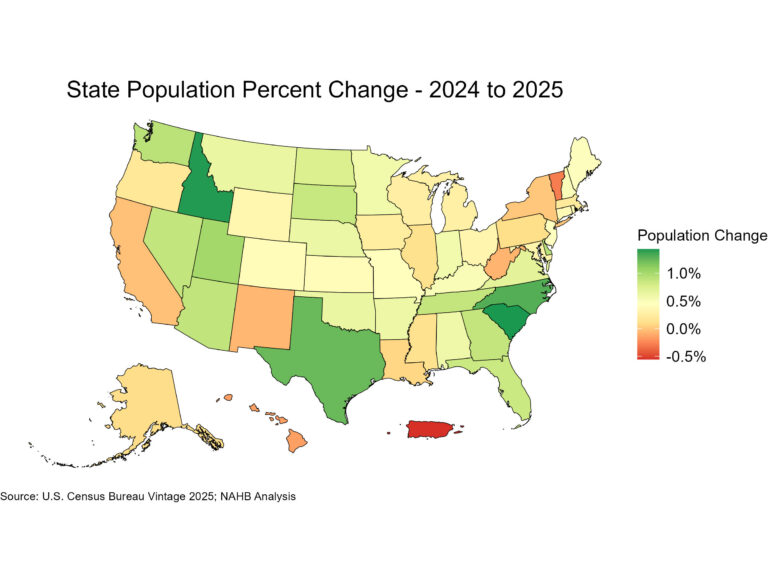
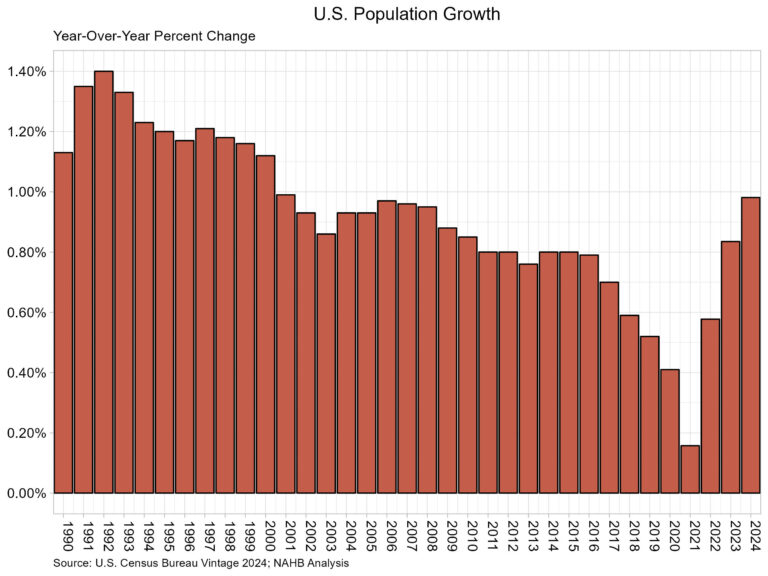
U.S. population growth slowed notably in the latest Vintage 2025 population estimates from the U.S. Census Bureau, with the nation expanding by just 0.5% in 20251, roughly half the pace of the prior year. The deceleration was primarily driven by a sharp decline in net international migration (NIM), which dropped from 2.7 million to 1.3 million, while natural change remained relatively stable.
As mentioned in a previous blog post, population gains remain concentrated in the South and parts of the West, while many areas in the Midwest and Northeast experienced slower growth or population declines.
Beyond national and state trends, this analysis aims to examine county-level dynamics, where these shifts are most visible. The 2025 data reveal a more fragmented demographic landscape, shaped by the diverging roles of domestic migration, international migration, and natural change. These forces are not only redefining where population growth occurs but also reshaping the geographic foundations of housing demand.
Part I: Country-Level Population Changes
At the county level, population growth slowed across much of the country. Among the nation’s 3,143 counties and the District of Columbia, the majority experienced decelerating population gains in 2025. Of the 2,066 counties that grew between 2023 and 2024, nearly 80% saw their growth slow or reverse. In many cases, counties already experiencing population loss saw those declines deepen further.
The county map of 2025 population change reveals a fragmented landscape where growth is no longer broad-based but driven by distinct demographic components that vary widely across regions and counties.
Net Domestic Migration has become the most visible driver of county-level divergence. Population flows continue to shift away from the largest and most expensive counties toward smaller and less densely populated areas. Collectively, the 50 counties with population exceeding one million recorded a net domestic migration loss of 637,634 in 2025. In contrast, large counties with populations between 50,000 and 999,999 posted a combined gain of 533,766 residents, while medium-sized counties with population between 15,000 and 49,999 gained 95,095. Even the smallest counties, with population below 15,000 residents, recorded a slight net gain of 8,773.
This redistribution is clearly reflected in the geographic pattern of growth. Counties across the West South Central, South Atlantic, and parts of the Mountain divisions continue to show relatively stronger gains, supported by inflows of residents seeking relative affordability, job opportunities, and fewer constraints on housing supply. Meanwhile, many counties in the Northeast, Midwest, and high-cost coastal regions are experiencing either muted growth or outright population loss, as domestic outmigration continues.
Net International Migration (NIM), while still a positive contributor overall, declined sharply in 2025 and remains highly concentrated geographically. Nine out of ten U.S. counties experienced lower NIM compared to the previous year.
The decline was especially pronounced in a small number of large urban counties. Ten counties (Los Angeles, CA; Queens, NY; Cook, IL; Kings, NY; Harris, TX; Bronx, NY; Dallas, TX; Miami-Dade, FL; New York County, NY; Maricopa, AZ) accounted for more than a quarter of the total national decline in NIM. These counties have historically relied on international inflows to offset domestic outmigration, but the sharp reduction in 2025 has significantly weakened that stabilizing effect, leaving many large urban cores with stagnant or declining population trajectories.
Natural Change, defined as the balance between births and deaths, continues to exert a structural influence on population growth, especially in smaller and rural counties. In 2025, approximately 65% of counties (2,055 in total) experienced a natural decrease, where deaths exceeded births.
Although this share is slightly below the peak seen during the pandemic period, it remains historically elevated. Regions such as the Midwest, Great Plains, and Appalachia continue to face persistent demographic headwinds driven by aging populations and low fertility rates. Even in counties with positive domestic migration, weak or negative natural change often limits overall population growth.
Overall, domestic migration, international migration, and natural change are producing a more selective and uneven pattern of population change. Growth has not disappeared, but it has become narrower in scope, increasingly dependent on migration flows, and less capable of supporting broad-based housing demand.
Part II: Linking Population Shifts to NAHB’s HBGI
Interestingly, these county-level population trends closely align with the latest fourth-quarter results from the NAHB Home Building Geography Index (HBGI), which tracks construction activity across counties with different population densities. The index shows that single-family construction has weakened across most geographies, with the exception of the least dense markets, while multifamily construction has increasingly shifted toward smaller and lower-density areas.
This pattern underscores a strengthening link between population dynamics and housing market outcomes. In large metro core areas, weaker construction conditions are associated with slower population growth, with 86% of counties also experiencing deceleration. In these higher-density markets, both single-family and multifamily development have moderated, reflecting softer demand and persistent affordability challenges.
Additionally, the HBGI indicates that market share has shifted toward smaller and lower-density areas in both single-family and multifamily construction, consistent with the continued domestic migration inflows. Small metro core and outlying counties recorded a net domestic migration gain of 327,598 in 2025, reinforcing this geographic shift in demand and building activity.
Conversely, counties with stagnant or declining populations are contributing to a softer national housing outlook. Builders in these markets are facing slower absorption, rising inventories, and a more cautious development environment, all of which are reflected in softer HBGI readings.
Part III: Population Growth and Housing Supply Across Metro Areas
To further quantify the relationship between population dynamics and housing supply, a metro-level comparison highlights how closely construction activity aligns with demographic change. Across metropolitan areas, the relationship between population growth and single-family building permits is both positive and statistically strong. With an R² of 0.6248, population change alone explains roughly 62% of the variation in permit activity, reinforcing the role of demographic growth as a primary driver of housing supply.
In general, faster-growing metros tend to issue more permits on a per 1,000 residents basis. This relationship is particularly evident in high-growth markets such as Myrtle Beach–Conway–North Myrtle Beach, SC-NC, and Ocala, FL, where rapid population gains are accompanied by elevated levels of single-family permits.
Both the NAHB Home Building Geography Index and metro-level permitting data point to the same conclusion: population growth remains a fundamental driver of housing supply; however, the strength of that relationship varies widely depending on local conditions, including land availability, regulatory constraints, and affordability.
Note:
The vintage population estimates are released annually and represent the change in the U.S. population between July 1, 2024, and July 1, 2025.
This article was originally published by a eyeonhousing.org . Read the Original article here. .