This article was originally published by a www.houzz.com . Read the Original article here. .
This article was originally published by a www.houzz.com . Read the Original article here. .

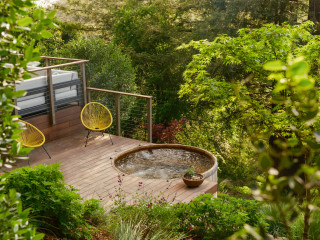
Seeing the site’s potential, the homeowners enlisted Barry Sacher, owner of Rock Paper Scissors Landscape, to craft an outdoor retreat that would both serve their family’s needs and work in harmony with the landscape. “Embracing the existing natural landscape drove the design,” Sacher says. “It was and still is the star of the show.”
This article was originally published by a www.houzz.com . Read the Original article here. .


Along with preserving the mature trees, the designer brought in plantings including ‘Superb’ grevillea (Grevillea ‘Superb’, zones 9 to 11), ‘Barbecue’ rosemary (Rosmarinus officinalis ‘Barbecue’, zones 8 to 10) and sage (Salvia clevelandii ‘Winifred Gilman’, zones 8 to 11, plus S. greggi ‘Dark Dancer’, zones 7 to 10). He focused on plants with low water needs throughout the entire redesigned landscape and turned to Houzz for ideas and inspiration.
Shop for outdoor lounge furniture on Houzz
This article was originally published by a www.houzz.com . Read the Original article here. .

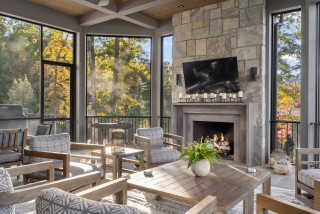
The homeowners, empty nesters from Chicago, originally planned for the house to serve as a second home and as a hub for themselves and their family. However, they wound up relocating permanently. “The house works really well for them. When they decided to move here full time, we didn’t have to tweak a thing,” interior designer Maggie Madarasz says.
This article was originally published by a www.houzz.com . Read the Original article here. .
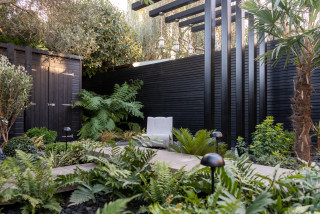
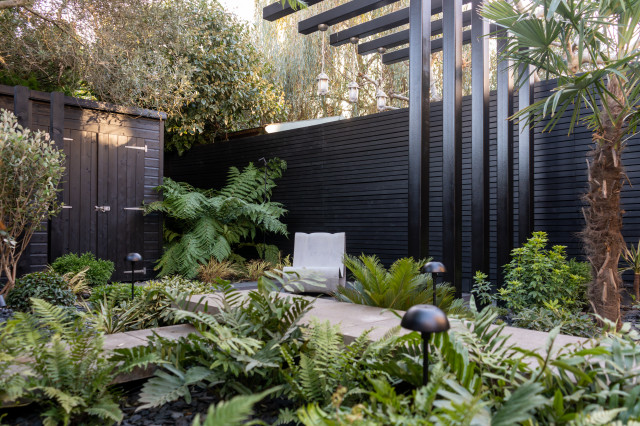
You can also see one of the ways she gave the small space depth, with the eye going from the black patio door frames to the steel pergola to the black wood posts attached to the shed.
Bejanaru also planted four new trees, placing the two tallest nearer to the house and the two shorter ones at the back. “The plants in front draw the eye upward, then the shorter ones — visually below the other two — draw your eye to the back of the [yard], so you have several focal points,” she says.
The new trees consist of two Tasmanian tree ferns (Dicksonia antarctica, USDA zones 9 to 10; find your zone) — one on the front left and the other at the back right; a tall windmill palm (Trachycarpus fortunei, zones 7 to 11) and a pineapple guava (Acca sellowiana, zones 8 to 10) in front of the shed.
The huge olive tree was already there. “We kept it, of course, because it’s beautiful and I also love the color of the bark, which stands out,” Bejanaru says.
9 Design Tips to Enhance Views of Your Garden From Indoors