Tag

Increase

Browsing


The number of open positions in the construction sector increased in May, per the Bureau of Labor Statistics Job Openings and Labor Turnover Survey (JOLTS). The current level of open jobs is down measurably from three years ago due to declines in construction activity, particularly in housing. Recent gains for nonresidential construction have increased demand for construction labor, although they have not fully offset the weakness present in the residential construction sector.

The number of open jobs for the overall economy was flat in May, remaining near 7.59 million. The May reading was also measurably higher compared to a year ago (7.31 million). The recent increase in job openings for the overall economy indicates that the labor market remains on solid footing, despite concerns over headline risk and AI.

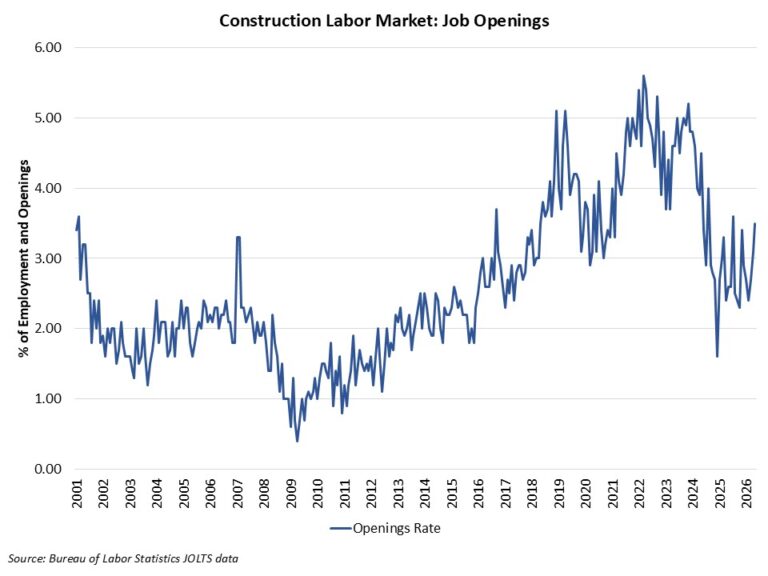
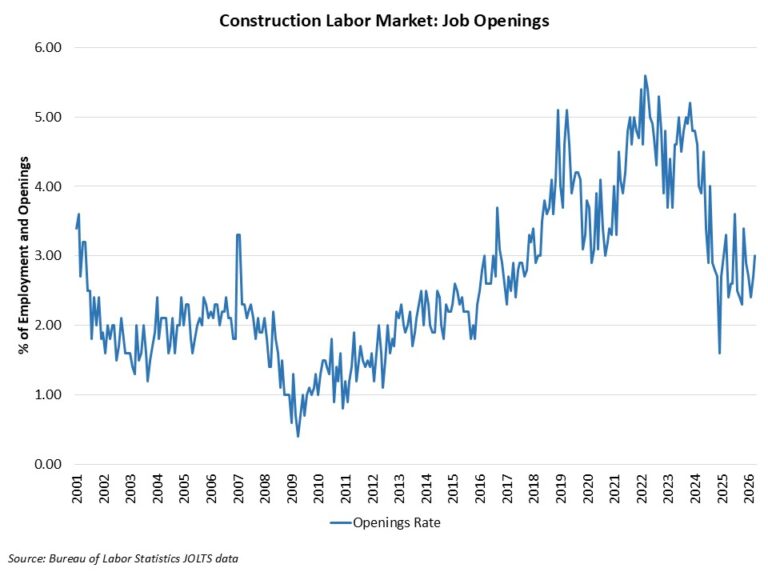
The number of open construction sector jobs increased for the month, rising slightly from 266,000 in April to 298,000 in May. This total was higher than the total from a year ago (222,000). The chart below notes a declining trend followed by a new range for unfilled construction jobs since the Fed raised the federal funds rate and home building weakened. While home building employment has declined over the last year, other subsectors of the construction industry have expanded (e.g. data center construction). This has produced volatility within a lower range in the job openings series since 2024.

The construction job openings rate increased to 3.5% in May, up from the 2.6% rate estimated a year ago.

The layoff rate in construction increased to 2.1% in May. The quits rate fell back 1.3% for the month.


This article was originally published by a eyeonhousing.org . Read the Original article here. .


Mortgage rates continued to increase in May as inflation accelerated. According to Freddie Mac, the 30-year fixed-rate mortgage averaged 6.41% in May, up 7 basis points (bps) over April. Since the conflict in the Middle East began, the 30-year mortgage rate has increased by 36 basis points. The average 15-year rate averaged 5.76% in May, up 7 bps from April, and up 33 basis points since the end of February. Even so, both rates remain lower than a year ago by 41 bps and 19 bps, respectively.

The 10-year Treasury yield, a key benchmark for long-term borrowing, averaged 4.47% in May, 16 bps higher than the previous month. Stronger-than-expected inflation pushed yields upward, with the 10-year yield reaching as high as 4.6% during the month. Rising energy prices kept inflation high, as fuel oil prices increased 5.8% and gasoline prices rose 5.4%.

Persistently high inflation has also strained household budgets. As people used more of their disposable income or drew down on savings to cover everyday expenses, the personal saving rate fell to 2.6% in April. The rate was the lowest since June 2022 when CPI was at its peak.


This article was originally published by a eyeonhousing.org . Read the Original article here. .


The number of open positions in the construction sector edged higher in April, per the Bureau of Labor Statistics Job Openings and Labor Turnover Survey (JOLTS). The current level of open jobs is down measurably from three years ago due to declines in construction activity, particularly in housing. Recent gains for nonresidential construction have not fully offset soft conditions for housing with respect to the demand for construction labor.

The number of open jobs for the overall economy surged in April, increasing from 6.89 million in March to 7.62 million. The April reading was also measurably higher compared to a year ago (7.10 million). It will be worth watching next month to see if these preliminary estimates stand, as the data suggests strength for labor demand, particularly in the professional and business service sectors.

The number of open construction sector jobs increased for the month, rising slightly from 234,000 in March to 259,000 in April. This total was higher than the total from a year ago (207,000). The chart below notes a declining trend followed by stability for unfilled construction jobs since the Fed raised the federal funds rate and home building weakened. While home building employment was declining during the second half of 2025, other subsectors of the construction industry have expanded (e.g. data center construction). This has produced volatility within a reduced range in the job openings series since 2024.

The construction job openings rate increased to 3% in April, up from the 2.4% rate estimated a year ago.

The layoff rate in construction declined slightly to 1.5% in April. The quits rate was unchanged at 1.7% for the month.


This article was originally published by a eyeonhousing.org . Read the Original article here. .


Energy input prices increased in March at their fastest pace since June of 2020 as the conflict in Iran shocked critical global supply chains. Building material prices, excluding energy, rose for the eleventh straight month. Price growth for trade services slowed while transportation and warehousing price growth accelerated.  

The Producer Price Index for final demand increased 0.5% in March, after rising 0.5% in February. The index for final demand services was unchanged in March, while the index for final demand goods rose 1.6% over the month.

The price index for inputs to new residential construction rose 1.2% in March and was up 3.8% from last year. The price of goods used in new residential construction was up 1.8% over the month and up 4.3% from last year, while the price of services was up 0.3% over the month and up 3.1% from last year.

Input Goods

The goods component has a larger importance to the inputs to residential construction price index, representing around 60% of the total. On a monthly basis, the price of input goods to new residential construction was up 1.8% in March.

The input goods to residential construction index can be further broken down into two separate components, one measuring energy inputs with the other measuring remaining goods. The latter of these two components simply represents building materials used in residential construction, which makes up around 93% of the goods index.

Energy input prices rose 21.4% in March and were 20.8% higher than one year ago. The monthly increase in March was the largest since prices rose 30.6% in June 2020. Building material prices were up 0.4% in March and up 3.1% compared to one year ago.

Among input goods, the largest year-over-year increase was for No. 2 diesel fuel as prices were 51.2% higher than a year ago. Metal molding and trim continued to show high price increases, as there were up 45.5% from last year. On the opposite end, the largest yearly declines in prices were for particleboard and fiberboard with prices down 15.7%. Notably, asphalt reported a price decline of 12.3% in March. For key inputs, ready-mix concrete prices were 0.5% higher than a year ago while softwood lumber prices were 7.8% lower than a year ago.

Input Services

Prices for service inputs to residential construction reported an increase of 0.3% in March. On a year-over-year basis, service input prices were up 3.1%. The price index for service inputs to residential construction can be broken out into three separate components: a trade services component, a transportation and warehousing services component, and a services excluding trade, transportation, and warehousing component (other services).

The most significant component is trade services (around 60%), followed by other services (around 29%), and finally transportation and warehousing services (around 11%). The largest component, trade services, was up 3.3% from a year ago. The price of transportation and warehousing services rose 6.2%, while prices for other services were up 1.5% over the year.

Expanded Inputs to New Construction Data

Within the PPI that BLS publishes, new experimental data was recently published regarding inputs to new construction. The data expands existing inputs to industry indexes by incorporating import prices with prices for domestically produced goods and services. With this additional data, users can track how industry input costs are changing among domestically produced products and imported products. This data focuses on new construction, but the complete dataset includes indices across numerous industries that can be found here on BLS website.

New construction input prices are primarily influenced by domestically produced goods and services, with domestic products accounting for 90% of the weight of the industry index for new construction. Imported goods make up the remaining 10% of the index.

The latest available data, for January 2026, showed that domestically produced goods continue to show price growth compared to imported goods used in new construction. On a year-over-year basis, the index for domestic goods increased 2.6%, while prices for imported goods have fallen 2.7%.

This article was originally published by a eyeonhousing.org . Read the Original article here. .


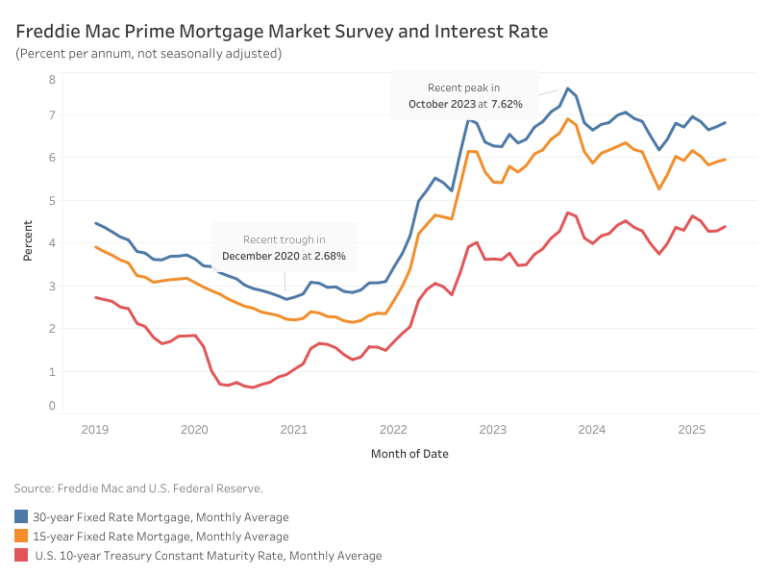
Mortgage rates continued their upward trend in May due to market volatility triggered by fiscal concerns and weaker U.S. Treasury demand. According to Freddie Mac, the average 30-year fixed-rate mortgage rose to 6.82% — a 9-basis-point (bps) increase from April. The 15-year fixed-rate mortgage increased by 5 bps to 5.95%.

The 10-year Treasury yield, a benchmark for mortgage rates, averaged 4.38% in May, with the most recent weekly yield surpassing 4.50%. Long-term treasury yields spiked following two events: first, a credit rating downgrade by Moody’s Ratings, and then, a tepid auction of the 20-year treasury. The weak demand for long-term government bonds necessitated a higher yield to attract investors.

At the core of the market unease is concern over the growing fiscal deficit that intensified as the new “One Big Beautiful Bill” threatens to further widen the federal deficit, which stood at $1.9 trillion as of January 2025. The combination of weakening fiscal credibility and poor auction performance suggests a possible upward repricing of long-term borrowing costs.

Discover more from Eye On Housing

Subscribe to get the latest posts sent to your email.


This article was originally published by a eyeonhousing.org . Read the Original article here. .


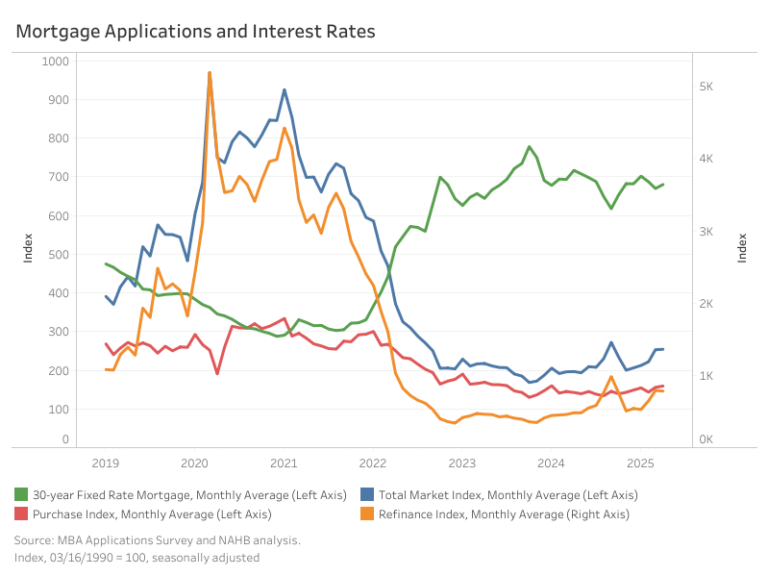
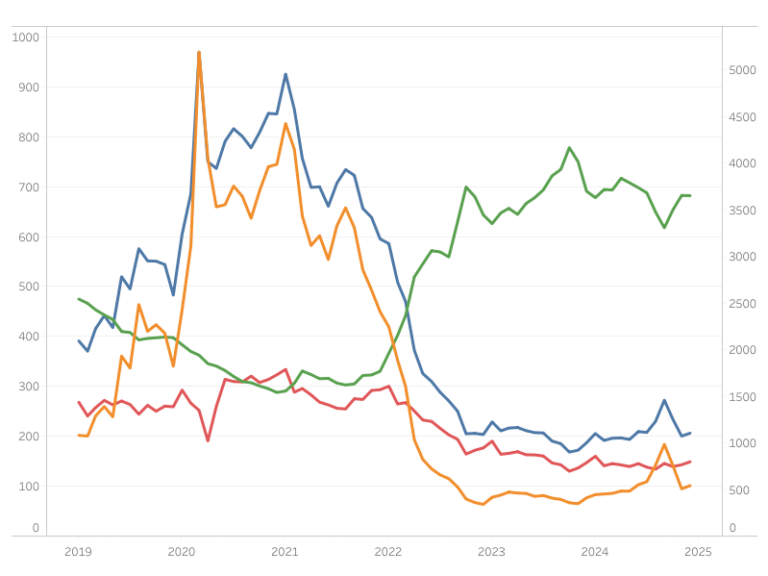
Mortgage loan applications saw little change in April, as refinancing activity decreased. The Market Composite Index, which measures mortgage loan application volume based on the Mortgage Bankers Association (MBA) weekly survey, experienced a 0.4% month-over month increase on a seasonally adjusted (SA) basis. However, year-over-year, the index is up 29.3% compared to April 2024.

The average rate for a 30-year fixed mortgage climbed 10 basis points in April, reaching 6.8%, according to the MBA survey. As rates edged higher, purchase activity posted a modest 1.9% month-over-month gain (SA), while the Refinance Index declined by 1.4% (SA). Compared to a year ago, mortgage rates are down 37 bps, and thus, purchase applications are higher by 11.2%, while refinance activity has jumped 62.0%.

Loan sizes remained relatively stable. In April, the average loan size across the total market (including purchases and refinances) held steady at $403,500, month-over-month, on a non-seasonally adjusted basis (NSA). Purchase loans sizes edged down 1.3% to $444,000, while refinance loan sizes increased 0.5% to $339,300. Notably, the average loan size for adjustable-rate mortgages (ARMs) fell 7.8%, from $1.14 million to $1.05 million.

Discover more from Eye On Housing

Subscribe to get the latest posts sent to your email.


This article was originally published by a eyeonhousing.org . Read the Original article here. .


Prices for inputs to new residential construction—excluding capital investment, labor, and imports—were up 1.2% in January according to the most recent Producer Price Index (PPI) report published by the U.S. Bureau of Labor Statistics. The Producer Price Index measures prices that domestic producers receive for their goods and services, this differs from the Consumer Price Index which measures what consumers pay and includes both domestic products as well as imports.

The inputs to the New Residential Construction Price Index grew 1.1% from January of last year. The index can be broken into two components—the goods component increased 2.1% over the year, while services decreased 0.3%. For comparison, the total final demand index, which measures all goods and services across the economy, increased 3.5% over the year, with final demand with respect to goods up 2.3% and final demand for services up 4.1% over the year.

Input Goods

The goods component has a larger importance to the total residential construction inputs price index, representing around 60%. For the month, the price of input goods to new residential construction was up 1.6% in January. Monthly growth of the index was relatively low in the past two years, as this monthly increase was the largest since March of 2022 (3.3%).

The input goods to residential construction index can be further broken down into two separate components, one measuring energy inputs with the other measuring goods less energy inputs. The latter of these two components simply represents building materials used in residential construction, which makes up around 93% of the goods index.

The 2.1% yearly growth in the goods component can be attributed to the rise in the prices of building materials, which grew 2.3% over the year. Meanwhile, the price of energy inputs was 1.6% lower than last year. Between December and January, building materials increased 1.4%, while energy inputs increased 4.3%.

At the individual commodity level, the five commodities with the highest importance for building materials to the New Residential Construction Index were as follows: ready-mix concrete, general millwork, paving mixtures/blocks, sheet metal products, and wood office furniture/store fixtures. Compared to last year, ready-mix concrete was up 4.1%, wood office furniture/store fixtures up 4.7%, general millwork up 2.4%, paving mixtures/blocks up 8.6% while sheet metal products were up 0.4%.

For January, the commodity used in new residential construction that featured the highest price growth was an energy input, home heating oil and distillates, increasing 16.0%. The non-energy input that had the highest monthly price growth was paving mixtures and blocks, up 14.8%. This is likely a pass-through of increases in asphalt prices, which were up 6.9% in January.

Input Services

While prices of inputs to residential construction for services were down 0.3% over the year, they were up 0.5% in January from December. The price index for service inputs to residential construction can be broken out into three separate components: a trade services component, a transportation and warehousing services component, and a services excluding trade, transportation and warehousing component. The most significant component is trade services (around 60%), followed by services less trade, transportation and warehousing (around 29%), and finally transportation and warehousing services (around 11%). The largest component, trade services, was down 1.9% from a year ago. The services less trade, transportation and warehousing component was up 1.6% over the year.   Lastly, prices for transportation and warehousing services advanced 3.1% compared to January last year, the largest year-over-year increase since January of 2023.

Discover more from Eye On Housing

Subscribe to get the latest posts sent to your email.


This article was originally published by a eyeonhousing.org . Read the Original article here. .


The Market Composite Index, a measure of mortgage loan application volume from the Mortgage Bankers Association’s (MBA) weekly survey, increased by 3.1% month-over-month on a seasonally adjusted (SA) basis, primarily driven by purchasing activity. Compared to January last year, the index is higher by 3.4%. The Market Composite Index which includes the Purchase and Refinance Indices: purchasing experienced a monthly gain of 3.8%, while refinancing decreased 2.3% (SA). On a year-over-year basis, however, the Purchase Index is lower by 3.4%, while the Refinance Index remains higher at 18.6%.

The average 30-year fixed rate mortgage reported in the MBA survey for January ticked up 20 basis points (bps) to 7.02% (index level 702). This rate is 24 basis points higher than the same period last year.

Average loan size (purchases and refinances combined) increased slightly by 0.8% on a non-seasonally adjusted (NSA) basis from December to $373,200. For purchase loans, the average size increased by 1.8% to $429,400, while refinance loans experienced a 5.4% decrease, reaching an average of $288,200. Adjustable-rate mortgages (ARMs) saw a continued decline in average loan size for three consecutive months, down 0.6% from $1.074 million to $1.068 million.

Discover more from Eye On Housing

Subscribe to get the latest posts sent to your email.


This article was originally published by a eyeonhousing.org . Read the Original article here. .


The Market Composite Index, a measure of mortgage loan application volume from the Mortgage Bankers Association’s (MBA) weekly survey, increase marginally by 2.9% month-over-month on a seasonally adjusted (SA) basis. Compared to December 2023, the index is higher by 10.2%. The Market Composite Index includes the Purchase and Refinance Indices, which saw monthly gains of 4.1% and 6.7% (SA), respectively. On a year-over-year basis, the Purchase Index showed a modest increase of 1.1%, while the Refinance Index is 31.7% higher.

The average 30-year fixed rate mortgage reported in the MBA survey for December remained relatively stable at 6.82% (index level 682), reflecting a minor decline of 0.4 basis points. This rate is 9 basis points lower than the same period last year.

Average loan sizes, excluding refinance loans, saw slight declines in December. On a non-seasonally adjusted (NSA) basis, the average loan size (purchases and refinances combined) fell by 2.1% from November to $370,300. For purchase loans, the average size decreased by 3.3% to $421,800, while refinance loans experienced a 4.8% increase, reaching an average of $304,500. Adjustable-rate mortgages (ARMs) also saw a marginal decline in loan size, down 0.8% from $1.08 million to $1.07 million.

Discover more from Eye On Housing

Subscribe to get the latest posts sent to your email.


This article was originally published by a eyeonhousing.org . Read the Original article here. .


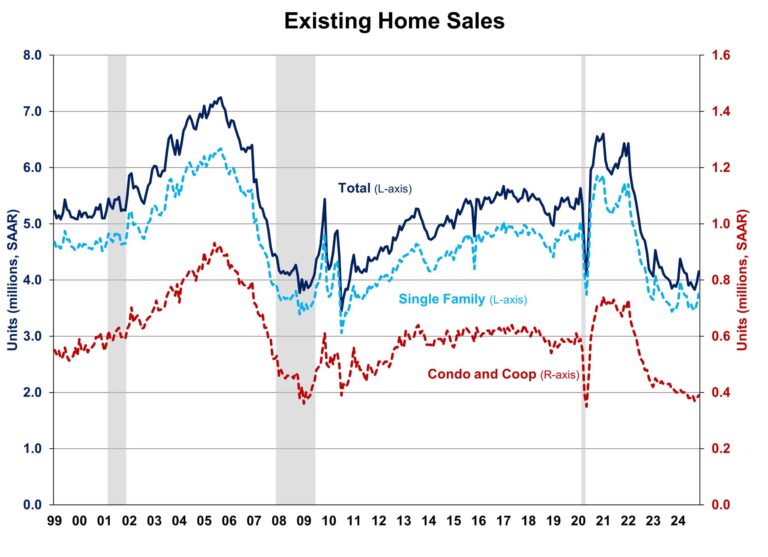
Despite higher mortgage rates and elevated home prices, existing home sales jumped to an 8-month high in November, marking the second month of annual increase in more than three years, according to the National Association of Realtors (NAR).

While inventory improves and the Fed continues lowering rates, the market faces headwinds as mortgage rates are expected to stay above 6% for longer due to an anticipated slower easing pace in 2025. The prolonged rates may continue to discourage homeowners from trading existing mortgages for new ones with higher rates, keeping supply tight and prices elevated. However, as mortgage rates continue trending lower, the gradual improvement in inventory should help slow home price growth and enhance affordability. As such, the recent gains for existing home sales may give way in the coming months of data.

Total existing home sales, including single-family homes, townhomes, condominiums, and co-ops, rose 4.8% to a seasonally adjusted annual rate of 4.15 million in November, the highest level since March 2024. On a year-over-year basis, sales were 6.1% higher than a year ago, the largest annual gain since June 2021.

The first-time buyer share rose to 30% in November, up from 27% in October but down from 31% in November 2023.

The existing home inventory level fell from 1.37 million in October to 1.33 million units in November but is up 17.7% from a year ago. At the current sales rate, November unsold inventory sits at a 3.8-months supply, down from 4.2-months last month but up 3.5-months a year ago. This inventory level remains low compared to balanced market conditions (4.5 to 6 months’ supply) and illustrates the long-run need for more home construction.

Homes stayed on the market for an average of 32 days in November, up from 29 days in October and 25 days in November 2023.

The November all-cash sales share was 25% of transactions, down from 27% experienced in both October 2024 and November 2023. All-cash buyers are less affected by changes in interest rates.

The November median sales price of all existing homes was $406,100, up 4.7% from last year. This marked the 17th consecutive month of year-over-year increases. The median condominium/co-op price in November was up 2.8% from a year ago at $359,800. This rate of price growth will slow as inventory increases.

Geographically, three of four regions saw an increase in existing home sales in November, ranging from 5.3% in the Midwest to 8.5% in the Northeast. Sales in the West stayed unchanged in November. On a year-over-year basis, sales grew in all four regions, ranging from 3.3% in the South to 14.9% in the West.

The Pending Home Sales Index (PHSI) is a forward-looking indicator based on signed contracts. The PHSI rose from 75.9 to 77.4 in October due to improved inventory. On a year-over-year basis, pending sales were 5.4% higher than a year ago per National Association of Realtors data.

Discover more from Eye On Housing

Subscribe to get the latest posts sent to your email.


This article was originally published by a eyeonhousing.org . Read the Original article here. .

Pin It