Tag

Increase

Browsing


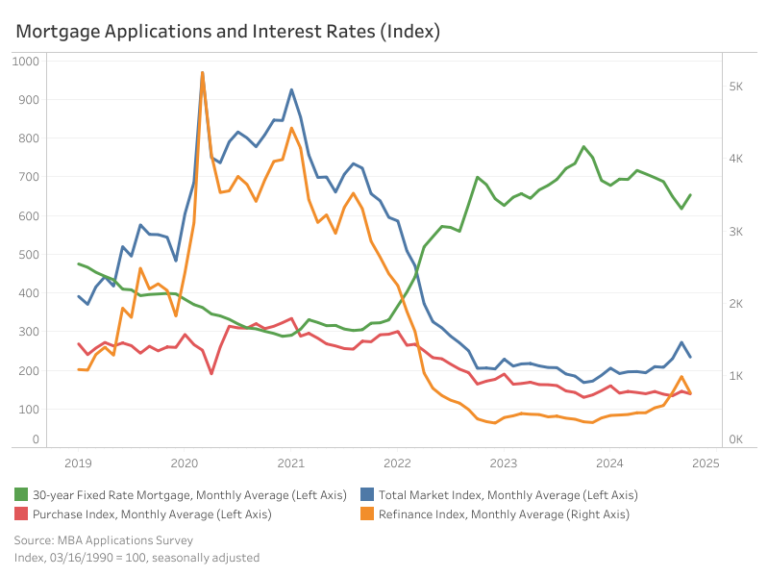
The Market Composite Index, a measure of mortgage loan application volume by the Mortgage Bankers Association’s (MBA) weekly survey, decreased 14.5%, month-over-month, in November on a seasonally adjusted (SA) basis. The slowdown in mortgage activity can be attributed to higher mortgage rates as the ten-year Treasury yield increased in November, reflecting uncertainties surrounding the elections.

The market decline was reflected primarily in the Refinance Index (SA), which decreased by 33.2% month-over-month. Meanwhile, the Purchase Index (SA) showed a modest increase of 2.7% over the same period. However, compared to October 2023, the Market Composite Index is up by 16.4%, with the Purchase Index seeing a slight 4.8% increase and the Refinance Index higher by 45.9%.

The average contract rate for 30-year fixed mortgage rate per the MBA survey for November averaged at 6.8%, 29 basis points (bps) higher month-over-month in response to a higher ten-year Treasury rate.

Loan size metrics also reflected market adjustments. The average loan size for the total market (including purchases and refinances) shrank 2.9% month-over-month on a non-seasonally adjusted (NSA) basis, decreasing from $389,800 to $378,400. Loan sizes for purchasing and refinancing decreased. Purchase loans averaged $436,200, down 2.7% from $448,300, while refinance loans saw a sharper 9.9% decrease, with the average loan size falling from $322,500 to $290,600. Adjustable-rate mortgages (ARMs) also declined 6.0%, from $1.15 million to $1.08 million.

Discover more from Eye On Housing

Subscribe to get the latest posts sent to your email.


This article was originally published by a eyeonhousing.org . Read the Original article here. .


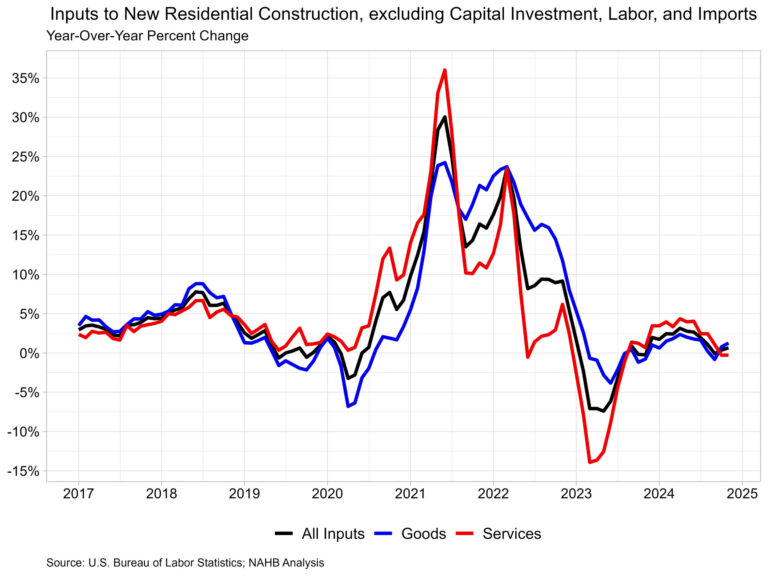
Prices for inputs to new residential construction—excluding capital investment, labor, and imports—were unchanged in November according to the most recent Producer Price Index (PPI) report published by the U.S. Bureau of Labor Statistics. Compared to a year ago, this index was up 0.7% in November after rising 0.3% in October.

The inputs to the new residential construction price index can be broken into two components­—one for goods and another for services. The goods component increased 1.2% over the year, while services decreased 0.3%. For comparison, the total final demand index increased 3.0% over the year in November, with final demand with respect to goods up 1.1% and final demand for services up 3.9% over the year.

Goods

The goods component has a larger importance to the total residential construction inputs price index, representing around 60%. The price of input goods to new residential construction was unchanged in November from October. The input goods to residential construction index can be further broken down into two separate components, one measuring energy inputs with the other measuring goods less energy inputs. The latter of these two components simply represents building materials used in residential construction, which makes up around 93% of the goods index.

Prices for inputs to residential construction, goods less energy, were up 2.3% in November compared to a year ago. This year-over-year increase was larger than in October (2.0%) and was the largest year-over-year increase since June earlier this year. The growth rate in November 2023 was 1.2%. The index for inputs to residential construction for energy fell 10.9% year-over-year in November, the fourth straight yearly decline in input energy prices.  

The graph below focuses on the data since the start of 2023 for residential goods inputs. Energy prices have continued to fall over the past year, with only two periods of growth in 2024.

At the individual commodity level, excluding energy, the five commodities with the highest importance for building materials to the new residential construction index were as follows: ready-mix concrete, general millwork, paving mixtures/ blocks, sheet metal products, and wood office furniture/store fixtures. Across these commodities, there was price growth across the board compared to last year. Ready-mix concrete was up 3.9%, wood office furniture/store fixtures up 3.4%, general millwork up 2.8%, paving mixtures/blocks up 1.6% and sheet metal products up 0.5%. Unsurprisingly, given how energy prices have trended this year, the input commodity that had the largest fall in price over the year was No. 2 diesel, which was down 20.6%.

Among lumber and wood products, the commodities with the highest importance to new residential construction were general millwork, prefabricated structural members, softwood veneer/plywood, softwood lumber (not edge worked) and hardwood veneer/plywood. The input commodity in residential construction that had the highest year-over-year percent change (across all input goods) in November was softwood lumber (not edge worked), which was 13.7% higher than November 2023. This is of particular note because none of the other top wood commodities had a year-over-year change above 3% in November. Lumber supplies have been driving prices higher over the past month as the sawmill industry continues to adjust to the mill closures that occurred earlier this year. Higher lumber demand as residential construction rebounds due to lower interest rates is likely to continue to increase lumber prices.

Services

Prices of inputs to residential construction for services, were unchanged in November from October. The price index for service inputs to residential construction can be broken out into three separate components: a trade services component, a transportation and warehousing services component, and a services excluding trade, transportation and warehousing component. The most significant component is trade services (around 60%), followed by services less trade, transportation and warehousing (around 29%), and finally transportation and warehousing services (around 11%). The largest component, trade services, compared to last year was down 1.2% in November after declining 1.5% in October.

Discover more from Eye On Housing

Subscribe to get the latest posts sent to your email.


This article was originally published by a eyeonhousing.org . Read the Original article here. .


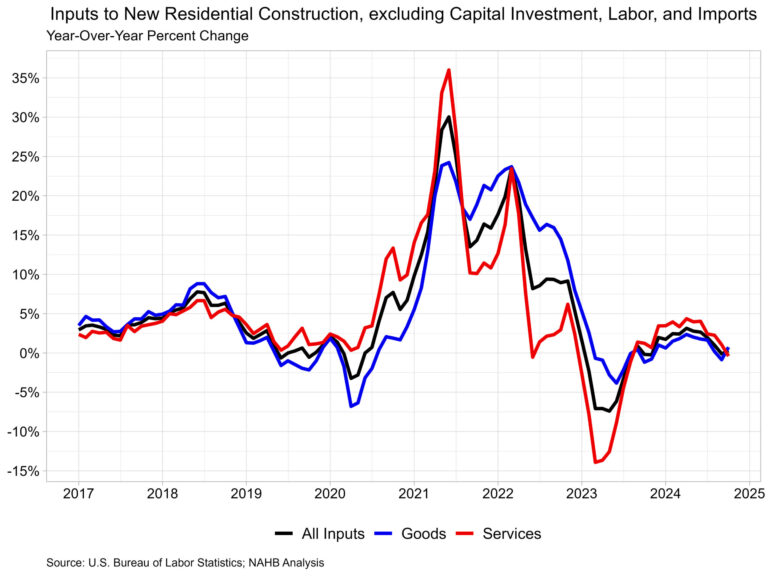
Prices for inputs to new residential construction—excluding capital investment, labor, and imports—decreased 0.2% in October according to the most recent Producer Price Index (PPI) report published by the U.S. Bureau of Labor Statistics. Compared to a year ago, this index is up 0.3% in October after a decline of 0.1% in September.

The inputs to the new residential construction price index can be broken into two components­—one for goods and another for services. The goods component increased 0.7% over the year, while services decreased 0.4%. For comparison, the total final demand index increased 2.4% over the year for October, with final demand with respect to goods up 0.2% and final demand for services up 3.5% over the year.

Input Goods

The goods component has a larger importance to the total residential construction inputs price index, representing around 60%. The price of input goods to new residential construction was up 0.3% in October from September. The input goods to residential construction index can be further broken down into two separate components, one measuring energy inputs with the other measuring goods less energy inputs. The latter of these two components simply represents building materials used in residential construction, which makes up around 93% of the goods index.

Prices for inputs to residential construction, goods less energy, were up 2.0% in October compared to a year ago. This year-over-year increase was larger than in September (1.4%) and was the first percentage point increase in the year-over-year rate since April. The growth rate in October 2023 was 0.8%. The index for inputs to residential construction for energy fell 13.1% year-over-year in October, the third straight yearly decline in input energy prices.

The graph below focuses on the data since the start of 2023 for residential goods inputs. Energy prices have continued to fall over the past year, with only two periods of growth in 2024.

At the individual commodity level, excluding energy, the five commodities with the highest importance for building materials to the new residential construction index were as follows: ready-mix concrete, general millwork, paving mixtures/ blocks, sheet metal products, and wood office furniture/store fixtures. Across these commodities, there was price growth across the board compared to last year. Ready-mix concrete was up 3.7%, wood office furniture/store fixtures up 3.6%, general millwork up 2.8%, paving mixtures/blocks up 2.4% and sheet metal products up 0.6%.

Input Services

Prices of inputs to residential construction for services fell 1.0% in October from September. The price index for service inputs to residential construction can be broken out into three separate components: a trade services component, a transportation and warehousing services component, and a services excluding trade, transportation and warehousing component. The most significant component is trade services (around 60%), followed by services less trade, transportation and warehousing (around 29%), and finally transportation and warehousing services (around 11%). The largest component, trade services, compared to last year was down 1.5% in October after increasing 0.6% in September. The decline in October was the first decline since August 2023, when the trade services index was down 1.2%.

Discover more from Eye On Housing

Subscribe to get the latest posts sent to your email.


This article was originally published by a eyeonhousing.org . Read the Original article here. .


The Market Composite Index, a measure of mortgage loan application volume by the Mortgage Bankers Association’s (MBA) weekly survey, decreased 13.9% month-over-month on a seasonally adjusted (SA) basis due to higher mortgage rates. This decline was reflected in both the Purchase and Refinance Indices, which fell by 4.4% and 23%, respectively. However, compared to October 2023, the Market Composite Index is up by 39%, with the Purchase Index seeing a slight 1.9% increase and the Refinance Index higher by 149.9%.

The average 30-year fixed mortgage rate reversed its downward trajectory with an increase of 36 basis points (bps), following volatility in the ten-year Treasury yield. This brought the rate back to around the same level as it was in August at 6.53%. However, compared to its peak last October, the current rate is 125 bps lower.

The average loan size for the total market (including purchases and refinances) was $390,225 on a non-seasonally adjusted (NSA) basis, a decrease of 2.6% from September. Purchase loans grew by 2.1% to an average of $448,675, while refinance loans declined by 11.3% to $323,750. Adjustable-rate mortgages (ARMs) saw a modest decrease of 3.4% in average loan size from $1.19 million to $1.15 million.

Discover more from Eye On Housing

Subscribe to get the latest posts sent to your email.


This article was originally published by a eyeonhousing.org . Read the Original article here. .


NAHB published research earlier this year on home buyer preferences called What Home Buyers Really Want. Consumers were asked to rate how 19 technology features would influence their home purchase decision, if at all, using the following four-point scale:

Do not want – not likely to buy a home with this design or feature.

Indifferent – wouldn’t influence decision.

Desirable – would be seriously influenced to purchase a home because this design or feature was included.

Essential/Must have – unlikely to purchase a home without this design or feature

Seventy-eight percent of home buyers rated a programmable thermostat as either essential/must have or desirable, followed by security cameras (76%), video doorbell (74%), and wireless home security system (70%).  Sixteen of the 19 technology features had at least 50% of home buyers rating them as essential or desirable.

The top eight features reveal that home buyers are looking for technology that helps them achieve two main goals:

Improve Energy Efficiency (programmable thermostat, multi-zone HVAC system, lighting control system, energy management system/display) AND

Increase Safety (security cameras, video doorbell, wireless & wired home security system)

Additionally, like the other areas of the home covered in the study, every question on technology features is tabulated by the buyer’s income, age, geography, race, household type, and the price they expect to pay for the home. These details can be very useful in particular cases. For example, the study discusses the five technology features that have the largest preference margins between the youngest and oldest buyers along with analyzing the prevalence of virtual tours by income and price point. 

Discover more from Eye On Housing

Subscribe to get the latest posts sent to your email.


This article was originally published by a eyeonhousing.org . Read the Original article here. .


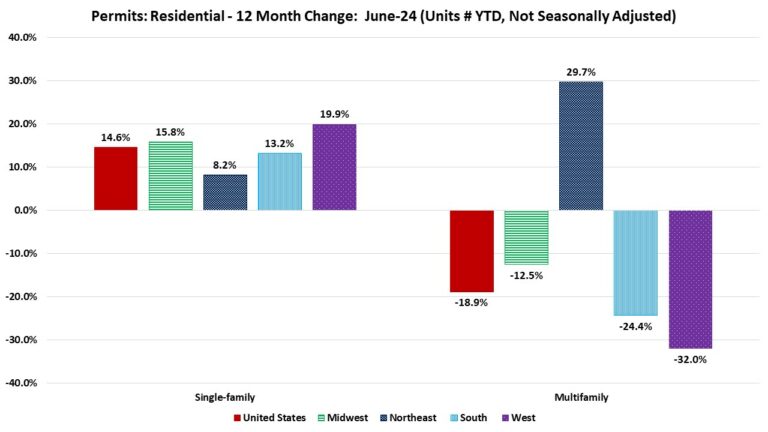
Over the first half of 2024, the total number of single-family permits issued year-to-date (YTD) nationwide reached 514,728. On a year-over-year (YoY) basis, this is an increase of 14.6% over the June 2023 level of 449,226.

Year-to-date ending in June, single-family permits were up in all four regions. The range of permit increases spanned 19.9% in the West to 8.2% in the Northeast. The Midwest was up by 15.8% and the South was up by 13.2% in single-family permits during this time. For multifamily permits, three out of the four regions posted declines. The Northeast, the only region to post an increase, was up by 29.7%. Meanwhile the West posted a decline of 32.0%, the South declined by 24.4%, and the Midwest declined by 12.5%.

Between June 2024 YTD and June 2023 YTD, 47 states posted an increase in single-family permits. The range of increases spanned 44.3% in Arizona to 3.0% in Alaska. Rhode Island (-0.3%), New Hampshire (-1.3%), Hawaii (-6.8%), and the District of Columbia (-9.0%) reported declines in single-family permits.The ten states issuing the highest number of single-family permits combined accounted for 64.2% of the total single-family permits issued. Texas, the state with the highest number of single-family permits, issued 84,920 permits over the first half of 2024, which is an increase of 18.2% compared to the same period last year. The succeeding highest state, Florida, was up by 9.2%, while the third highest, North Carolina, posted an increase of 10.6%.

Year-to-date ending in June, the total number of multifamily permits issued nationwide reached 237,935. This is 18.9% below the June 2023 level of 293,301.

Between June 2024 YTD and June 2023 YTD, 19 states recorded growth in multifamily permits, while 31 states and the District of Columbia recorded a decline. New York (+109.8%) led the way with a sharp rise in multifamily permits from 8,943 to 18,761, while the District of Columbia had the biggest decline of 71.0% from 1,677 to 487. The ten states issuing the highest number of multifamily permits combined accounted for 64.3% of the multifamily permits issued. Over the first half of 2024, Texas, the state with the highest number of multifamily permits issued, experienced a decline of 35.2%. Following closely, the second-highest state in multifamily permits, Florida, saw a decline of 24.1%. California, the third largest multifamily issuing state, decreased by 29.8%.

At the local level, below are the top ten metro areas that issued the highest number of single-family permits.

For multifamily permits, below are the top ten local areas that issued the highest number of permits.

Discover more from Eye On Housing

Subscribe to get the latest posts sent to your email.



This article was originally published by a eyeonhousing.org . Read the Original article here. .

Pin It