Tag

Gains

Browsing


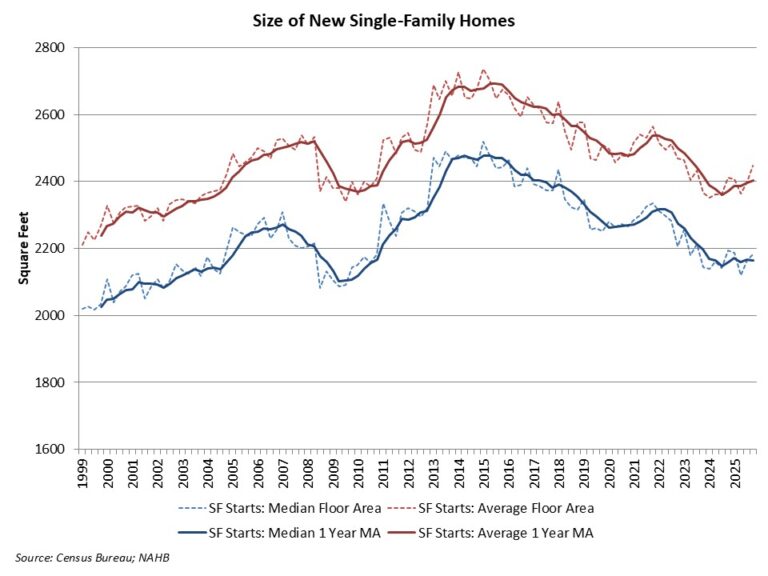
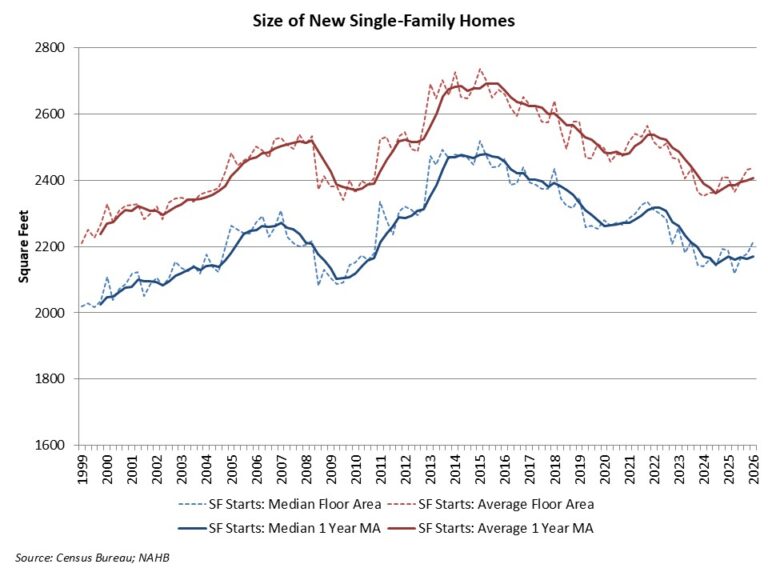
New single-family home size had been falling since 2015 in response to declining affordability conditions. An exception occurred in 2021, when new home size increased as interest rates reached historic lows. However, as mortgage interest rates increased in 2022 and 2023 and affordability worsened, demand shifted back toward smaller homes. More recent data suggest these trends have stabilized, although that reversal is likely due to weakness for the starter-home market.

According to first quarter 2026 data from the Census Quarterly Starts and Completions by Purpose and Design and NAHB analysis, median single-family square floor area was 2,211 square feet, effectively unchanged from the start of the year but up more than 3% over the past two years. Average (mean) square footage for new single-family homes registered at 2,436 square feet, a small increase year-over-year.

On a one-year moving average basis, the average size of a new single-family home was increased slightly to 2,408 square feet, while the median size increased to 2,169 square feet.

Home size trends in 2026 are likely to post continued small gains, driven by relative strength at the high end of the market but constrained by housing affordability challenges.


This article was originally published by a eyeonhousing.org . Read the Original article here. .


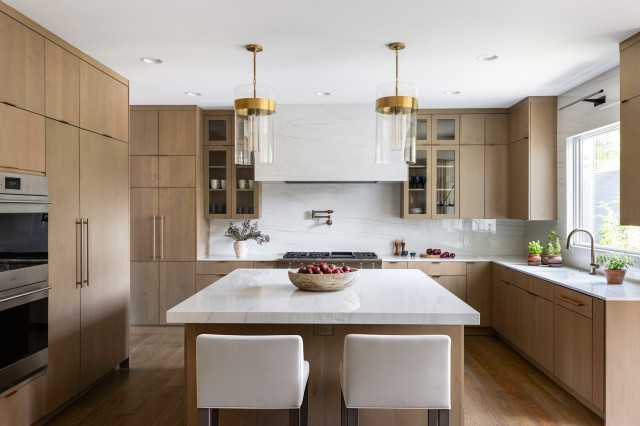
After purchasing a classic 1940s bungalow stripped of its original charm, these Seattle parents of two young boys turned to interior designer Jessica Nelson to restore it. Their goal was to reintroduce character through architectural details while keeping the home modest and family-friendly. The warm, cozy interiors were inspired by the front porch entrance’s custom white-painted wood lattice trellis structure, joined at the top in an arch and with jasmine vines beginning to grow.

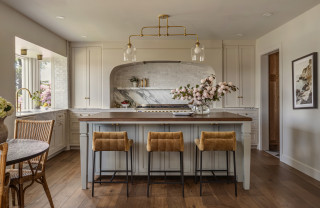
One of the primary objectives was establishing a kitchen that could transition effortlessly from busy school mornings to intimate dinner parties. At just 90 square feet, the original galley kitchen was cramped and inefficient. Nelson reimagined the floor plan, converting that space into a butler’s pantry and moving the kitchen to the back of the house to capture views of evergreen trees, Lake Washington and Husky Stadium.


This article was originally published by a www.houzz.com . Read the Original article here. .


Profitability for residential remodelers reached its highest level in more than two decades in 2024. Industry-wide profit benchmarks are important because they allow companies to evaluate their financial performance in context with the industry. Doing so can guide resource allocation, budgeting, and target setting for costs and expense lines, leading to a more successful business strategy. This post summarizes the results from NAHB’s most recent edition of the Remodelers’ Cost of Doing Business Study.

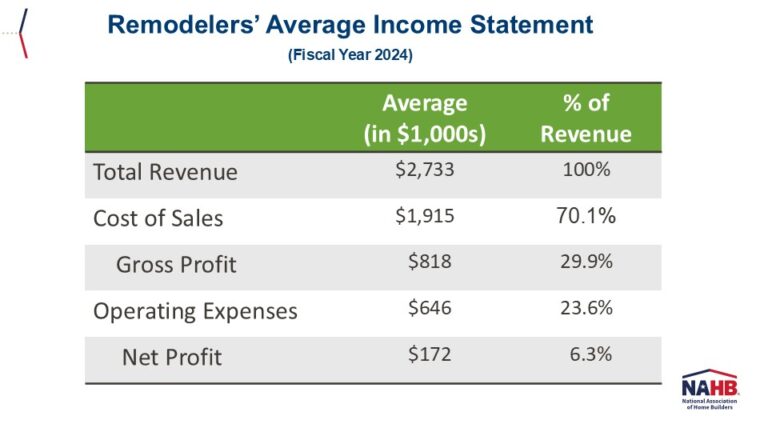
On average, residential remodelers reported $2.7 million in total revenue for fiscal year 2024. Of that, about $1.9 million (70.1%) was spent on cost of sales (i.e., labor, materials, contractors), which translates into an average gross profit margin of 29.9%. Operating expenses (i.e., indirect construction costs, finance, S&M, G&A, and owner’s compensation) cost remodelers an average of $646,000 (23.6% of revenue), leaving them with an average net profit margin of 6.3%. 

Remodelers’ 29.9% average gross profit margin in 2024 was a solid five percentage points higher than in 2021, when the metric sank to a record low of 24.9%. The improvement was due in large part to a significant reduction in trade contractor costs, which dropped from 36% of revenue in 2021 to 30% in 2024. The average gross margin in 2024 (29.9%) marked a return to gross profitability levels at par with 2018 (30.1%).

Successfully reducing their costs of sales improved remodelers’ bottom line. In 2024, their average net profit margin (6.3%) was higher than in 2021 (4.7%) and 2018 (5.2%). It was also the highest net margin reported by remodelers since 1996 (6.8%).

The Cost of Doing Business Study also tracks residential remodelers’ balance sheets. On average, they reported $668,000 in total assets on their 2024 balance sheets. Of that, $331,000 (50%) was financed by liabilities (either short- or long-term) and the other $337,000 (50%) by equity builders held in their companies.

Historical data show remodelers’ balance sheets expanded significantly in 2024, with average total assets ($668,000) up 34% compared to 2021 ($497,000). But perhaps more important than fluctuations in the nominal size of their balance sheets, the data clearly point to remodelers deleveraging their businesses in the last decade. In 2015, 68% of remodelers’ assets were financed through debt. By 2021, that share was down to 49%, where it remained essentially unchanged in 2024 (50%). Logically, the latter means remodelers are using more of their own capital to run their companies, as illustrated by their equity share rising from 33% in 2015 to 50% in 2024.

More specific data about remodelers’ various cost of sales lines (e.g., the share of revenue spent on materials), operating expenses (e.g., how much owners were paid as compensation), or types of assets (e.g., cash) are available in the official publication of the 2026 Remodelers’ Cost of Doing Business Study.


This article was originally published by a eyeonhousing.org . Read the Original article here. .


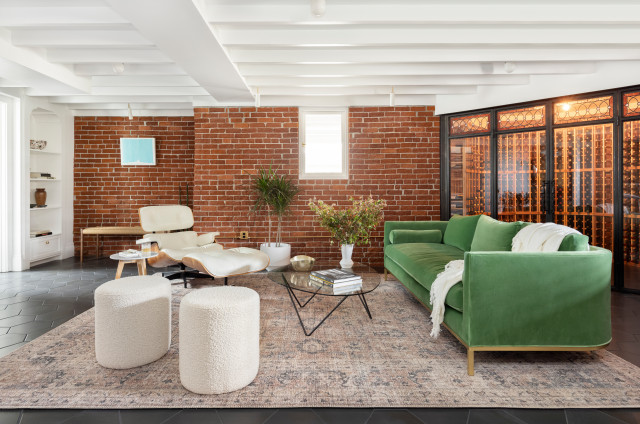
This Portland, Oregon, couple wanted to transform the basement of their historic home into a special place for entertaining. As parents in a blended family with three kids, they envisioned an adult-oriented retreat with a lounge, a home office, storage for their large wine collection and a bar for serving it when hosting friends.

After beginning construction with a contractor, they realized they needed more professional design help than they had anticipated. They initially hired Workaday Architects for a consultation on layout ideas, but the meeting inspired them to bring the firm on to design the entire project. The scope expanded to include built-ins, new stairs, a wine room, a powder room, the bar, lighting and more. The finished design balances the historic architecture of the home with the couple’s favorite midcentury pieces, meaningful artwork and modern updates.


This article was originally published by a www.houzz.com . Read the Original article here. .


New single-family home size had been falling since 2015 in response to declining affordability conditions. An exception occurred in 2021, when new home size increased as interest rates reached historic lows. However, as mortgage interest rates increased in 2022 and 2023 and affordability worsened, demand shifted back toward smaller homes.

More recent data suggest these trends have stabilized amid modest affordability improvements. According to fourth quarter 2025 data from the Census Quarterly Starts and Completions by Purpose and Design and NAHB analysis, median single-family square floor area was 2,183 square feet, effectively unchanged from the start of the year. Average (mean) square footage for new single-family homes registered at 2,447 square feet, a small increase.

On a one-year moving average basis, the average size of a new single-family home was essentially unchanged at 2,404 square feet, while the median size remained stable at 2,163 square feet.

Home size trends in 2026 are likely to remain relatively flat, reflecting crosswinds from housing affordability constraints and elevated construction costs.


This article was originally published by a eyeonhousing.org . Read the Original article here. .


Before Photo

WINN Design+BuildSave Photo

“After” photos by Sarah Pitterle Maldonado of Nova Soul Imagery

Kitchen at a Glance
Who lives here: A family
Location: Vienna, Virginia
Size: 256 square feet (24 square meters)
Designer-builder: Winn Design + Build

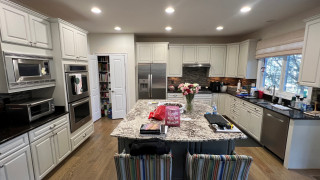
Before: Heavy traditional-style white cabinets stopped short of the ceiling and didn’t provide the storage the family needed. An abundance of stainless steel appliances overwhelmed the room, while a dated, busy tile backsplash created visual clutter. Dark granite countertops along the perimeter and a lighter granite on the island also felt out of step with the homeowners’ goals. They did want to keep the white oak flooring and have it refinished. “It continues into adjacent rooms,” says design-build pro Michael Winn.

The sink on the right and the rangetop on the back wall worked well but the left wall felt disjointed. A cramped grouping of wall ovens, a hulking microwave and a toaster oven sitting on the countertop crowded an awkward run of cabinetry. “They also had a workstation there that ends up for most people being a gathering space for papers,” Winn says. “We did away with that and cleaned things up.”

The large stainless steel refrigerator also made the cooking area feel tight. “To the left of that was the pantry closet,” Winn says. “It was a step-in pantry that simply consisted of deep shelves, so things would get lost in the back.”


This article was originally published by a
www.houzz.com . Read the Original article here. .


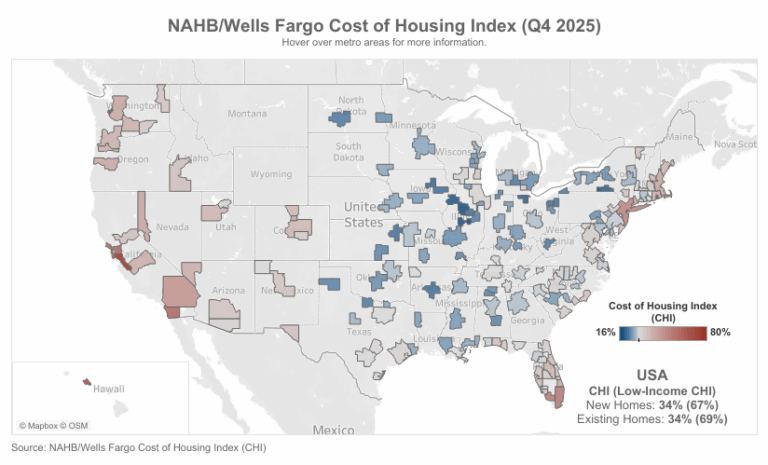
Though new and existing homes remain largely unaffordable, the needle moved slightly in the right direction in the second half of 2025, according to the latest data from the National Association of Home Builders (NAHB)/Wells Fargo Cost of Housing Index (CHI). The CHI results from the fourth quarter of 2025 show that a family earning the nation’s median income of $104,200 needed 34% of its income to cover the mortgage payment on a median-priced new home. Low-income families, defined as those earning only 50% of median income, would have to spend 67% of their earnings to pay for the same new home.

In the last three quarters of 2025, the income share needed to buy a new home declined from 36% in the second quarter, to 35% in the third quarter and 34% in the final quarter of 2025. These figures indicate a slight improvement in affordability.

The same trend holds true for existing homes. A typical family would have to pay 37% of their income for a median-priced existing home in the second quarter, 36% in the third quarter and 34% in the final three months of 2025. A low-income family would need to pay 69% of their earnings to make the same mortgage payment on an existing home in the fourth quarter.

The U.S. data for the percentage of earnings needed to purchase a new home in the fourth quarter is based on a national median new home price of $405,300 and median income of $104,200. The fourth quarter median new home price is down 1.2% from $410,100 in the third quarter. The corresponding price for an existing home in the fourth quarter fell to $414,900, 2.8% down from $426,800 in the previous quarter. The average 30-year mortgage rate moved lower from 6.65% in the third quarter to 6.32% in the fourth quarter.

CHI is also available for 175 metropolitan areas, calculating the percentage of a family’s income needed to make the mortgage payment on an existing home based on the local median home price and median income in those markets.

In eight out of 175 markets in the fourth quarter, the typical family is severely cost-burdened (must pay more than 50% of their income on a median-priced existing home). In 69 other markets, such families are cost-burdened (need to pay between 31% and 50%). There are 98 markets where the CHI is 30% of earnings or lower.

The Top 5 Severely Cost-Burdened Markets

San Jose-Sunnyvale-Santa Clara, Calif., was the most severely cost-burdened market in the CHI, where 80% of a typical family’s income is needed to make a mortgage payment on an existing home. This was followed by:

Urban Honolulu, Hawaii (69%)

San Francisco-Oakland-Fremont, Calif. (63%)

San Diego-Chula Vista-Carlsbad, Calif. (62%)

Barnstable Town, Mass. (56%)

Miami-Fort Lauderdale-West Palm Beach, Fla. (56%)

Naples-Marco Island, Fla. (56%)

Low-income families would have to pay between 111% and 159% of their income in all seven of the above markets to cover a mortgage.

The Top 5 Least Cost-Burdened Markets

By contrast, many of the least cost-burdened markets were located in Illinois. In the top five least cost-burdened markets, typical families needed to spend just 16-18% of their income to pay for a mortgage on an existing home. These markets are:

Decatur, Ill. (16%)

Elmira, N.Y. (16%)

Springfield, Ill. (17%)

Peoria, Ill. (17%)

Davenport-Moline-Rock Island, Iowa-Ill. (18%)

Low-income families in these markets would have to pay between 32% and 36% of their income to cover the mortgage payment for a median-priced existing home.

Visit nahb.org/chi for tables and details.


This article was originally published by a eyeonhousing.org . Read the Original article here. .


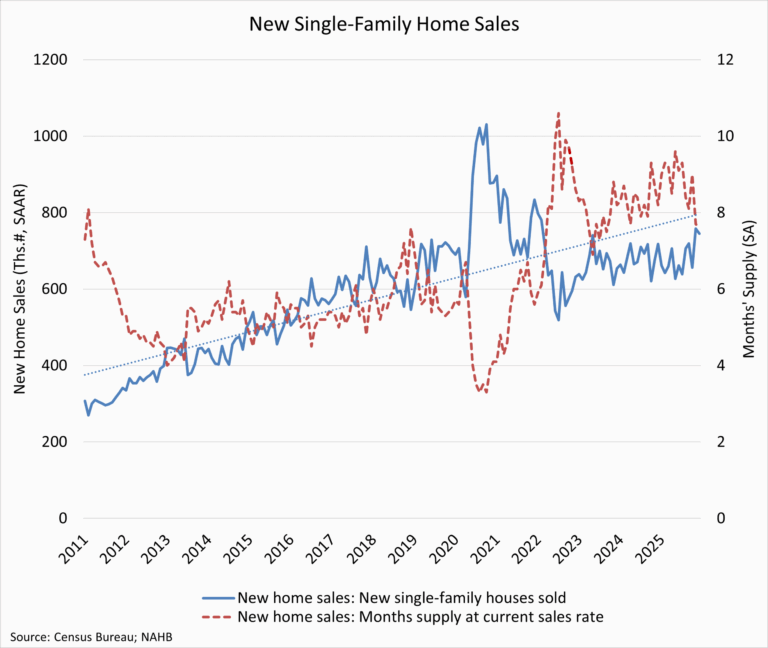
New home sales ended 2025 on a mixed but resilient note, signaling steady underlying demand despite ongoing affordability and supply constraints. The latest data released today (and delayed because of the government shutdown in fall of 2025) indicate that while month-to-month activity shows a small decline, sales remain stronger than a year ago, signaling that buyer interest in newly built homes has improved. The December NAHB/Wells Fargo Housing Market Index showed that 67 percent of builders used sales incentives, the highest percentage post-COVID. Builders offered an average home price reduction of 5 percent during December.

Sales of newly built single-family homes declined 1.7 percent month-over-month in December to a seasonally adjusted annual rate of 745,000 units, according to the U.S. Department of Housing and Urban Development and the U.S. Census Bureau. This represented a 3.8 percent year-over-year increase. An estimated 679,000 homes were sold in 2025, down 1.1 percent from the 2024 rate of 686,000. A new home sale is recorded when a contract is signed or a deposit is accepted, regardless of the stage of construction. The seasonally adjusted annual rate reflects the pace of sales that would occur over a 12-month period if current conditions persisted.

New single-family home inventory totaled 472,000 units in December, 2.7 percent lower than the prior month, and 3.5 percent lower than a year earlier. At the current sales pace, the months’ supply of new homes stood at 7.6 months, down from 8.2 months one year ago, though still above the six-month level that is generally considered balanced.

Combined new and existing home inventory has edged lower in recent months, with total months’ supply declining to 4.0, reflecting slower construction activity. Meanwhile, inventory conditions in the existing home market have retreated after making gradual improvement in prior months. Moderating prices across both markets have helped support buyer demand amid ongoing affordability concerns.

By the end of 2025, there were 128,000 completed, ready-to-occupy homes available for sale on a non-seasonally adjusted basis, up 8.5 percent from a year earlier. Completed homes accounted for a little more than a quarter of the total inventory, while homes under construction made up 51 percent. The remaining 22 percent of homes sold in December had not yet started construction at the time the sales contract was signed.

Home prices showed further signs of easing in 2025. The median new home sale price declined 1.3 percent to $415,000 from $420,300 in 2024. Affordability improved at the lower end of the market, with 20 percent of new homes priced below $300,000. Thirty-four percent of homes were priced above $500,000, while the remaining 46 percent fell within the $300,000 to $500,000 range.

Regionally, year-to-year new home sales were up 1.7 percent in the Midwest and 0.4 percent in the South but declined 4.9 percent in the West and 7.7 percent in the Northeast.


This article was originally published by a eyeonhousing.org . Read the Original article here. .


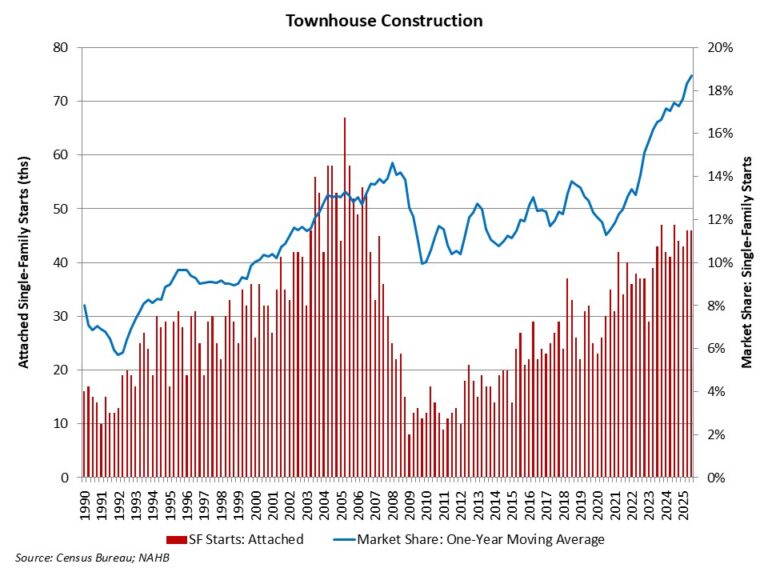
Townhouse construction gained single-family construction market share during the third quarter of 2025.

According to NAHB analysis of the most recent Census data of Starts and Completions by Purpose and Design, during the third quarter of 2025, single-family attached starts totaled 46,000. Over the last four quarters, townhouse construction starts totaled a strong 179,000 homes, which is 1% higher than the prior four-quarter period (177,000). Townhouses made almost 20% all of single-family housing starts for the third quarter of the year.

Using a one-year moving average, the market share of newly-built townhouses stood at 18.7% of all single-family starts for the third quarter. With gains over the last year, the four-quarter moving average market share is the highest on record, for data going back to 1985.

Prior to the current cycle, the peak market share of the last two decades for townhouse construction was set during the first quarter of 2008, when the percentage reached 14.6% on a one-year moving average basis. This high point was set after a fairly consistent increase in the share beginning in the early 1990s.

The long-run prospects for townhouse construction are positive given growing numbers of homebuyers looking for medium-density residential neighborhoods, such as urban villages that offer walkable environments and other amenities. Where it can be zoned, it can be built.


This article was originally published by a eyeonhousing.org . Read the Original article here. .


Clarke-Bishop InteriorsSave Photo
After: The large skylight brings a better quality of light into the room. Doing away with the slanted glazing has also freed up more wall space for a bigger cabinet.

While Clarke-Bishop has reduced the amount of black in the room, she’s also banished most of the white to make the kitchen feel warmer and more inviting.

“At first we were trying to do a pink kitchen, but we couldn’t find a shade that would work in this light — everything either looked too sugary or too dirty,” she says. They settled on a very pale but warm gray.

The walls, meanwhile, are a subtle pinkish-white. “It brings warmth into the room without being an overt color,” Clarke-Bishop says.

The client loves black, so Clarke-Bishop has retained some, designing a black island that echoes the existing range. The island is on legs. “It not being solid allows more light to come through and gives it a bit more airiness,” she says.

The island isn’t huge — 64½ inches long by 35½ inches wide by 32 inches deep — but it’s perfect for the homeowners. “They really didn’t want any appliances in the island. They wanted it to be a standalone” countertop, Clarke-Bishop says. “It’s become a real focal point of the kitchen — everyone stands around it chatting.”

The legs are a modern take on a Victorian turned leg. “I researched lots of Victorian table legs to find a good combination of the detail they needed to add a bit of something to the space without it being overly ornate, because everything’s quite simple and calm in the room,” Clarke-Bishop says.

The countertop is Arabescato marble, which has a hint of pink in it. The remaining countertops are a simple, lightly marbled quartz, “just to allow the island to have a shining moment.”

The refrigerator sits behind the far-left door, with a pantry in the right-hand tall cabinet.

Cabinet paint: Strong White; island paint: Pitch Black, both Farrow & Ball; wall paint: Rose Tinted White, Edward Bulmer


This article was originally published by a
www.houzz.com . Read the Original article here. .

Pin It