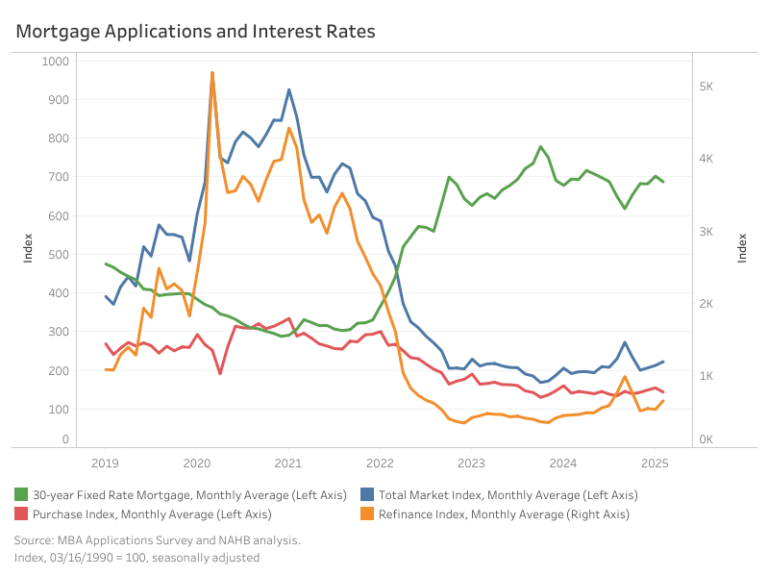
The Market Composite Index, a measure of mortgage loan application volume from the Mortgage Bankers Association’s (MBA) weekly survey, rose 4.7% month-over-month on a seasonally adjusted (SA) basis, primarily driven by refinancing activity. Compared to February last year, the index is 15.6% higher.
The Purchase Index declined 6.5% (SA) from the previous month, though it may rebound as mortgage rates continue to fall amid weakening consumer sentiment and growing economic concerns. Meanwhile, the Refinance Index surged 22.7% (SA). Compared to February last year, purchase applications are marginally higher by 2.1%, while refinance activity has jumped 43.7%.
The average 30-year fixed rate mortgage reported in the MBA survey for February fell 15 basis points (bps) to 6.9% (index level 687), 7 bps lower than a year ago.
Loan sizes also increased with the average total market loan size (purchases and refinances combined) rising by 4.4% on a non-seasonally adjusted (NSA) basis from January to $389,500. For purchase loans, the average size increased by 3.93% to $446,000, while refinance loans experienced a 6.1% increase, reaching an average of $305,800. Adjustable-rate mortgages (ARMs) saw a jump in average loan size of 5.9% from $1.07 million to $1.13 million.
Discover more from Eye On Housing
Subscribe to get the latest posts sent to your email.
This article was originally published by a eyeonhousing.org . Read the Original article here. .



1. Rotate your mattress. Before you put on a fresh set of sheets, take an extra minute to rotate the mattress if you haven’t done so recently. Rotating your mattress every few months will help it wear more evenly and extend its life (and comfort).
2. Pack up a bag of old sheets and towels to donate. If you bought new sheets or towels during January white sales, make some room by letting go of an old set or two. Homeless shelters and some churches will accept donations of bedding and towels in good condition, and animal shelters are often in need of towels. Really worn linens can be cut up and used as rags or dropped in a textile recycling bin.
Find a contractor on Houzz