Tag

Eye

Browsing


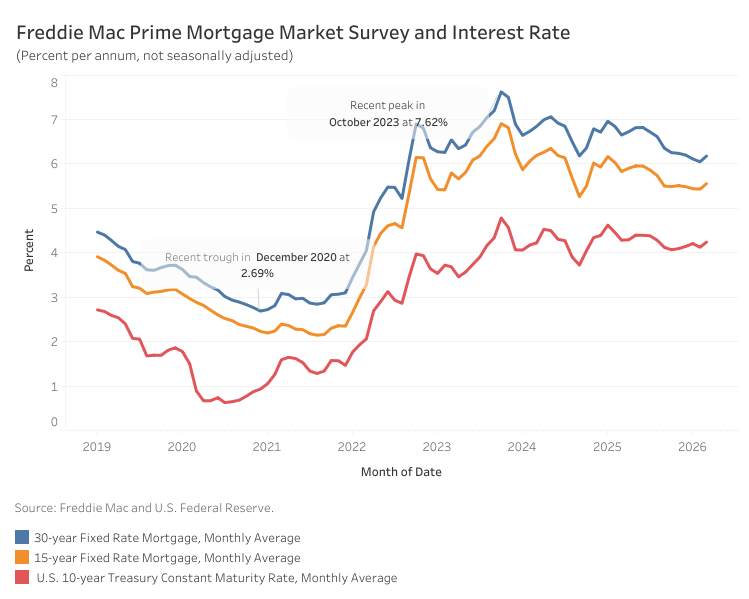
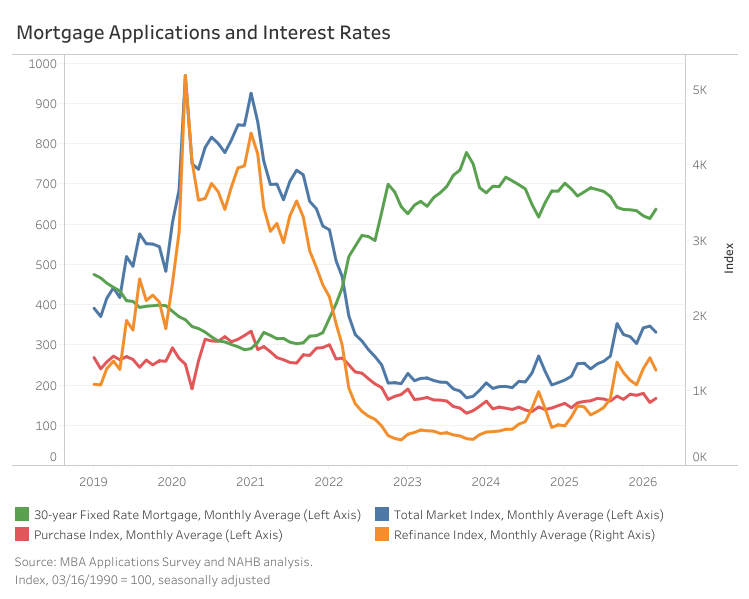
Housing affordability remains a critical challenge nationwide, and mortgage rates continue to play a central role in shaping homebuying power. Although rates have declined from the recent peak of about 7.6% in 2023 to around 6.01% as of February 19,2026, they remain elevated relative to typical levels in the 2010s. During that decade, mortgage rates generally ranged between 4% and 5%. They also remain well above the historic lows reached during the pandemic. Even modest declines in mortgage rates can have a significant impact on housing affordability, pricing more households back into the market. New NAHB Priced-Out Estimates illustrate how changes in interest rates affect the number of households that can afford a median-priced new home.

At the beginning of 2026, with the average 30-year fixed mortgage rate at 6.25%, around 31.5 million households could afford a median-priced new home at $413,595. This requires a household income of $124,336 by the front-end underwriting standards. A modest 25 basis-point rate reduction from 6.25% to 6% would lower the qualifying income threshold sufficiently to allow 1.42 million additional households to afford a median-priced new home in 2026.

This sizable affordability response reflects the underlying distribution of U.S. household incomes. Household incomes are heavily concentrated in the middle of the distribution, with many households near key affordability thresholds. Approximately 79.8 million households earn less than $105,880, and an additional 14 million households earn between $105,881 and $132,350. When mortgage rates decline, the qualifying minimum income shifts downward into these densely populated income ranges, bringing a substantial number of households into the market.

In contrast, an equivalent 25 basis-point cut at higher interest rate levels has a smaller impact on affordability. For example, a decline from 7.75% to 7.5% would only price around 1 million households into the market. At higher rate levels, fewer households remain near the margin of qualification.

Overall, the estimates demonstrate that modest mortgage rate relief at current levels can translate into significant gains in housing affordability, highlighting the importance of mortgage interest rates for prospective homebuyers and the housing market.


This article was originally published by a eyeonhousing.org . Read the Original article here. .


New home sales ended 2025 on a mixed but resilient note, signaling steady underlying demand despite ongoing affordability and supply constraints. The latest data released today (and delayed because of the government shutdown in fall of 2025) indicate that while month-to-month activity shows a small decline, sales remain stronger than a year ago, signaling that buyer interest in newly built homes has improved. The December NAHB/Wells Fargo Housing Market Index showed that 67 percent of builders used sales incentives, the highest percentage post-COVID. Builders offered an average home price reduction of 5 percent during December.

Sales of newly built single-family homes declined 1.7 percent month-over-month in December to a seasonally adjusted annual rate of 745,000 units, according to the U.S. Department of Housing and Urban Development and the U.S. Census Bureau. This represented a 3.8 percent year-over-year increase. An estimated 679,000 homes were sold in 2025, down 1.1 percent from the 2024 rate of 686,000. A new home sale is recorded when a contract is signed or a deposit is accepted, regardless of the stage of construction. The seasonally adjusted annual rate reflects the pace of sales that would occur over a 12-month period if current conditions persisted.

New single-family home inventory totaled 472,000 units in December, 2.7 percent lower than the prior month, and 3.5 percent lower than a year earlier. At the current sales pace, the months’ supply of new homes stood at 7.6 months, down from 8.2 months one year ago, though still above the six-month level that is generally considered balanced.

Combined new and existing home inventory has edged lower in recent months, with total months’ supply declining to 4.0, reflecting slower construction activity. Meanwhile, inventory conditions in the existing home market have retreated after making gradual improvement in prior months. Moderating prices across both markets have helped support buyer demand amid ongoing affordability concerns.

By the end of 2025, there were 128,000 completed, ready-to-occupy homes available for sale on a non-seasonally adjusted basis, up 8.5 percent from a year earlier. Completed homes accounted for a little more than a quarter of the total inventory, while homes under construction made up 51 percent. The remaining 22 percent of homes sold in December had not yet started construction at the time the sales contract was signed.

Home prices showed further signs of easing in 2025. The median new home sale price declined 1.3 percent to $415,000 from $420,300 in 2024. Affordability improved at the lower end of the market, with 20 percent of new homes priced below $300,000. Thirty-four percent of homes were priced above $500,000, while the remaining 46 percent fell within the $300,000 to $500,000 range.

Regionally, year-to-year new home sales were up 1.7 percent in the Midwest and 0.4 percent in the South but declined 4.9 percent in the West and 7.7 percent in the Northeast.


This article was originally published by a eyeonhousing.org . Read the Original article here. .


Real GDP growth slowed sharply in the fourth quarter of 2025 as the historic government shutdown weighed on economic activity. While consumer spending continued to drive growth, federal government spending subtracted over a full percentage point from overall growth.

According to the “advance” estimate released by the Bureau of Economic Analysis (BEA), real gross domestic product (GDP) expanded at an annual rate of 1.4% in the final quarter of 2025, a notable deceleration from a 4.4% increase in the third quarter. This growth rate was below the NAHB forecast for the quarter.

Furthermore, the latest data from the GDP report indicates that inflationary pressures intensified over the quarter. The price index for gross domestic purchases rose 3.7%, up from a 3.4% increase in the third quarter of 2025. The Personal Consumption Expenditures Price (PCE) Index, which measures inflation (or deflation) across various consumer expenses and reflects changes in consumer behavior, increased 2.9% in the fourth quarter. This is slightly higher than a 2.8% rise in the previous quarter.

For the full year, real GDP grew 2.2% in 2025. It marks a slowdown from the 2.8% increase in 2024 and stands as the weakest annual growth rate since the pandemic. The annual gain matched NAHB’s forecast and primarily reflected continued strength in consumer spending and gains in investment.

Breaking down the fourth-quarter data further, the increase in real GDP primarily reflected increases in consumer spending and investment, partially offset by decreases in government spending and exports. Imports, which are a subtraction in the calculation of GDP, decreased during the quarter as tariffs had measurable effects.

Consumer spending, the backbone of the U.S. economy, rose at an annual rate of 2.4% in the fourth quarter, the slowest pace since the first quarter of 2025. Spending on services remained solid, increasing at a 3.4% annual rate, while spending on goods edged down 0.1%.

Gross private domestic investment added 0.66 percentage points to headline GDP growth in the fourth quarter. The gain in investment was primarily driven by increases in intellectual property products, private inventory investment, and equipment spending.

Government spending fell, reflecting the effects of a prolonged federal government shutdown. 

Nonresidential fixed investment increased 3.7% in the fourth quarter. The increases in equipment (+3.2%) and intellectual property products (+7.4%) offset the decrease in structures (-2.4%). Meanwhile, residential fixed investment (RFI) declined 1.6% in the fourth quarter, marking the fourth consecutive quarterly decline. Within the residential category, single-family permanent site structures fell 5.2% at an annual rate, multifamily permanent site structures declined 3.6%, and spending on home improvements dropped 3.2%.

For the common BEA terms and definitions, please access bea.gov/Help/Glossary.


This article was originally published by a eyeonhousing.org . Read the Original article here. .


Delinquent consumer loans have steadily increased as pandemic distortions fade, returning broadly to pre-pandemic levels. According to the latest Quarterly Report on Household Debt and Credit from the Federal Reserve Bank of New York, 4.8% of outstanding household debt was delinquent at the end of 2025, 0.3 percentage points higher than the third quarter of 2025 and 1.2% higher from year-end 2024.

This increase reflects a normalization period coming out of the pandemic, when delinquency rates were suppressed by payment forbearance and fiscal support. As these government assistance programs ended and credit reporting normalized, delinquency rates rose steadily and are now on par with pre-pandemic levels.

While aggregate delinquency has normalized, transitions into serious delinquency (defined as 90+ days past due) show diverging patterns across loan types. Student loans and credit cards stand out as having significantly higher inflows into serious delinquency than before the pandemic, while mortgages, HELOC and auto loan transitions remain comparatively stable.

Late student loan payments saw a sharp rise in early 2025, and by the fourth quarter of 2025, 16.2% of student loan balances became seriously delinquent over the past year. This surge reflects the re-entering of delinquent balances into credit reports following a nearly 5-year pause due to the pandemic. Credit cards, on the other hand, show signs of deterioration with new seriously delinquent balances rapidly rising mid-2022 before moderating around 7% in recent years. In the fourth quarter of 2025, about 7.1% of credit card balances transitioned into serious delinquency over the past year, a rate comparable to levels observed during the early stages of the Great Recession.

Mortgage transitions into serious delinquency remain low at around 1.4% annually, despite edging higher in recent years and are currently slightly higher than pre-pandemic levels. In a further analysis on the credit report data from Equifax, the deterioration is concentrated among borrowers living in lower-income zip codes, where serious mortgage delinquency rates for this group of borrowers have reached roughly 3.0% by late 2025.

Comparing delinquency transitions with the overall balance of seriously delinquent loans provides a clearer understanding of current credit conditions. Credit cards display a concerning trend in which both transition rate and overall balance of seriously delinquent loan balances are rising. For example, the share of credit card balances 90+ days past due is only about one percentage point below its post-great recession peak in 2010 at 12.7%, which seems to suggest persistent issues in repayment by borrowers.

Mortgages show the opposite dynamic, whereby the balance of seriously delinquent mortgages has remained stable despite a steady increase in transitions into serious delinquency. This divergence indicates higher recovery rates or shorter delinquency periods, an implication that mortgage borrowers prioritize meeting their mortgage payments which would be rational if borrowers had locked in historic low mortgage rates and have built up sufficient home equity.

While it is too early to determine if elevated transition rates will translate into increasing seriously delinquent student loan balances, this rate remains high at 9.6% at the end of 2025. Furthermore, the credit scores of student loan borrowers that improved during the student loan payment pause, will now be affected and could weigh on borrowers’ demand or ability to access other forms of credit, especially in an environment of tighter labor markets.


This article was originally published by a eyeonhousing.org . Read the Original article here. .


Despite a strong finish in December, single-family home building dipped in 2025 as persistent affordability challenges continued to weigh on the market.

Total housing starts for 2025 were 1.36 million, down 0.6% from the 1.37 million total in 2024. Single-family starts in 2025 totaled 943,000, down 6.9% from the previous year. Multifamily starts ended the year up 17.4% compared with 2024.

Overall housing starts increased 6.2% in December to a seasonally adjusted annual rate of 1.40 million units, according to a report from the U.S. Department of Housing and Urban Development and the U.S. Census Bureau. This pace reflects the number of housing units builders would begin over the next 12 months if December’s activity were sustained.

Within this overall number, single-family starts rose 4.1% to a seasonally adjusted annual rate of 981,000 units. This is the highest rate since February 2025. The multifamily sector, which includes apartment buildings and condos, increased 11.3% to a 423,000-unit pace.

Looking at regional housing starts for 2025, combined single-family and multifamily starts were 8.7% higher in the Northeast, 7.2% higher in the Midwest, 4.0% lower in the South, and 0.8% lower in the West.

Overall permits rose 4.3% to a 1.45 million annualized rate in December but were down 2.2% compared with December 2024. Single-family permits declined 1.7% to an 881,000-unit rate and were 10.9% lower than a year earlier. Multifamily permits increased 15.2% to a 567,000-unit pace.

Total permits for 2025 were 1.43 million, a 3.6% decline from the 1.48 million total in 2024. Single-family permits in 2025 totaled 909,600, down 7.4% from the previous year.

Looking at regional permit data for 2025, total permits were 7.7% lower in the Northeast, 3.0% higher in the Midwest, 5.2% lower in the South, and 1.9% lower in the West.

The total number of housing units under construction stood at 1.3 million in December, down 10.5% from a year earlier. Single-family homes under construction fell to 587,000 units, an 8.4% year-over-year decline and the lowest level since November 2020. Multifamily units under construction declined to 690,000, down 12.2% from a year earlier and well below the peak of more than 1 million units reached in December 2023.


This article was originally published by a eyeonhousing.org . Read the Original article here. .


The NAHB 2026 priced-out estimates show that the housing affordability challenge is widespread across the country. In 39 states and the District of Columbia, over 65% of households are priced out of the median-priced new home market. This indicates a significant disconnect between higher new home prices, elevated mortgage rates, and household incomes.

New Hampshire stands out as the state with the highest share of households (83.4%) unable to afford the state’s median new home price of $677,982. High-cost states such as Hawaii and Maine follow closely, with 83% and 82.7% of households, respectively, struggling to afford new homes.

Even in states with relatively lower median new home prices, affordability remains a major concern. For example, in Mississippi, where the median home price is $266,837, 61.1% of households still find these new homes out of reach. Meanwhile, Delaware, the state with better affordability in the analysis, has a median new home price of $373,666, and even there, around 56% of households still struggle to afford a new home. Even modest price increases, such as an additional $1,000, could push thousands more households from affording these median priced new homes. For instance, in Texas, such an increase could price out over 14,365 households.

Affordability patterns also vary significantly across metropolitan areas. In high-cost areas like the San Jose-Sunnyvale-Santa Clara, CA metro area, where new homes largely target high-income Silicon Valley residents, only 14% of all households meet the minimum income threshold of $407,659 required to qualify for a loan on a median-priced new home. In contrast, in more affordable metro areas like Rome, GA, where the median new home price is $107,567, more than three-quarters of households can afford a median-priced new home. While higher home prices generally result in higher monthly mortgage payments and higher income thresholds, the relationship between home prices and affordability is not always linear. Factors like property taxes and insurance payments can also significantly impact monthly housing costs, adding complexity to affordability calculations.

The affordability of new homes, together with the population size of a metro area, significantly influences the priced-out impact of a $1,000 increase in new home prices. In metro areas where new homes are already unaffordable to most households, the effect of such an increase tends to be small. For instance, in the San Jose-Sunnyvale-Santa Clara, CA metro area, an additional $1,000 increase to the home price affects only 273 households, as only 14% of all households could afford such expensive new homes in the first place. Here, the additional price increase only affects a narrow share of high-income households at the upper end of the income distribution, where affordability is already stretched.

In contrast, metro areas, where new homes are more broadly affordable, experience a larger priced-out effect. A $1,000 increase in the median new home price affects a larger share of households in the “thicker part” of the income distribution. For example, in the New York-Newark-Jersey City, NY-NJ Metro Area metro area, a $1,000 increase in new home price would disqualify 4,028 households from affording a median-priced new home. This is the largest priced-out effect among all metro areas, driven by a substantial population base.

Detailed priced-out estimates for every state and more than 300 metro areas are available in the interactive dashboard below.


This article was originally published by a eyeonhousing.org . Read the Original article here. .


Builder confidence in the market for newly built single-family homes fell one point to 36 in February, according to the National Association of Home Builders (NAHB)/Wells Fargo Housing Market Index (HMI).

Persistent affordability challenges, including high housing price-to-income ratios and elevated land and construction costs, helped push builder confidence lower for the second straight month to start the year.

Housing affordability remains an ongoing challenge at the start of 2026. The solution for the housing market is the enactment of policies that will bend the construction cost curve and enable additional supply of attainable housing. On the positive side, easing inflation should continue to allow lower interest rates for mortgages and builder loans.

The latest HMI survey also revealed that 36% of builders cut prices in February, down from 40% in January. While this marks the lowest incidence of price-cutting since last May (34%), the average price reduction remains at 6%. The use of sales incentives was 65% in February, unchanged from January, and marking the 11th consecutive month this share has exceeded 60%.

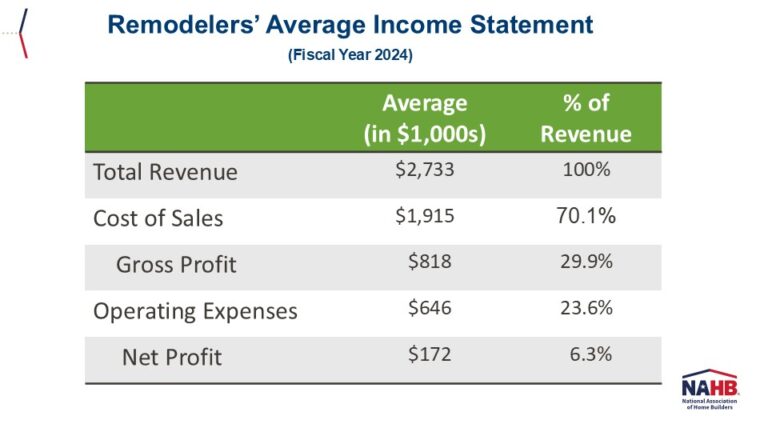
While the majority of builders continue to deploy buyer incentives, including price cuts, many prospective buyers remain on the sidelines. Although demand for new construction has weakened, remodeling demand has remained solid given a lack of household mobility, per comments from builders in the HMI.

Derived from a monthly survey that NAHB has been conducting for more than 40 years, the NAHB/Wells Fargo HMI gauges builder perceptions of current single-family home sales and sales expectations for the next six months as “good,” “fair” or “poor.” The survey also asks builders to rate traffic of prospective buyers as “high to very high,” “average” or “low to very low.” Scores for each component are then used to calculate a seasonally adjusted index where any number over 50 indicates that more builders view conditions as good than poor.

The HMI index gauging current sales conditions held steady at 41 from January to February, the index measuring future sales fell three points to 46 and the gauge charting traffic of prospective buyers fell two points to 22.

Looking at the three-month moving averages for regional HMI scores, the Northeast fell one point to 43, the Midwest held steady at 43, the South dropped one point to 35 and the West fell two points to 33. HMI tables can be found at nahb.org/hmi.

Editor’s Note: With the official 2026 release schedule for the Survey of Construction still unavailable from the U.S. Census Bureau, NAHB confirms the HMI for March 2026 will be released on March 16.  A schedule for the rest of the year will be available as soon as possible.


This article was originally published by a eyeonhousing.org . Read the Original article here. .


The cost of credit for residential construction and development declined in the fourth quarter of 2025,  according to NAHB’s quarterly survey on Land Acquisition, Development & Construction (AD&C) Financing. In particular, the average contract rate declined on all four categories of loans tracked in the survey: from 7.95% in the third quarter to 7.61% on loans for land acquisition, from 7.68% to 7.44% on loans for land development, from 7.89% to 7.47% on loans for speculative single-family construction, and from 7.90% to 7.16% on loans for pre-sold single-family construction.   

Meanwhile, the average initial points paid by builders and developers fell on three of the four types of AD&C loans: from 0.83% to 0.44% on loans for land development, from 0.75% to 0.34% on loans for speculative single-family construction, and from 0.67% to 0.37% on loans for pre-sold single-family construction. The only exception was loans specifically for land acquisition, on which the average initial points increased slightly—from 0.66% to 0.70%.

The small increase in points on land acquisition loans was not enough to offset the drop in the contract interest rate, however, so the average effective interest rate (which takes both the contract rate and initial points into account) declined across the board: from 10.15% to 9.81% on loans for land acquisition, from 10.92% to 10.28% on loans for land development, from 12.04% to 10.64% on loans for speculative single-family construction, and from 12.74% to 11.01%  on loans for pre-sold single-family construction.

In all four cases, this was the lowest the average effective rate has been since the period of generally rising interest rates in 2022.

Notwithstanding the drop in rates, builders and developers continued to report tightening credit conditions in the fourth quarter of 2025. The net easing index derived from NAHB’s AD&C survey posted a reading of -9.3 (the negative number indicating that credit has tightened since the previous quarter). This is quite similar to the results from the perspective of lenders reported in the Federal Reserve’s survey of senior loan officers. The net easing index derived from the Fed survey posted a reading of -1.8 in the fourth quarter. Both the NAHB and Fed survey have now reported consistently tightening credit conditions for 16 consecutive quarters. In both cases, however, the net easing index in Q4 2025  came closer to the break-even point of zero (between tightening and easing) than it has at any time since the first quarter of 2022. 

More details from the Fed’s survey of lenders—including measures of demand and net easing for residential mortgages—appeared in a previous post.

Also, in the NAHB AD&C survey, 35% of respondents who built single-family homes during the fourth quarter of 2025 reported financing some of the construction with a construction-to-permanent (one-time-close) loan made to the ultimate home buyer. On average, 59% of the homes these respondents built were financed in this manner.

More detail on credit conditions for residential builders and developers is available on NAHB’s AD&C Financing Survey web page.


This article was originally published by a eyeonhousing.org . Read the Original article here. .

Inflation eased to an eight-month low in January, confirming a continued downward trend. Though most Consumer Price Index (CPI) components have resolved shutdown-related distortions from last fall, the shelter index will remain affected through April due to the imputation method used for housing costs. The shelter index is likely to show larger increases in the coming months.

While headline inflation moderated, underlying cost pressures from trade policy persist. In 2025, the average U.S. tariff rate rose from 2.6% to 13%. A recent New York Fed study found that 94% of tariff costs were passed through to U.S. companies and consumers during the first eight months of 2025. Households still face elevated costs for consumer goods even as the pace of price growth slows.

On a non-seasonally adjusted basis, the Consumer Price Index (CPI) rose by 2.4% in January compared to the year prior, according to the Bureau of Labor Statistics (BLS) latest report. That was the lowest level since May 2025. Excluding the volatile food and energy components, the “core” CPI increased by 2.5% over the past twelve months. A large portion of the “core” CPI is the housing shelter index, which increased 3.0% over the year. Meanwhile, the component index of food rose by 2.9%, and the energy component index fell by 0.1%.

On a monthly basis, the CPI rose by 0.2% in January (seasonally adjusted), and the “core” CPI increased by 0.3%.

The price index for a broad set of energy sources fell by 1.5% in January, with the increase in natural gas (+1.0%) offset by decreases in fuel oil (-5.7%), gasoline (-3.2%) and electricity (-0.1%). Meanwhile, the food at home index rose by 0.2%, while the food away from home index increased by 0.1% in January.

The index for shelter continued to be the largest contributor to the overall monthly increase in all items index. Other top contributors that rose in January included indexes for airline fares (+6.5%), personal care (+1.2%), recreation (+0.5%), medical care (+0.3%), and communication (+0.5%). Meanwhile, the index for used cars and trucks (-1.8%), household furnishings and operations (-0.1%), and motor vehicle insurance (-0.4%) were among the few major indexes that decreased over the month.

The index for shelter, which makes up more than 40% of the “core” CPI, rose by 0.2% in January. The index for owners’ equivalent rent (OER) and the index for rent of primary residence (RPR) both increased by 0.2% over the month. NAHB constructs a “real” rent index to indicate whether inflation in rents is faster or slower than core inflation. It provides insight into the supply and demand conditions for rental housing. When inflation in rents is rising faster than core inflation, the real rent index rises and vice versa. The real rent index is calculated by dividing the price index for rent by the core CPI (to exclude the volatile food and energy components).

In January, the Real Rent Index remained unchanged. The index has remained virtually flat since August 2025, except for data quality issues in October and November.


This article was originally published by a eyeonhousing.org . Read the Original article here. .

Existing home sales fell in January to a more than two-year low after December’s strong rebound, as tight inventory continued to push home prices higher and winter storms weighed on activity. Despite mortgage rates trending lower and wage growth outpacing price gains, limited resale supply kept many buyers on the sidelines. Resale inventory remained at lowest level since January 2025. Though home price appreciation has slowed in recent months, affordability remains a challenge.

Total existing home sales, including single-family homes, townhomes, condominiums, and co-ops, fell 8.4% to a seasonally adjusted annual rate of 3.91 million in January, according to the National Association of Realtors (NAR). This marks the lowest level since August 2024. On a year-over-year basis, sales were 4.4% lower than a year ago.

The existing home inventory level was 1.2 million units in January, down 0.8% from December but up 3.4% from a year ago. At the current sales rate, January unsold inventory sits at a 3.7-months’ supply, up from 3.5-months in December and January 2024. Inventory between 4.5 to 6 months’ supply is generally considered a balanced market.

Homes stayed on the market for a median of 46 days in January, up from 39 days in the previous month and 41 days in January 2025.

The first-time buyer share was 31% in January, up from 29% in December and 28% from a year ago.

The January all-cash sales share was 27% of transactions, down from 28% in December and 29% a year ago. All-cash buyers are less affected by changes in interest rates.

The January median sales price of all existing homes was $396,800, up 0.9% from last year. This marks the new high for the month of January and the 31st consecutive month of year-over-year increases. The median condominium/co-op price in January was up 3.8% from a year ago at $364,600. Recent gains for home inventory will put downward pressure on resale home prices in most markets in 2026.

Sales declined in all four major regions in January, ranging from 5.9% in the Northeast to 10.3% in the West. On a year-over-year basis, sales also fell across all regions, from 1.6% in the South to 7.9% in the West.

The Pending Home Sales Index (PHSI) is a forward-looking indicator based on signed contracts. The PHSI fell from 79.2 to 71.8 in December after four months of increases. On a year-over-year basis, pending sales were 3.0% lower than a year ago, according to the National Association of Realtors’ data. The decline suggests buyers are holding back due to limited inventory choices.


This article was originally published by a eyeonhousing.org . Read the Original article here. .
Pin It