Author

realtykast_fmyriy

Browsing


Affordability challenges continued to weigh on the new-home market in June, as elevated mortgage rates, rising inflation and broader economic uncertainty kept many prospective buyers on the sidelines.

Sales of newly built single-family home rose 1.6% in June to a seasonally adjusted annual rate of 628,000, up from an upwardly revised May estimate, according to newly released data from the U.S. Department of Housing and Urban Development and the U.S. Census Bureau. The pace of new home sales is down 5.6% from a year earlier.

New home sales are down 5.2% on a year-to-date basis, as housing demand remains lackluster amid affordability challenges. At the regional level, only the Midwest has seen gains for new home sales thus far in 2026.

Builders continue to use incentives to support sales, with NAHB survey data showing that 62% of builders offered some form of incentive in June.

New home sales are gaining some momentum at the more affordable range of the market, with homes priced below $300,000 accounting for 23% of June sales, up from 16% a year earlier. However, that price point is generally only achievable in markets with lower development and construction costs, particularly with respect to lower state and local regulatory costs.

A new home sale occurs when a sales contract is signed, or a deposit is accepted. The home can be in any stage of construction: not yet started, under construction or completed. In addition to adjusting for seasonal effects, the June reading of 628,000 units is the number of homes that would sell if this pace continued for the next 12 months.

New single-family home inventory in June was virtually unchanged at 485,000 units, down 0.2% from May, and down 3.2% compared to a year ago. This represents an elevated 9.3 months’ supply at the current building pace. According to NAHB analysis, due to rising resale single-family inventory and elevated new construction inventory, combined new and existing home inventory stands at just above a 5.2 months supply, the highest level since the fall of 2014.

The median new home sale price in June fell 3.3% from May to $398,300, and was down 2.7% from a year ago, largely due to builder price cuts and some geographic shift in mix to the more affordable Midwest.

Regionally, on a year-to-date basis, new home sales are up 2.6% in the Midwest but fell in the other three regions, with declines of 4.7% in Northeast, 4.9% in the South and 10.1% in the West.


This article was originally published by a eyeonhousing.org . Read the Original article here. .


One of the biggest mistakes new investors make is analyzing rental properties for the best-case scenario. Today’s guest does the opposite. He plans for the worst, and it’s the reason his deals consistently outperform others. In this episode, he’s sharing his secret for getting maximum cash flow with the least work possible!

Welcome back to the Real Estate Rookie podcast! Luke Frizzell went from owning a primary residence that was draining his bank account, to converting his garage into an ADU and getting a 25% cash-on-cash return. But then, he did an “about face” and pivoted into residential assisted living, where he generates $3,000 in monthly cash flow, per property, without ever dealing with operations!

Tune in to learn how Luke uses the military “SMEAC” framework to turn every deal into a planned mission, why the best next investment might be the property you already own, and how the lease-to-operator model makes assisted living one of the most “hands-free” cash flow strategies available today.

If you’ve been chasing unit count and wondering why the effort never matches the returns, Luke’s story is your permission to think differently.

Ashley:
Most investors underwrite the upside. Today’s guest underwrites for everything that can go wrong first because that’s how he was trained to plan missions as a Navy SEAL. And he’s applying that same discipline to a real estate niche most rookies have never even considered, residential assisted living.

Tony:
Today we’re talking with Luke Frizzell, who went from a struggling house hack on active duty to running a $975,000 assisted living deal that nets his investors in 11% return. While he still collects roughly $2,000 a month in cashflow all without ever becoming a licensed care operator himself, which is crazy to think about. We’re going to break down exactly how he built this out and how he uses a military framework to make every single deal decision.

Ashley:
This is the Real Estate Rookie Podcast. I’m Ashley Care.

Tony:
And I’m Tony J. Robinson. And with that, let’s get into it, Luke. So thank you for joining us on the Real Estate Rookie Podcast today, brother.

Luke:
Guys, I’m so excited to be here. BiggerPockets was a huge part of my early investing journey and it’s really cool to see how time has gone on and it’s kind of a full circle moment for me. So I’m honored to be here and thank you guys for having me.

Tony:
Yeah. Luke, the pleasure’s all ours, brother. And before we jump in, thank you for your service. I’m very confident in my manhood, but whenever I get on the line with a Navy SEAL, I just feel like I’m like a rung lord because you guys have gone through so much, man. So thank you for the service and appreciate you joining us today, brother.

Luke:
I appreciate that. I got to say, we’re just normal guys, maybe with a little bit of a crazy streak in us, but definitely maybe a screw loose. I don’t know. But I got to say it was my honor and it was like all I wanted to do once I found out what a Navy SEAL was, that was all I wanted to do. So it was just a desire to do that and that’s what got me through everything. And it was the time of my life while I was in.

Ashley:
Well, Luke, you actually got started in real estate investing while you were a Navy SEAL and you found BiggerPockets. So kind of give us the 60 second version of how that all happened while you were in Navy SEAL.

Luke:
Yeah. I actually didn’t even know what investing was until I was a Navy SEAL. So I actually looked over the shoulder of one of my buddies who was in my platoon with me and saw that he had like $150,000 in his TSP, which is military’s version of a 401k. And I was like, “How do you have that much money?” And he was like, “Oh, you just put it into this thing that grows over time.” And I was like, “Oh, I thought that was risky. You’re supposed to go into the low risk things.” And he was like, “No, no, no. Let me explain.” So that was my first investment experience and learned a lot about what risk means in the investment space. But real estate is really what I consider myself as an investor. I got my start actually with a mistake, which maybe we can talk about because my first investment was a syndication that did not go according to plan.
And that’s why you need to have good due diligence and that’s why you need to understand what you’re investing in and not go for appreciation only. But my first real estate deal was just buying our own house. And it was using the VA loan in Southern California and we could barely afford it, but ended up making it an asset and copying that strategy again. That got my start into it and with the help of BiggerPockets, turned into an investor after that.

Ashley:
So with that first property, where was it and how did you purchase it and how was it actually an investment as your primary?

Luke:
With the first property, we just bought our primary residence with the VA loan. So we got to put 0% down on a seemingly unfinancially feasible market of San Diego on a young military salary, $650,000 purchase price. We could hardly afford it at the time. And as I would go and deploy and go on training trips, I would be mad at myself for having bought the property because in 2017, the interest rates hadn’t really dropped down to the bom. And because it was just a liability, we weren’t making any money on it. It was just draining our bank account. But this is where copying what works comes into play because I had seen other investors and my mentor doing what was then the ADU strategy and now has been coined that. So what we did was we converted our garage, which was 400 square feet into a studio apartment, started making $1,500 a month off of that.
And I was like, okay, I can get behind this because this was a way to actually cut down the cost, also for some apreciation. And I decided to do it again. So we did that a second time. And that was kind of like what scratched my itch on, “Okay, this is going to work.” And when I looked at the TSP that I started investing in versus the real estate appreciation and value and cashflow, I was like, “Okay, I’m just making little TSPs for myself except they’re paying me every month. So I think I can get behind

Tony:
This. ” Luke, how much did it cost? And obviously this was, you said 2017, 2018. How much did it cost to build out the ADU? How did you fund it? And then what impact did it have on the actual value of the property once you were done?

Luke:
So a lot of my early investment journey was a, let’s call it luck. Sure, I put myself in the position to get lucky by purchasing the house, but we bought in Southern San Diego, which obviously has appreciated well over time. We refinanced out of the VA loan into a conventional loan, pulled out some money and we put that $50,000 into the garage conversion, put an extra $20,000 from our own pockets into that conversion. And the way I figured it, hey, $1,500 a month times 12, can’t do that math off the bat, is going to over time pay for that $70,000 into this conversion within five years. So that makes it a no-brainer on the cashflow side. And then separately, it forced over $200,000 of appreciation on our home. So you add a lot of value with that. And I’m a huge proponent of house hacking and ADU strategy because of that.
But ultimately we found an even better situation with residential assisted living. And that’s why I pivoted over to that in 2022.

Tony:
Luke, I just want to make a quick comment because I did do the math really quickly and 1,500 bucks per month over the course of a year is $18,000. $18,000 in cash flow, because essentially the mortage and everything, you’re already paying for yourself. So this is just pure income coming back into your pocket. On a $70,000 investment, that’s a 25% cash on cash return. That’s a really, really solid cash on cash return in most investment vehicles. So I think for a lot of new investors, sometimes we get so caught up in how can we go take down the next deal, the next deal, the next deal? But sometimes it’s like, what if I just reinvest a little bit more capital into some of the real estate that I already own? Can I actually get a better return by doing that as opposed to going and buying something new?
And this feels like the perfect example of taking an asset you already have and just extracting more value from it.

Luke:
Yeah. In a time where interest rates are high and prices have not gone down, you got to look at what you currently have. And if you’re not in a home yet, we can talk about that. But if you’re already in a home, how can you maximize what you currently have to generate an ROI and make it make sense? My wife and I had a young family at the time. My wife didn’t want to share a house with someone else and house hack the traditional way where we have roommates, but we could put a wall in between our garage in our main house, live in the main side, and then have kind of a separate unit where we rented that side out. And it made sense for us. We were already living kind of in a smaller footprint of a home. So we just didn’t use the stuff in the garage and made that into a unit and made it make sense for us.
And that move really set us up to open my eyes to the opportunities that we saw with residential assisted living and into my entrepreneurship journey that allowed me to confidently leave the military the way I did. So definitely agree with that sentiment.

Ashley:
Now, how about other ways that serving in the military has kind of helped you as a real estate investor? So for example, kind of taking your mission planning frameworks and putting that into deal evaluation, what does that look like and what does that even mean?

Luke:
That’s a really good question. So I look at every deal and I couldn’t help but think this way because the SEAL teams, I was a SEAL before I was an investor. So I just looked at everything through that lens and I figured every deal is like a mission and we want the mission to be successful. And in the SEAL teams, we pick the missions that we do. We don’t like to just go and be told and wait for something to happen. We want to go and do something that we pick on the battlefield of our choosing so that we stack the deck in our favor. So first and foremost, you have to know your buy box. And what I equate that to is mission first. First you tackle the mission and then you can talk about the execution. So if you know your buy box, then you can look at what your mission is going to be and maybe that’s a home.
And then figure out how to make it happen on the execution side. First, you have to look at the situation, which is the macroeconomic environment, what deals are being done by other investors in the area and where money is moving. So the whole framework that I use is called SMEAC, situation, mission, execution, admin and logistics, and then command and control. That’s the acronym. It’s super simple, but it works. So starting with the situation as I talked about, getting into the mission, which is your buy box. I’m going to buy this type of home for this return on investment by this amount of time. And then you got to figure out how you’re going to do that. And that’s the execution. Who do I need to talk to? What parameters do I need to set? What underwriting do I need to practice? So that when I see a deal, I can figure out by looking at the property price and looking at the picture of the home within about one minute, if I’m going to dig deeper into that home and actually do the underwriting to figure out if it’s a deal or not and it’s going to match the mission.
And then you go and execute admin and logistics, you set up your lenders who you need to talk to. You set up the bank financing, figure out with a letter from them how you’re going to tackle the home and you know what that interest rate’s going to be because you’ve already talked to them. And then command and control, who are you going to talk to once everything’s done? How do you manage the tenants? Do you have a property manager? How do you run the whole ecosystem with you as the commander setting the parameters for your mission and how you communicate with everybody on the team? All

Tony:
Right. Coming up, Luke is going to walk us through the model that’s actually generating his cashflow right now, which is residential assisted living. And specifically a structure that lets you own the real estate without ever running the care business yourself. That’s right after a quick break to hear word from our show sponsors.

Ashley:
Okay. Welcome back. So Luke, let’s get into the residential assisted living and the lease to operator model, because I think that is going to be brand new territory for a lot of our listeners. So for someone who has never heard of assisted living as an investment, what is it and what made you walk away from comparing doors and chasing appreciation to focus on this strategy instead?

Luke:
Yeah. So back to kind of the core tenants of my investor philosophy, I believe in cashflow over door count. And what that really equates to is quality over quantity. There’s this fallacy in the real estate space that however many doors you have is how successful you are or how you can measure yourself. And I’ve never subscribed to that mentality. I would rather have five homes that are generating well over the cashflow of a hundred doors because that’s going to be a whole lot less hassle and you can actually manage that a whole lot better no matter how you skin it. If you have a hundred homes, hundred doors, or maybe it’s a huge apartment complex, that’s just going to be more problems that you have to deal with. And as entrepreneurs and as investors, we need to think about the mental fogginess that that’s going to bring about whenever you’re clouding your space and what you own with more and more things.
So I got into residential assisted living because I noticed that. And as we had done the Southern California deals and I was not seeing as interest rates increased and prices increased, I was not seeing more opportunity for the mission that I wanted to complete. So that was the pivot. I looked macroeconomically at the city of Phoenix, Arizona as a major metro and a place that seniors retired to. And all of this was brought about because I was looking for cashflow first and I was looking for hands off because I was a working professional in the Navy and I was not able to have a bunch of extra time to go and visit properties. But I did want cashflow because I wanted that base to work off of for future opportunity. So that’s what made me find residential assisted living. And I can get deeper into the why, but that was kind of how it started and what got me into it.

Ashley:
Now tell us about the lease to operator model. How does that work with assisted living? And kind of explain it to us in plain terms what that actually means.

Luke:
Yeah. So my two things were cashflow and hands-free. So I needed a model that worked with that, that worked with the numbers. So my ADU strategy in Southern California wasn’t going to work anymore. I had looked at short-term rentals and sure, I had talked to people who made decent amount of cash doing that, but every single person that I talked to was pulling their hair out with the stolen paper towels and the guests that were a huge problem and the legal issues. And I wanted no part of the amount of bandwidth that that was going to take for me to do that.
When I found out about residential assisted living, I saw that you can buy a regular assisted living home or a regular, let’s say my house that’s a four bed, three bath here in Virginia. And you can convert that into an assisted living home that can fit, let’s say in this house, eight residents, two per room. Or in Southern California where I had the three bed homes, six residents. And in Phoenix it was 10 residents. So I was looking for four or five bedrooms and I actually find an operator who’s going to run the care home because I don’t live in Phoenix. I lived in Virginia whenever I found this. So I needed to find the right operator, vet them, make sure that they had the right mindset, the right mentality. They were going to actually care for the residents the way I wanted to actually happen.
And I got them in there and they run the actual home and they pay me a commercial lease to be in the house. There’s a lot of operators out there that just don’t want to buy a home right now, but they do want to operate and care for residents the way we want to see. So just on the macro level, I knew that there was a senior care housing problem. I had personally experienced bad care through loved ones. So I knew that, and everybody, when you hear senior care or assisted living, you’re not thinking good thoughts generally. You’re thinking where people go to die and not be taken care of. But I wanted to affect that and I didn’t know a way how until I saw this strategy. So lease to operator encompassed is buy a regular residential home, convert it into ADA compliance, set up an operator in the home to pay you a commercial lease and let them run it.
And I set those leases up for three to five years. So it’s long term. They have ownership in the home. They treat it like it’s their own. They cover the utilities and everything inside the home cosmetically. And I talk to my operators once or twice a year if there’s more problems, maybe more frequently than that, but it is not that even the bandwidth suck that I had managing my own single family rental properties.

Tony:
Luke, this is a really interesting take because you’re basically doing or allowing for rental arbitrage from these operators so that they’re leasing the place from you at one price, but then they’re getting their spread by charging the residents a little bit more. We interviewed Han Stone back on episode 714, 714, and he also does assisted living facilities in Southern California, but I think he has three facilities, but he said part of the reason that he’s kept his portfolio small is because he actually operates those himselves. And as he talked to folks that kind of scaled beyond a certain number of facilities, the headaches started to outweigh the potential profits. But with the model that you’re talking about, it’s basically like a triple net lease where they’re kind of coming in, they’re taking care of everything. So I can see the benefit to this. I think the question that I have, maybe it’s a two-part question, but number one, what kind of spread are you able to make in terms of your own expenses, mortgage, whatever else is associated with owning that property, property taxes, all those things versus what you’re leasing it out for to these operators?
And then how are you actually finding them? Is there a Facebook group where there’s a bunch of operators you’re going to? Are you going to other facilities and ask them, “Hey, do you want to convert my other one?” So what’s the margin look like? And then how are you finding these folks?

Luke:
Yeah, that’s a great question. And there’s so much in there that I can expand on, but I’ll start with just commenting on the model. You can set this up and let these operators run it. And if you look at the numbers across the country, it’s about $6,000 a month across America for a resident to be taken care of at this level. So when you look at a home like our homes in Phoenix, and we have five of them, you can just in 10 residents per house. So if there’s 10 residents in a home and the average cost of care is about $6,000, that’s $60,000 gross coming in for that operator. Now that operator has the ability to pay you a little bit more in lease than you would normally get from a regular single family rental. My first deal in Phoenix, $875,000 purchase price. It was listed and the asking price was a million dollars.
But the lease amount over the course of five years is $8,000 a month. If I were to rent that out as a regular single family rental, the rental rate is about $3,000, $3,200 a month. That would not even cover my principal and interest on the property. My principal and interest is about 4,150 a month. And with taxes and insurance, it gets up to about 46, $4,700. But $8,000 a month in lease well covers that amount and the spread. So my cashflow in the $3,000 plus range. And what I’m covering is basically the taxes, the insurance and overall CapEx and everything else is them. So I don’t need to get my name on the utility bill, that’s them. Once that home is licensed and they’re running it in there, whenever there’s a vacancy, they are filling the beds. So if they’re not full up on 10, they need to get two more residents.
That’s on them to do that. And I really like letting them have the ability to have that ownership. And it is a partnership and I do like to have a good relationship with our operators, but that can be as much as I want. At a basic level, I’m the landlord and they are the operating business and I really like it. And I can get to your other parts of your question. I’m sure you want to follow up.

Tony:
Yeah. Let me ask one follow-up question there because why wouldn’t these operators just go to Zillow and find a market rent property? Why are they willing to pay you this premium as opposed to just whatever’s already on the market that they can go rent with saving more money themselves?

Luke:
Well, I think there’s a hesitation across the country in general on buying homes right now. People see where interest rates were. They see where the prices of homes were and they don’t want to get into it with that. There is a decent amount of risk at play whenever you’re starting your operations business or you’re expanding. And when you can have that type of spread, and let’s just use the $60,000 gross example and you’re paying me a $8,000 a month lease. And let’s say your staff is getting around 20, $25,000 a month. The food and all the miscellaneous expenses in there and the liability insurance, another 10,000, I’m just throwing numbers out there. Your spread is still in the above 10, maybe $20,000 if you’re running the operation. So if that’s what you’re focused on, a lot of operators just want to stay focused on that and they don’t want to get into the game of real estate.
Now in the railroom, and this is the business that my partners and I started after we had bought five residential assisted living homes, we had two paths that we could take. We could either continue to buy more homes and kind of take over the market as we though about doing, or we could start to affect the space at a national level and try to decentralize the way senior care is done in our country and empower other people to start doing residential assisted living to more personalize the care, make sure that we’re rewriting the script on seniors just going to an assisted living home to die. And we actually want to have more personalized care because that is just happening at such a better level at these residential homes than it is at the big facilities where they’re just a number on the wall.

Tony:
Luke, so that makes sense on the purchasing side, but what about just renting a house? Let’s say that I want to start up another residential assisted living facility. Why would I go to Luke versus just finding… Because you said market rents in Phoenix were like 3,500. They’re paying you eight. Why wouldn’t I just go rent the house for 3,500? What are the benefits of renting from Luke versus renting from the market priced property?

Luke:
That’s a great question. So you can’t just get a regular house and do it. You have to get ADA compliance. So you got to put the wheelchair ramps in. You got to put the grab bars by the toilet. So that’s the easy part. But maybe putting fire sprinklers in the home, which is state by state on the rules and regulations on what all the code requirements are. But you have to get that check from the city and the state to get licensed. So the home has to have that piece before you can just… So they wouldn’t be able to just rent out a home and then start operating it unless they’re going to be out of regulation. The good news is cities and states are getting more and more accustomed and finding out about what residential assisted living is instead of just hearing assisted living and thinking a hundred or more unit complex that houses seniors.
But there’s still a lot of opportunity in that they haven’t figured it out to where investors are getting in there and doing it at the kind of widespread level yet.

Tony:
So they’re basically paying you this premium because you’ve already added the necessary infrastructure to that home to make it qualify for whatever the local city, government, state, whatever wants out of a residential assisted living facility. So that’s what they’re paying you the premium for is because the house is already ready.

Ashley:
Yes.

Tony:
Got it. And then how are you finding these people? Again, is there an event that you guys go to and everyone’s hanging out together? Are there Facebook groups? Are you just posting on Zillow, saying ADA compliant? What are the best ways to actually find these operators?

Luke:
Well, when we first started, we were going through a specialty realtor in Phoenix that would help us find operators that already had the background check. And then I ideally wanted to talk to five different operators and interview and vet them to see which one were the best fit, have them walk the home. And if all the boxes were checked, that’s who I would pick. And I did pay a premium to that specialty realtor for that basically finder’s fee. However, as our network grew, we started to just log every single operator that we talked to or vetted or interviewed and we would bring the opportunities of the homes to them. You can also go to networking events where you’re finding other operators that want to expand and they’re already doing this. There are a lot of Facebook groups. There’s also franchises out there that they actually run the operating system and they’ve done it successfully.
So franchisees who want to operate will kind of buy into that franchise and get connected through that. So we talk to those franchise partners and say, “Hey, do you have an operator in this area?” They’ll connect us. And then the great thing about those is they’re actually backed by the franchise. So there’s a fail safe if they’re not operating to the capacity you want or they’re struggling, they can either put somebody else in there, grant it to someone else. There’s a number of different ways. We’ve even directly mailed all the operators in the Phoenix area at one point to see if we were trying to buy another home. But you could use that same mentality and look for operators that way. You have to get a little bit creative and that’s probably the biggest hurdle for a lot of people, but these things are figure outable.
And that’s a word that I’ve heard on a BiggerPockets podcast before. Everything is figure outable. You just have to have a little bit of creativity in how you do it. And it’s not just your Mark one motto, put a tenant listing up on rent.com.

Ashley:
Now Luke, what about evictions? I’m going through an eviction right now and I’m being told by my lawyer it’s going to be a long rocky road, but what about if your operator does not pay rent? So is this treated like a commercial tenant or is it treated residential because there’s actually people living there where there may be more grace depending on your state?

Luke:
Great question. So that’s one of the contingency plans that you got to plan for in your kind of mission planning and it’s definitely one you got to think about. And here’s the thing, evictions are going to happen whether you’re a real estate investor at the single family level, at the multifamily level. This is no different. However, there’s a lot more vetting that takes place before you put an operator into the home. So I actually like that that vetting happens a little bit more extensively the way we do it and the way we teach in the rail room to set that up for success. However, vetting can only get you so far and you could check every box and still find somebody who is lying or unforeseen circumstances happen. I’ll give you a story to answer the question. The second home that we had bought as partners, the operators got into the home expecting to run it as a behavioral health home because that’s where they had experience before.
However, a moratorium went out across Phoenix stopping any new behavioral health licenses from going out just coincidentally the day after we had signed with these operators and they had agreed to do this lease with us. So they could not get their license. Because it’s a commercial lease, they continued to pay their lease amount. And what we did, and I’m not going to just say, yeah, you have to pay full amount. I worked with them and this is the relationship part that you have to work through. Hey, I will give you a reduced lease amount just to help you get through this time. They never did not pay us during this time. But I said, “In exchange, I need you to help find a new backfill for who we’re going to get into the home. And in the meantime, I’m going to reach out to our operator network and start looking at other operators who can get in there and fill the void.” And that’s how we did it.
We never had a negative month during that time. And of course there can be worse stories than that, but it is treated as a commercial lease. And if an eviction has to happen, it’s more cut and dry than a tenant eviction, especially in states that are more tenant-friendly than landlord friendly, which I think is a benefit.

Ashley:
Well, don’t go anywhere. We’re wrapping up with Luke’s biggest piece of advice for any rookie who wants to apply the same discipline to their own investing, no matter whatever strategy that you are pursuing. We’ll be back in a minute.

Tony:
All right. We are back here with Luke. And Luke, you’ve given us a lot to think about today between the mission planning side and just your entire model of the lease operator, but I’ve got a few more big questions for you. If a rookie who’s listening takes away just one thing from this episode about mission planning and one thing about the lease to operator model, what should those two things be?

Luke:
Before you get into your journey as a newbie or a rookie, think very carefully about why you want to do it and what you’re looking for Or because it seemed very sexy to get into business and become an entrepreneur and an investor, but you don’t realize the toll that that’s going to take on your mentality and your overall bandwidth as a human being until you’re actually in it. So think carefully about what you want, set your buy box. We started buying these homes and realized that we want to start helping and enabling other investors to open up our goal is a thousand residential assisted living homes in the next two years and I think we’re going to beat that. So we pivoted from just buying more properties to this entrepreneurial path because we were so clear on our initial intent and we acted on it.
We were able to pivot creatively after we had done what worked. So go in with the mentality of, hey, do you want cashflow? Do you want hands off? Well, this might be an awesome opportunity because you have the entire real estate landscape ahead of you if that’s the path you choose. Are you going to get into a single family rental that you’re not going to cashflow in? Are you going to get into short-term rentals where your bandwidth is going to be pulled into every direction? Or do you want to take a path that is off the beaten path, not well known, you can get support through the railroam and everything we have, but you have to be willing to do creative strategies in the real estate space today. I believe that lease to operator path in the residential assisted living strategy is the best path for an investor who wants hands-free cashflow.
And of course it’s not hands-free. You are going to put some work into it. But bang for buck, quality over quantity, there’s nothing better in the space and I will die on that sword. From my perspective, this pivot was an easy one for me and I have not looked back since.

Ashley:
Luke, what tools or software are you actually using to manage your portfolio right now?

Luke:
I use no tools. I talk to my operators and I talk to them kind of on a schedule, just have a calendar update to reach out to them every once in a while, hear about how the property’s doing, maintain the relationship and see what’s going on. There have been times where even though the lease says, “Hey, the operator takes care of the HVAC in the heat of Arizona,” I have bent that rule and said, “You know what? You guys have been doing such a good job. I’m going to cover the cost of this. ” And a $15,000 HVAC was kind of nothing in the grand scheme of the two or three or $4,000 of cashflow we get per month on each property. And I would just ask investors like, “How many properties do you want to invest in? ” And I would reframe that to how much cashflow do you want?
What are you affecting in the space of the purpose side of what you’re doing with your investing? And can you do that a lot smarter than just buying more rentals before you’re too late? As far as other tools and resources, we have a free podcast called the Ral Room Podcast that my partners Alex and Charlie run, which is free information, great information about this space. And if anybody wants to find out more about the railroom and what we do and learn about the leased operator space more in depth, the entire thing that all the experience that we have wrapped into that in a community of other people in this network that actually can teach you how to do this, then go to theraroom.com/webinar. That’s T-H-E-R-A-L-R-O-O-M.com/webinar. And we are obviously biased, but it is the best resource that you can give bang for buck on learning about this space.
It is not well known and we aim to change that.

Ashley:
Now, Luke, what about rent collection and your bookkeeping, things like that? Are you using any software for that?

Luke:
For bookkeeping, we use QuickBooks online. We bill our operators directly through ACH through Mercury is our banking that we use. Mercury is very user-friendly. There’s a lot of local banks. There’s a local bank that we started with that the user interface wasn’t great and we ended up pivoting over to Mercury. But it’s as simple as Mercury Banking and ACH transfers. And then we do QuickBooks online.

Ashley:
Yeah. I think there’s two hot debates here in our closing segment here is first that you, even though it’s stated in your lease agreement that they are to pay for the HVAC, you still did that. And I want to hear everyone’s take on that and the comments because my brain automatically goes to, well, if you’re willing to take care of that, why don’t you put it in the lease in the beginning and increase your rent a little bit with them coming into the property knowing you’re going to take care of it? So I’m interested to hear everyone’s comments on that because I’ve definitely done it your way too, Luke, where I’ve had great tenants where I will say, you know what? I’m just going to take care of this even though it’s your responsibility. And then the second thing here is that you’re not using a lot of tools, software, AI, automations to actually run this business and run your portfolio.
And you’re kind of back to the basics, which sometimes can actually make it easier. So I want to hear everyone’s thoughts in the comments. If you’re watching on YouTube, do you think that it’s easier to go back to the basics than have all of these different tools, softwares, automations? And what do you think about that clause in the lease agreement?

Tony:
Now, Luke, you’ve said to copy success before you get creative. And for a rookie eyeing strategy as specialized as residential assisted living, what does responsibly copying someone else’s success actually look like? What would someone need to do if they want to copy Luke’s steps to success?

Luke:
Well, just look at what I’ve explained. So my first deal that I ever did in this space, I heard the idea from a podcast. Now, did they say everything exactly according to what I explained to you here? No. Did I extrapolate and think a little bit creatively and draw on my previous investing experience to put things in between the lines? Yes. But you can take an idea like that and take the framework of literally what I’ve shared with you guys and you can copy that idea and implement it. If you want to make that path shorter and easier, by all means, join our Facebook group, start listening to the podcast, join the railroom because it’s going to shorten that timeline a whole lot.
When I initially got into the ADU strategy, I just listened to a mentor, formed a relationship with them, and then talked to them about what they were doing. People that are entrepreneurial or investing, they want to share. And that’s something I’ve always been impressed with in the space. People want to share their ideas and they want other people to be successful. And I’m just going to go back really quickly, Ashley, to your point. And obviously I’m going to defend my answer on why I paid for the HVAC. I didn’t have to do that. And there is the letter of the law. So there’s the emotional quotient and how you manage and lead because even residential assisted living, regular residential real estate, you are the leader of your organization. You have a business, albeit a more hands-free one than a traditional business, but you have the opportunity to step in and do things at different times.
I’m in it for the long haul. I want those tenants to succeed as operators in the home. And after they’re done with their first five-year stint with me, that increases 3% per year annually on the lease amount. I want them to sign up for another five years afterwards. I’m not sweating this. And I had noticed in my previous conversations with them that they had struggled to have the number of beds filled that they wanted. And they didn’t complain about the HVAC cost, but they did communicate it with me and I decided to step in there and do it. Everything is negotiable as well in real estate and especially in this space. And the steps you take and how you treat your partners as operators will probably pay dividends over time. And I’m counting on that with that decision.

Ashley:
Well, Luke, thank you so much for joining us today. Where can people reach out to you and find out more information about your real estate journey?

Luke:
Well, I already plugged therawroom.com/webinar and I plugged our podcast. There are a number of Facebook groups out there on operators and investors. You’re not always going to get the best experience and you’re just going to be at the whims of what people are sharing there though. So if you want to be in a community of people who are dedicated to the space and whether they want to own and operate or just operate homes or develop homes, we have members that are doing all those different things and even passively investing in different deals across the country, certainly reach out to us at the Ral Room and check out our website. But I would say that those are the best places to start and that’s what I’ll leave it with.

Ashley:
Well, thank you so much for joining us today and to share your journey and your experience with us. My name is Ashley and that’s Tony. And thank you guys so much for joining us on Real Estate Rookie, and we’ll see you next time. All


Help us reach new listeners on iTunes by leaving us a rating and review! It takes just 30 seconds and instructions can be found here. Thanks! We really appreciate it!


Interested in learning more about today’s sponsors or becoming a BiggerPockets partner yourself? Email [email protected].


Source link


We’ve reached the midway point of 2026, and with six months of housing market data to pull from, one thing is clear: the headlines don’t match reality.

The media is full of economic uncertainty, global conflict, and even housing crash predictions. But the actual data points to something else entirely.

The 2026 housing market? It’s surprisingly stable. No, there isn’t a ton of activity. Interest rates remain elevated. We’re still in the “Great Stall.” But things are more predictable. And that’s all investors need to make informed decisions.

Not to mention, there’s a third factor—a silver lining—that not nearly enough real estate investors are paying attention to. You won’t see it reflected in the data, but investors are scooping up real estate deals at massive discounts.

To be clear, this isn’t happening in every market. But if it’s happening in yours—or a market you’re targeting—the next six months could be your window to buy rental properties at prices we might not see again.

Dave Meyer:
Are homes secretly cheaper than you think right now? All the data shows that the housing market is flat. Nationwide, the average home costs about the same today as it did a year ago, but those sale prices don’t tell the whole story because nearly half of all homes sold right now come with a seller concession. Sellers are willing to pay your closing costs, buy down your mortgage rate, or to make costly repairs just to get you to buy their properties. Seller concessions are more common now than in any other year we have data for. On homes that sell with a concession, they average close to 5% of the purchase price. That could easily be the difference between a deal penciling or not. And that’s our big story in this July’s housing market update.
What’s up everyone? I’m Dave Meyer, chief investment officer at BiggerPockets. Today, I’m giving you my monthly update on all the data in the housing market. We’ll cover trends in home prices, the risks of a real estate crash, the rise in seller concessions, and more. Let’s dive in. First up, let’s just talk about where the housing market is at this year. I’ll just give you the big picture headline here. Really not that much has changed. And I know if you look at the news, if you look at social media every day, you say someone saying the market is going to crash or something’s going terrible or no one can afford to buy homes. But the reality is we’re pretty much where we were three months, six months, 12 months ago. This is why for years now, I have been calling this the great stall because the market is pretty boring and pretty flat.
And I’ll just share with you the data and information that reflects that. So the first data that we’re going to look at is inventory. This is basically how many homes are for sale at any given time in the United States. And it’s a really, really important and helpful metric in the housing market because it helps us measure the balance between supply and demand. When inventory is up, that typically means that there are more sellers than buyers, and that creates a buyer’s market and prices tend to go down in those kinds of market. When inventory is going down, that points to a seller’s market. It means there’s more buyers than sellers, and that tends to lead to rising prices. What we have right now in terms of inventory is dead flat. It’s basically exactly the same, less than 1% difference year over year. And when I say year over year, just so you know, what I’m doing is comparing this week or this month in 2026 to the previous year.
So I’m talking about June of 2026 versus June of 2025. And the reason I do this and talk about this year over year data is because housing is seasonal. You can’t really compare January inventory to July inventory because there are always these patterns where inventory and sales are lower over the winter, they go up over the summer. And so that’s why you compare year over year. And what we see is inventory is exactly the same. And so all these people saying housing prices are going to explode because we have inflation, inflation pushes up prices, that hasn’t happened. All the people saying that the market is going to crash because everything is unaffordable and no one could buy a home also hasn’t happened. What we are seeing instead is inventory is almost exactly the same as it was last year. It’s kind of boring. But beneath the surface there, there are some variances that are important here.
So there’s sort of this subcategory of inventory called new listings, which is basically how many people are putting their homes up for sale in a given month. And this is different from inventory because inventory is how many homes are for sale. They could have been listed six months ago or three months ago or a month ago. New listings are just like, how many new ones hit the market, the MLS this month? Those are actually going up. Those are up about 8%. And that is notable because when you start to see new listings go up, oftentimes what can happen is inventory goes up too, that’s more supply, and then you start to see prices go down. But inventory hasn’t changed, right? So you’re seeing new listings go up and inventory in flat. How do you square that? Well, that means that buyers are scooping up those new listings.
It means people are coming in beyond what we had last year and buying those new listings. Basically, new demand is offsetting it. If these new listings were sitting on the market and we were starting to see this snowball effect that often precedes a deep correction or even a crash, we would see inventory go up, but we aren’t. And this is reflected in other data. We can verify that this is what’s happening because we also see this in pending sales. Pending sales are up 6% year over year. So if you want a holistic picture, a clear picture of what’s going on, the market is still sluggish. It’s not very exciting. More people are listing their homes for sale by a little bit, nothing crazy, 8%. But there are also more people buying. So when you hear all those people saying no one’s buying, that’s actually not true.
More people are buying this year, this summer than a year ago. And when that happens, when you have more new listings, but you also have a corresponding rise in the amount of people who are willing to buy those new listings, the equilibrium or the balance in the housing market stays exactly the same. When demand and supply move proportionally, prices stay the same. That’s exactly what we have. And that’s why prices are pretty much flat. They’re actually up a little bit depending on who you ask. If you look, Redfin has it up about 2% year over year. NAR is like one and a half percent. Different sources of different things, but they’re all usually, they’re about between one and 2%. So in nominal terms, we’re seeing modest gains, but in real terms, so inflation adjusted terms, prices are still going down. And that’s why I have said and continue to say that we are in a housing correction, because even though that price you see on Zillow or realtor.com or whatever is going up a little bit, 1%, 1.5%, it’s pretty much flat.
The fact that they’re going up slower than the pace of inflation means that real returns, and when I say real, real just means inflation adjusted. Inflation adjusted returns are actually going down. And I think as investors, if that is going down, if we are losing money to inflation on the price of homes, that’s a correction, that we are losing spending power in that scenario. And so that is what we need to pay attention to. So that’s it. In the interest of making good content, maybe it would be cooler if we had some big story to tell you, but I’ve been trying to tell y’all for years that this is going to be boring, that we’re in the great stall. This is a boring period in the housing market, and that is exactly what we’re getting. And I think it’s important to call out that this is happening even though affordability has actually gotten worse in recent months.
And to me, that’s a good sign. Not because I want affordability to get worse. I very strongly want the opposite to happen, but because I think it just shows the resilience of the market. I think that this last three, four months after the war in Iran started, interest rates went up, inflation has gotten worse. That was, in my mind, kind of a big test for the market to see, are we going to see demand really pull back? Are people super interest rate sensitive to the point where the rates going from six on average to six and a half percent is going to change demand? And we have an answer now, and the answer is no. And that’s good for the housing market. We’re seeing evidence of the great stall that even these minor changes in affordability and rates and blah, blah, blah, all that stuff, we’re kind of in this.
This is where we’re at for right now, and I expect that’s what’s going to continue. I don’t really think that we are going to see any fundamental changes to the housing market over the next couple months. Now, one of the questions I get a lot is there’s a peace deal kind of in place over the last couple of days. Iran and the United States have been trading fire. So by the time this airs, the ceasefire might be gone. But I just want to call out, a lot of people have asked me since the ceasefire in place, will inflation go down? Will rates go down? I don’t think so. I think that we’re going to have inflationary pressure for the rest of the year and that mortgage rates are probably going to stay higher mid-sixes, not higher than they are right now. If the war starts up again and the Strait of Hermos closes, who knows?
But if we sort of stay in the status quo that we have geopolitically right now, I think rates are going to stay in the mid-sixes. So if I were you, I wouldn’t be waiting around for some big change in mortgage rates. They’re always going to swing 0.1%, 0.2% in either direction, but I still think we’re going to be in the mid, hopefully maybe 6.2, 6.3 if the war ends by the end of the year, but I would be shocked if we were below six anytime in 2026. So that’s how I’m personally planning to make my own investing decisions. It’s what I recommend for all of you is just to count on the great stall continuing for affordability to hover around where it’s been and make decisions based on what is a pretty stable market. I know it’s not a good market and I know it’s not a healthy market, but it is stable.
We kind of know what to expect now. And for me, as an investor, that’s really what you should care about. You know that if you lock in a rate tomorrow, it’s not going to be that different a week from now. You know that prices aren’t probably going to jump in the next three months. They’re probably not going to go through the floor in the next three months. This allows you to underwrite deals better. And again, we all hope it gets to be a healthier housing market, but being in a place where you can underwrite deals confidently, that is a good spot to be as a real estate investor. So take this information, understand that we’re in the great stall, underwrite your deals conservatively, but feel confident when you do that. Feel confident that the market is probably not going to do something crazy, at least in the next six months.
Great stall is still what we got. So plan accordingly. Now on top of all this data, which we always talk about every month in the housing market update, there’s some new data that I’m stoked about and I think is a huge opportunity for investors who want to grow and pursue financial freedom in the great stall. And I’m going to share this new data with you right after this quick break. Stick with us.
Welcome back to the BiggerPockets Podcast. I’m Dave Meyer. This is our July 2026 housing market update. Before the break, I talked about how we’re in the great stall. The first half of the year has been kind of boring. I’m kind of expecting boring for the second half of the year. But I think in the data that we often talk about, that’s often in the mainstream media, I think some great opportunities for investors may be hiding in that data is not fully represented in that data. And that opportunity, in my opinion, is through seller concessions. If you don’t know what this is, this is basically sometimes during the course of negotiating a real estate deal purchase, you ask the seller to give you some money, to give you good terms. These are things like asking them to buy down your interest rate or to cover their closing costs or fixing things or adding something to the house.
These are all seller concessions that you as a buyer can ask for. And seller concessions kind of always exist, but there is data that shows right now that nearly half of US homes, when they’re sold, give concessions to buyers. Actually, in May, it’s the highest on record according to Redfin. Data does not go back that far. I think it goes back about 10 years. So it doesn’t go back to the great financial crisis. Keep that in mind. But still, nearly half of home sales have a concession. And really one in seven homes, one in seven, that’s 16% had a concession and a price drop. And so if you think about this and sort of extrapolate it, it kind of means in effect that prices are going down. Now the headline price, the thing that is recorded with the county and what the records say will say the same top line number, but the number that you as a buyer are effectually paying is actually going down.
Because let’s just say you’re going out and buying a home for $300,000. Even if you pay 300, but then they give you $20,000 in seller concessions, at the end of the day, you’re kind of paying 280, right? It depends on the nature of the concessions and all of that, but you are getting a discount on that deal even if the sale price does not reflect that discount. And so when I say the top part of the show that the median home price is up one and a half percent year over year in a nominal basis, that is true, that is factually accurate. But is that data sort of hiding the fact that concessions are where buyers are really getting their discounts? It might not be in the home price where you as an investor and a buyer can get your best discount. It might be getting concessions instead.
And this is kind of just a psychological thing. Sometimes people, sellers, they want their number. They just want to sell it for 300. They’ve decided because their neighbor sold it for 290, they want to sell it for 300. And they’re even willing to give you concessions just to hit that number. I don’t know why, that’s just sometimes how it works. And according to this data from Redfin, the typical concession size runs 1.5 to 2% of the sale price. But remember, that includes the 50% of homes that don’t get concessions. If you just zoom in on the properties that do get concessions, the average concession is closer to 5%. So on a $300,000 home like we were talking about, that’s 15 grand. That’s amazing. Now it might not come to you in the form of $15,000. It might be that you don’t pay closing costs. It might be five grand goes to closing costs and 10 grand goes to buying your interest rate down from 7% to five and a half or 5%.
Still super valuable. That is real, real money. And so the reason I’m telling you this is you should be using this in your bid strategy when you’re going out and looking for deals. Work with your agent and figure out how to try and negotiate concessions. This should be a tool every investor is using right now. Now you got to figure out the right balance between asking for concessions and price reductions because different sellers have different motivations, different things that they care about. But try this. I don’t see why you wouldn’t try to build this into your strategy and your offers if you’re in a market that is corrected. If you’re in the Sunbelt, why wouldn’t you be doing this? Now, if you’re in Chicago or Milwaukee or Hertford, Connecticut, probably not going to get concessions. But most places in the country, especially if you’re targeting motivated sellers or things that have been sitting on the market for a while, this could really work.
It could work better than low balling the sale price. It could work in conjunction with a lower sale price. That’s something you should talk to your agent about how to build the right combination here. But you should be trying this because clearly sellers are showing that they’re more willing to give money back in concessions than they are in lowering price. And you should be using that in your investing. Now you should also know though, you can’t count entirely on concessions. There are actually limits on how much concessions can be built into a contract. It depends on your loan type. If you’re buying for cash, you can do whatever you want. But for other loan types, if you get a conventional loan, it’s usually 3% is the limit. If you’re putting under 10% down, it can go up to 9% if you’re putting 25% plus down.
For FHAs, the limit is 6%. For VA loans, it’s 4%. For investment properties, you should know it is 2%. That’s a conventional investment property. And with DSCR loans, you’ll have to ask because those are less regulated. It depends on the specific lender. All right, well, hopefully that helps you go out and bid on your next property. I think this is really cool. We do have one more topic to cover on this month’s housing market update, which is our risk report. We’ve talked about being in the great stall era, but with foreclosures on the rise, we do need to address the elephant in the room and ask ourselves, is a crash likely? Could it actually happen again? We’ll get into that right after this quick break. Stick with us.
Welcome back to the BiggerPockets Podcast. I’m Dave Meyer. We’re doing our July 2026 housing market update. Before the break, we talked about how we’re in the great stall, but the opportunity that comes with negotiating concessions right now, because that is a tool you should be using as an investor. Our last story here today is our risk report, something we do every single month where we look at some of the fundamentals of the housing market and how some of the plumbing of the housing market and the financing and the credit world work to understand if there is a risk of the correction that we’re in turning into a full-blown crash. And the first thing we always look at when we do this is our delinquency rate. How many people in the United States are paying their mortgage on time versus how many aren’t? And the reason this is such a good indicator for the health and relative risk in the housing market goes down to supply and demand.
The more people who are not paying their mortgages, the more people are at risk of being foreclosed on, and the more risk there is that there’s going to be something called forced selling where we get more and more new listings on the market. Like I talked about before, you have more and more people listing their homes on the market, not because they want to, but because they have to. And if that happens at such a big volume that demand can’t absorb it, that can sort of start a crash. That’s what happened in 2008. So we want to know, could that happen again? And as of right now, the national delinquency rate is at 3.35%. That’s the number of people who are in some form late on their mortgage. And that is exactly unchanged over the last month. So nothing has really changed. And it is below the long-term average of about 4%.
It is also, importantly, below where it was in 2019. I like to compare data now to 2019 because it was the last normal year before COVID where a lot of the data you can’t really use because it was just so unusual. It was just an anomaly. You can’t say, oh, how does foreclosures this year compare to 2021? There were government forbearance programs, there was eviction moratoriums, all these things that make it very difficult to compare to that time. So I prefer when looking at this delinquency to look at the long-term average, which is 4%, and where it was in 2019, which was darn close to the long-term average of around 4% and compared to where we are today, which is 3.3%. So we’re still pretty far below. And I know the difference between 3.3 and 4% doesn’t sound like a lot. And it’s not crazy.
They’re pretty close, but when we’re dealing with really small numbers, the difference between 3.3 and 4%, that means we’re almost 20% lower now in delinquencies than we were in 2019. So if you’re worried about a crash coming from a similar source that it came from in 2008 where there was for selling, not super concerning right now. Now, FHA loans are sort of one area that I have flagged in previous risk reports that we need to keep an eye on. Because FHA loans recently, that delinquency rate really did start to shoot up. Looking at it right now and what we see in just terms of serious delinquencies, so 90 days plus, they call that a serious delinquency. Serious delinquencies are up near 6% for FHA loans. That is pretty high and it is significantly higher than it was in 2019. So again, we’re doing that analysis against 2019.
It was below four in 2019. Now it’s above six. So that is a concern. It’s an area that we’re going to watch on the risk report. But I will call out that in the last month, it actually started to go back down. That’s just one month. I am not going to say that there’s no more risk in FHA. I would like to see that come down for several months before we looked at that. But it is good to see that it’s not just going parabolic and we’re going to just see more and more delinquencies in FHA. Even a month of reprieve I think is a good sign. Now keep in mind, and I’m going to call this out every time we talk about FHA delinquencies, that FHA loans are about 11% of the total mortgage market. So it’s small compared to the other areas. So even if FHA loans get worse, the risk of it sort of spiraling the whole market is a lot lower.
Back in 2007, it was conventional mortgages that took down the market. It was not FHA. And so yeah, it’s concerning. You don’t want to see this stuff. It’s something we’ll keep an eye on. But right now, the risk of this causing a crash remains pretty low. When you look at the other indicator that we need to know about, which is foreclosures, delinquencies and foreclosures are kind of tied together. But it’s important because literally I was looking at three different news sources today and two of them had stories about foreclosures going up. Everyone’s saying foreclosure’s going up. Well, yes, they are. Foreclosure starts are up about 25% year over year. But again, year-over-year data comparing to the last few years, it’s kind of pointless. What I see when I look at this data is that foreclosure starts were 29% below 2019 levels. So not really concerning in my opinion.
And they were actually, foreclosure starts, by the way, fell five and a half percent from the previous month. So it’s not like they’re just going up and up and up and up and up. They actually went down last month. Now I do think foreclosures are going to go up. I think they’re going to continue to go up. But this is what we would call what is most likely what we would call a reversion to the mean, if you’ve heard that term before. But basically things have been artificially low because of these programs over the last couple of years. And so getting foreclosures back to the normal run rate is kind of what you would expect to happen. So that’s kind of why I’m saying that, not because I’m seeing any signs of particular distress in the market. Of course, there could be. The unemployment rate starts rising rapidly and all these AI fears come true.
Sure. Yeah, definitely could happen. But as of today, is there risk that foreclosures or delinquencies are taken down the housing market? No, there just isn’t. I say that pretty confidently. We’ll see what happens for the next few years. But again, as an investor, when I look at the market and what’s likely to happen, this is why I feel so confident in the great stall because I don’t see a lot of downside risk right now. I’ve said before, I think prices might go down nationally this year, one or 2%. But do I see risk of a crash? No, I really don’t. The only thing I could see creating a crash is if all of a sudden we have massive layoffs and unemployment goes to eight or 9%. But that’s not even happening. Unemployment’s at 4.2 right now. It went down last month. It’s partially because labor force participation declined, but now I’m getting into a whole economics nerdy rant.
But labor market data looks relatively solid right now. It’s not an inspiring labor market in my opinion, but it’s not as bad as people think. There’s all this data that shows the number of layoffs. It’s really not that bad. It’s high profile is the issue. It’s like big name companies are laying people off, but most people work for small businesses in the United States and they’re not laying people off. And so this is why I just don’t see the delinquency, foreclosure, forced selling, which you kind of need to see for the housing market to crash. I don’t see it. It’s just not there. There’s no evidence of it. The other thing we would see beyond just this data is what we talked about at the beginning of the show is inventory. Inventory would go up if the market was moving towards a crash. We would see it for a couple of months before a real crash materialized.
It was up a couple points year over year, three months ago. Now it’s flat, meaning that the trend of rising inventory is slowing, or you can even argue that it has stopped. It might even turn negative. So if you want an informed take on the risk of a crash right now, it’s low. Rest assured. In your market, it might go down, but on a national level, market, it’s stable, it’s fine, it’s boring, it’s sluggish, it’s not exciting, but it’s not that risky. Any given house, any given property could come down two, three, 5%. Certain markets in Florida, in Texas, where I live in Washington could come down. Those markets could drop three, four, 5%. But on a national basis, a crash, 10%. No, it’s not going to happen anytime soon unless something really dramatic changes, some sort of black swan event. Otherwise, you’re good. And for me, again, that’s what you need.
This assurance that the bottom is not going to fall out. You are not going to catch a falling knife. Those are the things you need to know to make an informed decision about investments. Should you still buy below current market comps? Of course. Yeah, definitely. In this kind of market, you should be buying five, eight, 10% below market comps just to be sure. If your market goes down 2%, you want to still be walking into equity. That’s the way to get a great deal here in 2026 or ask for a concession, right? Get that money back any way you can. Get them to buy down your interest rate so you’re saving two or $300 a month on your expenses. That’s cashflow in your pocket. That’s great. Use these things to your advantage. The market is boring and slow, but there are things that investors can and should do to take advantage of it.
There are more motivated sellers. There are more opportunities for concessions. You have more time to be patient and to negotiate. And if you use those things to your advantage, you can absolutely find great deals in the second half of 2026. I know I’m still going to be looking for deals. All the experienced investors I know are still going to be looking for deals, and you should be too. That’s our show for today. Thank you so much for checking out this episode of the BiggerPockets Podcast. I’m Dave Meyer, and I’ll see you all next time.


Help us reach new listeners on iTunes by leaving us a rating and review! It takes just 30 seconds and instructions can be found here. Thanks! We really appreciate it!

Interested in learning more about today’s sponsors or becoming a BiggerPockets partner yourself? Email [email protected].


Source link


At the start of 2026, most home builders predicted that high mortgage rates and hesitancy among buyers would be their toughest challenges this year. They weren’t wrong: the 30-year mortgage rate averaged 6.49% in June and housing demand has weakened, as reflected by flat mortgage applications in the first half of the year. As a result, new home sales are 7% behind this time last year and builders have put the brakes on production, starting 5% fewer homes than in the first half of 2025. Amid this tough business environment, when companies need to find efficiencies and economies of scale, the industry is experiencing increased levels of consolidation activity. So far in 2026 for example, Taylor Morrison was acquired by Berkshire Hathaway; Tri Pointe Homes by Sumitomo Forestry; and United Homes Group by Stanley Martin Home.

To better understand the extent of this phenomenon across a representative sample of builders in the country, the NAHB/Wells Fargo Housing Market Index survey asked about merger and acquisition (M&A) activity in August 2025 and again in June 2026. Results reveal an uptick in the share of builders reporting increased M&A activity in their local markets, from 14% in August 2025 to 21% in June 2026. More than 40% of builders, however, report no changes in consolidation trends in the markets where they operate. 

A second finding also points to somewhat higher levels of M&A activity in the industry: the share of builders who have been approached for acquisition and/or merger doubled between August 2025 and June 2026, from 9% to 18%. As a result, the segment who have not been approached at all dropped from 87% to 78% during this period.

When asked about future plans for growth, most builders (61%) plan to expand organically in their existing markets. Only small minorities plan to expand by acquisition (6%) or to be acquired by another company (5%). For additional details, please consult the full survey report.


This article was originally published by a eyeonhousing.org . Read the Original article here. .


Before Photo

Allie ReedSave Photo

“After” photos by Polina Pigulevsky

Kitchen at a Glance
Who lives here: A couple and their two Dachshunds
Location: Jacksonville, Florida
Size: 200 square feet (19 square meters)
Designers: Allie Reed for Woodsman Kitchens and Floors and Jessica Woodward of Welcome Home Styling
Builder: Inga Home Renovations

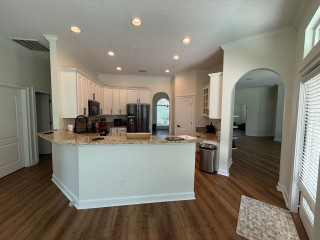
Before: The 170-square-foot kitchen was boxed in by the angled peninsula, which completely cut off the flow to the adjoining family room. The setup shoved the primary work zone into one tight corner. “It really felt like the sink, cooktop and refrigerator were all on top of each other,” Reed says. “There was no workspace around the cooktop and that was huge for them.”

While the couple wanted to keep the existing wood-look luxury vinyl plank flooring, they were ready to ditch the basic black appliances, short white cabinets and beige granite. They also wanted to address a cramped, angled desk area on the right next to the pantry closet. “That space over there was useless,” Reed says. “It ended up being a drop zone for everything.”

Traffic flow was another issue, with an arched doorway to a TV room on the right, another arched doorway to the dining room at the back and a hallway on the left leading to the bedrooms. “We had three entrances into the kitchen,” Reed says. “That’s why we wanted to close one of them up.”

Find home design and building pros on Houzz


This article was originally published by a
www.houzz.com . Read the Original article here. .


Dave:
Americans on average think they need $1.2 million to retire, which might seem reasonable at first, but there is a scary part here. Most people aren’t going to get anywhere close to that number. Over half of Americans expect to retire with less than $500,000 and many of them far less than that. But here’s the other thing that you need to pay attention to. Even though $1.2 million sounds like a lot, if you actually do the math, that may not buy the life you’d expect it to because almost no one accounts for the two things that quietly wreck a retirement plan, inflation and a social security system that may not be around when you go to retire, especially if you’re under 50. So today I want to talk about retirement and how to set a realistic retirement number and actually achieve it. And I have a simple framework I’m going to share with you that I personally use.
It’s designed specifically for real estate investors. And I’m going to walk you through how to figure out the number you actually need to retire, the real one, the inflation adjusted number. Then I’m going to show you why real estate investors get to use completely different and honestly better math to get to retirement than people who rely on equities. So if you want to secure your retirement using real estate, this episode is for you.
Hey everyone, welcome to On the Market. I’m Dave Meyer, chief investment officer at BiggerPockets and a lifelong real estate investor. Recently, I’ve been seeing a lot of worries about retirement. This is nothing new, but there have been a couple new retirement studies in the news and on social media. And honestly, they get me a little riled up because for how retirement obsessed we all are, myself included, the average American is kind of lost on their journey to retirement. Not only is the average American behind on their retirement, but many lack an understanding of how much they realistically need to retire. So not only are they behind on their goal, their actual goal is often wrong. I’ve seen some recent data that says that the average American thinks they need 1.2 million to retire. So another one said 1.4 million. Both of these sound like solid numbers until you do the math because 1.2 million using the 4% rule, which is a simple budgeting framework that says you could safely draw down 4% of your retirement account and not risk running out of money.
If you use that commonly used 4% rule, that only comes out to $48,000 a year. And that doesn’t sound like enough to me personally. I don’t know about you. Maybe for boomers who can safely count on social security, but I am sure as heck not counting on that social security that is. I don’t trust that and nor is $48,000 a year in today’s dollars enough to support my lifestyle. So today we’re going to go through retirement planning from a very simple mathematic perspective. I’m going to share with you the current state of retirement planning in the US and how well people are tracking against their goals. And I’ll explain why some of the traditional estimating tools that people use are really insufficient and they sell Americans short. But there’s good news. I’m going to share with you a better way to do it, a very dead simple framework that real estate investors specifically can use to plan their eventual retirement using real estate.
This is going to be fun. It’s going to be practical. I hope you take notes and actually go home and figure out these numbers for yourself because as we talk about all the time on the show, having a goal matters. And for most people, the retirement number, that’s the big goal. That’s the thing they really want to go after. So having this number correct and a plan to go after it is vitally important. Let’s do it. First up, let’s talk about expectations. There’s a new Schroeder’s US retirement survey and basically I told you this before, workers with a workplace plan like a 401k think they need $1.2 million to retire. Northwest Mutual did a similar survey. They came up with closer to 1.5 million. And we’re going to talk about whether these numbers make sense in the first place in a minute. But for now, you just need to know that regardless of the amount, the goal, people aren’t on track.
Even if they have realistic, maybe too low numbers in my mind, they’re not even on track for that. 51% of the people who participate in this survey expect to retire with less than $500,000. 24% expect less than 250,000. And although people have this idea in their mind that a million dollars is the goal to get to, only 30% of people will even get there. And so people have these numbers in their mind, but they know that they’re not on track to hit it. 81% of people are worried about outliving their money. 33%, this one kind of depressed me. 33% of people, a third of people have more credit card debt than they have in retirement savings. That is really rough. So yeah, it’s not looking good for the average American worker. And of course this is a big problem. Part of the social contract in the United States is that if you work hard and contribute, you should be able to retire at a reasonable age.
But for many Americans, that is feeling further and further away. And we should talk about why. There’s a lot to this question, but here’s the quick version. In the US, we now rely almost entirely on 401 s to retire people. Pensions have all but disapeared. Maybe if you work in the public sector, you still get that, but for most people, it’s about a 401k or an IRA because not everyone has access to 401k. And although this system has worked for some people and it can continue to work, it requires people to be diligent savers. Some people do that. Some people don’t due to bad financial habits, and some people legitimately just don’t earn enough money to put any money away for retirement. Now, of course, we have Social Security in this country and that’s supposed to provide the backstop to make sure people don’t run out of money, but the trust fund for Social Security is set to be depleted in 2032.
Don’t get me wrong, that does not mean Social Security will go away altogether, but it is at the point, unless something changes, that benefits will have to be cut. Pretty significant. I think I’ve seen up to 28% cuts just by 2032. I’m 39. So I’m looking 20, 25, 30 years down the line, don’t have high hopes here. I hope it gets fixed, but I haven’t heard a politician talk seriously about how they’re going to fix it in many, many years. And even so, the average retirement benefit on Social Security is only about $2,000 a month, so it’s never going to fund your retirement alone. So I’m not counting on Social Security. And although I do personally have a 401k, I do invest in the stock market. We have to address the reality that a 401k is entirely market dependent. If the market tanks in your first few retirement years or right before your retirement while you’re selling shares to live, you can permanently cripple your portfolio.
If you’re forced to sell low, that can really upset your entire retirement plan. That is sort of the fragility of living off of a pile of assets that you have to sell to live off of. So when you look at all these things together, the market dependency, the lack of savings, the uncertainty around social security, the traditional path is clearly not working. And not to make things sound worse, but I’m going to, I don’t even think those $1.2 million targets are enough in the first place, but people aren’t even on track for that. And I’ll explain why that target number is wrong because getting that target number right is so important, but almost everyone does it wrong and I’ll explain why and how to do it better after this quick break.
Welcome back to On the Market. Today we’re talking about retirement. We know now after the first segment today that we know people are behind and we know why the old playbook isn’t working the way we want it to. But before we talk about the framework real estate investors should use, which we’re going to get to, super easy. I think you’re all going to like it. I want to talk about your goal because this is super, super important because I’m just not buying that $1.2 million. When you’re doing retirement planning, most people use something called the 4% rule. It’s classic retirement math. It says that you can basically draw down 4% of your retirement portfolio each year and it will last for at least 30 years and you have a low risk of running out of money. So in other words, if you flip it around to become a target, basically you need 25 times the annual income that you need, right?
Because one divided by 4%, that’s 25. So it’s kind of like a 25% rule also. So when we bring this idea back to the $1.2 million target, if you use 4%, that throws off $48,000 a year before taxes. So you work for decades, you hit seven figures, you have a $1.2 million. It sounds like a lot. And the reward is below the median income in the United States. That doesn’t sound right to me. That personally would not support my lifestyle. And even if you add in the $24,000 a year from social security before taxes, 72,000 is decent. But personally, I would hope to have more. Not to mention the biggest thing this gets wrong and most people get wrong in retirement planning is inflation. This is a mistake I see people make all the time. People take their spending amount today. They multiply it by 25 using the 4% rule and they call that their number.
They assume their spending power stays frozen. But as we all know, it absolutely does not. Inflation eats the dollar every single year. The long run average is around 3%, meaning that in 30 years you need more than double, more than double the amount to maintain your spending power. In other words, in 30 years, your money will buy less than half of what it does today. So for example, if you say that you want the equivalent of $75,000 a year in today’s dollars, which is great, and you’re retiring in 30 years, if you multiply 75,000 by 25, you get about 1.9 million, which might feel doable. That might feel like a huge number to you, but either way it’s wrong because the real math is that that lifestyle, that $75,000 lifestyle is going to cost more like 150 or $175,000 a year due to inflation. And that’s at current inflation rates.
What if inflation gets worse? You can’t be planning around a number not accounting for inflation. So just to live a $75,000 lifestyle, you need closer to four and a half million dollars, not $1.9 million. That’s more than double. And that gap right there is why so many people retire and then feel poor. But real estate investors, we get to do it a little different. We actually get to use different math, better math in my opinion. And I want to share it with you because I think it’s a better, probably easier path. The 4% rule assumes you’re living off a pile of stocks and equities, maybe some bonds that you slowly sell down. But in real estate, we don’t do that. We live off what our equity produces. Our assets keep working in the form of cashflow. We’re not selling properties and then living off the proceeds.
We are keeping our money invested and it has a cash return that we can live off of. So instead of a 4% safe withdrawal rate on an equities portfolio, we need to use a different number. We need to use return on equity. You may have heard me talk about this on the show before. If you’re curious about it, you can look it up. I’ve written all about in my book, Real Estate by the Numbers. Return on equity is basically a measure of how efficiently your real estate is earning money on the equity you have invested. And that comes in the form of cashflow, yes, but it also can come in the form of appreciation or amortization or tax benefits. And a well-won real estate portfolio should produce a return on equity at least eight to 10% over time. Most of my properties produce 10 to 20%.
Sometimes if you hit a home run, it can be higher than 20%. So saying eight to 10% on average I think is good. And we’re talking about 20, 30 years down the line, don’t know what’s going to happen. So I don’t want to use some ambitious number. And as you get closer to retirement, you may choose to have a lower ROE because it’s a lower risk investment. That makes sense to me. Maybe you don’t use any leverage you buy for cash, which is great, that increases your cashflow, reduces your amortization. So eight to 10% I think makes sense, but I’m just going to be even more conservative because not all return on equity is spendable cash in hand. And so instead, let’s use 6% because we could just say that’s even our cash on cash return. The other stuff is just equity. It keeps growing your equity.
6% ROE though in terms of your cash return, no problem. You go out and buy almost anything for cash and it will probably return five, six, 8% cash on cash return. So we’re going to be very conservative here and use 6%. So this return on equity is one important number. The second number is your total equity, how much equity you actually need invested at that 6% return on equity to hit your income goal. So it’s the same idea as the 4% rule, but it’s just a better yield. Instead of 4%, I think real estate investors can very conservatively use a 6% return and that actually makes a huge difference. If we go back to our example of a $75,000 lifestyle, which we adjusted up to about $175,000, remember with equities at the 4% rule, you needed over four and a half million dollars. But with real estate at a 6% ROE, that number goes from four and a half million to three million.
That’s a big, big difference. If you’re able to achieve an 8% ROE, that gets you to 2.3 million. That’s about half of what you need if you’re investing in the stock market. This is a huge difference because our equity works harder and more reliably and because we live off whatever produces, what our equity produces instead of selling it, we need less equity to retire on the same income. And as you know, it just compounds in our favor, right? Rents rise with inflation. Our fixed rate debt gets cheaper in real inflation adjusted terms. Tenants pay down the loan. The real estate portfolio is an inflation hedge built in the exact thing that wrecks a lot of stock-only plans. Now I’m not saying stocks don’t adjust for inflation. They do in many cases, but real estate also doesn’t have that market risk. Now in a worst case scenario, even if the housing market crashed right before your retirement, rents almost never decline in the same way.
So even if your equity value goes down, you will still be generating the same income so you can still live off it even if the market tanks and you have really bad timing with your retirement. This is why real estate investing is so good for retirement. The math just proves it. So then how should real estate investors be planning for their retirement? I have a very simple aproach to this. I use it for my own planning and I’m going to share it with you right after this quick break. Stick with us.
Welcome back to On the Market. I’m Dave Meyer. Today we’re talking about retirement. Before the break, I share with you why the traditional 4% rule makes it harder than real estate investors have it. We have it a little bit easier because we don’t sell our assets. We live off the cash that they create. And so for real estate investors, we do retirement planning a little bit different. And I’ve just kind of come up with this framework myself, but I’ve talked to many other investors one-on-one, just giving advice to people and shared with them these just two simple numbers. It’s so easy. And I see this light bulb go off for people and they’re like, “Oh my God, I get it. I know what my goal is. I know what I have to do. ” Everything becomes easier when you know these two simple numbers. I’ve already explained them to you.
Number one is your return on equity. And number two is your total equity. How much equity you have in your properties. Figuring out equity is pretty easy. It’s basically your assets minus your liability. So the simple way to think about this is if you took your portfolio and sold it all, paid off your loans, paid all the fees, what would you walk away with? That’s your total equity. So those are the two things you need to know, your return on equity and your total equity. Hopefully this makes sense. If you know your total equity and your return on equity, you can figure out how much income you’re going to be having right now. So how should real estate investors figure out their number? And I’ll talk about how to get to that number in just a second, but how should you figure out your number?
Your real number, inflation adjusted number? Figure out your annual spending in today’s dollars. What do you want? And then adjust it for inflation. A good rule of thumb is just double it. So if you want to live a $100,000 lifestyle in your retirement 30 years from now, double it. You’re going to need $200,000. Don’t skip that step. It’s the one everyone gets wrong. Don’t skip it. Second, just convert it to an equity target. Take that annual income that you want and divide it by your return on equity. I’m going to recommend using 6% to be very conservative. So if you take that inflation adjusted number, so it’s $200,000 in our example, and you divide it by 0.06 or 6% return on equity, that would mean $3.3 million. That’s your equity target. That’s what you should be shooting for. That’s the number that matters. And I know that’s a big number.
I’m not saying retirement is going to be easy just because you’re a real estate investor. It still takes a lot of work. But now at least you know the number that you need to live a good lifestyle, right? 100 grand lifestyle in 30 years, that’s great. $3.3 million is what you’re going to need through real estate, in equity value, in real estate. That’s what you need. And once you have this number, I think something about your portfolio planning and your decision-making about real estate becomes so easy and clear. Building the equity, that $3.3 million is the hard part. The cashflow is not important right now because you’re not going to build up to that $200,000 a year, 200 bucks per month at a time. What you need to do is focus on the equity now because the cashflow is easy. It really is. I know cashflow is hard to find right now, but hear me out.
Building a big pile of equity, $3.3 million, saving up for down payments, forcing appreciation, doing value add, waiting for real gains and market appreciation, paying down loans, reinvesting every dollar. That’s the hard part. It takes time. It takes patience. That is the mountain you have to climb. But once you have that equity, converting it into safe, low risk cashflow, that’s easy. That is super easy. If you have all that money, pay off your mortgages.Do a 1031 into a higher yield cashflow. Move from growth markets into income markets. It’s super easy once you have the equity. Focusing on cashflow once you have the equity, that is a lever that you pull at the end when you’re close, when you’re ready to retirement, when you’re ready to move from growth mode to harvest mode. And this is why, and I know a lot of people will argue about this, it’s why I think most investors focus too much on cashflow too early.
Chasing 150 bucks a month of cashflow on a cheap rental in your 20s or 30s or 40s, it doesn’t move the needle. And those properties often don’t build equity at the same rate. So you’re optimizing for the easy number and ignoring the hard one. And I am not saying don’t buy cash flowing assets. I only buy cashflowing assets. If you’re holding onto something, it should cashflow once it’s stabilized. It doesn’t need to cash flow from day one. But once you do renovations, you stabilize it, it should cash flow. Not because I’m going to retire on those numbers, but because it removes a lot of risk for the equation. It allows me to keep building and to stay in the game over the long run. So in my opinion, in your early career, once you know these numbers and you see that that equity number, that’s what you need to focus on to get your cashflow later.
Early in your career, you need to be maximizing your total return in equity growth. Be willing to trade cashflow for appreciation and forced equity in the short run. Again, buy cashflowing assets if you’re holding onto them, but it’s always a spectrum, right? Certain deals are going to have more cashflow, less appreciation, les ability to force equity. If it’s me and what I’ve done and what I recommend is early in your career, focus on that equity number. Then late in your career as you near your retirement age, you flip the switch, you convert that equity mountain that you have built into the income you actually retire on. This reframing, this idea changed how I invest. And I think it does for a lot of people. When I talk to people and go through their portfolios with them, this idea really, really changes their way of thinking and I think it will for you.
So again, what I recommend you do after you listen to this episode is go figure this out, find your real number. Again, they’ll just go through the formula again. Desired annual spending in today’s dollars and then double it. Divide it by a conservative ROE of 6%, get your equity number and then build backwards. How do you get to that number? Because a lot of people have this light bulb go off. Maybe they own six, seven, eight great rental properties that are producing a little bit of cashflow, but their total equity is $800,000. So holding onto those eight rental properties and not trading, that’s a long way to go to 3.3 million if that’s your number. And so people realize I need to either refinance, I need to take out a HELOC, I need to tap that equity to keep building. I don’t care if that reduces my cashflow from $300 a month to $100 a month because the equity growth is what I care about.
That’s the real path to retirement. That’s what I’m doing. And it’s one that you can actually control. So go out, figure this out for yourself and start orienting your portfolio around your long-term goal. That’s something all of us can do. And thankfully, real estate makes this so achievable. There are so many great ways to build equity and then you get the cash flow later. To me, this is the most reliable, predictable way to pursue retirement in the United States. And it’s one I think all of us in the on the market community can be working towards. And who knows? Maybe you’ll even get a little social security to be the icing on your cake. Let’s hope. But if not, you will still be prepared and that’s what I want for all of you. That’s our show for today. Thank you so much for watching this episode of On the Market.
I’m Dave Meyer and I’ll see you next time.

Help us reach new listeners on iTunes by leaving us a rating and review! It takes just 30 seconds and instructions can be found here. Thanks! We really appreciate it!

Interested in learning more about today’s sponsors or becoming a BiggerPockets partner yourself? Email [email protected].


Source link


Buying a home typically generates a wave of consumer spending beyond the purchase of the home itself. Following a home purchase, households often buy appliances and furnishings and undertake remodeling and repair projects to make the home fit their needs and preferences. This spending supports many businesses and industries, extending the economic impact of home buying.

NAHB analysis of Consumer Expenditure Survey data from 2020 through 2023 shows that buyers of both newly built and existing single-family detached homes spend substantially more than homeowners who did not move. As shown in chart below, buyers of newly built homes spend an average of $26,882 on appliances, furnishings, and remodeling and repairs during the first year after purchasing a home, nearly three times the $9,457 spent by non-moving homeowners. Meanwhile, buyers of existing homes spend an average of $18,673 during the first year after purchasing a home, approximately twice the amount spent by non-moving homeowners.

Appliances

Among all households, buyers of newly built homes spend an average of $4,344 on appliances during the first year after purchasing a home, compared with $3,689 for buyers of existing homes and $1,955 for non-moving homeowners. The largest appliance expenditure among buyers of newly built homes includes refrigerators and home freezers, televisions, clothes washers and dryers, computers, and lawn equipment. This pattern may partly reflect differences in which appliances are already included with a newly built home and which items buyers must acquire separately. Most newly-constructed homes include essentials like stoves, ovens, and dishwashers. However, refrigerators and/or freezers and laundry appliances are often optional upgrades.

Televisions, while not among the most expensive appliances, rarely come with new homes. As a result, buying television sets for multiple rooms in the new house can add up to the high level of spending, reflecting the high frequency of these purchases by new home buyers rather than a particularly high cost of the item. Buyers of existing homes exhibit a similar spending pattern, although average expenditures are somewhat lower.  However, spending on clothes washers and dryers is higher for buyers of existing homes ($481) than for buyers of newly built homes ($387).

Furnishings

Recent home buyers also spent considerably more on furnishings than non-moving homeowners Among all households, buyers of newly built homes spend an average of $8,254, more than twice the $3,894 spent by buyers of existing homes and approximately seven times the $1,192 spent by non-moving homeowners.

Compared with buyers of existing homes, buyers of newly built homes spend more on nearly every major furnishing category. The largest furnishing expenditure among buyers of newly built homes is for bedroom furniture (about $1,204) and sofas ($1,178), followed by blinds, shades, and other window coverings ($1,089). The corresponding expenditures for buyers of existing homes are $385, $1,010, and $183, respectively, while non-moving homeowners spend only $111, $208, and $31.

Spending on dining room and kitchen furniture also differs substantially across homeowner groups. Buyers of newly built homes spend $702, compared with $399 for buyers of existing homes and $47 for non-moving homeowners. These differences reflect the need to furnish an entire home after a purchase, particularly for buyers of newly constructed homes with few window treatments.

Property Alterations and Repairs

Property alterations and repair projects account for the largest share of home buyer spending. During the first year after purchasing a home, buyers of newly built homes spend an average of $14,285 on property alterations and repairs, compared with $11,090 for buyers of existing homes and $6,310 for non-moving homeowners. While both groups of home buyers spend substantially more than non-moving homeowners, the composition of their property alterations expenditures differs considerably.

The composition of property alterations and repair spending differed between the two home buyer groups. Buyers of newly built homes allocate relatively more spending to projects that customized or expanded the property, including landscaping, patios, walkways, fences, driveways, swimming pools, and finishing basements, attics, or porches.

Buyers of existing homes, by contrast, invest more spending into updating, replacing, or repairing existing components. Major categories included room property alterations, heating and air-conditioning systems, flooring, painting, and roofing. The results, therefore, suggest that buyers of newly built homes tend to focus more on customization and additions, while buyers of existing homes tend to focus more on renovation and replacement.


This article was originally published by a eyeonhousing.org . Read the Original article here. .


As seasoned investors will tell you, the phrase “passive income” is largely an oxymoron—like the term “easy money” or, for Brit transplants like me, the sentence, “I think England can win the World Cup.” Amid soaring expenses, small investors are learning the hard way that passive income often equals massive headaches.

However, five years ago, it seemed like all investors had to do was lie back on a deck chair by the pool and watch the cash flood in. Post-COVID-19 pandemic, interest rates were around 3%, rents were soaring, and everyone wanted a piece of the residential real estate investment pie.

“The rents [we could charge compared] to the cost of buying it were insane,” William Lemmon, an investor in Akron, Ohio, told Realtor.com. “So we jumped in on it.” 

At the time, in 2021, William and his brother Josh were buying homes for $60,000 and renting them out for $1,000 per month.

A Passive Income Phenomenon

As BiggerPockets investors know, that period was at the height of the real estate investing boom, when the BRRRR strategy for recycling money to buy multiple homes was in full swing. A Realtor.com analysis of Google Trends data found that search interest in “passive income with real estate” nearly quadrupled between 2019 and 2022.

Soaring rents, namely a 20% median increase for studios through two-bedroom apartments, from $1,451 in 2019 to $1,741 in 2023, according to Realtor.com data, coupled with historic low interest rates, saw small investors buy in bulk—scaling from 186,592 homes in 2015 to 363,434 in 2022—nearly double the 2015 total.

“A Job Right Out of the Gate”

However, many real estate investors discovered the hard way that “passive” income was rarely passive.

“They became a job right out of the gate,” William Lemmon told Realtor.com. “That was the start of what I told you—the expectations of how it was going to go passively—and then it did not go that way at all.”

Even in 2021, buying older homes meant heavy expenditure. “If I buy a $90,000 property, I don’t rent it [out] that year, and I spend $30,000 renovating it, then get it rented at the end of the year—that’s negative,” William says. “We’ve been negative out the gate. The time in renovation really costs money and costs your time and then makes it not so passive.”

Increasing Costs Kill Cash Flow

The only thing passive about investing for many people has been the tenant paydown and the equity appreciation, which, with the tax benefits of depreciation, makes the reality of buying rental properties more of a long-term play than a short-term get-rich-and-retire-early cash flow play.

Hannah Jones, senior economist at Realtor.com, said in the Realtor.com article: 

“Rent softness stems largely from growing rental supply, especially in markets that boomed during the [COVID-19] pandemic. At the same time, owners are feeling the squeeze from the cost side—insurance premiums, maintenance labor, materials, and turnover expenses have all been climbing, compressing margins even where rents hold steady.”

Increasing Net Worth Is the New Goal

In a recent BiggerPockets podcast, Dave Meyer said that the magic number real estate investors needed to reach was $5 million in equity before they could even think about cash flow for personal use.

“Don’t focus on ‘Hey, I went from $500-$600 in cash flow,’” he said during the podcast. “The hard thing is building up that $5 million in equity. Once you’ve got that, it’s easy. You can just go out and buy stuff for cash.”

Low-Risk Real Estate Investment Strategies for Passive Income and Increasing Your Net Worth

If buying older rental properties in C-C+ neighborhoods equates to higher-risk investments due to deferred maintenance, the greater risk of tenants not paying rent, and escalating expenses (interest rates, upgrades, taxes, and insurance), there are ways to use real estate to build your net worth without taking on board the cash-sapping, time-consuming investment that makes investors sell their portfolios at a loss. Here are a few.

House hack

House hacking is as old school as it gets, but it bears repeating that living in a property and then having your tenants pay some or all of the mortgage takes away one of your biggest monthly expenses, allowing you to turbocharge your savings.

The fact that you are living in the same building as your tenants usually means they will be less likely to skip out on the rent, while you are always on hand to oversee maintenance issues, making for a smoother rental experience.

Save capital gains taxes by selling your house-hacked property every five years

If you live in a personal residence for two out of every five years, you can sell it without incurring capital gains taxes on the first $250,000 as a single person and $500,000 as a married couple, according to IRS rules.

Force higher rents

Short-term or medium-term renting will increase your rents compared to a 12-month lease, provided you are in the right location and are aware of the extra maintenance involved.

Become a private money lender

This is truly a passive way to earn money in real estate. There is no dearth of wannabe flippers and BRRRR investors looking for a source of funds for their next project. If you have the cash, you can earn 12% and more on your money by lending it out.

Even if you don’t personally have the money, knowing other people who do and taking a fee for brokering a deal is also another passive form of income that involves shuffling around some papers—often with the help of an attorney or title company. Just make sure you protect the potential downside by having the first lien on the property you are lending on.

Save cash and/or liquidate assets

Buying real estate for cash takes out the major expense in owning rental properties: the mortgage. If you have cash sitting around in various assets or have saved a sizable amount through your job or the stock market, putting that money to work adds all the tax and equity advantages of owning rentals, with some cash flow on top.

If exposing your money to the vagaries of the real estate market still leaves you feeling unsettled, buying tax-free municipal bonds that generate 4%-5% in annual interest and using that to invest keeps your principal safe.

Final Thoughts

Real estate remains a great source for investing, but even in the good times of low rates and increasing rents, it was never really a passive undertaking if done properly. Now the metrics have made things even harder for investors who want to leverage—hence, the need to shift accordingly from a cash flow to an equity-growth outlook. The faster you can build your net worth, the faster you will have options to get you to a more passive investment lifestyle. 

In the meantime, that means keeping your job and looking to increase your income, saving fastidiously and/or maximizing the equity on the rentals you already have through ongoing maintenance and gradual rent increases. It might not seem sexy, but being boring beats being broke every time.


Source link


According to the media and average Americans, landlords are all rich, lazy leeches growing fat off of honest workers. 

It’s an easy narrative to spin. Too bad the numbers prove it’s not true in the slightest. 

Most landlords actually lose money. I did, back when I still bought properties directly. 

Here’s why so many landlords quit—and a few alternative ways to invest for the same cash flow, appreciation, and tax benefits without all the headaches and costs. 

Average Landlord Size

What’s the most common portfolio size among landlords? 

To hear the media tell it, you’d think those evil landlords own entire blocks and neighborhoods. But a study by Doorloop found the most common portfolio size is exactly one unit (42% of landlords). 

That’s right: Most landlords own just one unit. 

Another 33% of landlords own two to four units (often a single property), and another 16% own five to 10 units. That means 91% of landlords own 10 or fewer units. 

In fact, a quarter of landlords never intended to own rentals in the first place. They became accidental landlords when they struggled to sell their home and ended up just renting it out instead. 

That’s hardly the stereotype of a rich, greedy landlord that owns hundreds of units “exploiting the working man.”

Soaring Costs

You already know that home prices soared 55% between 2020 and 2025. But that’s not the only ownership cost that’s surged.

Property insurance premiums spiked 24% between 2021 and 2024. Property taxes are up 30% since 2019. As for building material prices, they’ve exploded 44% since 2020.

Meanwhile, rents are down around 5% over the last year, per Zillow

The bottom line? It’s much harder to make rental properties pencil strong cash flow than it was before the pandemic. 

Landlord Results

The Doorloop study found only a third (35%) of landlords say their properties are profitable year after year. The other two-thirds see only intermittent profits—or consistent losses. 

This is precisely why just 44% of landlords have any interest in buying more rental properties. And even that unassuming number is up from a shoddy 35% in 2023. 

Landlords aren’t exactly hitting it out of the park—or clamoring to keep playing the game at all. 

Why Most Landlords Don’t Want More Units

I’ve owned dozens of rental properties over the years. At one point, I went to inspect a recently vacated property. The garbage was piled two to three feet high throughout the entire property, and I had to walk on top of it to get around and take photos. 

All the curtains were closed, so it was dark despite being daytime. At one point in a dark room piled high with garbage like everywhere else, I stepped on something particularly squishy. I looked down to lock eyes with a homeless man who had broken in and passed out. 

That’s what it was like being a landlord. 

And sure, that rental was in a lower-income neighborhood. But even the rentals I owned in middle- and upper-income neighborhoods caused me huge headaches, such as constant hassles with contractors, renters, and city inspectors. I hired property managers, but they were just as much work to manage. Like everyone else in the industry, they had an excuse every time they failed to do what they said they would do. 

Labor Required

Active investing is, well, active. It’s a business, whether a part-time side hustle or a full-time enterprise. 

That labor is split into two broad categories: the labor and skill required to acquire new properties and that required to manage them once owned. Underestimating the labor is one of the many mistakes made by novice cash flow investors

You can outsource some of that labor, but it takes huge bites out of your returns. For example, you can buy turnkey properties, but you won’t get a discount. You’ll pay full price and earn mediocre cash flow at best. 

Scoring great deals on properties requires a marketing engine to find off-market properties. Read: work and skill. 

So yeah, those professional landlords who own dozens or hundreds of properties? They actually do make money—but they’re a small minority of landlords, running a full-time business. They buy off-market properties at deep discounts, finance them with a network of lenders they’ve cultivated, renovate them with a team of contractors they’ve trained, refinance them, and fill them with uncommonly professional property managers. 

I know because my co-investing club invests alongside those operators as a silent partner

How I Invest for Cash Flow Instead

In 2018, I unloaded all my rental properties. Today, I own a smaller interest in over 5,000 units (plus dozens of other real estate investments not measured in “units”). 

In some cases, that means equity ownership through joint venture partnerships. In others, it’s equity ownership through syndications. For these equity investments, I enjoy the full tax benefits, cash flow, and appreciation that direct owners get. 

I’ve also lent at fixed-interest private notes between 10% and 15%, secured by real property at a low LTV. These notes don’t come with any tax benefits, but the high yield sure is nice. 

If you’re looking for passive income, check out these seven income investments paying 8%+ yield every year. 

“But Brian, don’t passive investments require $50,000 – $100,000 as a minimum investment, and aren’t they higher risk?”

For a lower minimum investment, join a co-investing club. In mine, members meet online every month to vet a new investment and can invest $2,500 or more in the ones they like. That’s a lot less than the $50,000+ you’ll need for a down payment and closing costs for a rental property. 

More Control Doesn’t Mean Lower Risk

As for risk, too many investors confuse risk with control. 

Most novice real estate investors think that because they “control” a rental property, that reduces their risk. I can tell you firsthand: It doesn’t. 

I was 24 when I bought my first rental property and didn’t know what I was doing. Sure, I technically had the final say over decisions like tenant applications and when to sell the property. But I underestimated the labor and skill involved, made every mistake in the book, and lost massive amounts of money. 

Today, I invest small amounts ($2,500+) at a time with expert operators who are better at asset management and property management than I ever was. I don’t have “control” over decisions like which type of loan to use or which tenants to lease to, and good riddance. I’ve outsourced that labor to professional operators. 

Don’t fall into the mental trap of thinking that control over the asset means control over the returns. They are not the same thing. 

I’ve built a “set it and forget it” real estate portfolio. Every quarter, my bank account floods with passive income. And someone else fields those phone calls about leaky roofs and delinquent tenants. 

Not sure how to vet operators or find passive deals to invest in? Join a co-investing club for consistent deal flow and to vet operators together alongside 50 other investors while putting small amounts in the deals you like. 


Source link


You don’t have to buy your first rental property—you can build one instead. Newer systems, fewer repairs, and that “brand new” feeling that tenants may pay more rent for. But…is it worth it? Building a small multifamily in a single-family area could let you house hack and own a rare property in your market, but is the headache worth the effort?

With more and more investors choosing to build rather than buy, we thought we’d weigh in.

Dave and Henry are back answering your questions from the BiggerPockets Forums. Today, we’re talking about building vs. buying rentals, when an investment property is too old to be worth buying, the lender-friendly rehab budget Henry uses to get loans for his BRRRRs (buy, rehab, rent, refinance, repeat) and house flips, and whether wholesalers (middlemen) are worth buying properties from.

Plus, if you’re house hacking, should you tell the tenant you’re the owner? Dave tried to hide it before, and shares whether it was worth it.

Dave (00:00):
Would you ever buy a house built in the early 1900s? If you answered no, you might be overlooking the best deals in your market. In some areas of the country, most houses are old, especially the affordable ones investors target. So if your buy box starts in the 1960s, you’re filtering out a huge chunk of inventory, including some potential home runs. Old houses do require a different playbook. Some repairs are surprisingly cheap, like new electrical might run you only five grand, but foundation issues or bad plumbing could turn your promising new rental properties into a long-term money pit. The key is spotting those differences before you close. So today we’re breaking it down. How to spot the old houses that are actually safe bets, which systems you absolutely need to inspect before closing, and the most common surprise is hiding behind those old walls. Plus, we’ll reveal the single best construction era to target on your next deal, the sweet spot where you can add value with modern updates, but the original build quality still holds up.

(01:10):
What’s up everyone? I’m Dave Meyer here with my co-host, Henry Washington. Today, we’re answering questions from real investors in the BiggerPockets Forums, and we’re going to spend a lot of this episode talking about how to safely buy older houses. But our first question comes from an investor named Kyler in Birmingham. He says, “Hey everyone, me and my fiance just got engaged. Congratulations, Kyler. And I’ve somehow convinced her to house ac for our first home in Oxford, Alabama. I don’t know anything about Oxford, Alabama, but it sounds like it feats. So congratulations on that too.” He goes on to say, “Being in a smaller city, there’s not a ton of residential multifamily properties in the area. Would it make sense to build a duplex as our first home utilizing an FHA construction loan? I can’t find much information on people taking this approach instead of finding a preexisting home.

(02:06):
I understand that the cost will be higher and there won’t be any opportunities to add value through renovation, but I wasn’t sure if those were big enough reasons to look into a different direction.” I mean, this is a good question though, right? I mean, new construction has become pretty popular these days. So Henry, what’s your take?

Henry (02:25):
Don’t do it?

Dave (02:29):
Sorry, Kyler. I guess don’t do it is the simple answer here, but why?

Henry (02:35):
Yeah. In all seriousness, I think that if you had construction experience or you’re in a situation where you have the resources necessary to pull this off, like you’ve got a great contractor that has a proven track record, you’ve vetted them apropriately, you’ve got the funds and everything all lined up and you’ve got the time horizon to wait for it to be finished, then potentially yeah, that’s a really good idea because you’re going to get the benefits of new construction and lower costs, but building isn’t easy.

(03:12):
It’s something typically that investors start to take on after they’ve had some experience doing some regular real estate deals, some value add deals once they’ve got some more skills under their belt. So does it mean you can’t have one built? I mean, people have personal homes built all the time. So if you were going to build a new home and you hire a builder and they take care of it all for you and the numbers make sense, then yeah, it might be a decent thing to do. But if it is something where you’ve got to go find the team, you’ve got to go get the loan and you’ve got to find the plans and hire the engineers, that’s just a lot. It’s quite an undertaking and you can make a lot of mistakes and it could not be as profitable or as easy as just going to buy something on the market.

Dave (04:00):
Yeah, I’m with you. I think this idea of build to rent, which is essentially what he’s talking about, but build to rent combined with a house hack, good idea. I mean, I think the numbers probably would make sense, but execution-wise, it’s difficult for a couple of reasons. First and foremost, if you already had to convince your fiance to house hack and she was maybe a little resistant to that, I’m just going to throw out there that managing a construction project that you’ve never done before might put some strain on your relationship. I don’t know you guys, but I’m just going to throw that out there that one could imagine that it might do that a little bit. The second thing I would ask you, Kyler, is why not just somewhere else? Maybe you live in Oxford, you’re passionate about this place. I just looked it up.

(04:50):
It looks like a small town, but is there another place where you could buy a multifamily and it would be existing and it wouldn’t be that hard? I say this one for everything Henry pointed out, the complexity of it. But the other thing I think a lot of people overlook is if there’s not a lot of multifamily in this market and you build something that’s unusual, you may have a really hard time renting it out. If everyone else in that market is used to renting single family homes because that’s what’s available in that market, you could come in with a new product and it can be beautiful, but it might not be in high demand just because people in this area want single family homes. My guess is the reason there aren’t multifamily homes in this area is because there’s not demand for it. So I think you also have to just think about the product you’re building and if it’s actually applicable or an appropriate thing to be investing in, in that market.

(05:48):
So if I were you, I would either choose a different market or maybe don’t go with a house hacking strategy, rent something and buy a investment property. There’s a lot of great markets in Alabama to buy just regular old rental properties, for example. It looks like Oxford, I’m looking this up, is not that far from Birmingham. There’s good rentals there. Huntsville’s a great market. I mean, you’re not even that far from Atlanta, some parts of Georgia. There are places that you could invest in. So for your first deal, I would recommend doing that even if that means giving up on house hacking, which obviously has a lot of benefits.

Henry (06:29):
All right. Our next question comes from an investor named Nicole. Now, Nicole asks on the BiggerPockets form, “I’m starting to look at some older properties pre – 1960s in Columbus, Ohio. Previously my buy box was post 1964 trying to avoid knob and tube wiring and other challenges with older homes. But that is becoming a barrier to buying. So I’m thinking about expanding my buy box and looking for any advice on things to be cautious about or questions to ask. Here’s what I would look out for in older properties. It’s yes, obviously knob and tube wiring. So the same thing applies. I’m always looking at the big five. I’m looking at plumbing, electrical, roofs, HVAC, and foundation. But these older properties, I think where they really can hurt somebody is foundation.

Dave (07:17):
Especially in the Midwest.

Henry (07:19):
Some of them have the old cinder block foundations. They’re super wobbly. And sometimes even when you fix these foundations and you can spend 20, 30, 40, 50 grand to do it, the house still is sloped and wobbly. It’s not like you can just completely remedy these things. So it’s something you have to consider when owning in this asset class. And more so even if you buy a property that’s older and you fix the foundation problems, if it’s still a little kowonkity on the inside –

Dave (07:49):
Kowankity? What is

Henry (07:51):
Kowonky? A little wobbly, a little –

Dave (07:55):
Okay. You’ve got a new one.

Henry (07:59):
You may have to sell that property eventually and trying to convince somebody else that even though you spent 20, 30 grand on fixing that foundation, it may be a hard sell. So

(08:08):
The first thing I tell you to look out for is to always have a specialist, a foundation specialist take a look at the foundation of that property and give you their fair assessment on how structurally sound they think it is and how long they think it’s going to last. Or if it’s not, what’s it going to cost to fix it? Because foundation work is I think the number one thing that’s going to cause you a big pain in the butt. Next is probably plumbing issues with old pipes and make sure that you get a quote for what it’s going to cost if you’ve got to re-plumb that entire house up to new plumbing standards because especially if it’s an older property and it’s a buy and hold, if you’re planning on holding this for five, 10, 15, 20 years, at some point that falls on you to take care of.

Dave (08:58):
Dude, I’m doing this right now, re-plumbing a whole house. I think I’ve been telling you this for nine months because it’s been going on for nine months. And

Henry (09:04):
What’s it costing you?

Dave (09:05):
80 grand.

Henry (09:06):
Woo, that’s a house.

Dave (09:07):
Yeah. Well, for you.

Henry (09:09):
For me, yes.

(09:11):
For me, the things to watch out for in older properties is always going to be plumbing and foundations. Electrical, yeah everybody says watch out for an album too, but electricals, between five and 10 grand, you put new electrical in. It’s not the end of the world on electrical. Roof is fine. But yeah, roof, 10, 15 grand, depending on how big the property is, not the end of the world. But plumbing and foundation, you can get up there into almost six figures and having to fix some of those problems. So you definitely want to have an understanding of what’s going on with those things prior to you buying or closing on an older property.

Dave (09:46):
I really like this question because I don’t think there’s a right answer. I think in the first eight years of my investing career, I didn’t buy something that was after 1940. Everything I bought in Colorado was 1890s, 1920s, that kind of stuff, because that’s what I could afford and those are the deals that I can do. So I feel like I’ve learned a lot about this. I would still buy older properties. I think what you need to think through though is how recently renovated the property has been when you’re buying it. Because if it hasn’t really been touched, if no one’s done the work Henry was talking about of making sure the foundation is good, making sure the plumbing is up to date, you don’t want to do that. Most people don’t want to do that unless you have a lot of experience with this kind of thing.

(10:35):
I even talked to James, our mutual friend, Flipper. He said that there’s only a certain number of contractors he uses and he has done thousands of deals for these older type homes because it is really specialized to be able to do this effectively. So I think the challenge here is that a lot of people look at these older homes and say, “Oh, that’s a great value add opportunity.” And there is if you can execute it, and there are some things that I’ve been able to do successfully, but I will say everything costs more when you’re doing these renovations than if you’re you take out a tub, all of a sudden literally this happens and you’re like, “Oh, that’s a drain I’ve never seen before.You can’t get a part. So you wind up having to replace the whole thing. The other thing I would say is that doing a lot of the value ad that is most valuable, like redoing a layout is very, very difficult.

(11:30):
And so I think it’s the kind of situation where you can buy an old home if the layout is good, if the plumbing has been upgraded, ideally electrical, but as Henry said, it’s not crazy, but ideally it’s been updated. If all that’s true and you’re just doing cosmetic or someone’s done a great job and it’s a really cool old house that’s been renovated, go for that. That’s fine. But I think it’s the like, “Hey, this is cheap. I’m going to renovate it cheap.” It’s tough.

Henry (11:58):
Another thing to be cognizant of is your heat and air situation. Some of these old homes have boilers.

Dave (12:05):
And

Henry (12:05):
These things vary depending on what part of the country you’re in. But if you’ve got to update that to modern heating and cooling, especially if it’s a property that’s never been ducted before, your price goes through the roof in terms of what it costs to put modern heat and air in there if you have to do all new ducts and actually duct a house. Instead of you spending five to eight grand, you spend 16 to 20 grand or more putting in HVAC and modernizing HVAC. So another thing to watch out for.

Dave (12:38):
What is your sweet spot year? If you could pick a year for a house to be from, what would you pick?

Henry (12:45):
70 to 75.

Dave (12:48):
Because

Henry (12:49):
The layouts are cool. They have big rooms.

Dave (12:51):
They might even have a sunken living room with one of those weird couches.

Henry (12:56):
Built-in couches. Yeah. Yeah, absolutely.

Dave (13:00):
I think it’s the sweet spot because yeah, you don’t have the risk of knob and tube. 60s is good, but you still have some asbestos risk in the 60s. So yeah, lead paint. If you get into the mid – 70s, the lumber quality was better than it is today. That’s fair. It’s true. There’s some really funny memes. You can go look at the size of a two by four over time. It used to actually be two by four. Now it is far from that. But yeah, a lot of the quality of the construction was really good back in the ’70s. And I agree, you see a lot mid-century kind of style homes. That layout is popular right now again. So I’d still try and find 1960s or more recent, but you might be able to find some gems in there in the older stock that has been upgraded where someone bought it in the ’80s, upgraded it a lot, and now most of the systems are ’80s quality.That’s a little different than something that truly is like a time capsule hasn’t been changed in a really long time.

(14:05):
All right, great question though, Nicole. Really interesting one. I think a real predicament and thing to think about for anyone investing, especially in the Midwest and the Northeast. You see a lot of these old homes. It’s an important thing to consider. We got to take a quick break, but we’ll be back with more BiggerPockets community questions right after this. Stick with us.

(14:29):
Welcome back to the BiggerPockets Podcast. Henry and I are here answering your question or BiggerPockets community questions about anything to do with real estate. By the way, we are answering these from the BiggerPockets Forums. If you have questions about your own investing, go post them on the BiggerPockets forums. You can get dozens or hundreds of responses from experienced investors. There are three and a half million people on biggerpockets.com answering these kinds of questions, and we might just pick one of your questions for these episodes. Our next question is from Allie in Houston who has a question about renovation budgets. She asks, “For investors using hard money, private money, or renovation loans, how detailed does your rehab budget need to be? I’ve seen some lenders accept a pretty simple breakdown. For example, roof cost, HVAC costs, interior cost and contingency, but others seem to want line item scope including trades, assumptions, draw schedule logic, and proof that the numbers are realistic.

(15:27):
For people who have done this a few times, what makes a rehab budget lender ready in your experience? Uh-oh, Henry’s giggling.

Henry (15:36):
No,

Dave (15:38):
It’s a good question. It’s a good question. What do you do? Just write $50,000 on a piece of paper and hand it over? Yeah,

Henry (15:43):
I give him a napkin with Cheeto dust on it and then I write a number. In my experience, let me put it this way. I’ve done hundreds of deals. I’ve used the exact same template for a rehab budget to send to a lender every single time. And it’s

Dave (16:00):
Just – Across lenders. Different lenders.

Henry (16:03):
Different lenders. And it is a very simple high level renovation budget breakdown. So I’ll do a detailed scope, but when I send it to the lender, I roll it up to high level. And so I’m just going to read some of the line items that I have on one of my most recent renovation budgets. So I’m going to share my screen so you can see what it is that I submit to the banks. I’ve been using the same template here and it really is just the trad in one column and then the total cost for that trade on the other column. And I’d say it’s a fair mix between enough detail so that the bank knows what I plan to do, but not so much detail that it’s annoying for me to put it together. Does that make sense?

Dave (16:53):
Yeah. You’re prioritizing how annoying is this for you?

Henry (16:57):
Right. Absolutely.

Dave (16:58):
I like that. Absolutely. Yeah. So you’re thinking about it just so the way your mind is working on this is these are the different vendors trades that you’re going to and paying to. So you’re not saying like, oh, I’m putting down X square feet of Y product of flooring. You’re just like flooring six grand.

Henry (17:18):
Yeah. So for me, flooring six grand, that includes the tile I’ll use, the LVP that I’ll use. It includes the carpet that I’ll use in the bedrooms. It’s just all rolled up into one. Interior paint, that’s just interior paint. If I was going to paint the kitchen cabinets, it would be in this same numbers, labor and materials. There’s some individual items that I’ll purchase in here, toilets, appliances.

Dave (17:43):
Yeah, you get granular with some of it. Some of it gets

Henry (17:45):
A little granular, but for the most, I consider this high level because you can get a lot more detailed. And behind the scenes, if I were to unhide some of these columns, you’ll see the detail behind it, how many square feet of flooring or paint. But I don’t show that to them. I just roll it up and show them. So when I’m building the spreadsheet, I’m doing it in detail and then I’ll roll it up to give to the bank.

Dave (18:10):
Well, let me ask you this because you do far more flips than I can ever dream of, but aren’t you doing this anyway? Aren’t you creating this budget when you’re underwriting the deal? So what additional work are you really doing here even to talk to the lender?

Henry (18:28):
Yeah, you are doing this work or you should be doing this work.

Dave (18:32):
Where

Henry (18:32):
This gets annoying for the investor is if you’re shopping lenders, what they will do is a lot of them have their own templates for this that they want you to fill out. And it becomes very tedious and annoying to have to keep converting your spreadsheet into whatever versions they have. So I just use my own and I send that to them and I tell them if you have your own template, that’s great. You can put this in your template, but I’m just going to do this one time. And I do it, like I said, I do it at the detailed level, but then I can roll it up because I have to do it anyway. So I’m not really spending any extra time to build this for a particular lender. It’s something I have to build anyway. I just give them a simplified version.

Dave (19:14):
And you’ve never, regardless of who you’re talking to, what lenders you’re talking to, fine, no one’s pushing back on this?

Henry (19:22):
No one’s ever pushed back and said, “You must put this in our template.” I have had people say, “We want this in our template.” And then I just say, “You can absolutely put that in your own template

Dave (19:32):
If you want to. ” Yeah, go for it. Have fun. D whatever you want.

Henry (19:37):
Have at it.

Dave (19:38):
I get that it’s annoying to do it, but if you go to the level of detail Henry has done here, which doesn’t seem onerous, right? It’s not crazy. You’re just going to give people a lot more confidence in you. So I don’t see why you wouldn’t. I don’t see quote unquote just writing interiors 50,000 or doing what Henry’s talking about is a difference, what, 30 minutes of work?Just do that and get the loan.

Henry (20:02):
Absolutely. Yes, it’ll give lenders confidence. You’re right. They’re just going to do a gut check. And honestly, if I gave them this and they came back to me questioning the details of it, that’s not a lender I’m going to use because that’s telling me that the rest of this process is going to be equally as annoying.

Dave (20:18):
The one thing I will say is if you’re a newer investor, expect a higher degree of scrutiny and that’s okay. You have to put yourself in the lender’s shoes. And if they’re going to make you jump through a couple extra hoops to say, look, I’ve done my research, I’ve gotten multiple quotes, I have good people lined up, just do it. I know it’s annoying, but it’s like a couple hours of work. You have to think about the scale of what you’re asking for. Usually you’re asking tens or hundreds of thousands of dollars for someone to lend you. It’s not that big of a problem to do this because you should be doing it anyway for your underwriting.

Henry (20:54):
All right, Dave, we have another question coming in from Andrea in Houston. Andrea has a classic question about house hacking a duplex. She says, “I purchased a duplex and I’m planning to live in one unit and rent the other one. I don’t want the renters to know that I’m the owner, but I’m not sure how to do that. I have a realtor who will list and show the property, but I’ll be the property manager and sign the lease agreement. I’d appreciate any tips on minimizing issues.

Dave (21:22):
When I first house hacked for several years, I did this exact thing. I said that I was the property manager and that I had a partner, which is true. And so when they would ask me questions, I would say like, oh, I got to go talk to my partner,” which is true. But there were times when I just kind of like, you want to distance yourself from it. And so this can be useful. I will just say looking back on it now, I probably wouldn’t have done that. I guess I’ve just gotten to a more mature place in my life where I just feel more comfortable having direct conversations with people about what you’re comfortable with and not comfortable with. I was just young and I didn’t want to have hard conversations and I was trying to avoid conflict and it worked fine, but you don’t need to do this.

(22:15):
Absolutely not. You can be the owner. It’s okay to own the property. It’s okay. It’s okay to say no when someone asks for something that’s unreasonable. And I think honestly, it just builds trust. I kind of look back on that. I’m like, “I wish I was honest about that. ” But the truth was I was a part owner. So I could have just said that and have it been fine. I just think realistically you’re going to tie yourself in knots to create an illusion that doesn’t need to exist.

Henry (22:51):
This is all based I think in some one bad story or myth or something that’s made its way around the investor’s fear. I’ve never done this. Anytime I’ve house hacked, they knew I was the owner and I didn’t have problems and I didn’t get excess questions. No one bothered me. It was fine. It’s not a big deal.

Dave (23:14):
I would also think about the upsides of telling them you’re an owner. If they know the owner of the house and not just some random property manager is sitting next door, they might take more care of the property. That’s 100%. Maybe you could just focus on forming a strong relationship with your tenants and then they’ll stay forever and they’ll like living there. I think that part I did get right, even though I wasn’t fully honest about my ownership stake in these things. When I house hacked, I just tried to get along well with people. And before they moved in, I would sit down with them and explain what I’ve explained to every tenant I’ve ever had. I’m a very reasonable person. I will pay for the things that need to be fixed. I’m not trying to nickel and dime you. I want you to have a good experience in this home.

(23:59):
All of those things are true. And I would ask in return for them to be reasonable. If they are going to be late, if they have a problem, just tell me and we’ll talk about it. And it was always fine. It was always fine. So I just think that that is the better long-term approach. I just see people recommending this, I think out of fear instead of realizing that the best thing to do is just have an honest and good relationship with your tenants.

Henry (24:24):
My initial thought process when I was becoming a landlord and I was going to house hack was that I just assumed if they knew I was the owner and I lived next door, that they’d probably take better care of the property. And I was more concerned about that. But I do the same thing you did with tenants when they moved in. I just sit down and have an honest, upfront, just open conversation because there’s just such a stigma between tenants and landlords. It

Dave (24:48):
Goes

Henry (24:49):
Both ways a lot of the times. And tenants just want a landlord who’s going to take them seriously if they have a real problem. And landlords just want a tenant who’s going to pay rent on time. And so I just sit down and have that conversation like, “Hey, my job, what I want to do is to provide you a safe, clean, comfortable place to live. If something’s wrong, I want to fix it. I don’t want you to fix it. I want to do my job.” 100%. And so as long as you let me do my job, I want you to do your job, which is to pay rent on time. And if there’s something that’s stopping you, let’s just talk about it. And it’s always set a good tone.

Dave (25:24):
All right. We got one more question for you, but we got to take a quick break. We’ll be right back. Welcome back to the BiggerPockets Podcast. Henry and I are answering investor questions from the BiggerPockets forums. Our next question comes from Corey in St. Petersburg, Florida. Corey asks, “Should you work with wholesalers or avoid them altogether?” Pretty straight up question, right? Goes on to say, “On one hand, wholesalers seem like a great way to get off-market deals without having to build a full marketing machine. On the other hand, I’ve heard mixed opinions about deals being marked up too much, numbers not penciling out, or getting blasted on massive buyer’s lists with the same property. For those of you who have experience, do you work with wholesalers? Do you prefer to source deals yourself? And if you do use them, how do you filter out the good ones from people pushing bad deals?

(26:17):
Henry, I think it’s got your name all over this.

Henry (26:21):
My general answer to this question is sure you should work with wholesalers. I think where the question comes from is because there are a lot of bad wholesalers that kind of give the business a bad rep. And maybe it’s disproportionate in wholesaling, but there’s bad operators in every business and we still use other

Dave (26:42):
Businesses. Every business.

Henry (26:43):
There’s bad realtors. You still hire a realtor. There’s bad contractors. You still hire a contractor. And that’s scary when you’re new because it’s hard to know what to evaluate or how to evaluate if a wholesaler is a good wholesaler. And I also think there’s two parts to this question/answer. If you bought a bad deal from a wholesaler, chances are that’s your fault and not their fault. That means you didn’t evaluate the deal properly. Maybe you took the wholesaler at their word on what they said the property ARV was, or maybe you took the wholesaler at their word on what they said the renovation was going to cost. When I look at a deal from a wholesaler, I pretend anything they say isn’t there. I don’t care how much they think the ARV is. I don’t care how much they think the renovation is. I don’t care how much they’re asking for the property.

Dave (27:40):
I agree.

Henry (27:41):
It has absolutely nothing to do with what I’m willing to pay for the property. The only thing that matters on a wholesaler sheet when they send me a property is the address so I can do my own due diligence and so that I can underwrite that property myself. I can determine what the renovation budget is myself, and I can figure out what my offer price is. And even if my offer price is $50,000 or $100,000 less than their asking price, guess what? I make the offer anyway. So the first part that I think you’re concerned about, which is probably buying a bad deal from a wholesaler, that’s on you. You have to evaluate every deal on your own with your own research and come up with your own number and then decide whether you want to buy that deal or not. Now the second part about this is fear of working with wholesalers because you get yourself into some sort of legal trouble because things weren’t done the right way from a legal perspective.

(28:42):
This is a different problem in my opinion. And this does happen sometimes. Wholesalers will market deals as if they have them under contract when really they’re just available on the MLS

Dave (28:54):
Or

Henry (28:55):
Wholesalers will daisy chain a deal, meaning they don’t have the contract on the property. Somebody else has the contract on the property. They found that deal that’s already under contract. Maybe they said, “All right, this wholesaler’s got it in the contract and is trying to sell it for $100,000. I’m going to pitch it to this guy for $105,000. And if I get this guy to say yes, then I’ll go to the wholesaler who has it and say, Hey, put me in this deal. I got you a buyer for 105. I just want to make my five.That’s the kind of stuff you need to watch

Dave (29:27):
Out

Henry (29:27):
For. That’s the kind of stuff that takes a little more knowledge to be able to know what to look out for and what questions to ask. So I would always make sure you ask the question of the wholesaler, Hey, are you in direct contract with the seller? That’s a very upfront question and they should be able to answer that yes. If that answer sounds funky or funny or it sounds like there’s some other stuff going on, then you should probably just stay away. There’s other deals that may be able to get done a lot cleaner than that. Two, I would ask them about their experience. How many deals have they done Done, ask them where they close those deals and then call that title company to verify that they’ve done transactions before and ask that title company, did they go smooth? Did everything work out okay?

(30:10):
Does this seem like somebody that I should be able to trust based on the deals that they’ve done in the past? So you can verify their experience through the title company that closed their previous deals. If they don’t want to share any of their experience or the title company that’s closed their deal, I’d probably stay away from it. I probably wouldn’t do it. And then always, always,

(30:30):
Always ask to see the original contract between the wholesaler and the seller before you sign the assignment contract because an assignment contract is just an addendum to the original contract the wholesaler has with the seller. And when you sign that addendum, you’re agreeing to take the wholesaler’s place in the original contract. And so if there are things in that original contract that you don’t agree with, you can’t perform on or you don’t like, you are already saying that you will do those things. So never sign an assignment contract without seeing the original contract. And now wholesalers may have an issue with this because typically that’s going to let you know how much they make to get around this. I just tell them, “Hey, you can redact the original purchase price and you can redact how much your assignment fee. I don’t care about that. I need to see what everything else in the contract says so that I can make sure that I can perform to this contract that I will now be legally obligated to perform on.

(31:39):

Dave (31:40):
I mean, that’s perfect. I have very few things to add to that. That was an incredibly good holistic answer. I will just say this. I think you should view wholesalers the same way you look at all of your deal flow. You wouldn’t just take a listing that you saw on Zillow or sent to you by an agent or a pocket listing and be like, “Oh, that’s the price I should pay. Because this person sent it to me, I’m going to buy it and I’m going to trust it. ” You would verify everything and just treat wholesalers the same way. The second thing I’ll just say is this idea that it’s marked up too much. I hear this a lot. I understand that it does not feel good to do that, but your job is not to figure out who’s making what before you get your hands on it.

(32:18):
It’s to figure out, am I willing to pay the price that we’ve agreed on? If it works at that price, what does it matter who’s going to the wholesaler and what’s going to the seller? It doesn’t matter. I know it gets in your brain. I’ve had those thoughts too, but at the end of the day, if you’re getting the deal at the price you need it to be at, don’t care. Absolutely. Good for you. You got it. That’s what you want. Absolutely. Don’t be mad because they made some money too. I think that’s kind of the right way to think about it.

Henry (32:47):
The last deal I closed from a wholesaler I made $50,000 on and I found out as I closed that the wholesaler also made $50,000. And I’m not going to lie to you, I was a little like, “Man, you made 50 grand and you didn’t have to do anything?” But would I do that exact same deal all over again? Right. 100% I would.

Dave (33:07):
I mean, you’re just a little jealous.You did way less work than me the same amount of money as me. It’s annoying, but you still made money. I made money. So you got to just kind of look at it from the big picture. All right. Well, these were fun. Great questions for the BiggerPockets community. Again, if you have them, go check them out on BiggerPockets forums or answer some for yourself. If you can answer these questions, go help out another investor on the BiggerPockets community. That’s what the whole thing is about. Henry, thanks as always, man. This was a lot of fun.

Henry (33:34):
Thanks, man. Good to be here.

Dave (33:36):
And thank you all for watching this episode of the BiggerPockets Podcast. We’ll see you next time.


Help us reach new listeners on iTunes by leaving us a rating and review! It takes just 30 seconds and instructions can be found here. Thanks! We really appreciate it!

Interested in learning more about today’s sponsors or becoming a BiggerPockets partner yourself? Email [email protected].


Source link

Pin It