This once-unfinished street-level basement in a 1932 brick Tudor in Kitsap County, Washington, is now a bright, 800-square-foot accessory dwelling unit built for aging in place. The empty-nest homeowners envisioned a cheerful, wheelchair-accessible home they could live in during construction of a new primary suite, and later offer as a comfortable residence for a family member with impaired vision.
To bring that goal to life, they hired designer Molly Erin McCabe, whose work centers on accessibility, sustainability and long-term livability. Structural upgrades, a streamlined layout and lively furnishings transformed the former basement into a fully functional home with a kitchen, dining area, living room, bedroom and bathroom, and a flex space that serves as an office and a dressing room. Aging-in-place features are integrated throughout, including a zero-threshold entry, wide doorways, a curbless shower, abundant layered lighting and durable, easy-care finishes.
Before Photo
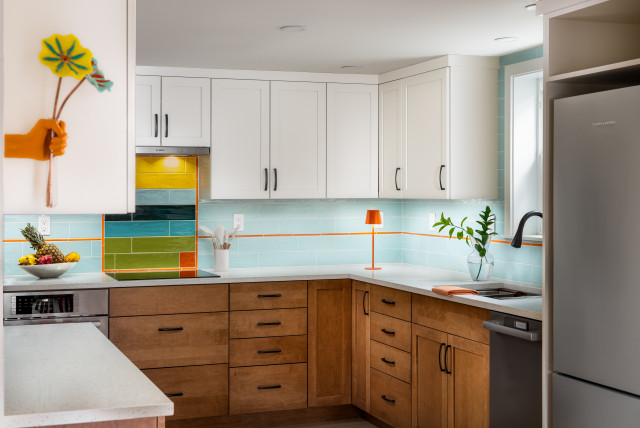
A glazed sky-blue ceramic tile backsplash, accented with a multicolored design above the induction cooktop, adds a cheerful touch. A strip of thin orange accent tiles runs throughout the kitchen, to help a family member with impaired vision navigate the space in the future. “The [homeowners] felt the orange accent tiles are a good wayfinding indicator.”
The three-burner induction cooktop is paired with a slim-profile stainless pullout exhaust hood with LED lights, while a speed oven sits to the lower left. “They wanted this kitchen to be highly functional,” McCabe says.
Cabinets: Dura Supreme Cabinetry
Find an interior designer on Houzz
Sink: Ruvati; faucet: Arbor in oil-rubbed bronze, Moen
10 Aging-in-Place Features Pros Swear By
A dining area lies just behind the sofa, with a coat closet tucked behind the door between the dining area and the kitchen (see the “After” floor plan below). A ductless mini-split unit glimpsed on the wall above the dining table heats and cools the room. An open linen closet stands to the left of the bathroom, and the staircase leads to the home’s main level. “A locking door can be installed at the ADU end of the staircase if desired,” McCabe says.
4 ADUs Just Right for Multigenerational Living
A corner pocket door opens to a storage closet, and wood-look linoleum flooring runs throughout. “It’s highly durable and low-maintenance, so it stands up to a wheelchair,” McCabe says. “We also live in a damp climate, so it’s a good choice for that too.”
Flooring: Marmoleum Linear Striato in Desert Sand, Forbo
See why you should hire a professional who uses Houzz Pro software
Nearby, a combination washer-dryer fits neatly into a niche under the staircase, a cost-effective location made possible by its proximity to the bathroom’s plumbing and drain lines.
25 Home Design Trends Defining How We’ll Live in 2026
An LED-lit mirror above the sink offers task-ready illumination. “There are multiple lighting options that provide the right light level for every task,” McCabe says. Wall-hung storage cabinets flank the sink, with easy-to-spot high-contrast pulls and positioning that ensures equal access for users of all abilities.
10 Bathroom Projects That Deliver Big Results
The bathroom also features a two-piece comfort-height elongated toilet with a contemporary skirted trapway. Grab bars mounted on two sides provide added safety and support for someone transferring from a wheelchair, standing or reaching into nearby cabinetry. “The grab bar [on the right] was intended to be used for the toilet as well as to transfer to the shower seat,” McCabe says.
An open cabinet door above one of the grab bars reveals access to the linen closet previously shown in the living room. “There’s LED strip lighting going vertically on each side when you open the cabinet,” McCabe says. “You don’t have to manually operate the light.”
Toilet: Betello, Kohler
New to home remodeling? Learn the basics
The bedroom opens to this private office and dressing room designed for flexibility and everyday function. A desk built from the same cabinetry used in the kitchen combines open and closed storage, while built-in shelves to the left provide additional easy-access storage. The closet includes hanging rods at two heights, along with integrated shoe and clothing shelves. Heating and cooling are provided by the wall-mounted ductless mini-split. “[The room is] also illuminated with an overhead light for enhanced visibility,” McCabe says.
Before: This floor plan shows the original unfinished basement layout, with the street-level entrance at the bottom right and the staircase centered within the space.
More on Houzz
Read more stories
Browse photos for ideas
Find home professionals
This article was originally published by a www.houzz.com . Read the Original article here. .



ADU at a Glance
Who lives here: An empty-nest couple
Location: Kipsap County, Washington
Size: 800 square feet (74 square meters)
Designer: Molly Erin McCabe of McCabe by Design
Builder: Bryce Whisnant of Fine Line Carpentry
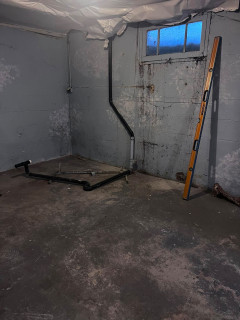
Before: Here’s a look at the southeast corner of the basement, where the kitchen was always planned to be, McCabe says. “The kitchen for the main house is located right above it, so the plumbing and utilities could be shared and make the build-out more economical,” she says.
The renovation began with grinding and sealing the original concrete floor to level it as much as possible, maximizing the ceiling height to meet the 7-foot-minimum code requirement. Some of the floor was jackhammered to reroute the original waste drain, creating connections for the new shower and other plumbing. McCabe also added an interior perimeter framing wall with insulation, boosting the space’s energy efficiency.