Tag

place

Browsing


Adjusting living spaces as we age is a smart move: extra light here, less slip risk there, and who wants to spend more time than necessary scrubbing anything? In these four baths, designers considered all of that and then kept going, swapping out hazardous tubs for roomy showers, clearing floor space for wheelchairs and walkers and installing safety features such as grab bars. And of course, they waved the beauty wand too, creating spaces that are a joy to be in. Have a look, then let us know in the Comments if you’re inspired to borrow any ideas.

Before Photo

Sea Pointe Design & RemodelSave Photo

“After” photos by Leigh Ann Rowe

1. Elegant and Open

Bathroom at a Glance
Who lives here: A couple and the wife’s elderly mother
Location: Laguna Niguel, California
Size: 185 square feet (17 square meters)
Designer: Janna Parr of Sea Pointe Design & Remodel

Before: Stuck in the 1970s, hard to clean and with insufficient storage, this Southern California primary bathroom also lacked safety features to support the elderly mother of one of the homeowners. It had a shower and tub atop a slip-prone step, for instance, and no shower niche, meaning products lined the floor. Designer Janna Parr of Sea Pointe Design & Remodel came up with a plan to make the space modern, streamlined and safer while adding stylish storage.

Sea Pointe Design & RemodelSave Photo
After: A semicustom rich cherry double vanity now spans the angled end of the bathroom, offering a mix of accessible storage and a spacious, easy-to-clean quartz surface. In front, the flooring is more open for better mobility. Just out of frame to the left sits a new linen closet that adds shelving and a rollout hamper.

Countertop: Pure White, Caesarstone

Find a bathroom designer on Houzz

Sea Pointe Design & RemodelSave Photo
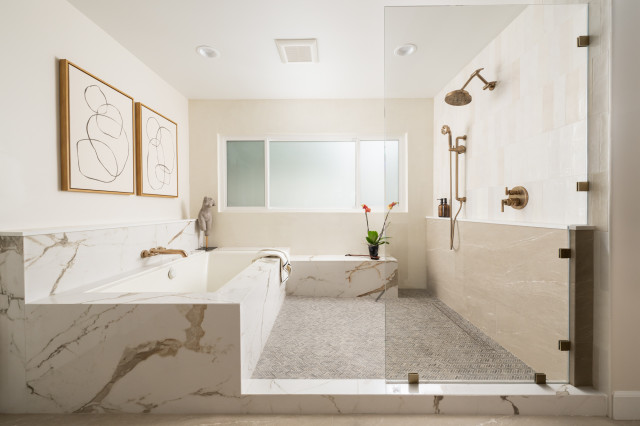
Opposite the vanity, a luxurious low-curb wet room has replaced the dangerous tub and shower. (Curbless would have been cost-prohibitive, due to the room’s foundation.) Large-format marble-look porcelain tiles designed for minimal grout lines surround the tub, and the tub filler has easy-to-operate lever handles. The shower has a wall-mounted shower head and a handheld shower with a slide bar for flexibility. A low bench allows a caregiver to help with bathing if needed. And a shower shelf keeps products from becoming tripping hazards.

Tub surround tiles: Origines Or glossy, 24 by 48 inches, Elysium; shower fixtures: Litze in Brilliance Luxe Gold, Brizo

Read more about this project

Before Photo

Lorain Design AssociatesSave Photo

2. Organic and Warm

Bathroom at a Glance
Who lives here: A pair of empty-nest retirees
Location: Davis, California
Size: 125 square feet (12 square meters)
Design team: Penny Lorain (design) and Matthew Laughlin (project management) of Lorain Design Associates
Builders: Nader Faris and John Rieboldt of AMA Construction

Before: These retiree homeowners in California’s Sacramento Valley wanted to stay put for the long term, so their dated bathroom, with its chopped-up layout, monolithic tub and lack of accessibility, had to go. They brought on Penny Lorain and Matthew Laughlin of Lorain Design Associates to redesign the space for better mobility, ease of use and airy good looks.

See why you should hire a professional who uses Houzz Pro software

Lorain Design AssociatesSave Photo
Photo by Rich Baum Photography

After: The team knocked everything back to the studs and got rid of a water closet in front of the old shower, opening up the space. (The toilet is now in an open area at the front right, out of frame.) Then it rejiggered the layout, creating a spa-like bath with a curbless wet-room-style area at one end. Aging-friendly features include wheelchair and walker maneuverability, ADA-compliant grab bars by the tub, grooved floor tiles that help prevent slippage, and a lower sink and makeup area with wheel space below. Style-wise, wood-look porcelain wall and floor tiles, along with polished blue glass accent tiles, create a warm, organic feel and help the existing vaulted ceiling stand out.

Shower wall tiles: Cypress in Natural, 9 by 48 inches, Happy Floors; floor tiles: Elan Ribbon Maple, 24 by 48 inches, Soho Studio; blue accent tiles: Brook Stacked in Sky, Soho Studio

Read more about this project

Before Photo

Che Bella Interiors Design + RemodelingSave Photo

“After” photos by Spacecrafting

3. Clear and Bright

Bathroom at a Glance
Who lives here: A couple of empty nesters
Location: Inver Grove Heights, Minnesota
Size: 105 square feet (9.8 square meters)
Designer: Stefanie Cohoe of Che Bella Interiors Design + Remodeling

Before: When one of them started using a wheelchair, these Minnesota homeowners tapped designer Stefanie Cohoe of Che Bella Interiors Design + Remodeling to redo their primary bath based on ADA standards. One big to-do: widen the too-narrow main door and shower door openings for maneuverability. While she was at it, Cohoe took the space from uninspired and a bit dark to polished and bright.

Che Bella Interiors Design + RemodelingSave Photo
After: Generous swaths of white give the redesigned bath a luminous look. The doorway gained 6 inches of width and now has a pocket door that stays out of the way. The right side of the double vanity is lower than the left and has space underneath for wheels as well as a hand towel hook; the mirrors above pivot downward. Rollout shelves in the lower part of the linen closet allow for easy access, and a 9-inch-high toe kick below the cabinet makes room for feet.

Paint: Gossamer Veil (walls) and Pure White (cabinets), Sherwin-Williams

11 Ways to Age-Proof Your Bathroom

Che Bella Interiors Design + RemodelingSave Photo
Removing the bathtub and expanding into a closet added square footage to allow for a bigger shower stall, this one curbless and with three grab bars, a lower shower niche, a handheld shower head and a portable teak stool. The toilet area, now to the right of the vanity, also has grab bars for safe maneuvering. On the style side, a lively floral painting, plants, green towels and natural materials keep the look spirited rather than sterile.

Read more about this project

Before Photo

Steveworks LLCSave Photo

4. Convenient and Space-Savvy

Bathroom at a Glance
Who lives here: A couple in their 70s
Location: Newton, Massachusetts
Size: 69 square feet (6.4 square meters)
Design-build firm: Steveworks

Before: Although its first-floor location was ideal for the aging homeowners, this bathroom in their 1923 New England Craftsman had a hard-to-navigate tub-and-shower combo. Could design-build firm Steveworks give them a zero-threshold shower and some safety features, as well as a washer-dryer so they could avoid basement treks? Yes indeed, and with a sweet new look to boot.

Photo by Robert Umenhofer Photography

After: The new walk-in shower has a sliding barn door that’s wide enough for a walker, with a large handle, as well as a built-in seat and an adjustable handheld shower head. Steveworks’ Tova Greenberg moved the sink from that corner to make way for the roomier shower and a petite all-in-one washer-dryer unit on a pedestal next to it. Slip-resistant flooring, ample lighting and a grab bar by the toilet boost safety too, while botanical wallpaper (April Blossom by York Wallcoverings) and lots of white update the room’s style.

Oh, and that original radiator? Yes, it takes up some floor space, but it has charm and does important work keeping the space toasty on cold days. The Steveworks team just refinished it so it would fit the fresh look.

Read more about this project

Your turn: Does your bath support aging in style? Show us in the Comments.

More on Houzz
Read more bathroom stories
Browse bathroom photos
Find a bathroom remodeler


This article was originally published by a
www.houzz.com . Read the Original article here. .


This once-unfinished street-level basement in a 1932 brick Tudor in Kitsap County, Washington, is now a bright, 800-square-foot accessory dwelling unit built for aging in place. The empty-nest homeowners envisioned a cheerful, wheelchair-accessible home they could live in during construction of a new primary suite, and later offer as a comfortable residence for a family member with impaired vision.

To bring that goal to life, they hired designer Molly Erin McCabe, whose work centers on accessibility, sustainability and long-term livability. Structural upgrades, a streamlined layout and lively furnishings transformed the former basement into a fully functional home with a kitchen, dining area, living room, bedroom and bathroom, and a flex space that serves as an office and a dressing room. Aging-in-place features are integrated throughout, including a zero-threshold entry, wide doorways, a curbless shower, abundant layered lighting and durable, easy-care finishes.

Before Photo

McCabe By Design LLCSave Photo

“After” photos by Emily Barrows Photography

ADU at a Glance
Who lives here: An empty-nest couple
Location: Kipsap County, Washington
Size: 800 square feet (74 square meters)
Designer: Molly Erin McCabe of McCabe by Design
Builder: Bryce Whisnant of Fine Line Carpentry

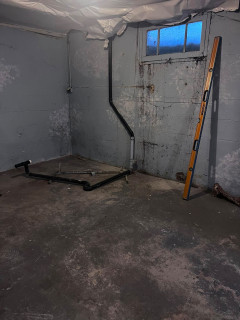
Before: Here’s a look at the southeast corner of the basement, where the kitchen was always planned to be, McCabe says. “The kitchen for the main house is located right above it, so the plumbing and utilities could be shared and make the build-out more economical,” she says.

The renovation began with grinding and sealing the original concrete floor to level it as much as possible, maximizing the ceiling height to meet the 7-foot-minimum code requirement. Some of the floor was jackhammered to reroute the original waste drain, creating connections for the new shower and other plumbing. McCabe also added an interior perimeter framing wall with insulation, boosting the space’s energy efficiency.

McCabe By Design LLCSave Photo
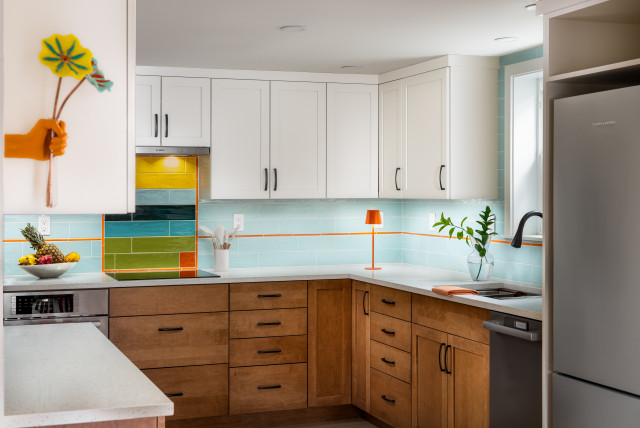
After: McCabe and the homeowners chose durable, low-maintenance materials. The bright kitchen features ample terrazzo-look quartz counters, maple base cabinetry and paint-grade upper cabinets with soft-close doors and drawers. “The maple’s going to be more durable if hit with a walker or wheelchair, but we felt it would be too dark if done throughout,” she says.

A glazed sky-blue ceramic tile backsplash, accented with a multicolored design above the induction cooktop, adds a cheerful touch. A strip of thin orange accent tiles runs throughout the kitchen, to help a family member with impaired vision navigate the space in the future. “The [homeowners] felt the orange accent tiles are a good wayfinding indicator.”

The three-burner induction cooktop is paired with a slim-profile stainless pullout exhaust hood with LED lights, while a speed oven sits to the lower left. “They wanted this kitchen to be highly functional,” McCabe says.

Cabinets: Dura Supreme Cabinetry

Find an interior designer on Houzz

McCabe By Design LLCSave Photo
A 30-inch undermount, 16-gauge stainless workstation sink accommodates large pots and pans, and comes with handy accessories like a basket strainer and an integrated cutting board for easy prep and cleanup. Its motion-activated pull-down faucet makes using it effortless for older people, and the rich oil-rubbed bronze finish adds warmth. A code-compliant egress window above the sink brings in natural light and fresh air from the dug-out window well. A stainless dishwasher sits to the lower right.

Sink: Ruvati; faucet: Arbor in oil-rubbed bronze, Moen

10 Aging-in-Place Features Pros Swear By

McCabe By Design LLCSave Photo
Wide pathways extend through and off the living area, supporting easy movement throughout the ADU. “The bathroom has a 36-inch-wide entry door that provides full access for users of mobility devices such as a wheelchair,” McCabe says. Bright white walls and ceilings (White Dove by Benjamin Moore) enhance visibility and create a flexible backdrop for colorful furnishings and art. “The bright colors also help you travel through the space, especially for those who are visually impaired,” McCabe says.

A dining area lies just behind the sofa, with a coat closet tucked behind the door between the dining area and the kitchen (see the “After” floor plan below). A ductless mini-split unit glimpsed on the wall above the dining table heats and cools the room. An open linen closet stands to the left of the bathroom, and the staircase leads to the home’s main level. “A locking door can be installed at the ADU end of the staircase if desired,” McCabe says.

4 ADUs Just Right for Multigenerational Living

McCabe By Design LLCSave Photo
From the kitchen, this view looks toward the front entry behind the sofa. The glass door and sidelight include built-in blinds for privacy. “This basement has a zero-threshold entry, and you enter right off the street,” McCabe says. “There are no stairs to enter the structure, so anyone using a wheelchair or walker can go in and out easily.”

A corner pocket door opens to a storage closet, and wood-look linoleum flooring runs throughout. “It’s highly durable and low-maintenance, so it stands up to a wheelchair,” McCabe says. “We also live in a damp climate, so it’s a good choice for that too.”

Flooring: Marmoleum Linear Striato in Desert Sand, Forbo

See why you should hire a professional who uses Houzz Pro software

McCabe By Design LLCSave Photo
The bathroom includes an open, curbless shower outfitted with multiple grab bars, a fold-down bench and a handheld sprayer. Mosaic porcelain tile flooring is wet-rated for slip resistance. “The grout provides additional traction,” McCabe says. The floors are also heated. “Heated floors dry faster, reducing slip hazards while preventing mold and mildew, which means less cleaning and better indoor air quality,” McCabe says.

Nearby, a combination washer-dryer fits neatly into a niche under the staircase, a cost-effective location made possible by its proximity to the bathroom’s plumbing and drain lines.

25 Home Design Trends Defining How We’ll Live in 2026

McCabe By Design LLCSave Photo
The bathroom’s wall-hung lavatory sink provides clear space below for a wheelchair or walker. “The wide ledges on either side of the sink are convenient for keeping grooming products and appliances close at hand,” McCabe says.

An LED-lit mirror above the sink offers task-ready illumination. “There are multiple lighting options that provide the right light level for every task,” McCabe says. Wall-hung storage cabinets flank the sink, with easy-to-spot high-contrast pulls and positioning that ensures equal access for users of all abilities.

10 Bathroom Projects That Deliver Big Results

McCabe By Design LLCSave Photo

The bathroom also features a two-piece comfort-height elongated toilet with a contemporary skirted trapway. Grab bars mounted on two sides provide added safety and support for someone transferring from a wheelchair, standing or reaching into nearby cabinetry. “The grab bar [on the right] was intended to be used for the toilet as well as to transfer to the shower seat,” McCabe says.

An open cabinet door above one of the grab bars reveals access to the linen closet previously shown in the living room. “There’s LED strip lighting going vertically on each side when you open the cabinet,” McCabe says. “You don’t have to manually operate the light.”

Toilet: Betello, Kohler

McCabe By Design LLCSave Photo
The cozy bedroom is filled with natural light from an enlarged window overlooking a window well. A former fireplace area that couldn’t be relocated prevented the addition of a traditional closet, but the bedroom opens to an adjacent office and dressing room that includes closet storage (shown below). A white oak handrail, partially visible here on the right, wraps around the corner into the bedroom. “It’s an elegant wayfinding guide,” McCabe says.

New to home remodeling? Learn the basics

McCabe By Design LLCSave Photo

The bedroom opens to this private office and dressing room designed for flexibility and everyday function. A desk built from the same cabinetry used in the kitchen combines open and closed storage, while built-in shelves to the left provide additional easy-access storage. The closet includes hanging rods at two heights, along with integrated shoe and clothing shelves. Heating and cooling are provided by the wall-mounted ductless mini-split. “[The room is] also illuminated with an overhead light for enhanced visibility,” McCabe says.

McCabe By Design LLCSave Photo

Before: This floor plan shows the original unfinished basement layout, with the street-level entrance at the bottom right and the staircase centered within the space.

McCabe By Design LLCSave Photo
After: Aside from extending the new front door by about 1 foot, McCabe designed the fully accessible ADU within the basement’s original footprint. The kitchen sits in the upper right, with the bathroom along the top, the bedroom in the upper left, the office and dressing room in the lower right and the living area at the center. “Accessible dwelling units are being embraced in communities across the country,” McCabe says. “It’s a growing option for affordable housing and an alternative to assisted care.”

More on Houzz
Read more stories
Browse photos for ideas
Find home professionals


This article was originally published by a
www.houzz.com . Read the Original article here. .


The value of a single-family home depends not only on its physical features but also on its location and neighborhood context. In this second part of our two-part series, we examine how geography and neighborhood quality further influence single-family detached home values across the United States. Not surprisingly, location remains one of the strongest drivers of home values (Figure 2). Homes in a big metropolitan area are valued 60% higher than comparable homes in non-metro areas, while those in smaller or midsized metro areas are 22% more.

Home values also vary significantly across Census Divisions. Using New England as the baseline, homes in the Pacific Divisions, including Alaska, California, Hawaii, Oregon, and Washington, are valued around 35% higher values on average. By contrast, homes in the rest of the divisions show substantially lower values relative to New England. Homes in the East South Central and West South Central divisions are more than 60% lower in value, while those in the Middle Atlantic are about 30% lower. In the East North Central and West North Central Divisions, home values are roughly 47% and 46% lower, respectively. Homes in the South Atlantic are 39% lower, and those in the Mountain Division are about 19% lower.

People are willing to pay a premium for a better neighborhood. This analysis shows that a higher overall neighborhood quality rating, measured on a 1 to 10 scale, contributes about a 2% increase in home value for every 1-point rise (Figure 3). For example, moving from a neighborhood rated 5 to one rated 7 could increase your home value by 4%.

On the other end, the impact of specific negative conditions is substantial (Figure 4). Homes located near abandoned or vandalized buildings have 17% lower values. Additionally, the presence of visible trash nearby reduces home values by 8%. Improving the broader neighborhood environment could have as much impact on the final home value as upgrades inside the home.

Please click here to be redirected to the full special study.


This article was originally published by a eyeonhousing.org . Read the Original article here. .


“Hallways and landings are vital circulation spaces that ensure safe and comfortable movement throughout the home,” architect Thomas Mullally says. “As architects, we keep all of this in mind with our design process. As mobility may decrease with age, these areas need to be designed to minimize obstacles and hazards, promoting ease of use in daily life.”

We’re not talking ugly institutional additions that would ruin the aesthetic of your stylish home. When ideas are incorporated from the outset of a renovation, you have the power to streamline them aesthetically. Whether it’s thoughtful custom cabinetry, careful flooring choices or flexible lighting, there are many simple ideas you can consider incorporating into your project to ensure your house is fit for living long into the future.


This article was originally published by a www.houzz.com . Read the Original article here. .


After raising their daughter, a California couple shifted focus to caring for the wife’s elderly mother in their late-1970s home. To make the space safer and more functional, they prioritized updating their outdated primary bathroom, which had a cramped vanity and a hazardous step-up shower and tub.

They turned to Sea Pointe Design & Remodel, where lead designer Janna Parr reimagined the bathroom as a spacious wet room with a built-in tub and open shower featuring both a multifunction shower head and a hand shower. A new cherry double vanity adds warmth and storage, while a mix of calming, textured tiles brings style and serenity to this now safe, modern retreat.

Before Photo

Sea Pointe Design & RemodelSave Photo

“After” photos by Leigh Ann Rowe

Bathroom at a Glance
Who lives here: A couple and the wife’s elderly mother
Location: Laguna Niguel, California
Size: 185 square feet (17 square meters)
Designer: Janna Parr of Sea Pointe Design & Remodel

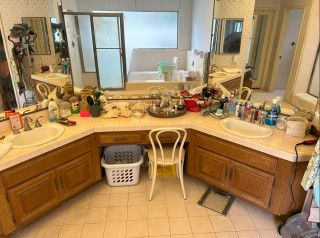
Before: The aging bathroom, with its peeling floral wallpaper, lacked both safety and style. A basic angled wood double vanity had large plain mirrors and a hard-to-clean tile countertop. The only drawer storage came from a small makeup station in the center, leaving hair and skincare products cluttering the surface. “We had a challenge with the angled wall and did not want to turn it into a structural project,” Parr says. “We couldn’t really move walls. There was also a peeling soffit above with a fluorescent light that we wanted to eliminate.”

Across from the vanity, the step-up tub and shower (visible here in the mirrors) raised safety concerns and felt outdated. The homeowners chose to keep the water closet as is. “We didn’t change anything in there,” Parr says.

Find a bathroom designer

Sea Pointe Design & RemodelSave Photo
After: Parr removed the tub, shower and double vanity to make way for a complete transformation, including updated plumbing and electrical systems.

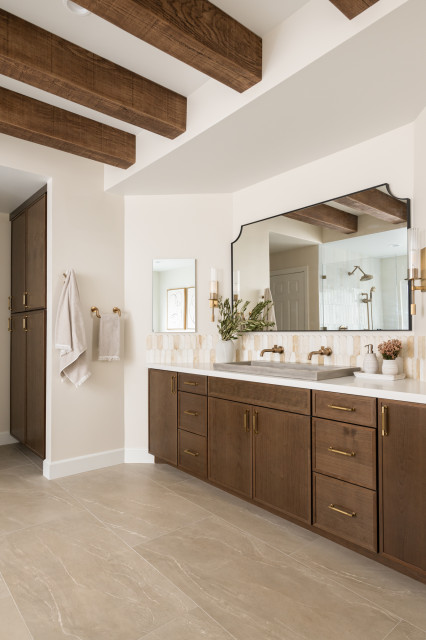
An elegant semicustom cherry double vanity anchors the space. It offers a smart mix of shallow and deep soft-close drawers along with spacious cabinets for improved storage. A rich clove brown finish adds depth and warmth. “We wanted to make sure we had enough counter space and sink space,” Parr says. “We went with one long sink to achieve symmetry with the way we were planning to do the mirror and medicine cabinets above.”

The two frameless mirrored medicine cabinets flank a metal-framed mirror in an oil-rubbed bronze finish. Wall sconces with traditional torch-style silhouettes and brass accents sit on either side. “We fell in love with the detail on the top of the mirror,” Parr says. “It also bounces light around the bathroom, so it feels more open and airy.”

A soft, warm white now coats the walls and ceiling, while a bright white on the trim adds subtle contrast.

Paint colors: Shoji White (wall and ceiling) and Pure White (trim), Sherwin-Williams; sconces: Elton in Patina Brass, Troy Lighting; vanity hardware: Top Knobs; mirror: Colestin in oil-rubbed bronze, Rejuvenation

Shop for bathroom vanities on Houzz

Sea Pointe Design & RemodelSave Photo
The artisan-crafted 36-inch concrete trough sink gives the vanity a modern, organic feel. Its semivessel design adds visual depth, while two wall-mounted, single-handle faucets in a luxe gold finish bring a touch of sophistication. “We were looking at trough sinks in general because we wanted a long sink,” Parr says. “Color-wise it also tied into tiles we used in the shower. The semivessel sink design also offered some dimension and interest.”

Topping the vanity is a polished pure white quartz surface that’s resistant to scratches, stains, cracks and heat. “We had a lot of movement with the backsplash tile that was our feature and wanted something to complement but not compete,” Parr says. “It also ties into other white elements throughout the space.”

The backsplash consists of polished ivory onyx mosaic tiles in a scalloped design with tonal variation that adds texture and charm. “I think they add both luxury and whimsy,” Parr says. “They also add interest to an otherwise neutral palette. We also wanted to tie in some of the gold tones on this side of the bathroom with the gold tones seen around the tub.”

Sink: Native Trails; faucets: Litze in Brilliance Luxe Gold, Brizo; countertop: Pure White, Caesarstone; wall tile: Piano Onyx Ivory mosaic, Elysium

11 Ways to Age-Proof Your Bathroom

Sea Pointe Design & RemodelSave Photo
A new linen closet at the back left now coordinates seamlessly with the updated double vanity, replacing a pair of aging upper and lower cabinets that were falling apart. “It has a rollout hamper inside and extra shelving that gives them lots of storage,” Parr says.

To enhance the existing tray ceiling, faux architectural beams were added where fluorescent lights once sat, adding both character and warmth. “That was a last-minute decision from the homeowners,” Parr says. “That was a splurge, but we had dreamed of adding them into the design to give it an old-world feel.”

A towel bar and hook near the vanity complement the space’s other luxe gold accents.

See why you should hire a professional who uses Houzz Pro software

Before Photo

Sea Pointe Design & RemodelSave Photo

Before: Across from the vanity in the former bathroom, the hazardous step-up tub sat next to a dated stall shower with a low enclosure, which was also raised above the main floor level. “It was clumsy and slippery,” Parr says. “There was also a ‘fern trench’ from the 1970s there behind the tub and shower.” The trench area was meant to hold plants.

Before Photo

Sea Pointe Design & RemodelSave Photo

Before: Here’s a closer look at the old shower beside the tub. With no shower niche, bathing products cluttered the floor, and the step-up entry was a key feature the homeowners were eager to eliminate.

Sea Pointe Design & RemodelSave Photo
After: The new wet room seamlessly combines a modern built-in rectangular tub with an open-concept shower, creating a stylish, low-maintenance space with a low-curb entry for easier access. “It would have been cost-prohibitive to revise the foundation in order to garner a curbless entry,” Parr says. “But as a designer, I also liked the way we carried the tile across the curb and bench to elongate the space and create a modern organic look and Roman luxury influence.”

The operable window on the back wall was updated by the homeowners, while a textured microcement finish — an ancient European technique gaining popularity in the U.S. — was applied to the wall in thin layers for durability and waterproofing. “I just didn’t want it to feel busy, and wanted to eliminate more tile and more grout,” Parr says.

Is a Wet Room Right for You?

Sea Pointe Design & RemodelSave Photo
The modern 36-by-66-inch acrylic tub is surrounded by large-format (24-by-48-inch) polished marble-look porcelain tiles. These rectified tiles, made using advanced inkjet technology, offer a realistic appearance and are precisely cut for minimal grout lines, creating a sleek, seamless look.

A streamlined, wall-mounted tub filler in a gold finish with lever handles replaced the original fixture. “Keeping the plumbing in the same location allowed us to keep within our budget,” Parr says. The paneled door partially visible at left leads to the primary bedroom.

Tile surround: Origines Or glossy, 24 by 48 inches, Elysium; tub filler: Litze in Brilliance Luxe Gold, Brizo

New to home remodeling? Learn the basics

Sea Pointe Design & RemodelSave Photo
The wet room’s shower area features a multifunction, wall-mounted shower head and a separate hand shower with a slide bar for flexibility and ease of use. All the fixtures match those used at the tub and vanity for a cohesive, polished look. “We strategically placed the fixtures so the valves are off to the side, so they can’t get wet when turning them on,” Parr says. “We also designed the shower bench a bit shorter so a caregiver can help with bathing.”

The upper portion of the shower wall is clad in 3-by-12-inch ivory ceramic tiles with subtle tonal variation, soft texture and a gentle glaze. “We did a staggered vertical pattern to kind of mirror the backsplash at the vanity,” Parr says.

Below, 24-by-48-inch matte sand-colored porcelain tiles add visual depth and contrast. A quartz-topped shower shelf, matching the vanity countertop, offers a clean, dry space for hair and body products, keeping clutter off the wet-room floor.

Shower fixtures: Litze in Brilliance Luxe Gold, Brizo; shower wall tile (top): Flash in ivory, 3-by-12-inch, Arizona Tile; shower wall tile (bottom): Waystone Sand, 24-by-48-inch, Elysium

Sea Pointe Design & RemodelSave Photo
The wet-room floor features authentic limestone mosaics with an aged finish, arranged in a herringbone pattern with driftwood-hued grout. A linear drain is seamlessly integrated using the same tile for a clean, cohesive look. “The more natural materials I can incorporate into a space will make it feel timeless and luxurious,” Parr says. “They also can take on a lot of water and abuse.” A custom spot-resistant shower glass divider with brass clips and hinges adds to the open, airy feel.

The doors just outside the wet room lead to the water closet — located behind the shower fixtures — and a walk-in closet on the adjacent wall. “The thoughtful design and layout for functionality was a primary focus,” Parr says, “but the clients put full faith and trust in me to create a layered bathroom with multiple textures, sheens and touches of luxury.”

More on Houzz
Read more bathroom stories
Browse bathroom photos
Find a bathroom remodeler
Shop for your bathroom


This article was originally published by a
www.houzz.com . Read the Original article here. .


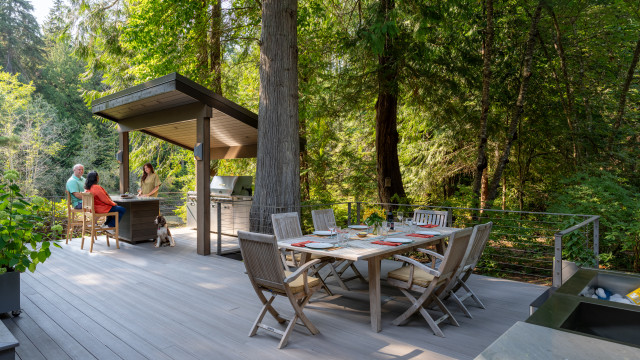
Hoffman LandscapesSave Photo
7. Turn to Technology

Automate as many maintenance chores as you can. A good place to start is with your irrigation systems. You can add timers to in-ground systems, drip systems and soaker hoses. These systems allow for watering all parts of a garden without having to drag a hose from place to place. In-ground systems with a timer also reduce the possibility of tripping over a garden hose. You can set the timers for the times that are best for both you and your garden, such as during the night.

Take it a step further by adding other automated features, such as motion-activated lights that come on when you step out at night or lights that turn on and off on a regular schedule.

New smart and automated garden products and features are rapidly coming on the market as well. Look through gardening magazines and websites, and talk to the staff at nurseries and hardware stores about what automated features they would recommend.

Bonus: An automated watering system, particularly one with smart features, ensures that your garden will get the water it needs when it needs it, and often results in using less water.

Plus, automating both your irrigation and your lighting will allow you to go on vacation without scouring the neighborhood for someone to tend to your plants or, if it’s in a front yard, worrying that your home will look empty.


This article was originally published by a
www.houzz.com . Read the Original article here. .


Brighton Homes Idaho Inc.Save Photo
5. Consider Flooring Carefully

Rugs can add texture, interest and warmth to a bedroom, but they can be treacherous underfoot, especially for anyone unsteady of body or visually compromised.

“It’s important to note that rugs can be hazardous for the elderly,” Lecoufle-Vinet says. “If someone doesn’t lift their feet as much, they may stumble over rugs and fall. Choosing bare wooden floors or wall-to-wall carpeting can offer a safer alternative.”

Jones suggests that hard surfaces, particularly wood, can be ideal if mobility aides are used. “For those using a wheelchair or walker, carpet or rugs can be difficult to navigate, and carpets can create too much resistance for a wheelchair.”

Linoleum and cork will also provide a warm, soft, insulated floor that’s easier to navigate on wheels, but get expert advice and make sure your chosen flooring is suitable for your situation.

Find a general contractor


This article was originally published by a
www.houzz.com . Read the Original article here. .


Lumar InteriorsSave Photo
2. Aim for Higher Seating

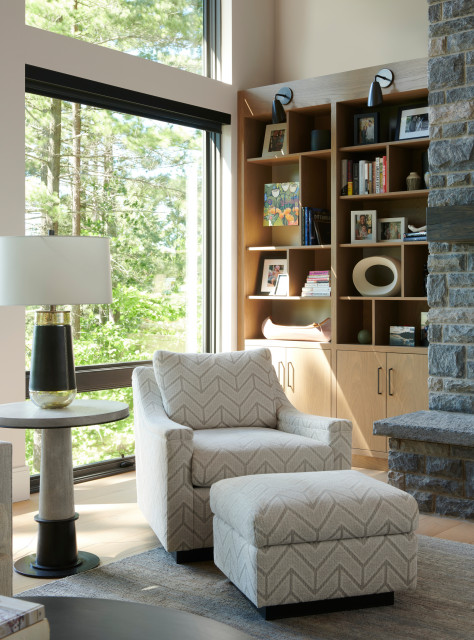
Seating is the heart of any living room and is an area to really focus on. “Higher and firmer seats and armrests really make a difference,” Mullally says.

Becky Storey of Storey Interiors highlights the importance of seating that’s easy to get in and out of, especially for those with mobility difficulties. Seating that’s too low can be problematic, she says. “Or seating that slopes down at the back, because it requires a lot more upper body strength to pull yourself up. The same goes for sofas that have really soft cushions or where the seat is very deep.”

For a lesser change than buying new chairs and sofas, Eva Byrne of houseology suggests that a standard seat height of 18 inches should accommodate yourself and all visitors, and “a raised cushion at your favorite spot will improve accessibility here if needed.”

Vatzeva also highlights the importance of good support for the back to keep it straight, along, potentially, with support for the feet to be lifted. But she also has a word of caution about electric recliners. “Personally, I don’t think they are in our favor,” she says. “They promote less movement and less activity … which can have a negative impact on body, mind and general health.”

It’s not all about sofas and armchairs — consider custom solutions too. Vatzeva suggests that a great spot for adding new seating is within a bay window or alcove. “These are good places to install seating at a suitable height,” she says. “They can be standalone pieces or built-in, and offer a wonderful way of combining the practical with the beautiful while being bespoke for one’s own needs.”

Shop for living room furniture


This article was originally published by a
www.houzz.com . Read the Original article here. .


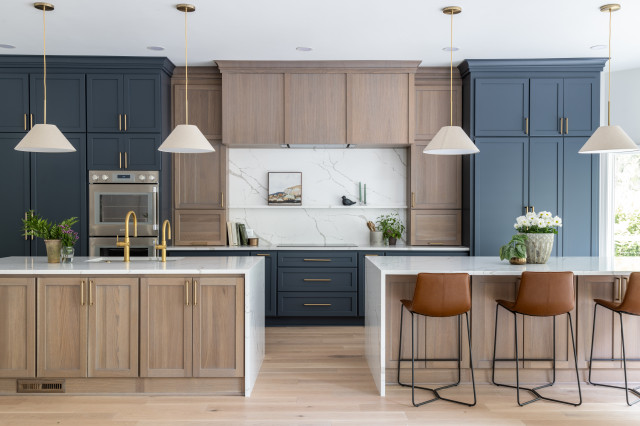
Successfully planning a kitchen that will work beautifully for you and other family members well into later life comes down to a number of factors. Considerations include safety, functionality, ease of use — and sustainability, because you’ll be building something that will last.

“We are frequently considering how things will work in 20 years’ time and all that’s in between,” says designer Steve Root of Roots Kitchens, Bedrooms and Bathrooms. “That means thinking about how the homeowners’ needs might change, how lifestyles may develop, how things will wear and break and, thus, how they can be maintained.”

But that doesn’t means a kitchen without character. Because when form and function work hand in hand, you’re winning at design.


This article was originally published by a www.houzz.com . Read the Original article here. .


Successfully planning a kitchen that will work beautifully for you and other family members well into later life comes down to a number of factors. Considerations include safety, functionality, ease of use — and sustainability, because you’ll be building something that will last.

“We are frequently considering how things will work in 20 years’ time and all that’s in between,” says designer Steve Root of Roots Kitchens, Bedrooms and Bathrooms. “That means thinking about how the homeowners’ needs might change, how lifestyles may develop, how things will wear and break and, thus, how they can be maintained.”

But that doesn’t means a kitchen without character. Because when form and function work hand in hand, you’re winning at design.


This article was originally published by a www.houzz.com . Read the Original article here. .
Pin It