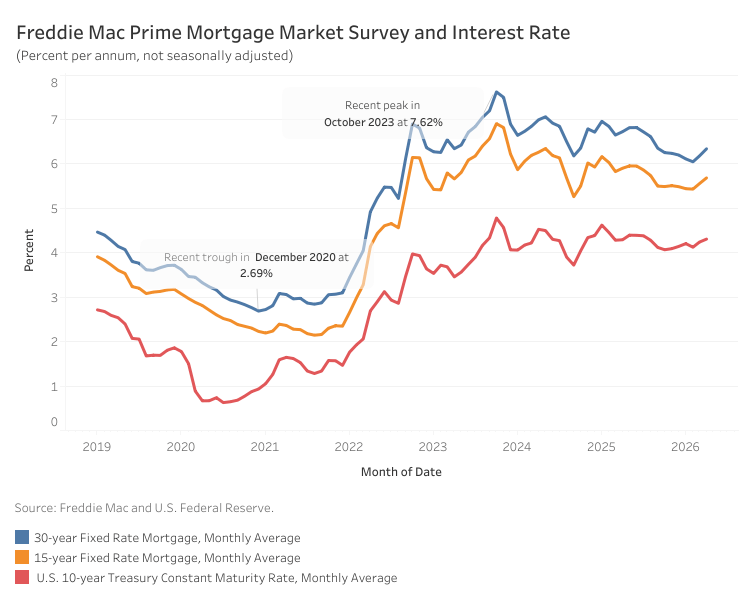
Mortgage rates continued to increase in April as ceasefire negotiations remain inconclusive. According to Freddie Mac, the 30-year fixed-rate mortgage averaged 6.34% in April, 16 basis points (bps) higher than March. The average 15-year rate also increased by 13 bps to 5.69%. Despite the recent increase, both rates remain lower than a year ago by 39 bps and 21 bps, respectively.
The 10-year Treasury yield, a key benchmark for long-term borrowing, averaged 4.31%, up 7 bps from the previous month. Ongoing blockades in the Strait of Hormuz have kept oil prices above $100 per barrel. This has passed through to inflation which climbed to 3.3%, nearing a two-year high. Energy components led the increase with fuel oil prices rising 30.7% and gasoline up 21.2% in March.
At its latest meeting, the Federal Reserve held the federal funds rates unchanged at 3.5% to 3.75% as inflation remains elevated alongside continued economic expansion. Jerome Powell’s term as Chair will end next month but has announced that he will remain on the Board of Governors. Kevin Warsh, President Trump’s pick as the next Fed Chair, indicated during a Senate Banking Committee hearing a preference for alternative inflation measures, including “trimmed averages”, which removes outliers above and below a certain threshold. For example, by stripping out outsized swings like a 50.8% annualized drop in telecom equipment and a 384.6% jump in moving and freight services, the Dallas Fed’s trimmed-mean measure last February registered 2.3%, below the 2.8% headline PCE and 3.0% core PCE.
This article was originally published by a eyeonhousing.org . Read the Original article here. .