Tag

YearoverYear

Browsing


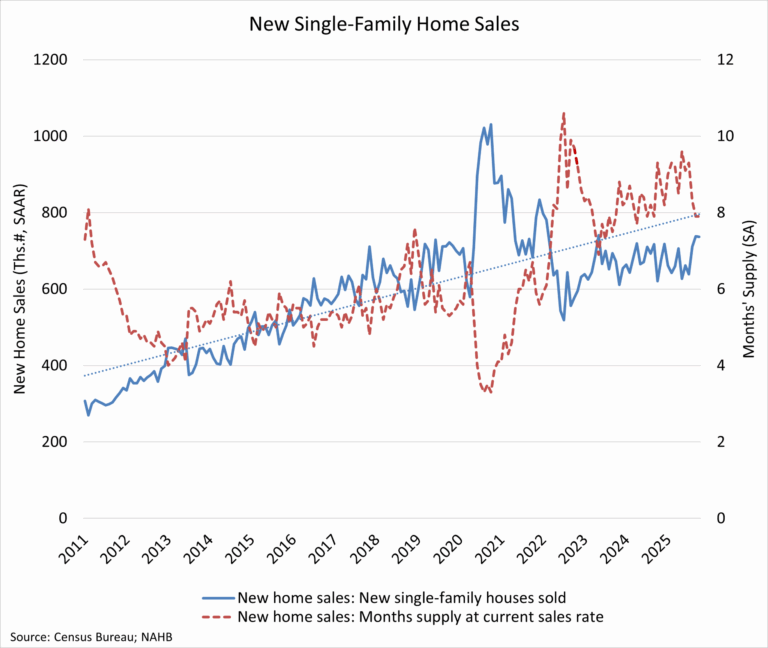
The new home sector has played an increasingly important role in meeting housing demand as resale inventory remains constrained in many regions. The latest data released today (and delayed because of the government shutdown in fall of 2025) indicate that new single-family home sales continue to reflect a stabilizing market after a period of heightened volatility. While month-to-month activity shows some variability, sales remain stronger than a year ago, signaling that buyer interest in newly built homes has improved.

Sales of newly built single-family homes increased 18.7 percent year over year in October to a seasonally adjusted annual rate of 737,000 units, according to the U.S. Department of Housing and Urban Development and the U.S. Census Bureau. This represented a modest 0.1 percent decline from September and a 1.2 percent decrease on a year-to-date basis. A new home sale is recorded when a contract is signed or a deposit is accepted, regardless of the stage of construction. The seasonally adjusted annual rate reflects the pace of sales that would occur over a 12-month period if current conditions persisted.

New single-family home inventory totaled 488,000 units in October, unchanged from the prior month and 1.7 percent higher than a year earlier. At the current sales pace, the months’ supply of new homes stood at 7.9, down from 9.3 months one year ago, though still above the six-month level that is generally considered balanced.

Combined new and existing home inventory has edged lower in recent months, with total months’ supply declining to 4.9, reflecting slower construction activity. Meanwhile, inventory conditions in the existing home market have shown gradual improvement, and moderating prices across both markets have helped support buyer demand amid ongoing affordability concerns.

By the end of October 2025, there were 124,000 completed, ready-to-occupy homes available for sale on a not seasonally adjusted basis, up 10.7 percent from a year earlier. Completed homes accounted for roughly one-quarter of total inventory, while homes under construction made up 51 percent. The remaining 24 percent of homes sold in October had not yet started construction at the time the sales contract was signed.

Home prices showed further signs of easing in October. The median new home sale price declined 3.3 percent to $392,300, marking an 8.0 percent decrease from a year ago. Affordability improved at the lower end of the market, with 25 percent of new homes priced below $300,000, the highest share in recent months. Thirty percent of homes were priced above $500,000, while the remaining 45 percent fell within the $300,000 to $500,000 range.

Regionally, year-to-date new home sales declined in three of the four regions, falling 0.1 percent in the Midwest, 7.2 percent in the West, and 22.9 percent in the Northeast. The South was the only region to post growth, with sales up 2.9 percent.


This article was originally published by a eyeonhousing.org . Read the Original article here. .
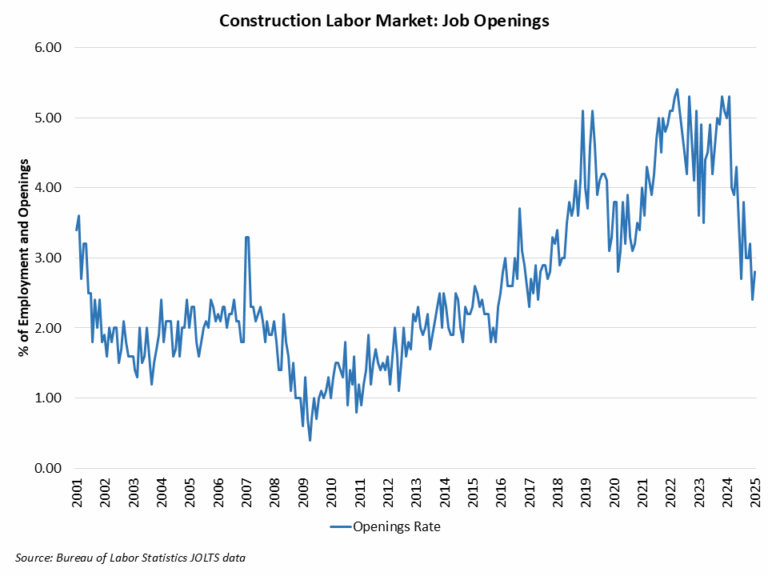

After a period of slowing associated with declines for some elements of the residential construction industry, the count of open construction sector jobs remained lower than a year ago, per the January Bureau of Labor Statistics Job Openings and Labor Turnover Survey (JOLTS).

The number of open jobs for the overall economy increased from 7.51 million in December to 7.74 million in January. This is notably smaller than the 8.47 million estimate reported a year ago and reflects a softened aggregate labor market. Previous NAHB analysis indicated that this number had to fall below 8 million on a sustained basis for the Federal Reserve to feel more comfortable about labor market conditions and their potential impacts on inflation. With estimates remaining below 8 million for national job openings, the Fed in theory should be able to cut further despite a recent pause. However, tariff proposals may keep the Fed on pause in the coming quarters.

The number of open construction sector jobs increased from a revised 205,000 in December to 236,000 in January. This nonetheless marks a significant reduction of open, unfilled construction jobs than that registered a year ago (407,000) due to a slowing of construction activity because of ongoing elevated interest rates.

The construction job openings rate edged higher to 2.8% in January, significantly down year-over-year from 4.8%.

The layoff rate in construction stayed low (1.8%) in January. The quits rate moved higher to 2% in January, near to its rate from a year ago.

Discover more from Eye On Housing

Subscribe to get the latest posts sent to your email.


This article was originally published by a eyeonhousing.org . Read the Original article here. .
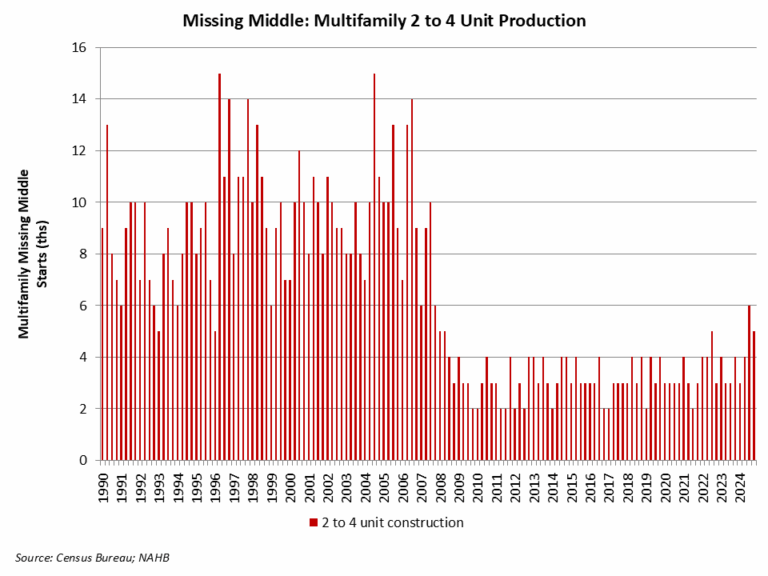

The missing middle construction sector includes development of medium-density housing, such as townhouses, duplexes and other small multifamily properties.

The multifamily segment of the missing middle (apartments in 2- to 4-unit properties) has generally disappointed since the Great Recession. However, there was a noticeable uptick for this type of housing construction in recent data. For the fourth quarter of 2024, there were 5,000 2- to 4-unit housing unit construction starts. This is up 25% from the fourth quarter of 2023.

As a share of all multifamily production, 2- to 4-unit development was just above 5% of total multifamily development for the fourth quarter. However this is still lower than recent historic trends. From 2000 to 2010, such home construction made up a little less than 11% of total multifamily construction.

Construction of the missing middle has clearly lagged during the post-Great Recession period and will continue to do so without zoning reform focused on light-touch density. But recent data offer hope for additional housing supply for these kind of structures.

Discover more from Eye On Housing

Subscribe to get the latest posts sent to your email.


This article was originally published by a eyeonhousing.org . Read the Original article here. .
Pin It