Tag

Year

Browsing


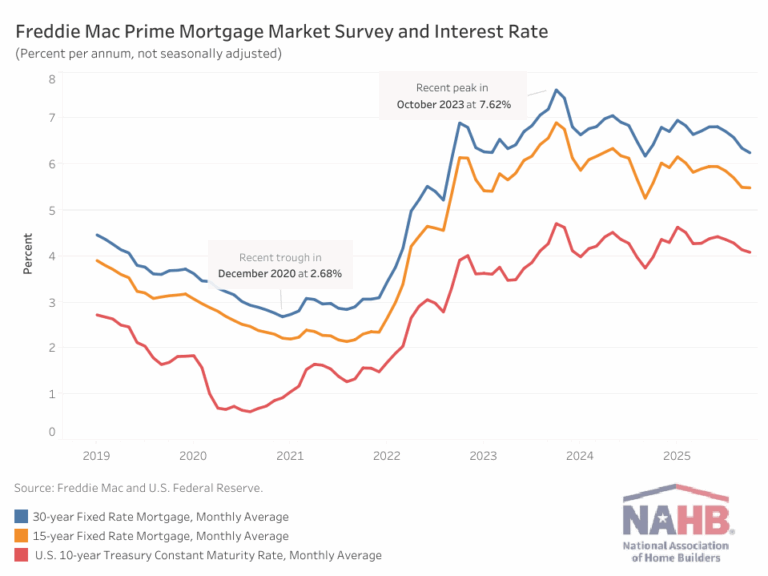
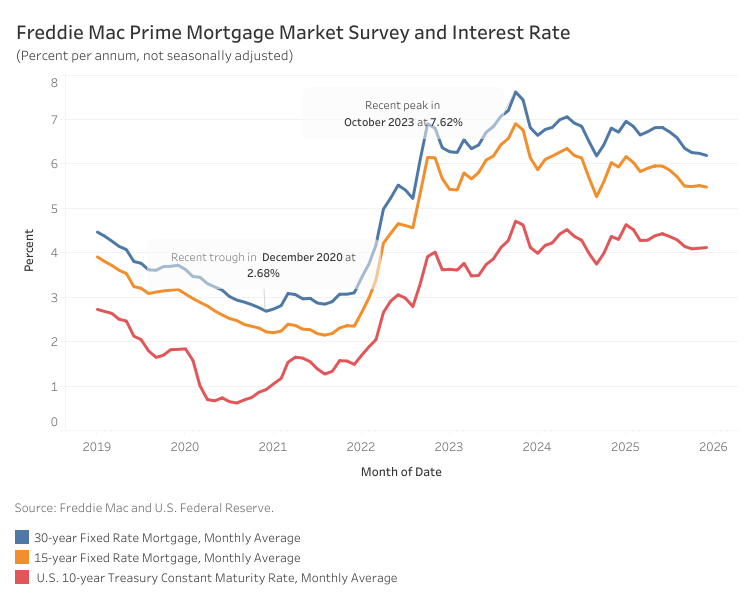
Long-term mortgage rates have been declining since mid- 2025 and ended the year at their lowest level since September 2024. According to Freddie Mac, the 30-year fixed-rate mortgage averaged 6.19% in December, 5 basis points (bps) lower than November. Meanwhile, the 15-year rate declined 3 bps to 5.48%. Compared to a year ago, the 30-year rate is lower by about half a percentage point, or 53 basis points (bps). The 15-year rate is also lower by 45 bps.

The 10-year Treasury yield, a key benchmark for long-term borrowing, averaged 4.12% in December – a modest increase of 2 bps from the previous month. Given forward-looking markets, the 10-year Treasury yield declined during the week preceding the Federal Reserve’s third rate cut of the year. However, compared to the prior month, yields ended slightly higher, rising 2 bps, as labor market data released shortly thereafter pointed to slowing job gains and rising unemployment rate.

Falling lower mortgage rates have started to translate into gains as existing home sales edged up slightly in November. However, this increase remains limited as mortgage rates above 6% are still considered elevated. Nonetheless, as financing costs continue decline, more households are likely to reenter the housing market. An NAHB analysis shows that a 25 bps reduction in the 30-year mortgage rate, from 6.25% to 6.00%, could bring approximately 1.1 million additional households back into the buyer pool.

NAHB expects the 30-year mortgage rate to average 6.17% in 2026 and would reach 6% by 2027.


This article was originally published by a eyeonhousing.org . Read the Original article here. .


Ascent Contracting IncSave Photo
2. Analyze Key Areas of Your Business

Take a deep dive into the previous year’s performance of your firm, prioritizing four main areas.

Finances. Profitability and cash flow are, of course, essential for any business, so make sure you cover this aspect thoroughly during your annual review. “I keep records of each project, the time spent and revenue earned, as well as the types of projects that work best for me,” Auzins says. “We review fees and costs, and work out if changes are needed.”

“We analyze profitability, evaluate individual project performance and examine trends in financial data,” says Alex Strikovs, managing director of design-build firm Home Republic. “This helps us understand what drives profitability and where to focus our efforts.”

Reader recommends doing an audit of all your outgoings. “It’s important to keep an eye on the functionality of key expensive tools, such as the computer and software, and to plan upgrades ahead of time,” he says. “I also review the ongoing relevance of regular outgoings, such as memberships and publicity payments, to ensure they’re still required and are delivering.

“Income is obviously also key and with [at least] nine months of income data in hand, as well as client numbers and types of projects, I can reflect on the balance and areas of income generation of the business,” he says. “From these, I can make informed decisions on my preferred work and my pricing model for the coming year.”

How to Build Systems and Teams That Can Cope With Busy Times


This article was originally published by a
www.houzz.com . Read the Original article here. .


1. An Elegant Soiree

Whether you want to celebrate with just that special person in your life or fill your house with friends, New Year’s Eve is the perfect excuse to pull out all of the stops. Champagne and oysters? Why not?

Indulging in these luxuries at home is far more cost conscious than ordering them in a restaurant. A note on the invitation to dress “to the nines” should be enough encouragement to get people in their party clothes.

For extra amusement scatter an assortment of fun props across a console table — boas, tiaras, hats, noisemakers, horns — and invite guests to help themselves. As always, be a thoughtful host and provide festive nonalcoholic beverages for your guests who do not drink.

Find an interior designer on Houzz


This article was originally published by a www.houzz.com . Read the Original article here. .


Builder confidence inched higher to end the year but still remains well into negative territory as builders continue to grapple with rising construction costs, tariff and economic uncertainty, and many potential buyers remaining on the sidelines due to affordability concerns.

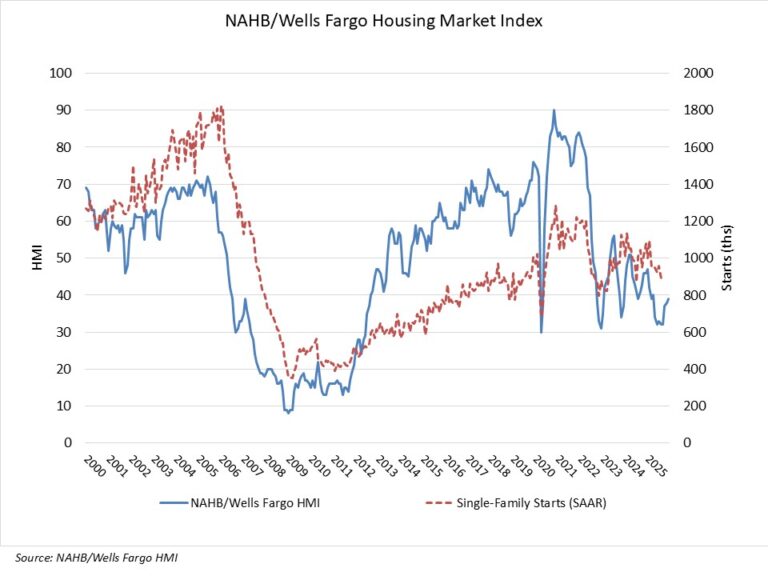
Builder confidence in the market for newly built single-family homes rose one point to 39 in December, according to the National Association of Home Builders (NAHB)/Wells Fargo Housing Market Index (HMI). Sentiment levels were below the breakeven point of 50 every month in 2025 and ranged in the high 30s in the final quarter of the year.

Market conditions remain challenging with two-thirds of builders reporting they are offering incentives to move buyers off the fence.

In positive signs for the market, builders report that future sales expectations have been above the key breakeven level of 50 for the past three months and the recent easing of monetary policy should help builder loan conditions at the start of 2026. However, builders continue to face supply-side headwinds, as regulatory costs and material prices remain stubbornly high. Rising inventory also has increased competition for newly built homes.

In a further sign of ongoing challenges for the housing market, the latest HMI survey also revealed that 40% of builders reported cutting prices in December, marking the second consecutive month the share has been at 40% or higher since May 2020. It was 41% in November. Meanwhile, the average price reduction was 5% in December, down from the 6% rate in November. The use of sales incentives was 67% in December, the highest percentage in the post-Covid period.

Derived from a monthly survey that NAHB has been conducting for more than 40 years, the NAHB/Wells Fargo HMI gauges builder perceptions of current single-family home sales and sales expectations for the next six months as “good,” “fair” or “poor.” The survey also asks builders to rate traffic of prospective buyers as “high to very high,” “average” or “low to very low.” Scores for each component are then used to calculate a seasonally adjusted index where any number over 50 indicates that more builders view conditions as good than poor.

The HMI index gauging current sales conditions increased one point to 42, the index measuring future sales rose one point to 52 and the gauge charting traffic of prospective buyers held steady at 26.

Looking at the three-month moving averages for regional HMI scores, the Northeast fell one point to 47, the Midwest rose two points to 43, the South increased two points to 36 and the West gained four points to 34.

The HMI tables can be found at nahb.org/hmi.

Editor’s Note: With the official 2026 release schedule for the Survey of Construction still unavailable from the U.S. Census Bureau, NAHB confirms the HMI for January 2026 will be released on January 16.  A schedule for the rest of the year will be available as soon as possible.


This article was originally published by a eyeonhousing.org . Read the Original article here. .


Cloud Dancer is a soft off-white with just a hint of yellow-green — clean, crisp and never stark. Not warm and creamy, not icy and gray, it’s a versatile white that works anywhere.

But before we dive into ways to use it at home, a quick note on Pantone. The company develops and manages color standards and tools for a variety of industries, including fashion, advertising, branding, product development and interior design. Every year the company puts out color trend forecasts, including a Color of the Year selection, to help guide product design and marketing. The institute partners with major brands to showcase its annual color selection. This coming year you’ll find Cloud Dancer used for Joybird furniture fabrics, Motorola’s Edge 70 smartphone and 3M Post-it Notes, among other products.


This article was originally published by a www.houzz.com . Read the Original article here. .


Every year, NAHB and other industry experts and economists bring their latest insights to the NAHB International Builders’ Show® (IBS). For 2026, IBS offers an unparalleled lineup of IBS Education sessions that cover every sector of the housing industry: single-family, multifamily, remodeling, design trends, and building materials.  

The Builders’ Show in 2026 is in Orlando, February 17 – 19. This is the only event where you’ll find all these speakers and sessions at one conference: 

The Outlook: 2026 Housing & Economic Forecast (Super Session)  

Tuesday, February 17 | 2:15 – 3:45 PM  

This IBS Super Session is hosted by our very own Chief Economist, Robert Dietz, as well as Chief Economist of Realtor.com, Danielle Hale, and Chief Economist of Zonda, Ali Wolf. Not only does this session give you the chance to hear from these three nationally recognized economists, but it also gives you a complete overview of the housing economy.  

2026 Multifamily Market Outlook 

Tuesday, February 17 | 10:00 – 11:00 AM  

Danushka Nanayakkara-Skillington, NAHB AVP of Forecasting & Analysis, and Selma Hempp, Chief Economist of Cotality, host a deep dive into multifamily housing. Explore the construction pipeline, financing challenges, rent growth, and more. Join the discussion for an exclusive forecast of where the multifamily sector is headed.  

Remodeling by the Numbers: Market Outlook & Business Benchmarks for 2026 

Wednesday, February 18 | 8:15 – 9:15 AM 

Featuring NAHB Economist Eric Lynch, as well as remodeling expert Alan Hanbury, learn what key indicators and trends are shaping the home improvement industry and where it is headed. Compare how your business is doing with exclusive benchmarks on profit margins, operating costs, and more with exclusive findings from the NAHB ‘Remodelers’ Cost of Doing Business’ study.  

Home Trends, Buyer Preferences & Most Likely Features for 2026 

Wednesday, February 18 | 10:00 – 11:00 AM 

Explore the latest research on the home and community features buyers want most in this session led by NAHB AVP of Survey Research, Rose Quint and architect and industry thought-leader Donald Ruthroff. Discover what trends are shaping new home designs, including how preferences shift by price– point. See these trends in action, illustrated through award-winning designs from recent Best in American Living Awards™ (BALA) winners. 

Building Materials in Flux: Pricing Trends, Trade Dynamics & Supply Chain 

Wednesday, February 18 | 2:15 – 3:15 PM 

Gain timely insights into the ever-evolving trending issue of building materials, hosted by NAHB Director of Tax and Trade, Jesse Wade, custom builder and industry leader Don Dabbert, and industry expert and analyst Nishu Sood from John Burns Research and Consulting. Learn how key building materials like lumber are affected by tariffs and other international trade dynamics. Explore what’s driving material costs and availability, and how global and domestic supply chains are adapting.   

Register Now  

To attend IBS Education sessions, you must register for an Expo+Education Pass.  Seating for sessions is on a first-come, first-served basis. So, register for an IBS Expo+Education Pass and then mark these sessions on your calendar. For more information on all that IBS has to offer, please visit BuildersShow.com. We hope to see you there!  

Discover more from Eye On Housing

Subscribe to get the latest posts sent to your email.


This article was originally published by a eyeonhousing.org . Read the Original article here. .


Average mortgage rates in October trended downward to the lowest rates in over a year. According to Freddie Mac, the 30-year fixed-rate mortgage averaged 6.25% in October, 10 basis points (bps) lower than September. Meanwhile, the 15-year rate declined just 1 bp to 5.49%. Both the 30-year and 15-year rates remain lower than a year ago, dropping by 17 bps and 11 bps year-over-year, respectively.  

The 10-year Treasury yield, a key benchmark for long-term borrowing, averaged 4.09% in October – a 5-basis point decrease from the previous month. Markets priced in rate cuts from the Fed at the start of the month, resulting in relatively unchanged rates following the announcement of a 25 bps cut to the federal funds rate on October 29th. 

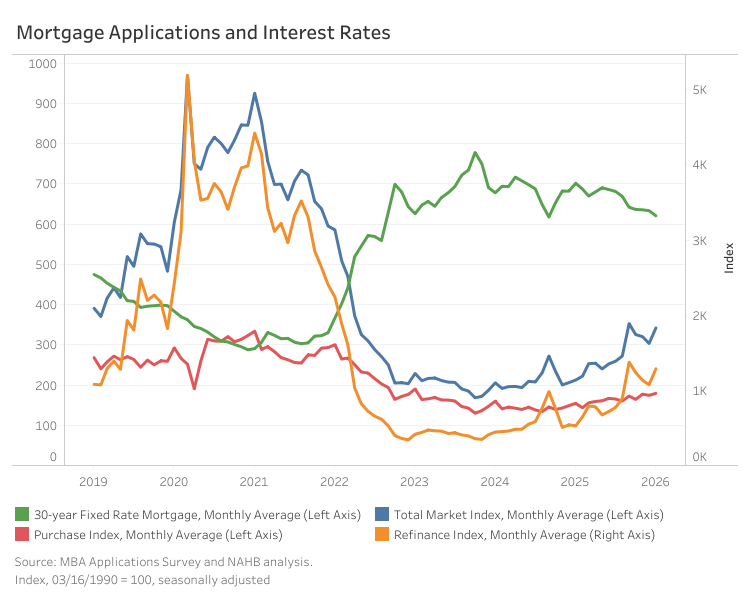
Falling mortgage rates have shown some small impacts on housing activity. According to the latest Mortgage Bankers Association (MBA) report, mortgage application activity strengthened, with refinancing applications rising and purchase applications also increasing. Additionally, existing home sales rose to a seven-month high in September. There is no data available for new home sales in September due to the government shutdown. 

Looking forward, the industry faces a bifurcated market characterized by a weakening job market and elevated inflation. Additionally, there are wildcard factors such as the upcoming Supreme Court case regarding the legality of recent tariffs and lack of economic data. As a result, the vote at the December Fed meeting will be difficult to predict.  

Discover more from Eye On Housing

Subscribe to get the latest posts sent to your email.


This article was originally published by a eyeonhousing.org . Read the Original article here. .


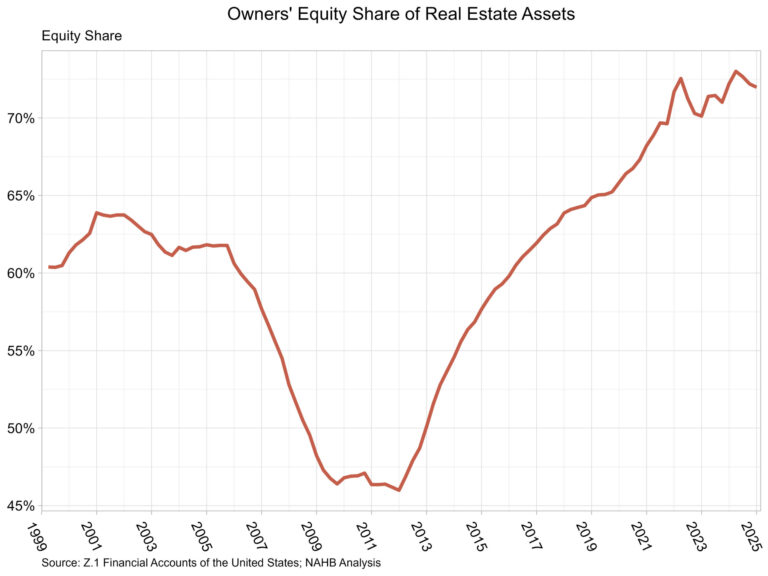
The market value of household real estate assets fell from $48.1 trillion to $47.9 trillion in the first quarter of 2025, according to the most recent release of U.S. Federal Reserve Z.1 Financial Accounts. The value of household real estate assets declined for three consecutive quarters after peaking at $48.8 trillion in the second quarter of 2024 but remains 2.1% higher over the year.

Real estate secured liabilities of households’ balance sheets, i.e. mortgages, home equity loans, and HELOCs, increased 0.3% over the first quarter to $13.4 trillion. This level is 2.9% higher compared to the first quarter of 2024.

Owners’ equity share of real estate assets was 72.0% in the first quarter, marking a small decline in owners’ equity share which matches the decline in the market value of households real estate assets. The share in the first quarter of 2024 was 72.2%.

Discover more from Eye On Housing

Subscribe to get the latest posts sent to your email.


This article was originally published by a eyeonhousing.org . Read the Original article here. .
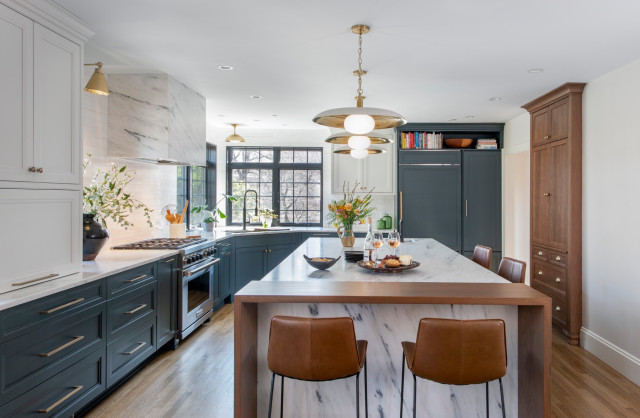

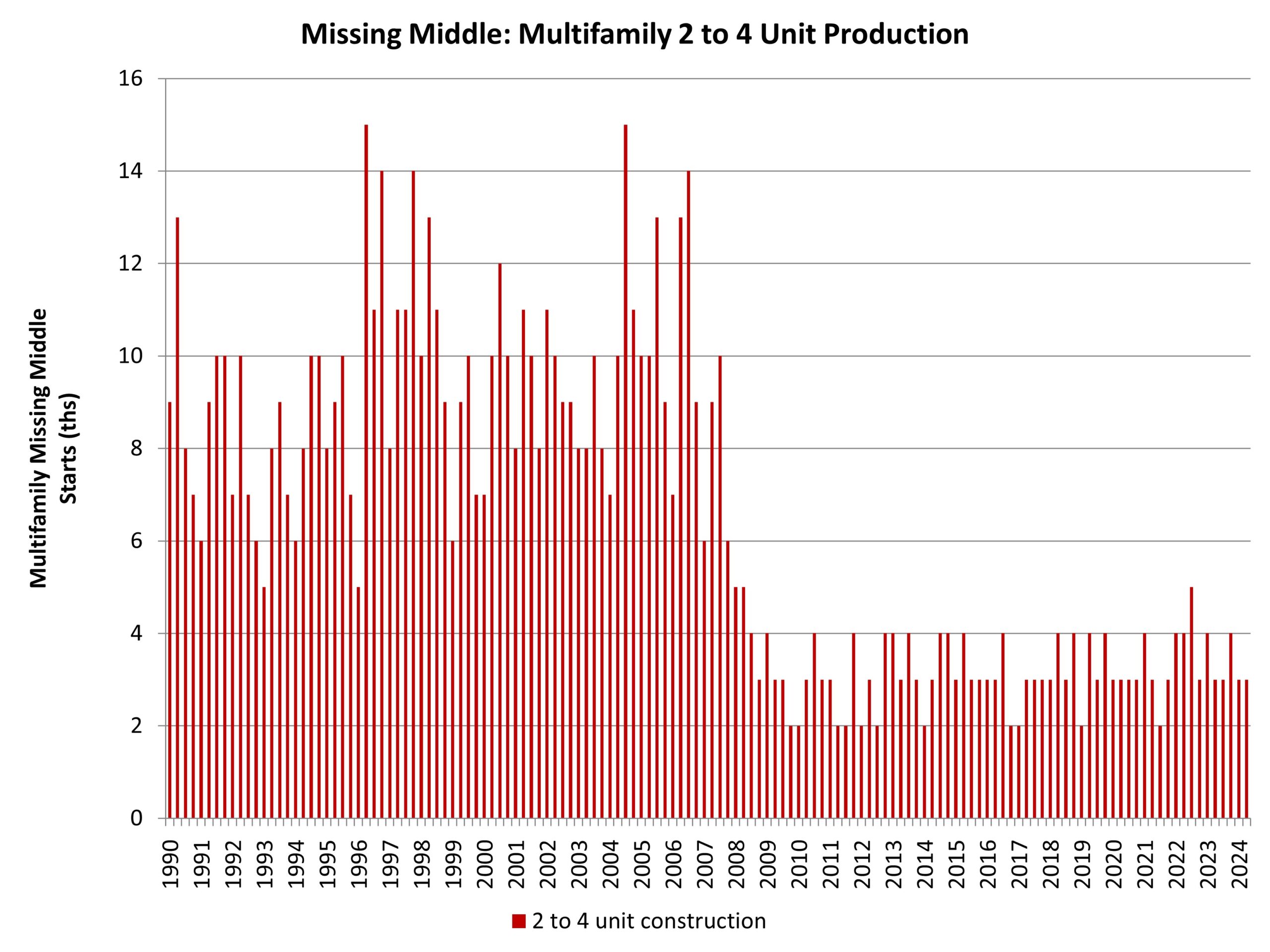
The missing middle construction sector includes development of medium-density housing, such as townhouses, duplexes and other small multifamily properties.

The multifamily segment of the missing middle (apartments in 2- to 4-unit properties) has generally disappointed since the Great Recession. However, there has been a noticeable uptick for this type of housing construction in recent data. For the first quarter of 2025, there were 5,000 2- to 4-unit housing unit construction starts. This is flat relative to the first quarter of 2024.

However, over the last four quarters this type of construction totaled 23,000 units, up 53% over the four quarters prior to that period.

As a share of all multifamily production, 2- to 4-unit development was just above 6% of total multifamily development for the first quarter. However this is still lower than recent historic trends. From 2000 to 2010, such home construction made up a little less than 11% of total multifamily construction.

Construction of the missing middle has clearly lagged during the post-Great Recession period and will continue to do so without zoning reform focused on light-touch density. But recent data offer hope for additional housing supply for these kind of homes.

Discover more from Eye On Housing

Subscribe to get the latest posts sent to your email.


This article was originally published by a eyeonhousing.org . Read the Original article here. .


Housing’s share of the economy grew to 16.4% in the first quarter of 2025, according to the advance estimate of GDP produced by the Bureau of Economic Analysis. This is the highest reading since the third quarter of 2022 and is up 0.2 percentage points from the fourth quarter of 2024.

The more cyclical home building and remodeling component – residential fixed investment (RFI) – was 4.1% of GDP, up from 4.0% in the previous quarter. The second component – housing services – was 12.3% of GDP, up from 12.2% in the previous quarter. The graph below stacks the nominal shares for housing services and RFI, resulting in housing’s total share of the economy.

Housing service growth is much less volatile when compared to RFI due to the cyclical nature of RFI. Historically, RFI has averaged roughly 5% of GDP, while housing services have averaged between 12% and 13%, for a combined 17% to 18% of GDP. These shares tend to vary over the business cycle. However, the housing share of GDP lagged during the post-Great Recession period due to underbuilding, particularly for the single-family sector.

In the first quarter, RFI added 5 basis points to the headline GDP growth rate, marking the second straight quarter of positive contributions. RFI was 4.1% of the economy, recording a $1.216 trillion seasonally adjusted annual pace. Among the two segments of RFI, residential structures rose 1.2% while residential equipment rose 5.5%.

Breaking down the components of residential structures, single-family structure RFI grew 5.9%, while multifamily investment fell 11.5%. RFI for multifamily structures has contracted for seven consecutive quarters. Permanent site structure RFI, which is made up of single-family and multifamily RFI, grew 1.2%.  Other structures RFI rose 0.6% in the first quarter, down from 11.4% the previous period.

The second impact of housing on GDP is the measure of housing services. Similar to the RFI, housing services consumption can be broken out into two components. The first component, housing, includes gross rents paid by renters, owners’ imputed rent (an estimate of how much it would cost to rent owner-occupied units), rental value of farm dwellings, and group housing. The inclusion of owners’ imputed rent is necessary from a national income accounting approach, because without this measure, increases in homeownership would result in declines in GDP. The second component, household utilities, is composed of consumption expenditures on water supply, sanitation, electricity, and gas.

For the first quarter, housing services represented 12.4% of the economy or $3.691 trillion on a seasonally adjusted annual basis. Housing services expenditures grew 3.4% at an annual rate in the first quarter and contributed 41 basis points to GDP growth. Real personal consumption expenditures for housing grew 1.3%, while household utilities expenditures grew 18.7%. Real personal expenditures for natural gas services grew 53.1% in the first quarter, as residential consumption of natural gas recorded its highest monthly level since January 2014, at 1.035 trillion cubic feet in January 2025. Through the first two months of 2025, residential households consumed 1.833 trillion cubic feet of natural gas, higher than the 1.582 trillion in 2024 and 1.498 trillion in 2023.

Discover more from Eye On Housing

Subscribe to get the latest posts sent to your email.


This article was originally published by a eyeonhousing.org . Read the Original article here. .
Pin It