Tag

Worker

Browsing


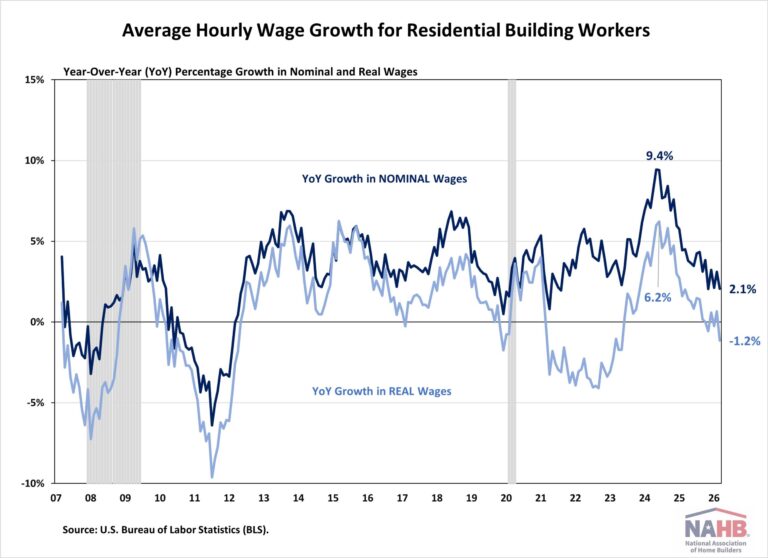
Wage growth for residential building workers remained subdued during the first quarter of 2026, reflecting continued softness in housing construction activity and easing labor demand. According to the latest data from the U.S. Bureau of Labor Statistics, both nominal and inflation-adjusted wage gains moderated further, marking a clear transition from the rapid post-pandemic expansion toward a slower labor market.

In nominal terms, average hourly earnings (AHE) for residential building workers increased 2.1% year-over-year in March 2026, down notably from the 9.4% peak reached in mid-2024 and continuing the broader cooling trend observed throughout 2025.

After accounting for inflation, real wages declined 1.2% year-over-year in March 2026, indicating that wage gains have not fully kept pace with broader price increases. Real wage growth strengthened temporarily during parts of 2024, reaching a peak of 6.2%, but has since softened alongside the slowdown in residential construction activity.

Meanwhile, the number of open, and unfilled construction sector jobs has continued to trend downward, consistent with weaker housing demand and slower construction hiring.

Despite the slowdown in wage growth, residential building workers’ wages remain competitive relative to other industries:

8.4% higher than the manufacturing sector ($36.54 per hour)

22.4% higher than the transportation and warehousing sector ($32.34 per hour)

3.6% lower than the mining and logging sector ($41.10 per hour)

Note:

Data used in this post relates to all employees in the residential building industry. This group includes both new single-family housing construction (excluding for-sale builders) and residential remodelers but does not include specialty trade contractors.


This article was originally published by a eyeonhousing.org . Read the Original article here. .
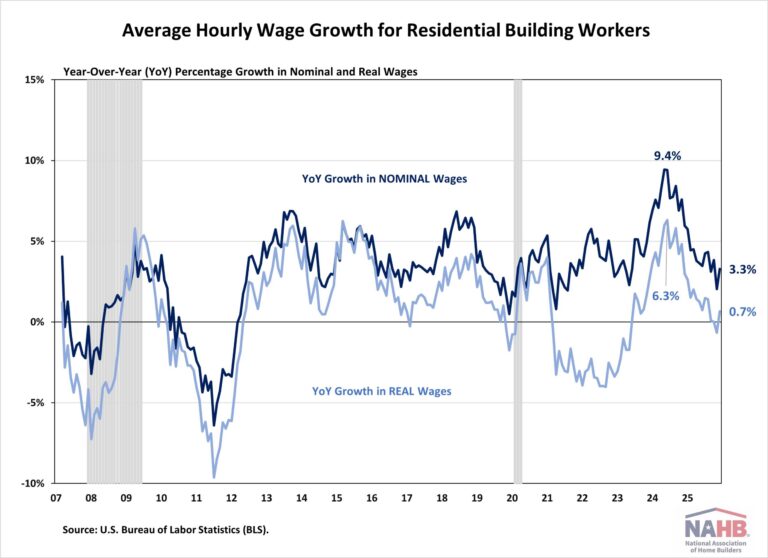

Wage growth for residential building workers moderated notably in 2025, reflecting a broader cooling in housing activity and construction labor demand. According to the latest data from the U.S. Bureau of Labor Statistics (BLS), both nominal and real wages remained modest during the fourth quarter, signaling a shift from the rapid post-pandemic expansion to a slower-growth phase.

In nominal terms, average hourly earnings (AHE) for residential building workers rose to $39.63 in December 2025, up 3.3% from $38.37 a year ago. While this marked a modest acceleration from November’s 2.0% year-over-year gain, wage growth has slowed considerably from the peak of 9.4% recorded in June 2024. Elevated mortgage rates, ongoing affordability challenges, and persistently high construction costs constrained home building activity over the past year. As a result, labor demand eased accordingly. Meanwhile, the number of open, and unfilled construction sector jobs continued to trend downward, consistent with the overall slowdown in housing activity.

Despite the slowdown in wage growth, residential building workers’ wages remain competitive relative to other industries:

9.9% higher than the manufacturing sector ($36.07 per hour)

23.3% higher than the transportation and warehousing sector ($32.14 per hour)

2.6% lower than the mining and logging sector ($40.69 per hour)

Note:

Data used in this post relate to all employees in the residential building industry. This group includes both new single-family housing construction (excluding for-sale builders) and residential remodelers but does not include specialty trade contractors.


This article was originally published by a eyeonhousing.org . Read the Original article here. .
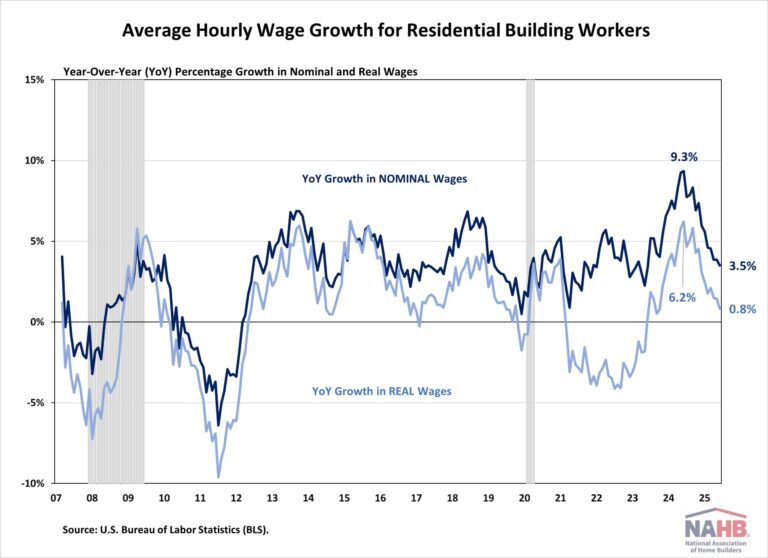

Both real and nominal wage growth for residential building workers slowed during the second quarter of 2025, reflecting a broader cooling in the construction labor market, according to the latest report from the U.S. Bureau of Labor Statistics (BLS).

In nominal terms, average hourly earnings (AHE) for residential building workers rose to $39.35 in June 2025, a 3.5% increase from $38.02 a year ago. This marks a continued deceleration in the year-over-year wage growth, which peaked at 9.3% in June 2024. The recent slowdown reflects a slowdown in residential construction activity and a decline in labor demand across the sector. Meanwhile, the number of open, and unfilled construction sector jobs has continued to trend downward, in line with the overall slowdown in housing activity.

Despite the slowdown in wage growth, residential building workers’ wages remain competitive:

11.4% higher than the manufacturing sector ($35.32/hour)

25.3% higher than the transportation and warehousing sector ($31.4/hour)

2.3% lower than the mining and logging sector ($40.29/hour)

Note:

Data used in this post relate to all employees in the residential building industry. This group includes both new single-family housing construction (excluding for-sale builders) and residential remodelers but does not include specialty trade contractors.

Discover more from Eye On Housing

Subscribe to get the latest posts sent to your email.


This article was originally published by a eyeonhousing.org . Read the Original article here. .
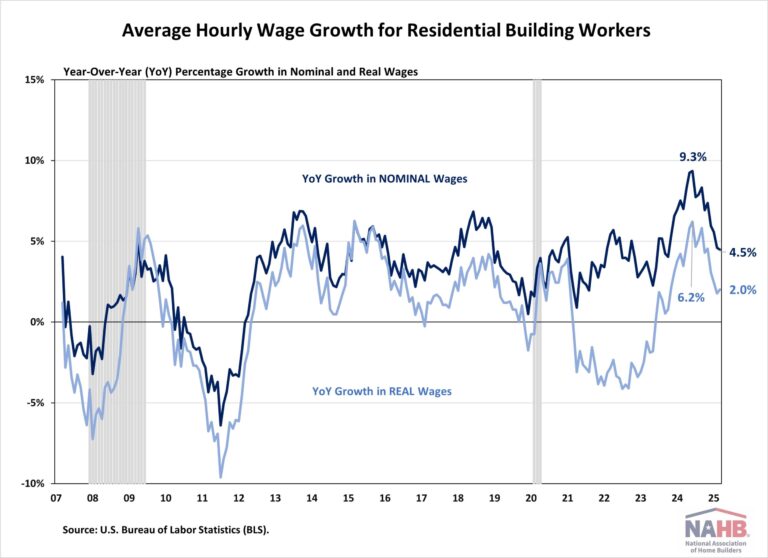

Wage growth for residential building workers continued to slow in March 2025, reflecting softening in the construction labor market, according to the latest report from the U.S. Bureau of Labor Statistics (BLS).

On a nominal basis, average hourly earnings (AHE) for residential building workers reached $38.76 in March 2025, up 4.5% from $37.10 a year ago. This marks a continued deceleration in the year-over-year wage growth, which peaked at 9.3% in June 2024. The recent slowdown reflects an easing of pandemic-related labor shortages and a softening labor demand in the construction sector. In March, the construction labor market saw a decline in job openings as employers slowed hiring plans amid ongoing economic uncertainty.

Despite the slowdown in wage growth, residential building workers’ wages remain competitive:

10.2% higher than the manufacturing sector ($35.17/hour)

24.0% higher than the transportation and warehousing sector ($31.25/hour)

3.7% lower than the mining and logging sector ($40.23/hour)

Note:

Data used in this post relate to all employees in the residential building industry. This group includes both new single-family housing construction (excluding for-sale builders) and residential remodelers but does not include specialty trade contractors.

Discover more from Eye On Housing

Subscribe to get the latest posts sent to your email.


This article was originally published by a eyeonhousing.org . Read the Original article here. .
Pin It