
Tag

Weigh

Browsing


Mortgage rates continued to increase in June as markets priced in a rate hike due to high inflation and stronger-than-expected labor market. According to Freddie Mac, the 30-year fixed-rate mortgage averaged 6.49% in June, up 8 basis points (bps) over May. Since the conflict in the Middle East began, the 30-year mortgage rate has increased by 44 basis points. The average 15-year rate averaged 5.82% in June, up 8 bps from May, and up 39 basis points since the end of February. Even so, both rates remain lower than a year ago by 33 bps and 13 bps, respectively.

The 10-year Treasury yield, a key benchmark for long-term borrowing, held steady at an average of 4.48% in June. The 10-year yield surpassed 4.5% in the second week of the month following reports of persistent high inflation and a surprisingly resilient labor market. Furthermore, the latest Federal Open Market Committee (FOMC) meeting revealed that nine out of 18 Fed officials indicated at least one rate hike within the year.

Nonetheless, the 10-year Treasury yield eased later in the month, ending June at around 4.44%, as the United States and Iran reached a preliminary agreement and signed a Memorandum of Understanding (MoU). The agreement temporarily reopened the Strait of Hormuz to commercial shipping on a “toll-free” basis through mid-August to facilitate further negotiations over Iran’s nuclear program.


This article was originally published by a eyeonhousing.org . Read the Original article here. .
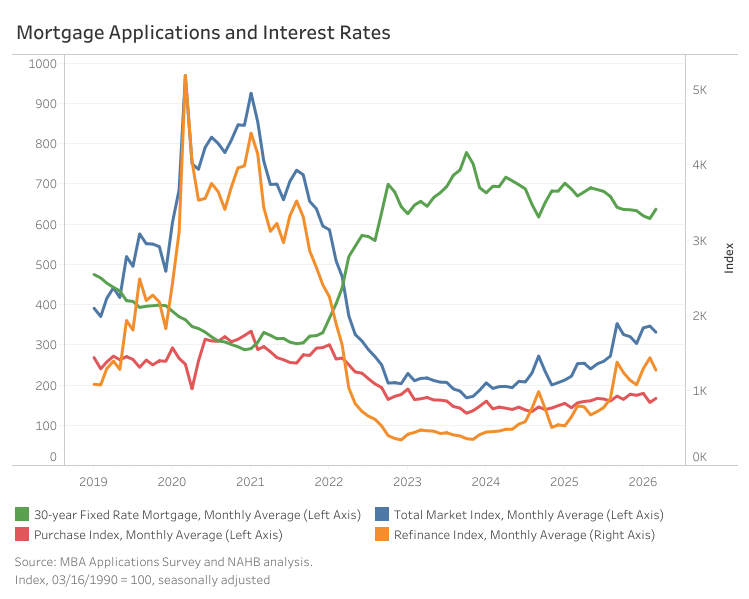

Mortgage application activity decreased month-over-month as the 30-year fixed mortgage rate rose. The Mortgage Bankers Association’s (MBA) Market Composite Index, a measure of total mortgage application volume, declined 4.3% from February on a seasonally adjusted basis but remained 30.8% higher than a year earlier. Applications for adjustable-rate mortgages (ARM) also decreased 4.5% month-over-month, while their share of total applications was unchanged at 8.3%.

The average contract rate for a 30-year fixed-rate mortgage increased 13 basis points (bps) to 6.37%, setting back the improvement seen over the last five months. Nonetheless, the rate remained 33 bps lower than its level a year ago. The increase in mortgage rates diminished refinance activity, which fell 11.4%. Purchase applications, on the other hand, increased 6.4%, driven by growth in both FHA and VA segments. Relative to March 2025, refinance and purchase activities were up 60.4% and 6.4%, respectively.

By loan type, applications for both adjustable-rate mortgages (ARMs) and fixed-rate mortgages (FRMs) both decreased 4.5% month-over-month. On a year-over-year basis, FRM applications were up 28.6%, while ARM applications rose 62.4%. As of March 2026, ARMs applications–including both purchase and refinance loans–accounted for 8.3% of total applications on a non-seasonally adjusted basis, unchanged from last month and 1.6 percentage points higher than a year earlier. The average contract interest rate for 5/1 ARMs was 5.6% in March.

Loan sizes declined across all categories except purchase loans in March, pulling the overall average loan size down 3.3% to $401,300. The average purchase loan size rose 1.0% to $450,800, while the average refinance loan size fell 10.4% to $351,000. The average ARM loan size declined 4.0% to $929,500.


This article was originally published by a eyeonhousing.org . Read the Original article here. .
Pin It