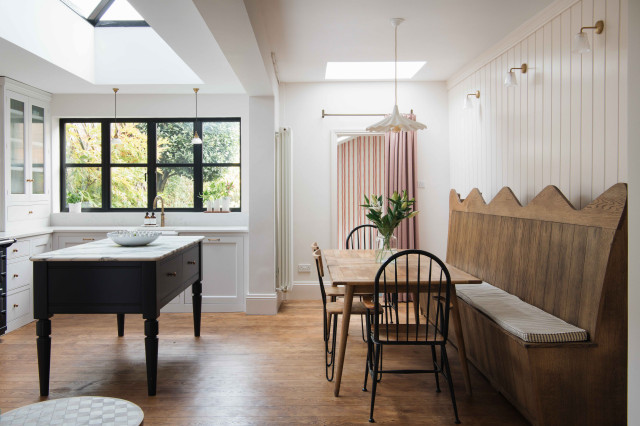
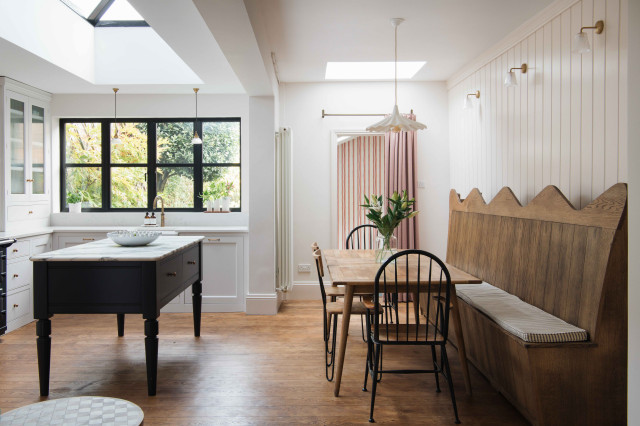
After: The large skylight brings a better quality of light into the room. Doing away with the slanted glazing has also freed up more wall space for a bigger cabinet.
While Clarke-Bishop has reduced the amount of black in the room, she’s also banished most of the white to make the kitchen feel warmer and more inviting.
“At first we were trying to do a pink kitchen, but we couldn’t find a shade that would work in this light — everything either looked too sugary or too dirty,” she says. They settled on a very pale but warm gray.
The walls, meanwhile, are a subtle pinkish-white. “It brings warmth into the room without being an overt color,” Clarke-Bishop says.
The client loves black, so Clarke-Bishop has retained some, designing a black island that echoes the existing range. The island is on legs. “It not being solid allows more light to come through and gives it a bit more airiness,” she says.
The island isn’t huge — 64½ inches long by 35½ inches wide by 32 inches deep — but it’s perfect for the homeowners. “They really didn’t want any appliances in the island. They wanted it to be a standalone” countertop, Clarke-Bishop says. “It’s become a real focal point of the kitchen — everyone stands around it chatting.”
The legs are a modern take on a Victorian turned leg. “I researched lots of Victorian table legs to find a good combination of the detail they needed to add a bit of something to the space without it being overly ornate, because everything’s quite simple and calm in the room,” Clarke-Bishop says.
The countertop is Arabescato marble, which has a hint of pink in it. The remaining countertops are a simple, lightly marbled quartz, “just to allow the island to have a shining moment.”
The refrigerator sits behind the far-left door, with a pantry in the right-hand tall cabinet.
Cabinet paint: Strong White; island paint: Pitch Black, both Farrow & Ball; wall paint: Rose Tinted White, Edward Bulmer
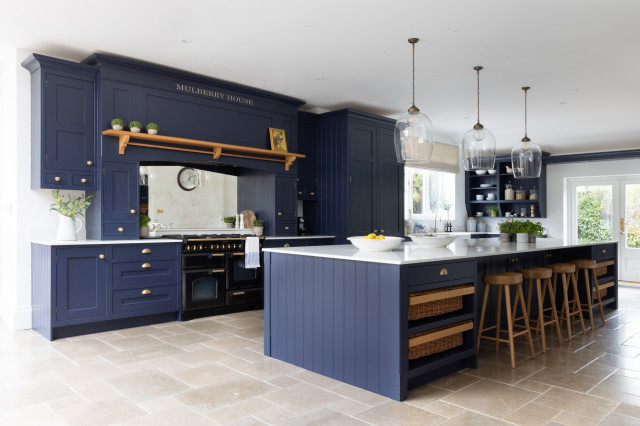
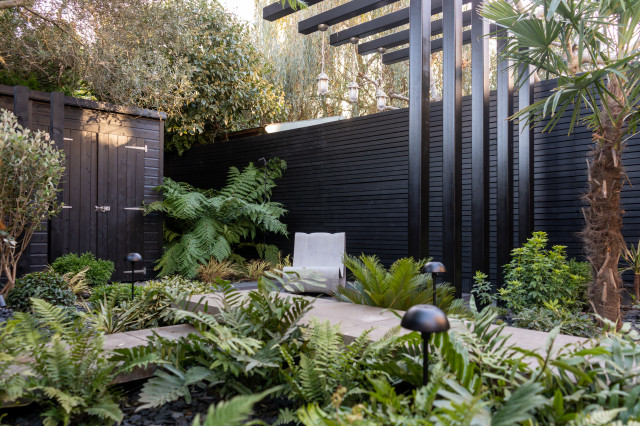




You can also see one of the ways she gave the small space depth, with the eye going from the black patio door frames to the steel pergola to the black wood posts attached to the shed.
Bejanaru also planted four new trees, placing the two tallest nearer to the house and the two shorter ones at the back. “The plants in front draw the eye upward, then the shorter ones — visually below the other two — draw your eye to the back of the [yard], so you have several focal points,” she says.
The new trees consist of two Tasmanian tree ferns (Dicksonia antarctica, USDA zones 9 to 10; find your zone) — one on the front left and the other at the back right; a tall windmill palm (Trachycarpus fortunei, zones 7 to 11) and a pineapple guava (Acca sellowiana, zones 8 to 10) in front of the shed.
The huge olive tree was already there. “We kept it, of course, because it’s beautiful and I also love the color of the bark, which stands out,” Bejanaru says.
9 Design Tips to Enhance Views of Your Garden From Indoors