Tag

Weaker

Browsing


Single-family built-for-rent (or built-to-rent, BTR) construction fell back in the fourth quarter of 2025, as a higher cost of financing and increased multifamily supply crowded out development.

Housing legislation now under final consideration in Congress would also weaken the sector. The legislation, as approved by the Senate, would require institutionally financed new-construction single-family rental housing to be sold to individual home buyers within seven years. This requirement would decrease investable capital and lower housing supply. A preliminary NAHB estimate indicates the proposed rule places approximately 40,000 units per year at-risk.

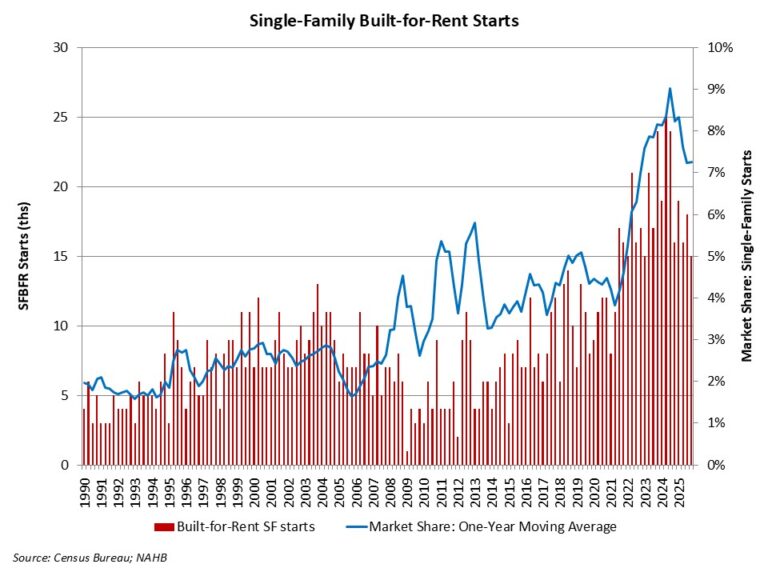
According to NAHB’s analysis of data from the Census Bureau’s Quarterly Starts and Completions by Purpose and Design, there were approximately 15,000 single-family built-for-rent (SFBFR) starts during the fourth quarter of 2025. This is down slightly from the fourth quarter of 2024 (16,000 starts).

Over the course of 2025, 68,000 such homes began construction, which is a 19% decrease compared to the 84,000 estimated SFBFR starts in 2024.

The SFBFR market is a source of inventory amid challenges regarding housing affordability and down payment requirements in the for-sale market, particularly during a period when a growing number of people want more space and a single-family structure. Single-family built-for-rent construction differs in structural characteristics compared to other newly-built single-family homes, particularly with respect to home size. However, investor demand for single-family homes, both existing and new, has cooled with higher interest rates.

Given the relatively small size of this market segment, the quarter-to-quarter movements typically are not statistically significant. The current four-quarter moving average of market share (7%) is nonetheless higher than the historical average of 2.7% (1992-2012).

Importantly, as measured for this analysis, the estimates noted above include only homes built and held by the builder for rental purposes. The estimates exclude homes that are sold to another party for rental purposes, which NAHB estimates may represent another three to five percent of single-family starts based on industry surveys.

The Census data note an elevated share of single-family homes built as condos (non-fee simple), with this share averaging about 4% over recent quarters. Some, but certainly not all, of these homes will be used for rental purposes. Additionally, it is theoretically possible that some single-family built-for-rent units are being counted in multifamily starts, as a form of “horizontal multifamily,” given that these units are often built on a single plat of land. However, spot checks by NAHB with permitting offices indicate no evidence of this data issue occurring (the condo element identifies another difficulty with respect to the 7-year sale requirement of the proposed legislation in Congress).

With the onset of the Great Recession and declines in the homeownership rate, the share of built-for-rent homes increased in the years after the recession. While the market share of SFBFR homes is small, it has clearly expanded. Given affordability challenges in the for-sale market, the SFBFR market will likely retain an elevated market share. However, in the near term, SFBFR construction is likely to slow given market and policy headwinds.


This article was originally published by a eyeonhousing.org . Read the Original article here. .


Lending standards for most types of residential mortgages were essentially unchanged but overall demand was weaker in the fourth quarter of 2025, according to the recent release of the Senior Loan Officer Opinion Survey (SLOOS). However, for commercial real estate (CRE) loans, lending standards for multifamily were looser, while standards for construction & development were essentially unchanged. Demand for construction & development loans was stronger, while demand for multifamily loans was essentially unchanged for the quarter. 

After three consecutive 25 basis point cuts to finish 2025, the Federal Reserve decided to maintain its key short-term interest rate (i.e., Federal Funds) unchanged during its first meeting of 2026. Participants on the Federal Open Market Committee (FOMC) continue to assess how to weigh the components of its dual mandate, as inflation continues to be above the stated target of 2% (i.e., the case for higher rates) while the economy is experiencing further deceleration in job growth (i.e., the case for lower rates). Given the current macroeconomic landscape and a change in leadership at the Fed as Jerome Powell’s term as Chair ends in May, NAHB anticipates that any further rate cuts will occur in the latter half of this year.

Residential Mortgages

In the fourth quarter of 2025, three of seven residential mortgage loan categories; GSE-eligible, Qualified Mortgage (QM) non-jumbo non-GSE eligible, and Government, saw a positive net easing index for lending conditions with an additional two (non-QM non-jumbo and QM jumbo) recording a neutral reading (i.e., 0). Subprime and non-QM jumbo loans experienced tighter lending conditions, as evidenced by a negative value, -8.3 and -4.2 respectively.

All seven residential mortgage loan categories reported weaker demand in the fourth quarter of 2025, with the weakest demand coming from subprime loans. This category has experienced weaker demand for 22 consecutive quarters.

Commercial Real Estate (CRE) Loans

For the CRE loan categories, multifamily registered a net easing index of +5.5 for the fourth quarter of 2025, indicating looser credit conditions for the first time since Q1 2022. As a reminder, this was when the Federal Reserve began their aggressive rate hiking path, which saw the Federal Funds rate increase by 525 basis points over a year and a half period. For construction & development loans, the net easing index was -1.8, or essentially unchanged.

The net percentage of banks reporting stronger demand was 8.9% for construction & development loans, with a positive number indicating stronger demand. This is the first time construction & development has been positive since Q4 2021. For multifamily loans, demand was -1.9% in the fourth quarter of 2025, which is essentially unchanged according to the Fed’s classification scheme (i.e., between -5.0% and +5.0%).


This article was originally published by a eyeonhousing.org . Read the Original article here. .


In the second quarter of 2025, overall demand for residential mortgages was weaker, while lending standards for most types of residential mortgages were essentially unchanged, according to the recent release of the Senior Loan Officer Opinion Survey (SLOOS).  For commercial real estate (CRE) loans, lending standards for construction & development were modestly tighter, while demand was moderately weaker. However, for multifamily loans within the CRE category, lending conditions and demand were essentially unchanged for the third consecutive quarter. 

Last week, the Federal Reserve left its monetary policy stance (i.e., Federal Funds rate) unchanged for the fifth consecutive meeting, with Chairman Jerome Powell indicating in his statement that the Fed “is attentive to the risks to both sides of its dual mandate [maximum employment and inflation at the rate of 2%]” and the “uncertainty about the economic outlook remains elevated”.  NAHB is still forecasting two interest rate cuts before the end of 2025.

Residential Mortgages

In the second quarter of 2025, five of seven residential mortgage loan categories saw a neutral net easing index (i.e., 0) for lending conditions.  Only Qualified Mortgage (QM) non-jumbo non-GSE eligible loans experienced easing, as evidenced by a positive value (+1.8). Meanwhile, the only loans to experience tightening were non-QM non-jumbo loans at -2.0.  Nevertheless, based on the Federal Reserve classification of any reading between -5 and +5 as “essentially unchanged,” all seven categories fell within this range.

All residential mortgage loan categories reported at least modestly weaker demand in the second quarter of 2025, except for QM-jumbo which was essentially unchanged for the second consecutive quarter.  Most notably, non-QM non-jumbo (-22.0%) and subprime (-20.0%) loans experienced significantly weaker demand during the quarter.  The net percentage of banks reporting stronger demand for most of the residential mortgage loan categories has been negative for at least four years.

Commercial Real Estate (CRE) Loans

Across CRE loan categories, construction & development loans recorded a net easing index of -9.7 for the second quarter of 2025, indicating modestly tighter credit conditions.  For multifamily loans, the net easing index was -4.8, or essentially unchanged.  Both categories of CRE loans show tightening of lending conditions (i.e., net easing indexes below zero) since Q2 2022.  However, the tightening has become less defined recently for multifamily, with its net easing index essentially unchanged (i.e., between -5.0 and +5.0) for three consecutive quarters.

The net percentage of banks reporting stronger demand was -11.3% for construction & development loans and -3.2% for multifamily loans, with negative numbers indicating weakening demand.  Like the trend for lending conditions, demand for multifamily loans has experienced unchanged conditions (i.e., between -5.0% and +5.0%) for three straight quarters.

Discover more from Eye On Housing

Subscribe to get the latest posts sent to your email.


This article was originally published by a eyeonhousing.org . Read the Original article here. .


Overall demand for residential mortgages was weaker while lending standards for most types of residential mortgages were essentially unchanged according to the Federal Reserve Board’s April 2025 Senior Loan Officer Opinion Survey (SLOOS).  For commercial real estate (CRE) loans, lending standards for construction & development were moderately tighter, while demand was modestly weaker.  However, for multifamily loans within the CRE category, lending conditions and demand were essentially unchanged for the second consecutive quarter. 

The Federal Reserve left its monetary policy stance (i.e., Federal Funds rate) unchanged during its most recent meeting stating that the Fed “is attentive to the risks to both sides of its dual mandate and judges that the risks of higher unemployment and higher inflation have risen.”  Nevertheless, NAHB is maintaining its forecast for interest rate cuts in the second half of 2025.

Residential Mortgages

In the first quarter of 2025, only one of seven residential mortgage loan categories saw a slight easing in lending conditions, as evidenced by a positive value for GSE-eligible loans, which was +3.2 in the first quarter of 2025.  Subprime and government loans both recorded a neutral net easing index (i.e., 0) while the other four categories (Non-QM jumbo; Non-QM non-jumbo; QM non-jumbo, non-GSE-eligible; QM jumbo) were negative, representing tightening conditions.  The Federal Reserve classifies any net easing index between -5 and +5 as “essentially unchanged,” however.  By this definition, lending standards changed significantly for only one category of residential mortgages: non-QM jumbo (-7.5).

All residential mortgage loan categories reported significantly weaker demand in the first quarter of 2025, except for QM-jumbo which was essentially unchanged.  The net percentage of banks reporting stronger demand for most of the residential mortgage loan categories has been negative since mid-2022.

Commercial Real Estate (CRE) Loans

Across CRE loan categories, construction & development loans recorded a net easing index of -11.1 for the first quarter of 2025, indicating tightening of credit conditions.  For multifamily loans, the net easing index was -1.6, or essentially unchanged. Both categories of  CRE loans show at least three consecutive years of tightening lending conditions (i.e., net easing indexes below zero).  However, the tightening has become less pronounced recently—especially for multifamily, with its net easing index rising (i.e., becoming less negative) for six straight quarters.

The net percentage of banks reporting stronger demand was -6.3% for construction & development loans and -1.6% for multifamily loans, the negative numbers indicating weakening demand.  Like the trend for lending conditions, demand for CRE loans has become less negative recently, especially for multifamily loans  where the net percentage of banks reporting stronger demand has risen (i.e., become less negative) for six consecutive quarters.

Discover more from Eye On Housing

Subscribe to get the latest posts sent to your email.


This article was originally published by a eyeonhousing.org . Read the Original article here. .


Lending standards for residential mortgages were essentially unchanged across most categories, while overall demand for most residential mortgages was weaker according to the Federal Reserve Board’s January 2025 Senior Loan Officer Opinion Survey (SLOOS).  Examining lending conditions for commercial real estate (CRE) loans, construction & development loans were modestly tighter, while demand was modestly weaker.  However, for multifamily properties loans within the CRE category, lending conditions and demand were essentially unchanged for the quarter. 

With recent commentary from the Federal Reserve citing current policy as “meaningfully restrictive”, inflation remaining sticky, and uncertainty caused by current trade policy, NAHB is forecasting any potential cuts (if any) to the federal funds rate to occur in the latter half of 2025.

Residential Mortgages

The Federal Reserve classifies any loan category achieving a value between -5 and +5 as “essentially unchanged.”  Five of seven residential mortgage loan categories saw a slight easing in lending conditions, as evidenced by their positive easing index values, ranging from +1.8 to +4.0, in the fourth quarter of 2024.  That marks the highest number of residential mortgage loan categories showing easing since the Federal Reserve started raising interest rates back in first quarter of 2022.  Subprime and Non-QM jumbo loans were the only categories that were negative for the fourth quarter of 2024, representing tightening conditions.  

All residential mortgage loan categories reported at least modestly weaker demand in the fourth quarter of 2024, except for Non-QM jumbo which was essentially unchanged.  Subprime loans have had weaker demand for the past 18 consecutive quarters, which is the longest weak streak among all residential mortgage loan categories and recorded the lowest net percentage (-45.5%) in the quarter.

Commercial Real Estate (CRE) Loans

Across CRE loan categories, construction & development loans recorded a net easing index value of -9.5 for the fourth quarter of 2024.  As for the multifamily loan category, its net easing index value was -3.2, or essentially unchanged.  For overall CRE loans, results show at least 11 consecutive quarters of tightening lending conditions.  However, the tightening was less pronounced than in recent quarters; the net easing index values for both categories were the closest they have been to neutral (i.e., 0) since the first quarter 2022.

The net percentage of banks reporting stronger demand for construction & development loans was -6.3% and –4.8% for multifamily.  Although weaker demand has continued for the past 10 consecutive quarters for both CRE loan categories, the net percentages are approaching neutral. For the fourth quarter of 2024, the net indices reached their highest levels in over two years.

Discover more from Eye On Housing

Subscribe to get the latest posts sent to your email.


This article was originally published by a eyeonhousing.org . Read the Original article here. .


Lending standards were essentially unchanged for all residential mortgage categories in the third quarter of 2024, except for Subprime loans, according to the Federal Reserve Board’s October 2024 Senior Loan Officer Opinion Survey (SLOOS).  Demand for most residential mortgage loans remained weaker across all categories in the quarter.  Lending conditions for commercial real estate (CRE) loans were moderately tight, amid modestly weak demand as well.  However, NAHB believes that financial conditions for the home building industry should improve next year as the Federal Reserve continues along their current rate cutting cycle.

Residential Mortgages

GSE-eligible and Qualified Mortgage (QM) non-jumbo non-GSE eligible mortgages recorded a neutral net easing index value (i.e., 0) while the other five residential mortgage loan types (Subprime, Non-QM jumbo, QM jumbo, Non-QM non-jumbo, Government) were negative for the third quarter of 2024, representing tightening conditions.

Besides GSE-eligible, which posted stronger demand (i.e., positive value) for the first time since Q2 2021, and QM non-jumbo non-GSE eligible (neutral demand), all other residential mortgage loan categories reported weaker demand in Q3 2024. Weakness is less widespread than in recent quarters, however. Among all residential mortgage loan categories, falling demand is best highlighted by Subprime loans which  experienced weaker demand for 17 consecutive quarters, or for over four years.

Commercial Real Estate (CRE) Loans

Banks reported moderately tightening lending conditions for both multifamily as well as all CRE construction & development loans in the third quarter of 2024.  However, the tightening was not as widespread as in recent quarters. Results show 10 consecutive quarters of tightening lending conditions for CRE loans.

For multifamily, the net percentage of banks reporting stronger demand was -8.2% while –14.8% for construction & development loans.  Although improving, weaker demand has continued for over two years for both CRE loan categories.

Discover more from Eye On Housing

Subscribe to get the latest posts sent to your email.


This article was originally published by a eyeonhousing.org . Read the Original article here. .

The homeownership rate for those under the age of 35 dropped to 37% in the third quarter of 2024, reaching the lowest level since the first quarter of 2020, according to the Census’s Housing Vacancy Survey (HVS). Amidst elevated mortgage interest rates and tight housing supply, housing affordability is at a multidecade low. The youngest age group, who are particularly sensitive to mortgage rates, home prices, and the inventory of entry-level homes, saw the largest decline among all age categories.

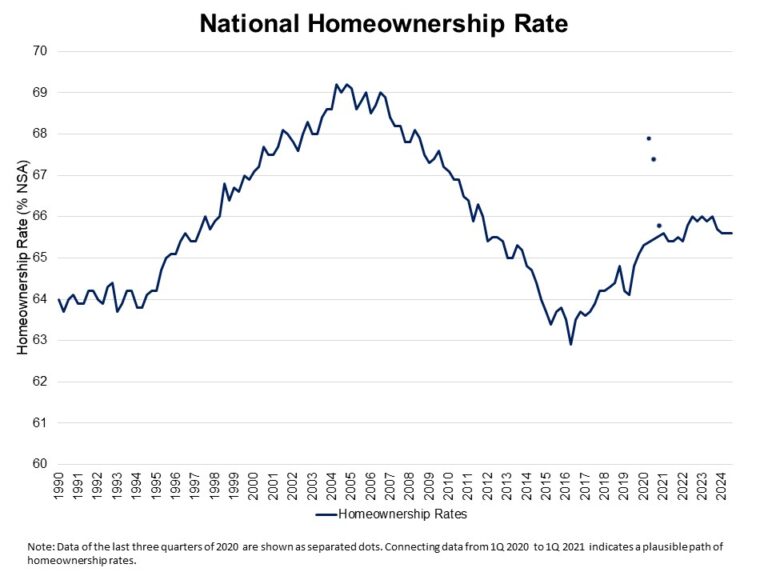
The U.S. homeownership rate held steady at 65.6% in the third quarter of 2024, showing a flat trend over the last three quarters.  However, this marks the lowest rate in the last two years. The homeownership rate remains below the 25-year average rate of 66.4%.

The national rental vacancy rate went up to 6.9% for the third quarter of 2024, and the homeowner vacancy rate inched up to 1%. The homeowner vacancy rate remains close to the survey’s 67-year low of 0.7%.

Homeownership rates declined across all age groups compared to a year ago, except for those aged 55-64. Householders under 35 experienced the largest drop, declining by 1.3 percentage points from 38.3% to 37%. The 45-54 age group also saw a 1.3 percentage point decrease, decreasing from 71% to 69.7%. For householders aged 35-44, who experienced a modest 0.6 percentage point decline. Among those 65 years and over, homeownership inched down slightly from 79.2% to 79.1%. In contrast, the homeownership rate of the 55–64 age group rose to 75.9% from 75.4%.

The housing stock-based HVS revealed that the count of total households increased to 132.1 million in the third quarter of 2024 from 130.3 million a year ago. The gains are largely due to gains in both renter household formation (1.1 million increase), and owner-occupied households (655,000 increase).

Discover more from Eye On Housing

Subscribe to get the latest posts sent to your email.


This article was originally published by a eyeonhousing.org . Read the Original article here. .


According to the Federal Reserve Board’s July 2024 Senior Loan Officer Opinion Survey (SLOOS), lending standards were essentially unchanged for all residential real estate (RRE) categories in the second quarter of 2024.  However, demand for RRE loans remained modestly weaker across all categories in the quarter.  Lending conditions were significantly tighter, and loan demand modestly was weaker across all commercial real estate (CRE) loan categories.  Nevertheless, language from the most recent Federal Open Market Committee (FOMC) suggest that cuts to the federal funds rate are imminent which will be welcomed relief for the real estate market and will help stimulate future loan activity.

Residential Real Estate (RRE)

Four of the seven RRE categories (GSE-eligible, non-Qualified Mortgage or QM jumbo, Non-QM non-jumbo, and Subprime)recorded a net share of banks reported tighter lending standards in Q2 2024 as neutral (i.e., 0%) . The other three categories, which included government (i.e., issued by FHFA, Department of Veteran Affairs, USDA, etc.), QM jumbo, and QM non-jumbo non-GSE eligible recorded a negative reading which means that more banks reported looser rather than tighter conditions.

Six of the seven categories of RRE loans showed a decrease in net tightening from Q1 2024 to Q2 2024, with the only exception being GSE-eligible which increased 1.8 percentage points.  The largest drop in the net tightening percentage occurred for Non-QM jumbo which fell 9.8 percentage points (pp) from 9.8% in Q1 2024 to 0% in Q2 2024.

All RRE categories reported net weaker demand in Q2 2024.  The survey has shown that banks have indicated weaker demand for at least 12 consecutive quarters for all RRE categories going back to Q2 2021 (Subprime leads all RRE categories at 16 consecutive quarters).

Commercial Real Estate (CRE)

Banks reported significantly tighter lending conditions for both multifamily as well as all CRE construction & development loans in Q2 2024.  However, both categories showed less net tightening than they did a quarter before, most noticeably multifamily falling 11.7 percentage points.  Nevertheless, it has been 10 consecutive quarters of tighter lending conditions for construction & development and 9 consecutive quarters for multifamily.

For multifamily, 17.5% of banks reported net weakening of demand for loans which is 16.4 percentage points lower compared to Q1 2024.  As for construction & development loans, 15.9% of banks reported net weakening of demand for loans which was little changed from the previous quarter.  Weaker demand has persisted for roughly the last two years for construction & development (10 consecutive quarters) and multifamily (8 consecutive quarters).

Special Questions

The Federal Reserve included a set of special questions this quarter which asked banks “to describe the current level of lending standards at your bank relative to the range of standards that has prevailed between 2005 and the present.”  Effectively, they are asking banks to think about the median lending standards over the last two decades and determine where do conditions today rank on this continuum.  On balance, banks indicated that the current level of lending standards is located at the tighter end of this range for all loan categories, including CRE and RRE loans.

Discover more from Eye On Housing

Subscribe to get the latest posts sent to your email.


This article was originally published by a eyeonhousing.org . Read the Original article here. .
Pin It