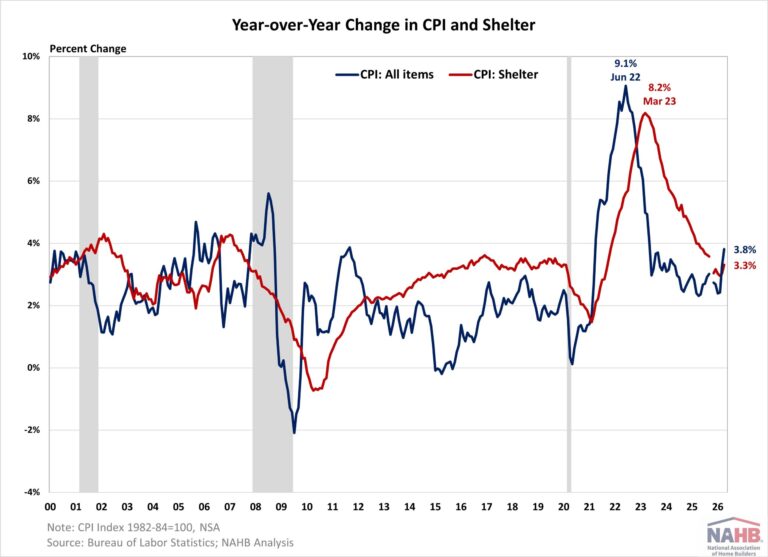
Inflation accelerated to a nearly three-year high in April, driven by continued increases in energy costs from the Iran war. Energy costs drove more than 40% of the monthly increase, with national gasoline prices soaring above $4.50 in early May for the first time since July 2022. With energy costs straining household budgets and eroding purchasing power, this marks the first time inflation has outpaced wage growth since May 2023. As the ceasefire remains tenuous, energy prices are expected to remain elevated for months, continuing to put upward pressure on inflation and complicating the Fed’s path toward its 2% target.
Meanwhile, shelter inflation in April is likely elevated due to a statistical quirk from last October government shutdown. After missing normal collection in October, the Bureau of Labor Statistics (BLS) used a six-month panel carry-forward imputation method to calculate shelter inflation, resulting in lower readings from November through March. Shelter inflation should normalize in the coming months as the BLS has resumed regular collection.
On a non-seasonally adjusted basis, the Consumer Price Index (CPI) rose by 3.8% in April from a year ago, following a 3.3% increase last month, according to the BLS latest report. This was the largest annual increase since May 2023.
The “core” CPI, excluding the volatile food and energy components, increased by 2.8% over the past twelve months, following a 2.6% increase in March. The housing shelter index, which makes up a large portion of “core” CPI, rose 3.3% over the year, following a 3.0% increase last month. Meanwhile, the component index of food rose by 3.2%, and the energy component index increased by 17.9%, the largest annual increase since September 2022.
On a monthly basis, the CPI rose by 0.6% in April (seasonally adjusted), and the “core” CPI increased by 0.4%.
The price index for a broad set of energy sources rose by 3.8% in April, with increases in fuel oil (+5.8%), gasoline (+5.4%), and electricity (+2.1%), with a minor decline in natural gas (-0.1%). Meanwhile, the food at home index rose by 0.7%, while the food away from home index increased by 0.2% in April.
Outside of energy, other top contributors that rose in April included indexes for household furnishings and operations (+0.7%), airline fares (+2.8%), personal care (+0.7%), apparel (+0.6%), and education (+0.2%). Meanwhile, the index for new vehicles (-0.2%), communication (-0.2%) and medical care (-0.1%) were among the few major indexes that decreased over the month.
The index for shelter, which makes up more than 40% of the “core” CPI, rose by 0.6% in April. The index for owners’ equivalent rent (OER) rose by 0.5%, while the index for rent of primary residence (RPR) increased by 0.5% over the month.
NAHB constructs a “real” rent index to indicate whether inflation in rents is faster or slower than core inflation. It provides insight into the supply and demand conditions for rental housing. When inflation in rents is rising faster than core inflation, the real rent index rises and vice versa. The real rent index is calculated by dividing the price index for rent by the core CPI (to exclude the volatile food and energy components). In April, the Real Rent Index rose by 0.2%.
This article was originally published by a eyeonhousing.org . Read the Original article here. .