Tag

Treasury

Browsing


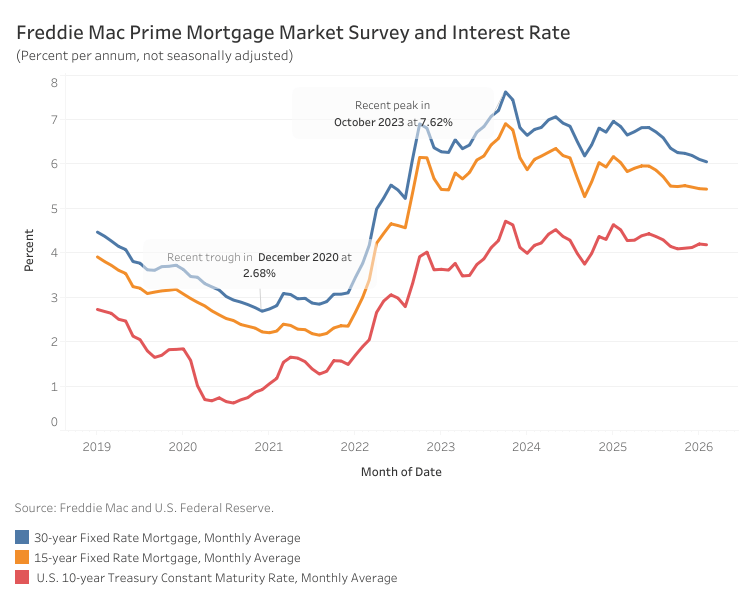
Mortgage rates continued to decline in February, dipping below 6% in the last week of February. According to Freddie Mac, the 30-year fixed-rate mortgage averaged 6.05% last month, 5 basis points (bps) lower than January. Meanwhile, the average 15-year rate declined only a basis point to 5.43%. Compared to a year ago, the 30-year and 15-year rates are lower by 79 bps and 60 bps, respectively.

The 10-year Treasury yield, a key benchmark for long-term borrowing, held relatively steady for most of February with an average 4.18% – a marginal decrease of 2 bps from the previous month. However, yields fell significantly in the final week of February as investors moved to secure U.S. Treasuries amid rising risk aversion in corporate credit markets, widening the spread between corporate bond yields and U.S. Treasuries. Investor concerns centered on the large capital expenditures by major technology firms to finance artificial intelligence infrastructure, much of which has been funded through corporate bond issuance, contributing to rising debt levels among these “hyperscalers”.

Following the recent escalation of conflict in the Middle East, the 10-year Treasury yield has shown signs of reversing course. Investors are closely monitoring how protracted the conflict may become and its potential implications for global energy markets. If oil prices rise significantly or remain elevated, inflation pressures could intensify, potentially pushing Treasury yields higher.


This article was originally published by a eyeonhousing.org . Read the Original article here. .
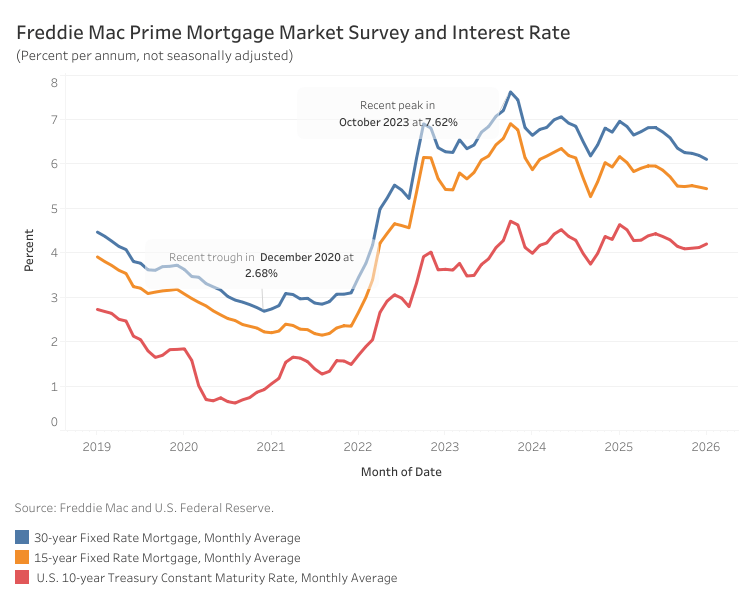

Long-term mortgage rates continued to decline in January. According to Freddie Mac, the 30-year fixed-rate mortgage averaged 6.10% last month, 9 basis points (bps) lower than December. Meanwhile, the 15-year rate declined 4 bps to 5.44%. Compared to a year ago, the 30-year rate is lower by 86 bps. The 15-year rate is also lower by 72 bps.

The 10-year Treasury yield, a key benchmark for long-term borrowing, averaged 4.20% in January – an increase of 8 bps from the previous month, but remained considerably lower than last year by 43 bps. While mortgage rates typically move in tandem with the treasury yields, the spread between the two narrowed during the month. Reports that the Trump administration encouraged Fannie Mae and Freddie Mac to expand purchases of mortgage-backed securities (MBS) boosted demand for MBS, pushing mortgage rates lower.

However, treasury yields rose sharply in the final week of January from global and fiscal pressures. The impact of the rift with Europe and the broader reduction of international purchases of U.S. Treasuries has left a measurable impact on U.S. interest rates. The 10-year Treasury rate at the beginning of 2026 was at 4.11%. That rate has now increased to 4.26%. This unfortunately means the beneficial impact of the $200 billion of additional acquisition of Fannie Mae and Freddie Mac MBS by those GSEs has been partially offset by international concerns.


This article was originally published by a eyeonhousing.org . Read the Original article here. .
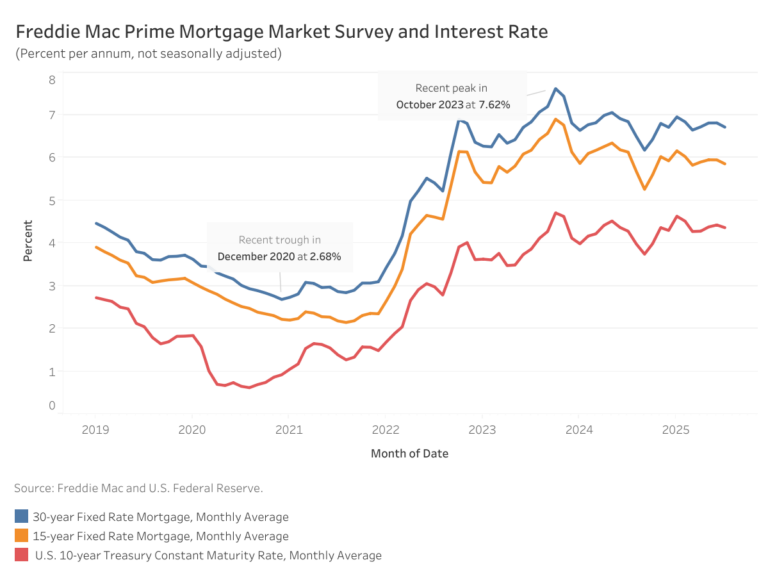

Average mortgage rates dipped in July, according to Freddie Mac. The average 30-year fixed-rate mortgage was 6.72%, 10 basis points (bps) lower than June. Meanwhile, the 15-year rate declined 9 bps to average at 5.86%. Compared to a year ago, the 30-year rate is down 13 basis points (bps), and the 15-year rate is 28 bps lower.

The 10-year Treasury yield, a key benchmark for long-term borrowing, averaged 4.37% in July – a 6 bps decline from the previous month. Yields began the month lower but reversed course and rose steadily as investor expectations solidified that the Federal Reserve would maintain its current policy stance. These expectations were driven by economic data showing an uptick in inflation while the economy and labor market remained solid.

On July 30, the Federal Open Market Committee (FOMC) solidified market expectations by voting to keep the federal funds rate unchanged at 4.25% to 4.50%. However, just days later, the July employment report released by the Bureau of Labor Statistics on Friday, August 1, showed downward revisions to job gains in May and June. In response, yields fell to around 4.2% as investors perceived an increased likelihood of a rate cut at the Fed’s next meeting in September.

Discover more from Eye On Housing

Subscribe to get the latest posts sent to your email.


This article was originally published by a eyeonhousing.org . Read the Original article here. .
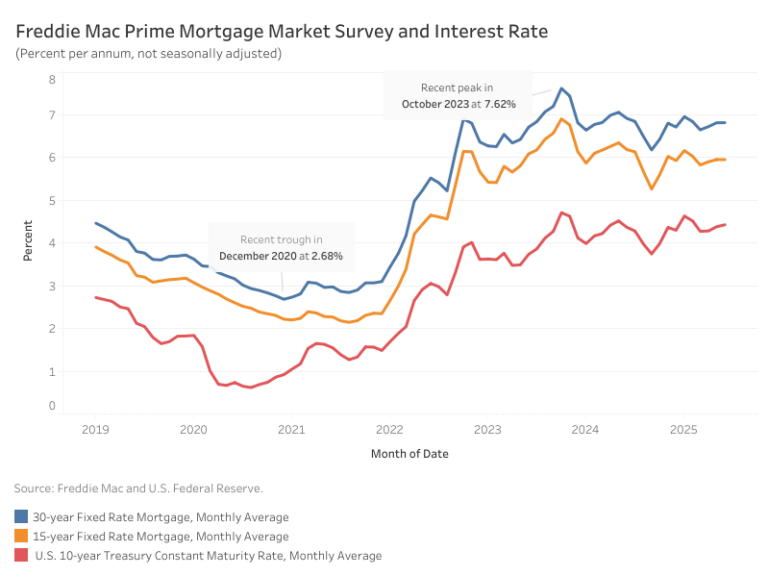

Average mortgage rates were flat in June, according to Freddie Mac. The average 30-year fixed-rate mortgage held at 6.82%, while the 15-year stayed at 5.95%. Compared to a year ago, the 30-year rate is down 10 basis points (bps), and the 15-year rate is 24 bps lower.

The 10-year Treasury yield, a benchmark for long-term borrowing, averaged 4.43% in June – a marginal increase of 5 bps from the previous month. However, the most recent weekly yield saw a small decrease following Federal Reserve Chair Jerome Powell’s congressional testimony, where he noted the possibility of a rate cut being “sooner rather than later” if inflation remains contained. Nonetheless, he reiterated the Fed’s “wait and see” stance, citing ongoing uncertainty around how changes in trade, immigration, fiscal, and regulatory policies will affect the economy.

Last week, the Federal Open Market Committee (FOMC) continued its pause on rate cuts, keeping the federal funds rate unchanged at 4.25% to 4.5%. The updated dot plot continues to signal a cumulative rate cut of 50 bps by the end of 2025. However, the latest Summary of Economic Projections revised the median 2025 GDP forecast down from 1.7% to 1.4%. Forecasts for unemployment (4.4% to 4.5%), PCE inflation (2.7% to 3.0%), and core PCE inflation (2.8% to 3.1%) were all revised upward.

Discover more from Eye On Housing

Subscribe to get the latest posts sent to your email.


This article was originally published by a eyeonhousing.org . Read the Original article here. .
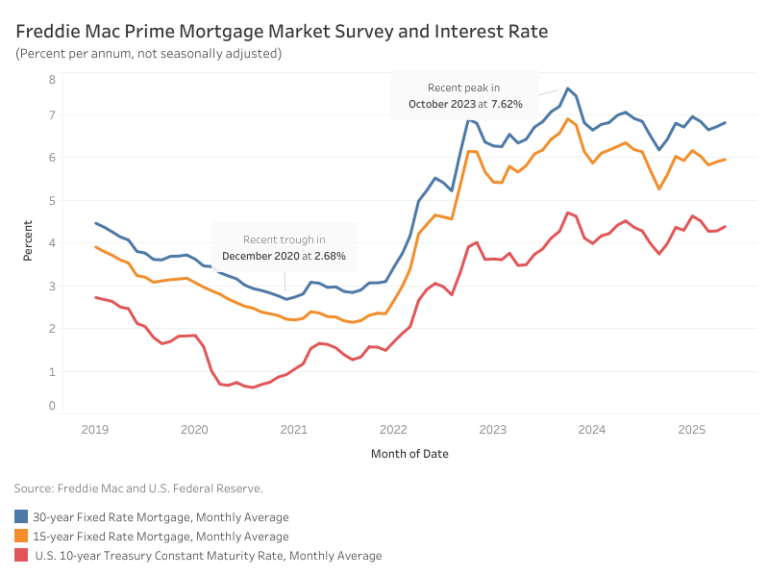

Mortgage rates continued their upward trend in May due to market volatility triggered by fiscal concerns and weaker U.S. Treasury demand. According to Freddie Mac, the average 30-year fixed-rate mortgage rose to 6.82% — a 9-basis-point (bps) increase from April. The 15-year fixed-rate mortgage increased by 5 bps to 5.95%.

The 10-year Treasury yield, a benchmark for mortgage rates, averaged 4.38% in May, with the most recent weekly yield surpassing 4.50%. Long-term treasury yields spiked following two events: first, a credit rating downgrade by Moody’s Ratings, and then, a tepid auction of the 20-year treasury. The weak demand for long-term government bonds necessitated a higher yield to attract investors.

At the core of the market unease is concern over the growing fiscal deficit that intensified as the new “One Big Beautiful Bill” threatens to further widen the federal deficit, which stood at $1.9 trillion as of January 2025. The combination of weakening fiscal credibility and poor auction performance suggests a possible upward repricing of long-term borrowing costs.

Discover more from Eye On Housing

Subscribe to get the latest posts sent to your email.


This article was originally published by a eyeonhousing.org . Read the Original article here. .
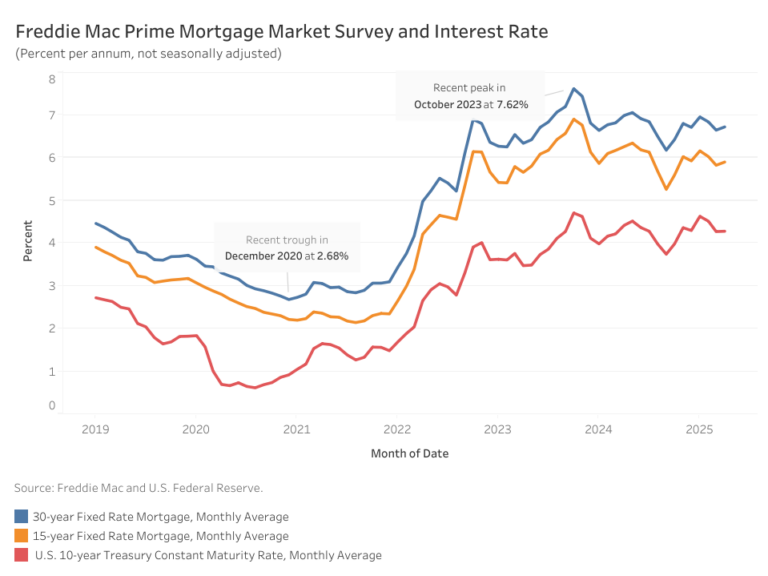

Mortgage rates edged up slightly in April, with the average 30-year fixed-rate mortgage settling at 6.73%, according to Freddie Mac. This marks an 8-basis-point (bps) increase from March. The 15-year fixed-rate mortgage increased by 7 bps to 5.90%.

The uptick in mortgage rates followed a sell-off in U.S. Treasury securities, driven by concerns surrounding the ongoing trade war. As demand for Treasuries declined, prices fell and yields rose. The 10-year Treasury yield averaged 4.28% in April, with the most recent weekly yield rising to 4.34%. The sell-off signals a potential loss of investor confidence in what is typically considered a safe-haven asset.

In response to rising yields, the president has pressured Federal Reserve Chair Jerome Powell to cut interest rates. However, at the recent Economic Club of Chicago, Chairman Powell stated that “tariffs are highly likely to generate at least a temporary rise in inflation” and emphasized the Fed’s obligation to price stability, adding that it must ensure “a one-time increase in the price level does not become an ongoing inflation problem”.

Discover more from Eye On Housing

Subscribe to get the latest posts sent to your email.


This article was originally published by a eyeonhousing.org . Read the Original article here. .
Pin It