Tag

Trades

Browsing


A previous post examined the median age of the overall construction workforce and how it compares with workers in all industries. This analysis takes a closer look at workers in construction trades, where the median ages differ considerably across occupations.

According to NAHB analysis of the 2024 American Community Survey (PUMS data), the median age of construction trades workers is 40, two years younger than the median age of all workers employed in the construction industry. However, median age varies substantially across individual construction trades. Construction and building inspectors and plasterers and stucco masons share the highest median age at 46. Highway maintenance workers follow closely, with a median age of 45, while carpet, floor and tile installers and finishers have a median age of 44. At the younger end of the spectrum, roofers have a median age of 35, followed by pipelayers at 34, and helpers in construction trades at 32. With a median age of just 27, solar photovoltaic installers represent the youngest occupational group among the construction trades.

This wide variation in the median age shows that the workforce aging is not uniform across construction trades. Of the 27 construction trades analyzed, 12 have a median age above the overall median of 40 for construction trades workers. While some occupations have a relatively young workforce, others have a larger concentration of older workers.


This article was originally published by a eyeonhousing.org . Read the Original article here. .


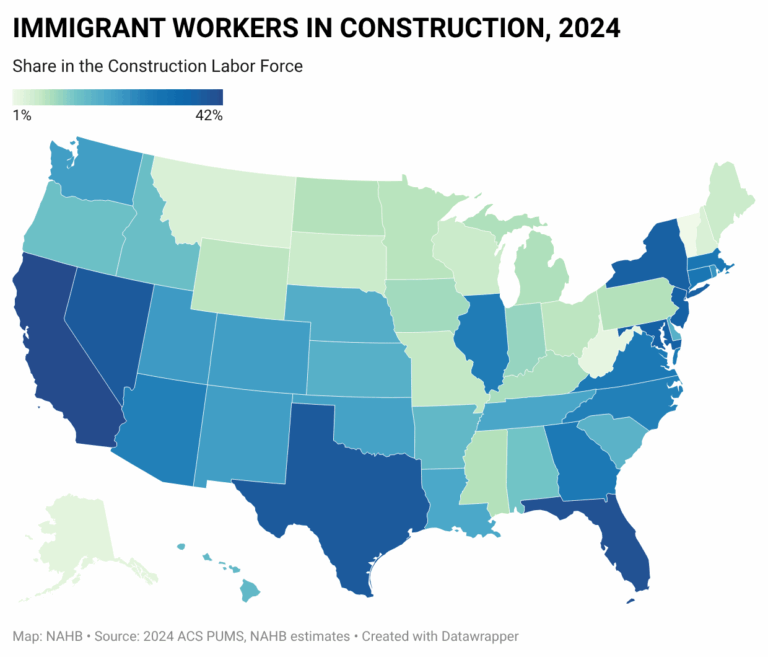
Immigrants’ share of the construction workforce reached a record high in 2024, with foreign-born workers accounting for more than a quarter of the industry’s labor force (26.3%). The share is even higher among construction trades, for which one in three craftsmen is foreign-born. In several states, reliance on foreign-born labor is especially pronounced: immigrants make up more than 40% of the construction workforce in California and Florida, 39% in Texas, and 38% in Nevada.

According to the government’s occupational classification system, the construction industry employs workers across roughly 390 occupations. Of these, only 28 are construction trades, yet these workers account for about 60% of the total construction labor force. The remaining workers are in finance, sales, administration, and other off-site roles.

The concentration of immigrants is particularly high in key construction trades essential to home building, including drywall and ceiling tile installers (57%), plasterers and stucco masons (56%), roofers (53%), painters (53%), and carpet, floor, and tile installers (51%).

The two most prevalent construction occupations, laborers and carpenters, account for more than a quarter of the industry’s labor force. Among them, 35% of carpenters and 43% of construction laborers are foreign-born. These trades typically require less formal education, yet such workers consistently rank among those with the most severe labor shortages, according to the NAHB/Wells Fargo Housing Market Index (HMI) and NAHB Remodeling Market Index (RMI) surveys.

In the April 2025 HMI survey, more than half of builders reported either some or a serious shortage of workers performing finished carpentry. Shortages are similarly widespread for other construction trades directly employed by builders, such as bricklayers and masons, despite the relatively high share of immigrant workers in these occupations.

Labor shortages are also common among more technical trades such as electricians, plumbers, and HVAC technicians. In contrast to labor-intensive trades, these occupations typically require longer formal training, often involve professional licensing, and tend to attract fewer immigrant workers. Over 40% of surveyed builders reported deficits in these skilled trades.

The reported craftsmen shortage is somewhat less acute for trades where the foreign-born presence is more pronounced, such as drywall, ceiling, flooring installers, painters, and roofers – the trades where immigrants make up more than half of the workforce.

More than half (52%) of the nation’s three million immigrant construction workers reside in the four most populous states – California, Texas, Florida, and New York. California and Texas each have over half a million foreign-born construction workers; together, these states account for roughly one-third of all immigrant workers in the industry. Florida and New York contribute an additional 19% combined.

These states are not only the largest by population but also longstanding immigrant gateways, making them particularly reliant on foreign-born construction labor. Immigrants comprise 42% of the construction workforce in California and 41% in Florida, followed by 39% in Texas and 37% in New York.

At the same time, reliance on foreign-born labor is expanding beyond these traditional hubs. Nevada, for example, recorded the fourth-highest share of immigrant construction workers in 2024 (38%), closely trailing Texas. Maryland and New Jersey also reflect this broader trend, with immigrants accounting for 37% of the construction labor force in each state.

In Connecticut, Massachusetts, Georgia, Virginia, Illinois, Arizona, and North Carolina, more than one-quarter of construction workers are foreign-born. At the other end of the spectrum, several states, including New Hampshire, Montana, Alaska, West Virginia, and Vermont, have immigrant shares below 5%.

Because immigrant workers are disproportionately concentrated in construction trades, their presence among craftsmen exceeds their overall share of the industry in every state. In California and Texas, immigrants account for more than half of all construction tradesmen. In Florida, Maryland, and Nevada, the shares are similarly elevated, approaching 50%, while in New Jersey and New York, more than 45% of craftsmen are foreign-born.

While most states draw most of their immigrant foreign-born workers from the Americas, Hawaii relies more heavily on Asian immigrants. European immigrants are a significant source of construction labor in New York, New Jersey, and Illinois.


This article was originally published by a eyeonhousing.org . Read the Original article here. .


Twenty years after building their home in the countryside outside Fayette, Ohio, this couple were ready to rethink their primary bathroom. The teal walls, single-sink vanity and corner shower-tub layout felt dated and underwhelming, especially the tub they rarely used and the cramped storage. They had always imagined a more customized retreat that reflected how they actually live, but the options just weren’t there when they built the house.

With a clear vision and a collection of inspiration photos in hand, the homeowners turned to Lange Custom Builders to transform the space. By removing the corner tub and expanding into two closets, the team added 35 square feet, freeing up space for a floating walnut double vanity and a spacious low-curb shower that lend a light and airy feel. Oversize checkerboard porcelain floor tiles and richly toned zellige shower tiles add personality and texture, delivering a classic-meets-modern bathroom that finally feels tailored to the couple’s preferences and lifestyle.

Before Photo

Lange Custom Builders, Inc.Save Photo

Photos by Lindsey Lange of Lange Custom Builders

Bathroom of the Week
Who lives here: A couple with teenagers
Location: Fayette, Ohio
Size: 185 square feet (17 square meters)
Design-build firm: Lange Custom Builders

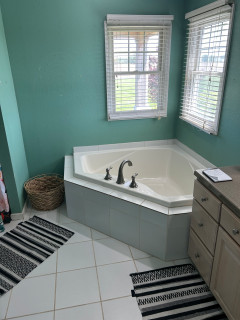
Before: The former 150-square-foot bathroom had teal walls, an off-white ceramic tile floor and a large corner tub with tiled deck that the homeowners rarely used. “It wasn’t functional and they needed more storage space and an open flow,” says Lindsey Lange, co-owner of Lange Custom Builders. “This couple came to us with a clear vision of what they wanted since they built this home 20 years ago and were ready to make it their dream bathroom with style and function.”

A standard single-sink vanity (partially seen on the right) sat near the tub, while the toilet and small corner shower were positioned across the room. Two small closets further broke up the layout.

Two windows over the tub brought in natural light, but the room still felt dark. “She really wanted to see the window from the door of the bathroom and bedroom,” Lange says. “She wanted as much natural light as possible.”

Lange Custom Builders, Inc.Save Photo
After: Lange removed the tub, flooring, vanity, shower and toilet. “Everything was torn down to the studs, both in the bathroom and bedroom area,” Lange says. She then reworked the layout, creating a new water closet in the former shower area, converting the former toilet zone and one closet into a walk-in closet and transforming the second closet into a spacious low-curb shower.

These changes freed up space for a custom-built floating walnut double vanity. The contemporary piece features white sinks with vertical sides, luxe gold widespread faucets with square spouts and a Calacatta Viola marble-look quartz top with a 6-inch mitered-edge profile. “She had an inspiration picture we went off of for the vanity,” Lange says. “Especially the counter.”

Large-format (24-by-24-inch) matte porcelain floor tiles in white and asphalt with light gray grout add durability and drama. “The material is very practical, and they give the bathroom a bold statement with the checkerboard pattern,” Lange says.

Larger operable double-hung windows on two walls flood the space with natural light and fresh air. “They also made the bathroom feel a lot bigger because they’re more proportional to the wall space,” Lange says.

Floor tile: Sterlina II in white and Asphalt, matte finish, 24 by 24 inches, Emser Tile; sinks: Verticyl, Kohler; faucets: Allaria widespread with square spout in Luxe Gold, Brizo

Find a bathroom remodeler on Houzz

Lange Custom Builders, Inc.Save Photo
The new vanity offers easy-access drawer storage for grooming products and other essentials. The homeowners opted for no visible hardware on the drawer fronts. “The drawers have integrated handles and electrical outlets,” Lange says. “She wanted a clean look to it. Just simple and modern.”

Arched mirrors and white-and-gold pendant lights add a glam touch, while new LED recessed ceiling lights improve overall illumination. A warm off-white paint with soft, creamy undertones (Alabaster by Sherwin-Williams) keeps the space bright without feeling stark. “Alabaster is a color we use often in our projects,” Lange says. “It’s for people who want white but a bit of more warmth to it.”

10 Bathroom Vanity Features Pros Always Recommend

Before Photo

Lange Custom Builders, Inc.Save Photo

Before: The former single-sink vanity lacked style and user-friendly storage. “It was just very outdated and she didn’t have good storage for all of the things she needed,” Lange says. “It also had no personality. It was a standard vanity and she wanted a custom look.” The wall to the right is the exterior of one of the two small closets the room contained.

See why you should hire a professional who uses Houzz Pro software

Lange Custom Builders, Inc.Save Photo
After: Lange absorbed the closet into the bathroom, creating space for a larger, low-curb shower with a custom tempered glass enclosure. The same marble-look quartz used for the vanity top was carried into the shower. “The countertop material was used for the curbs to tie everything together and keep the flow for the bathroom,” Lange says. The doorway to the right of the shower opens to the primary bedroom.

Before and After: 4 Stylish Bathrooms in 150 to 190 Square Feet

Lange Custom Builders, Inc.Save Photo
The shower walls are lined with authentic zellige tiles made from natural unrefined clay in a moody red-brown color. These handcrafted tiles have a variation in tone that adds depth and dimension. “She went back and forth on what she wanted the shower to look like, and the color of these tiles was one of the last things she picked out,” Lange says. “She liked the moody feel of them and liked how the color was similar to the color of the walnut vanity.”

The shower includes a fixed modern shower head and hand shower on a slide bar in a gold finish. A custom double niche and built-in bench feature the same quartz as the vanity counter and shower curbs.

Shower fixtures: Litze in Luxe Gold, Brizo; wall tiles: Burnt Sugar, 4 by 4 inches, Zia Tile

10 Tips for Designing the Perfect Shower

Before Photo

Lange Custom Builders, Inc.Save Photo

Before: The corner shower sat next to an aging white toilet. “The toilet was sort of just out in the open,” Lange says. A small linen closet to the left of the toilet, hidden behind a door, added little function. Lange and the homeowners saw the potential to reimagine and expand the space.

Lange Custom Builders, Inc.Save Photo
After: At the far end of the photo, near the sunlit window, a new water closet on the left replaces the former corner shower. Midway along the wall on the left, an opening now leads to a walk-in closet that Lange created from the former toilet and linen closet. Opposite the closet opening, the vanity is partially visible on the right wall. In the foreground on the left, a new linen closet behind black-framed glass doors features walnut drawers and shelving. It stands across from the shower. “She saw a picture she liked and thought it looked clean and luxurious with the glass doors,” Lange says. “The black frame with the glass doors and the walnut just looked really beautiful.”

New to home remodeling? Learn the basics

Lange Custom Builders, Inc.Save Photo
Here’s a peek inside the new walk-in closet off the upgraded bathroom. “The arched mirror in here and the dark walnut cabinetry and drawers match the vanity in the bathroom,” Lange says. “The bathroom has a more open feel with a lot more natural light and the warmth of the walnut. It’s more modern now than it was before, but also timeless because of the classic elements like the marble-look tiles on the floor and the marble-look quartz.”

More on Houzz
Read more stories
Browse photos for ideas
Find home professionals


This article was originally published by a
www.houzz.com . Read the Original article here. .


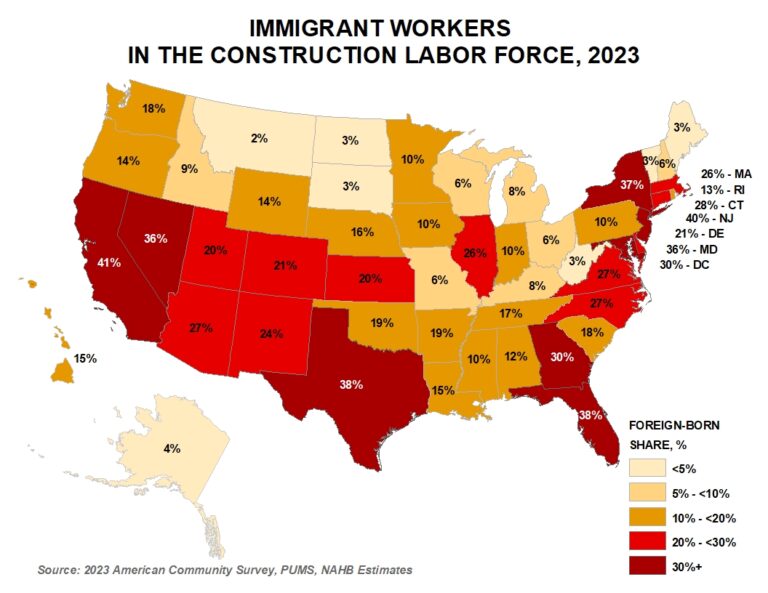
As reported in a previous post, immigrants make up one in four workers in the construction industry. The share of immigrants is significantly higher (32.5%) among construction tradesmen. In some states, reliance on foreign-born labor is particularly evident, with immigrants comprising over 40% of the construction workforce in California and New Jersey, and 38% – in Texas and Florida.

According to the government’s system for classifying occupations, the construction industry employs workers in about 390 occupations. Out of these, only 28 are construction trades, yet they account for almost two thirds of the construction labor force. The other one-third of workers are in finance, sales, administration and other off-site activities.

The concentration of immigrants is particularly high in construction trades essential for home building, such as plasterers and stucco masons, drywall/ceiling tile installers (61%), roofers (52%), painters (51%), carpet/floor/tile installers (45%).

The two most prevalent construction occupations, laborers and carpenters, account for over a quarter of the construction labor force. A third of all carpenters and 42% of construction laborers are of foreign-born origin. These trades require less formal education but consistently register some of the highest labor shortages in the NAHB/Wells Fargo Housing Market Index (HMI) and NAHB Remodeling Market Index (RMI) surveys.

In the latest February 2024 HMI Survey, 65% of builders reported some or serious shortage of workers performing finished carpentry. Looking at other tradesmen directly employed by builders, the shortages of bricklayers and masons are similarly acute, despite a high presence of immigrant workers in these trades.

Labor shortages are also high among electricians, plumbers and HVAC technicians, with over half of surveyed builders reporting shortages of these craftsmen. In contrast, these trades demand longer formal training, often require professional licenses and attract fewer immigrants.

More than half (53%) of the three million immigrant construction workers reside in the four most populous states in the U.S. – California, Texas, Florida, and New York.  California and Texas have over half a million foreign-born construction workers each. Combined, these two states account for over a third (35%) of all immigrant construction workers. Florida and New York combined account for an additional 18%.

These are not only the most populous states in the U.S., but as traditional gateway states, they are also particularly reliant on foreign-born construction labor. Immigrants comprise 41% of the construction workforce in California. In Florida and Texas, 38% of the construction labor force is foreign-born. In New York, 37% of construction industry workers come from abroad. 

The reliance on foreign-born labor continues to spread outside of these traditional immigrant magnets. This is evident in states like New Jersey, that registered the second highest share of immigrant workers, 40%, in 2023, closely following California. Nevada and Maryland, where immigrants (as of 2023) account for over a third of the construction labor force (36%) also illustrate spreading reliance on immigrant labor.

In Georgia, Connecticut, North Carolina, Virginia, Arizona, Massachusetts, and Illinois, more than a quarter of construction workers are foreign-born. At the other end of the spectrum, seven states – Montana, North and South Dakota, Vermont, Maine, West Virginia, and Alaska – have share of immigrant workers of less than 5%.

Because immigrant workers are disproportionately concentrated within the construction trades, immigrant presence among craftsmen is higher than their overall representation in the industry across all states. In California and DC, immigrant workers account for more than half of all tradesmen in construction. In New Jersey and Texas, these shares are similarly high at 49%. In Maryland, Nevada, Florida, New York and Georgia, between 40% and 47% of craftsmen are foreign-born. 

While most states draw the majority of immigrant foreign-born workers from the Americas, Hawaii relies more heavily on Asian immigrants. European immigrants are a significant source of construction labor in New York, New Jersey and Illinois.

Discover more from Eye On Housing

Subscribe to get the latest posts sent to your email.


This article was originally published by a eyeonhousing.org . Read the Original article here. .

Pin It