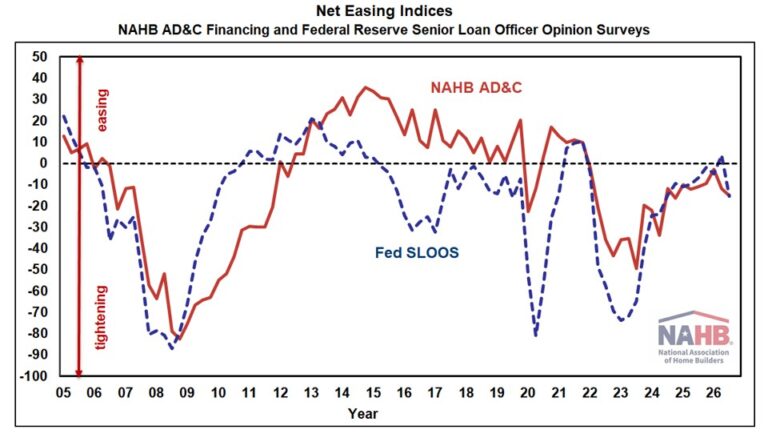
Credit conditions on loans for residential Land Acquisition, Development & Construction (AD&C) were still tightening in the third quarter of 2026, according to NAHB’s quarterly survey on AD&C Financing. The net easing index derived from the survey posted a third-quarter reading of -15.3 (the negative number indicating net tightening). This marks the nineteenth consecutive quarter during which residential builders and developers have reported tightening credit conditions.
The NAHB survey agrees closely with the third-quarter results reported by lenders in the Federal Reserve’s survey of senior loan officers, as the net easing index constructed from the Fed survey posted a third-quarter reading of -15.5. Although lenders previously reported a slight easing in 2026 Q2, lenders have generally agreed with builders and developers that credit conditions have been tightening since the beginning of 2022. The Fed survey’s net easing index was in negative territory (indicating net tightening) for 18 of the past 19 quarters.
More details from the Fed’s survey of lenders—including measures of demand and net easing for residential mortgages—appeared in a previous post.
Meanwhile, measures on the cost of AD&C credit exhibited a combination of relatively small quarter-to-quarter changes, signaling no clear trend in either direction. The average contract interest rate declined from 8.09% in the second quarter to 7.83% in the third quarter on loans for land development, but increased for the other three categories of loans tracked in the NAHB AD&C survey: from 7.77% to 8.08% on loans for land acquisition, from 7.28% to 7.72% on loans for speculative single-family construction, and from 7.01% to 7.27% on loans for pre-sold single-family construction.
However, the initial points charged by lenders declined on all four categories of AD&C loans in the third quarter: from 1.05% to 0.86% on loans for land acquisition, from 1.05% to 0.97% on loans for land development, from 0.85% to 0.71% on loans for speculative single-family construction, and from 0.71% to 0.51% on loans for pre-sold single-family construction.
Those changes left the average effective interest rate (taking both contract rate and initial points into account) essentially unchanged at 11.83% (compared 11.82% in the second quarter) on loans for speculative single-family construction. The average effective rate increased from 10.43% to 10.55% on loans for land acquisition, but declined from 12.59% to 11.69% on loans for land development, and from 11.67% to 11.47% on loans for pre-sold single-family construction.
The NAHB AD&C survey also revealed that 32% of respondents who built single-family homes during the third quarter of 2026 financed some of their homes with a construction-to-permanent (one-time-close) loan made to the ultimate home buyer. On average, 58% of the homes these respondents built were financed in this manner.
While the market for residential mortgages has been showing signs of stress recently—including a recent decline in mortgage applications and increase in delinquencies—it is important not to overlook the role access to AD&C credit plays in helping builders and developers expand the supply of affordable housing.
More detail on credit conditions for residential builders and developers is available on NAHB’s AD&C Financing Survey web page.
This article was originally published by a eyeonhousing.org . Read the Original article here. .